Advertisement
Help Keep Boards Alive. Support us by going ad free today. See here: https://subscriptions.boards.ie/.
https://www.boards.ie/group/1878-subscribers-forum

Private Group for paid up members of Boards.ie. Join the club.
Hi all, please see this major site announcement: https://www.boards.ie/discussion/2058427594/boards-ie-2026

Energy infrastructure

1199200202204205233

Comments

  • Registered Users, Registered Users 2 Posts: 80 ✭✭silvertimelinings


    It isn't just development costs. It is that there are no large sites available for Wind Farms.

    Set Back must be respected. This link puts a wrinkle on that issue in that a wind farm may constrain growth in rural locations and at the edges of villages: https://cathalcrowe.ie/clarity-urgently-needed-on-rules-around-wind-turbine-setback-distance/

    Ireland was a population of 8 million rural dwellers. This distribution of the population in rural areas was continued by the Land Commission who gave plots of land smaller than what are now economical for Agriculture.

    Planning permission for wind farms dictates a 500 metre set back from homes. Ireland has comparatively good wind resource but you will not find good large sites(and large is needed for reduced cost of generation) for Wind Farms due to homes being dotted throughout the countryside. About the only large onshore sites left where set back is not an issue are in the boglands or on the west coast up a mountain far away from where transmission lines and the demand for electricity are. We are supposed to be saving the bogs so digging access roads destroys the bogs. Solar is "easier" to site but Ireland does not have a good solar resource to exploit.

    Urban dwellers would not be familiar with the spiderweb of lanes and minor roads with residential buildings on them. You won't get 500m set back without tearing those houses down.

    There is a gold rush at the moment to acquire the last few exploitable sites and the hope is that larger turbines can be exchanged in on older wind farms.

    If larger turbines are exchanged in then a set back of 500 metres becomes even more important.

    If the future depends on renewable electricity then Ireland will always have expensive electricity.


  • Registered Users, Registered Users 2 Posts: 2,963 ✭✭✭Nermal


    But they aren't the true costs. The true cost of electricity includes the infrastructure required to ensure a continuous uninterrupted supply.

    The cost of that infrastructure is attributable to renewable sources only. The more energy we source from renewables, the higher it gets.

    That cost is not passed on to suppliers who connect intermittent energy sources to the grid. It should be.


  • Registered Users, Registered Users 2 Posts: 1,672 ✭✭✭Busman Paddy Lasty


    "The cost of that infrastructure is attributable to renewable sources only."

    That's a bit much there. Adapting to varying demand has always been needed. Grid maintenance, R&D and modernisation needs to happen anyway and the costs are passed on to customers. Which is normal market economics.

    What do you propose, a penalty or adjustment to payments to renewable suppliers?


  • Registered Users, Registered Users 2 Posts: 2,963 ✭✭✭Nermal


    Either is fine. They both have the same economic affect. If you supply on an intermittent basis, you should be the ony paying the cost of turning intermittent supply into guaranteed supply.


  • Registered Users, Registered Users 2 Posts: 1,599 ✭✭✭gjim


    That's not true at all unless the cost of supporting infrastructure for large thermal plants (nuclear and coal) was zero and we know it's absolutely not.

    The most expensive and advanced pieces of transmission infrastructure in the state are the two 400kV transmission lines starting at Moneypoint and ending in Dunstown and Woodland-Portan in Leinster. These were built for the sole purpose of allowing Moneypoint to join the grid and are the only 400kV lines in the state. I would willing to bet money that the cost of these two lines alone would dwarf the cost for ALL the transmission infrastructure added to support wind - which are cheaper, simpler and much shorter 110kV branch lines.

    And thermal requires backup also. You can't just plonk a 1GW coal plant on grid without also providing 1GW of backup. Even if the plant is running flat out with a capacity factor of 82% - the kind of numbers achieved back in the old days when coal was competitive in the sector - means you have a total of 9 weeks a year when the plant will be offline for both scheduled and unscheduled downtime (about 10% + 8% according to US stats from the EIA). So you still need 1GW of back-up to ensure you can meet demand during these times, just like you need if you have 1GW of wind.

    It's precisely why wind has been able to penetrate the sector so quickly and economically - we already have all this reserve natural gas (turbine) capacity to support legacy thermal generation which can also be used to provide reserve for variable sources like wind. It's why Moneypoint, and countless sites globally are being repurposed for renewables and batteries, because we've already sunk so much money into providing the infrastructure around these sites when they were developed during the steam-age of electricity generation.


  • Advertisement
  • Registered Users, Registered Users 2 Posts: 1,599 ✭✭✭gjim


    It is. And I think nearly everyone here will agree. Especially given the cost of biomass electricity - I've seen numbers in the €160/MWh range.

    Unless it involves consuming existing sources of bio-waste, the entire biofuels "industry" is green-washing that solely exists as a way to funnel government money to industrial scale farmers or owners of legacy steam-based power plants from what I can see. It makes zero economic sense to generate electricity this way.

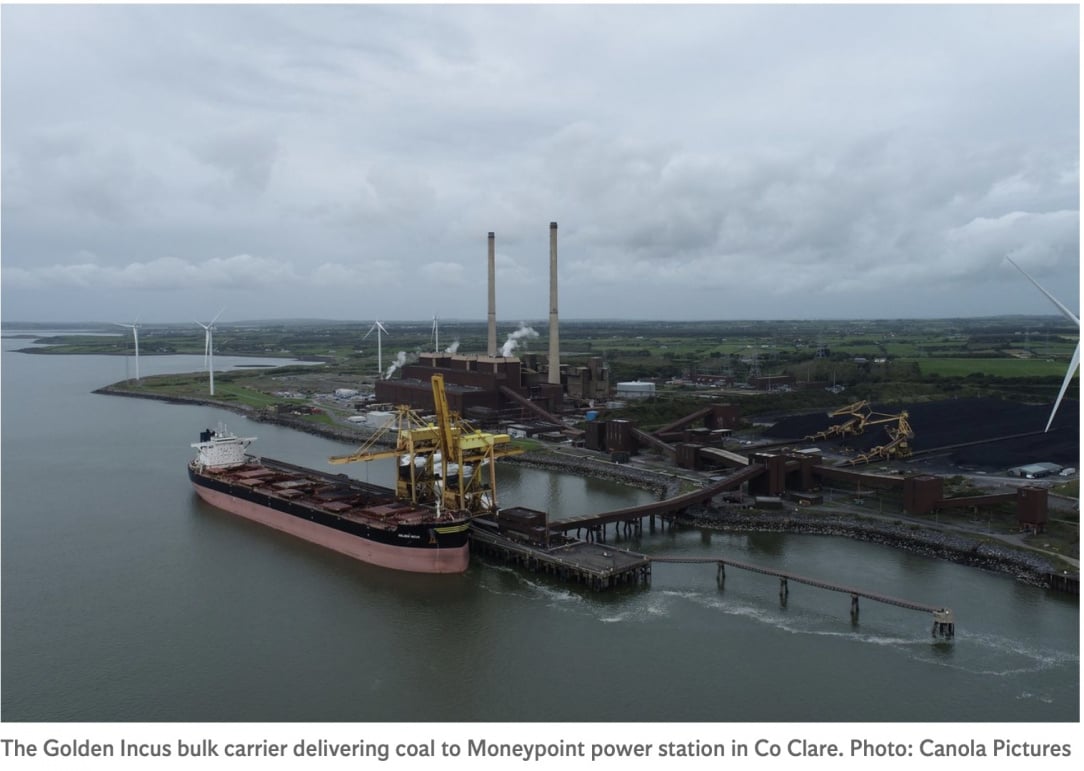
    Another example lunacy (also involving shipping dead trees around the world to be combusted for electricity):

    moneypoint_coal.jpg

    If you are going to produce biofuels from waste - at least produce bio-methane which can be turned into electricity using a natural gas turbine or combined cycle plant instead of burning solid organic matter in the heat box of a large steam engine.


  • Registered Users, Registered Users 2 Posts: 80 ✭✭silvertimelinings


    The contribution of Wind to the grid over the last week has been nothing short of atrocious. It seems that the Government has de facto decided to power its grid through Gas and Interconnector since Wind contributes precious little for extended periods of time. Solar and BESS will not change this.


  • Registered Users, Registered Users 2 Posts: 21,874 ✭✭✭✭cnocbui


    I agree with you - if bio and energy are in the same sentence it's 95% likely eco-bulldust, unless it's about methane generation from abundant local waste.

    We're saving the planet by clear-felling old growth forests in Canada and shipping the trees to the UK and lying about it all being 'waste' - we are the Drax eco-monster.


  • Registered Users, Registered Users 2 Posts: 80 ✭✭silvertimelinings


    There are ongoing problems with offshore wind projects:

    https://apnews.com/article/offshore-wind-new-jersey-leading-light-pause-6c2777622c034ae03e87948503a59821?utm_source=copy&utm_medium=share

    https://publicaccess.bpu.state.nj.us/DocumentHandler.ashx?document_id=1363926

    costs are spiralling out of control and manufacturers won't supply or increasing prices dramatically.

    What will happen in Ireland? Will Auctions go unbid or will proposals be crazy expensive.


  • Registered Users, Registered Users 2 Posts: 80 ✭✭silvertimelinings


    https://www.innovationnewsnetwork.com/ddhp-delivers-largest-sustainable-district-heating-system-in-ireland/51956/

    supposedly this district heating project fed from Poolbeg incinerator will go live in late 2025 but I have no idea if it is delayed or not.

    This is what the Incinerator was meant to be doing all along but Gormley sat on it and delayed it by a decade.


  • Advertisement
  • Registered Users, Registered Users 2 Posts: 9,127 ✭✭✭Markcheese


    How long was John Gormley minister for the environment ? I thought it was only 4 years ?

    I'm not sure what the connection between John Gormley and there not being a district heating scheme for poolbeg .. ?

    Slava ukraini 🇺🇦


  • Registered Users, Registered Users 2 Posts: 80 ✭✭silvertimelinings


    If Gormley did everything he could to block the incinerator then it follows that no district heating scheme powered by the incinerator is available.

    An article which meanders but ctrl-f for "gormley" at

    https://thedublinreview.com/article/the-poolbeg-prophecy/

    and then listen to his protégé

    https://www.rte.ie/radio/radio1/clips/21163433/

    at the end he talks about not using the waste heat…that heat is going to be used now but the greens are ideologically opposed to Waste to Energy so he will still complain.

    That incinerator can produce up to 60MW of electricity and prevents huge amounts of waste going to landfill.


  • Registered Users, Registered Users 2 Posts: 9,127 ✭✭✭Markcheese


    Gormley was in gov for 4 years ending in 2007,he Definitely delayed it ,but it got built! , all 600 million euros worth ,completed in 2017 , and now - 2025 ,there are plans for district heating scheme,

    Slava ukraini 🇺🇦


  • Registered Users, Registered Users 2 Posts: 80 ✭✭silvertimelinings


    Capturing waste heat as a by-product of the incineration process was always the intent as referenced on page 17 of this document from 20 years ago. Gormley and his ilk did everything they could to prevent the incinerator/CHP plant from being built.

    Compared to the cost of Renewable Energy projects which were approved in the meantime the Incinerator appears to be a bargain in that it limits landfill dumping, will heat the homes and businesses of the local community and consistently generates up to 470MW of Electricity.

    https://www.sdcc.ie/en/services/environment/recycling-and-waste/waste-management-plan/dublin-waste-plan-executive-summary.pdf


  • Registered Users, Registered Users 2 Posts: 987 ✭✭✭DumbBrunette


    Solar farm planned at Knock airport. It is expected to provide 40% of the airport's electricity needs.


  • Moderators, Motoring & Transport Moderators, Technology & Internet Moderators Posts: 24,122 Mod ✭✭✭✭bk


    I support incinerators with two caveats:

    1. We only build enough for the waste we genuinely produce, we don't want to get into a scenario where we are importing waste from other countries or worse "biomass" because we don't have enough waste for them.
    2. That it doesn't discourage us from reducing waste reduction, reduce, reuse, recycle.


  • Registered Users, Registered Users 2 Posts: 80 ✭✭silvertimelinings


    we have no indication that the incinerator is importing biomass or waste from other countries. Germany has been known to import waste for incineration from across its borders but shipping waste in to Dublin Port is obviously undesirable.

    reducing waste reduction ? 🤔


  • Moderators, Motoring & Transport Moderators, Technology & Internet Moderators Posts: 24,122 Mod ✭✭✭✭bk


    reducing waste reduction ?

    Sorry if that wasn't clear. I mean it is better to reduce how much waste we produce, then burning it. I wouldn't want to see the presence incinerators leading to us putting less emphasis on recycling, etc. because we need the waste to burn.

    Some, people don't realise, but the reduce, reuse, recycle saying is actually a list of priorities. As in it is better to reduce then recycle. For instance, it is better to reduce unnecessary plastic and packaging on fruit and veg in the first place, then trying to recycling it later.

    So it might become, reduce, reuse, recycle, burn. But that means we prioritise the first three over burning.


  • Registered Users, Registered Users 2, Paid Member Posts: 15,607 ✭✭✭✭josip


    Are our 2030 targets for 1/1/2030 or 31/12/2030 ?


  • Registered Users, Registered Users 2 Posts: 281 ✭✭specialbyte


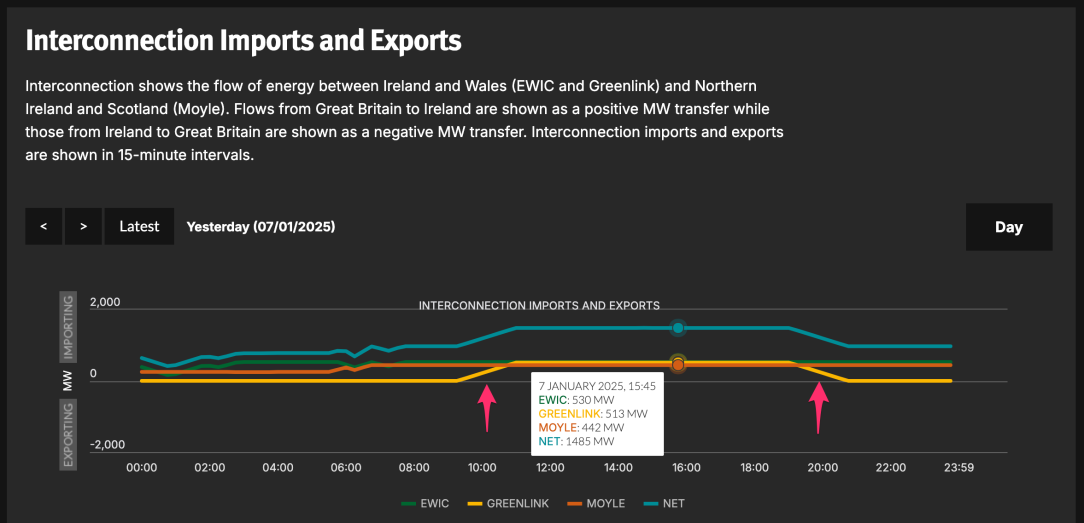
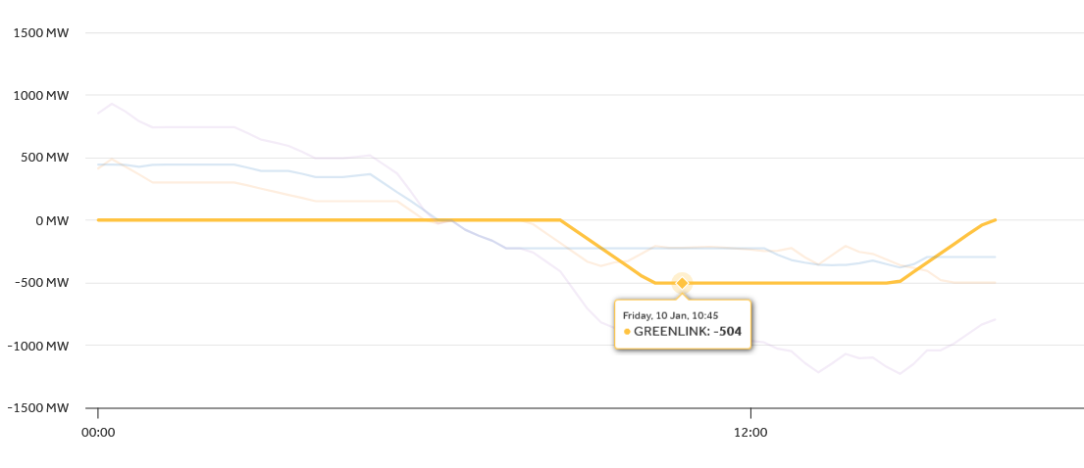
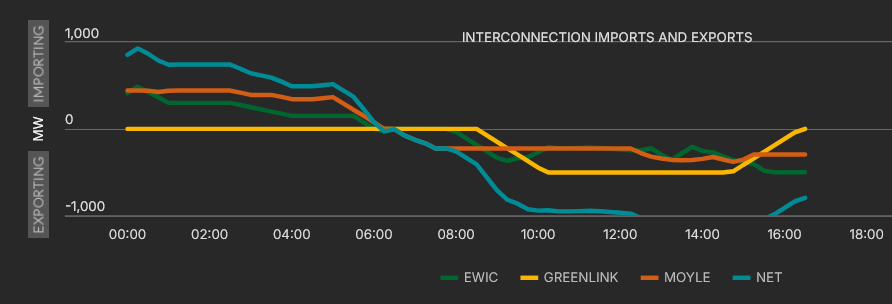
    The new Greenlink interconnector between Great Island in Ireland and Pembroke in the UK had it's first big day yesterday. It was importing at over 500MW for most of the day. It looks like the first time it has run at any significant amount for more than a few hours.

    greenlink.png


  • Advertisement
  • Registered Users, Registered Users 2 Posts: 80 ✭✭silvertimelinings


    Devils advocate: Reduction and Re-use should be encouraged but as the volume of waste in a country of only 5 million is low and transport costs of waste are high feeding the channel with benign packaging which is easily combustible is eminently preferable to trying to recycle waste. Greater London for example has greater population density and higher population than all of Ireland. It is more cost effective to collect and recycle there than in Ireland.

    I note that manufacturers of cars have been claiming increasing recyclability rates for latest models…this does not mean that those newest models will get recycled to a greater extent than before and much will go to landfill because virgin plastic is nearly always a preferable input than recycled plastic as it is virgin clean and very cheap.

    Ireland has been signed up to recycle X percent of waste whether it is practical or not. Considering the small size of the Irish waste market most pragmatic people would prefer packing where the absolute bare minimum amount non-hazardous material has been used and is there after incinerated in a CHP incinerator plant.


  • Registered Users, Registered Users 2 Posts: 3,906 ✭✭✭Apogee


    image.png

    All 3 interconnectors effectively importing at the max, so almost 1500MW in total.

    Independent reporting that we hit a system demand high this evening with the cold weather, although Greenlink wasn't operational today.

    Electricity use has soared to record levels today as the country turned up the heat to beat the sub-zero temperatures.

    The all-time record set during the cold snap last November was broken at 4.45pm when power demand hit 5,777 megawatts (mw), exceeding the 5,706mw recorded at 5.45pm last November 24.

    It climbed steadily during the teatime surge to a high of 6,024mw at 5.47pm, surpassing the 6,000mw peak forecast by power system operators, Eirgrid.

    https://www.independent.ie/irish-news/electricity-use-hits-record-high-as-country-turns-up-the-heat-to-beat-the-freeze/a606053701.html

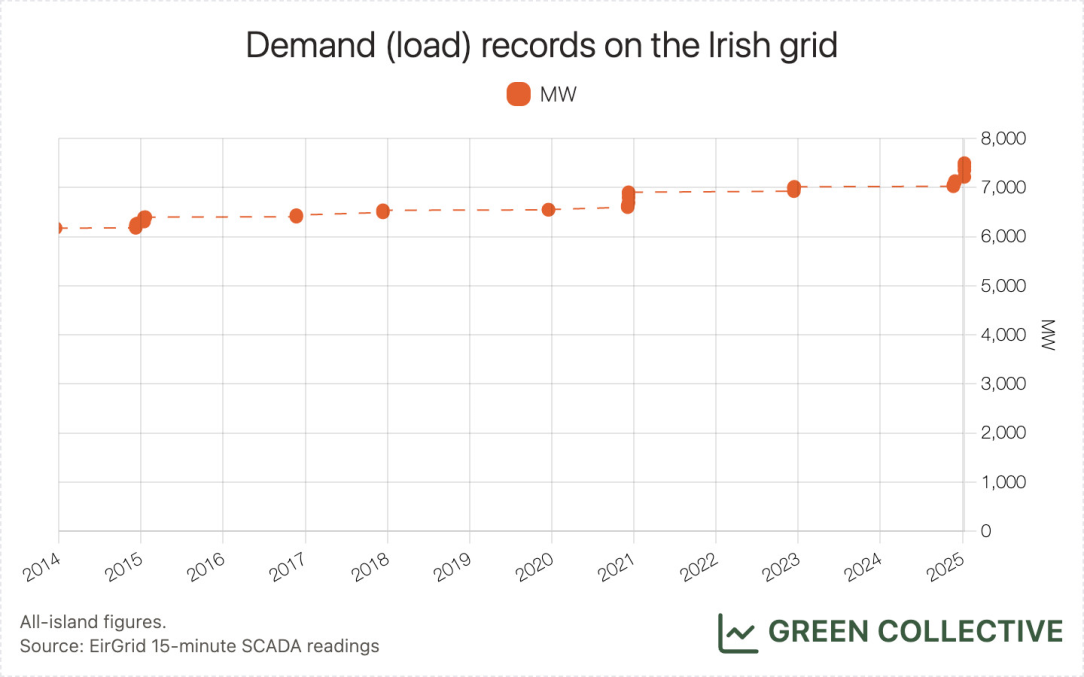
    All island demand of 7497MW

    image.png

    https://bsky.app/profile/greencollective.io/post/3lfaywtczg22w

    Post edited by Apogee on


  • Registered Users, Registered Users 2 Posts: 21,874 ✭✭✭✭cnocbui


    To meet this all time demand record, Ireland produced 1536% more CO2 per KWh than France did.


  • Registered Users, Registered Users 2 Posts: 1,427 ✭✭✭MightyMunster


    Luckily it's only a couple of days every decade or so 👍


  • Registered Users, Registered Users 2, Paid Member Posts: 15,607 ✭✭✭✭josip


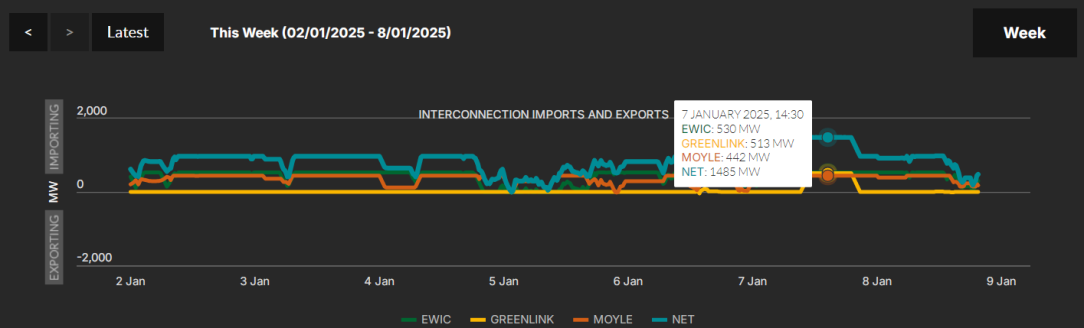
    Although we expect to be importing more than exporting over the interconnectors in the short term, today we were at times exporting over 1200MW thanks in part to Greenlink.

    image.png

    But don't bother trying to see it on the smartgriddashboard because this scenario wasn't considered possible before now 🙂 (although if you change to a week view, the scale does adjust sufficiently)

    image.png
    Post edited by josip on


  • Registered Users, Registered Users 2 Posts: 80 ✭✭silvertimelinings


    what happens when all the central heating systems and ICE cars are replaced with the Green alternatives which consume huge amounts of electricity. The high watermark will be breached again and again as the years go by.


  • Registered Users, Registered Users 2 Posts: 80 ✭✭silvertimelinings


    Wind Industry Lobbyists expect the Grid to accommodate the variable intermittent output of Wind Farms and blame someone/anyone else.

    https://gript.ie/2024-worst-year-on-record-for-wind-power-lost-as-electricity-supplied-by-wind-falls/


  • Registered Users, Registered Users 2, Paid Member Posts: 15,607 ✭✭✭✭josip


    The high water mark will be breached by increasing data centres, not by heat pumps and and EVs. Most EV owners charge their cars overnight. Smart meters and billing plans such as the UK's Octopus will also incentivise off-peak consumption. https://octopus.energy/


  • Registered Users, Registered Users 2, Paid Member Posts: 15,607 ✭✭✭✭josip


    And in other news, water makes you wet. What else would you expect a wind industry lobbyist to say?


  • Advertisement
  • Registered Users, Registered Users 2, Paid Member Posts: 3,300 ✭✭✭KrisW1001


    To counter some particularly lazy thinking that keeps coming up in the energy debate: Heat pumps do not consume more energy than traditional heating systems; in fact they consume far less: one Watt of input energy typically gets you between 2 and 5 watts of heat energy depending on the type of installation.

    Leaving aside CO2 emissions for a moment, if you just shifted from directly burning gas to heat a home to using electricity (even if generated by burning gas) to heat the home using a heat pump, you automatically reduce your energy use dramatically. But once you’ve broken that link with fossil fuels, you have far more options about where you get the energy to heat your home.

    Yes, electricity is more expensive than gas, but it isn’t during the night. Storage batteries are recommended for larger heat-pump installations to allow the system to be run by charging the battery at low-demand times, and using that energy at peaks. The running cost of a heatpump can be cheaper than gas, and it doesn’t suddenly get expensive when some dictator has an episode.


Advertisement
Advertisement