Advertisement
Please note that it is not permitted to have referral links posted in your signature. Keep these links contained in the appropriate forum. Thank you.

https://www.boards.ie/discussion/2055940817/signature-rules
Help Keep Boards Alive. Support us by going ad free today. See here: https://subscriptions.boards.ie/.
https://www.boards.ie/group/1878-subscribers-forum

Private Group for paid up members of Boards.ie. Join the club.
Hi all, please see this major site announcement: https://www.boards.ie/discussion/2058427594/boards-ie-2026

Classic cars vs modern crash tests the latest evidence

13»

Comments

  • Registered Users, Registered Users 2 Posts: 1,343 ✭✭✭MrCostington


    BrianD3 wrote: »
    Also, the angle may have favoured the E46 a little there, looks somewhat oblique. In general, if you see a frontal crash where the LHS of one car impacts the RHS of the other, it will often be a less favourable angle for one or other of them. Also the case if one is hit in the grille/numberplate area while the other is hit in the headlamp/wing area.


    Well normally for us in Ireland/UK it will be RHS on RHS with less than full overlap, hence the now standard NCAP tests.


    You are right, I think to say if drover side hit passenger side, I assume driver would be worse off, if that's what you're saying?


    Anyways this looks like 80-90% overlap and at an odd angle. I think if it has been the 'standard' head on with less overlap the driver would have been even worse injured.


    What is telling is the crumple damage in the rear panel, assuming this was not done during the rescue.


  • Registered Users, Registered Users 2 Posts: 7,476 ✭✭✭Cordell


    CiniO wrote: »
    The hypothesis that older cars are much less safe than modern ones is obviously true. There was never a doubt about it.

    However most tests/articles/etc seem to omit few important facts.
    1. Biggest advances in passive vehicle safety (so how it will become in crash and protect occupants) happened around 1995-2005. Most cars before 1995 didn't have airbags, crush zones, etc..) If you compare 2008 car to 1993 car (15 years apart) difference is enormous.
    If you compare 2006 car vs 2021 car there is not so much difference in crash result.

    2. It's never really mentioned, that size of a car really matters.
    It's a simple physics, but most people don't really understand it.
    A small car hitting a wall at 50km/h might protect occupants as well as big car hitting a wall at 50km/h. That's what crash tests show. And that's why makes many people think that small cars are as safe as big ones.

    However in real life, big car which is heavy collides with small light car, then momentum transmitted will cause so much more effect on small car.

    Example
    Car A weights 1000kg.
    Car B weights 2000kg.
    Both travel at 50km/h in opposite directions and collide head on.

    What will happen according to theory of momentum conservation, will be that heavy car B will slow down from 50 to 16km/h so forces which will affect occupants will be similar to hitting the wall at 33km/h. Lighter car A however, will not only be stopped to 0, but also pushed backwards to 16km/h, so its total sudden change of speed will be 66km/h. That's again forces on occupants similar to hitting the wall at 66km/h.

    Effect is that occupants of smaller car will be liable to forces like hitting the wall at 66km/h while bigger car only 33km/h. And obvously forces at 66km/h are 4x higher than at 33km/h (kinetic energy depends on square of speed).

    In other words, occupants of small car in simple equal speed head on collision, could be liable to forces 4x higher than occupants of big car, and that is very likely difference between being OK and dead.


    You are right in saying that the lighter car and it's passengers will be affected more, but it's not 4x more.
    For start you are ignoring that quite a lot of energy is absorbed by the car deformation and friction, so after the impact the speed won't be 16km/h, but only a fraction of that.
    And the forces don't depend on the speed, but on the acceleration and linearly, not squared (F=m * a)


  • Registered Users, Registered Users 2 Posts: 9,014 ✭✭✭BrianD3


    You are right, I think to say if drover side hit passenger side, I assume driver would be worse off, if that's what you're saying?
    No I wasn't thinking about what side of the car the driver and passenger were sitting on but rather the effect of the angle on the car's structure. Below is an example of an oblique impact which can load the structures in each car differently. If one or both cars were repositioned you could have a LHS to RHS impact which would change things again


  • Registered Users, Registered Users 2 Posts: 16,041 ✭✭✭✭CiniO


    Cordell wrote: »
    You are right in saying that the lighter car and it's passengers will be affected more, but it's not 4x more.
    For start you are ignoring that quite a lot of energy is absorbed by the car deformation and friction, so after the impact the speed won't be 16km/h, but only a fraction of that.
    I disagree.
    Of course lots of energy will be absorbed by deformation of vehicles at impact.
    However this loss is already accounted for in loss of speed (we had 2 cars travelling at 50km/h, and after crash we have two crashed vehicles travelling at 16km/h - that's a huge transfer of kinetic energy to deformation of vehicles).

    But look at conservation of momentum:
    For a collision occurring between object 1 and object 2 in an isolated system, the total momentum of the two objects before the collision is equal to the total momentum of the two objects after the collision. That is, the momentum lost by object 1 is equal to the momentum gained by object 2.

    If you look at conservation of momentum, calculation is simple.
    Car A momentum = m*s = 1000kg * 50km/h = 5000 (kg*km/h)
    Car B momentum = m*s = 2000kg * 50km/h = 10000 (kg*km/h)
    Both are vectors of opposite direction so total momentum of an isolated system of those two vehicles will be 10000 - 5000 = 5000 in the direction of heavier car B.

    So momentum after crash will have to be equal 5000 in the direction of heavier car. And as directly after crash both cars are joined together and can be treated like 3000kg object, then simple calculation revels that speed of that object of two cars will be 16km/h in direction that heavier car was going.

    Of course they will stop very quick especially that they are badly crashed at that stage.
    But what I'm talking about is moment directly after a collision (milliseconds after) and in that moment heavier car B will just suffer slowing down from 50 to 16km/h (deceleration of 33km/h) while lighter car A will suffer slowing down to 0 and being pushed in opposite direction to 16km/h (deceleration of 66km/h)
    And the forces don't depend on the speed, but on the acceleration and linearly, not squared (F=m * a)

    Yes - forces depend on acceleration(or deceleration).
    But as shown above, deceleration of smaller vehicles will be from 2x higher speed, therefore deceleration will be 4x higher (as deceleration depends on square of difference in speed).

    I know all those calculations are just theoretical and lots of "real life factors" are not accounted for, however general idea is shown, and definitely in real life results will be similar.


    It just proves how much worse it is to be in head on collision in a small car when colliding with 2x heavier car.
    Not that small car is not designed to withstand crash at the same speed, but real impact of crash causes it to be affected like it crashed at higher speed (due to effect of being pushed back by heavier car).

    And many people don't realise how much of an difference it makes.
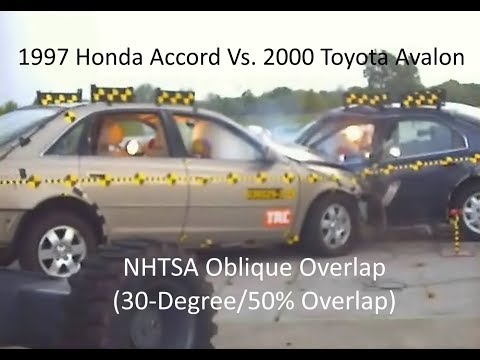
    Even have a look at first clip on this video. It shows the idea perfectly.
    The same way as lighter man is bounced back, same happens with smaller car in a collision with big one.


  • Registered Users, Registered Users 2 Posts: 39,359 ✭✭✭✭BorneTobyWilde


    So what did proves is newer cars are a real danger to older cars. It's like a sledge hammer v a Tomato /
    Older cars crashing into older cars do less damage to each other, as both absorb the energy.


  • Advertisement
  • Registered Users, Registered Users 2 Posts: 16,041 ✭✭✭✭CiniO


    So what did proves is newer cars are a real danger to older cars. It's like a sledge hammer v a Tomato /
    Older cars crashing into older cars do less damage to each other, as both absorb the energy.

    For me it's as follows:

    If I was to crash into a wall at 50km/h, I'd hundred percent prefer to be in brand new Dacia Sandero than a early 90's Camry.

    I was was to crash head on with another vehicle both doing similar speed, I'd definitely prefer to be in 30 year old Range Rover than new Dacia Sandero.


  • Registered Users, Registered Users 2 Posts: 7,476 ✭✭✭Cordell


    CiniO wrote: »
    I disagree.
    Of course lots of energy will be absorbed by deformation of vehicles at impact.
    However this loss is already accounted for in loss of speed (we had 2 cars travelling at 50km/h, and after crash we have two crashed vehicles travelling at 16km/h - that's a huge transfer of kinetic energy to deformation of vehicles).
    True, my mistake, it's been to many years since I needed it :)
    But the forces are not 4x if the mass of the car is 1/2. The mass of the passengers (and their internal organs :| ) matters here.
    a = (v1 - v2) / t
    a1 = (50 - 16 km/h)/t, a2=(50 + 16 km/h)/t
    a2 is twice a1 so the force is twice, not 4x


  • Registered Users, Registered Users 2 Posts: 762 ✭✭✭kaahooters


    short version.

    dont crash.


  • Registered Users, Registered Users 2 Posts: 6,368 ✭✭✭kirving


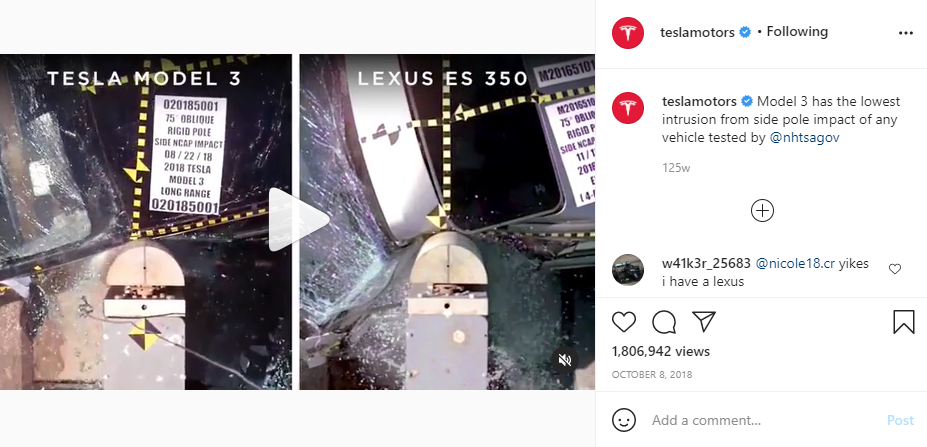
    I saw something recently, from Tesla, comparing a Model 3 to a Lexus ES. Both are extremely safe cars, but looking at this video, you would assume the Lexus is far worse.

    Screenshot for those who are not on Instagram
    545919.png

    Both cars hit the pole at the same time, and I've paused the video at the point of maximum intrusion to the Tesla before it bounces back.

    You would think think that the Lexus scores far worse, based on the above. But both manufacturers have taken a different approach. Tesla try to minimise injury by minimising intrusion, why Lexus aim to minimise deceleration.

    Euro NCAP Ratings go Good-Adequate-Marginal-Week-Poor

    Lexus score Good everywhere but the Head, which is Adequate: Total 15/16
    Tesla scores Good everywhere but the Chest, which is Marginal: Total 15.3/16

    In this particular test, the difference to the occupant really is marginal, despite first apperances.


  • Registered Users, Registered Users 2 Posts: 7,677 ✭✭✭frozenfrozen


    tesla have to be stiffer because the car weighs 500 trillion giggatonnes and is filled with explosive material

    the lexus crumples...


  • Advertisement
  • Registered Users, Registered Users 2 Posts: 2,586 ✭✭✭newmember2


    You'd think the Tesla would be the less safer car compared to the Lexus as it doesn't crumple as readily so transmitting the energy to the passengers/restraints.


  • Registered Users, Registered Users 2 Posts: 263 ✭✭Maxface


    CiniO wrote: »
    For me it's as follows:

    If I was to crash into a wall at 50km/h, I'd hundred percent prefer to be in brand new Dacia Sandero than a early 90's Camry.

    I was was to crash head on with another vehicle both doing similar speed, I'd definitely prefer to be in 30 year old Range Rover than new Dacia Sandero.


    I've seen hundreds of car accidents, there has been plenty of freak ones in that time. What I have noticed the last few years is the amount of damage new cars take in accidents. Your 30 year old Range Rover in that head on would have decent front damage but also the engine would probably have pushed in to the cab. Legs would be broken, ankles possibly and maybe hip etc, that sandero would be in bits. Engine would be up the road and the car a write off.


    New cars now, clearly much better than before, decrease as much energy before it gets to the driver and then pushes it around the shell and out the back. You can see it. Engine breaks away, ripples moving back and so on but the drivers compartment is secure. With new technology now on newer cars then we are safer than ever. I will say that any car versus a wall is the one accident where we would have some work, any accident versus a tree then body retrieval would be high up there.


  • Registered Users, Registered Users 2 Posts: 9,014 ✭✭✭BrianD3


    Maxface wrote: »
    I've seen hundreds of car accidents, there has been plenty of freak ones in that time. What I have noticed the last few years is the amount of damage new cars take in accidents. Your 30 year old Range Rover in that head on would have decent front damage but also the engine would probably have pushed in to the cab. Legs would be broken, ankles possibly and maybe hip etc, that sandero would be in bits. Engine would be up the road and the car a write off.

    New cars now, clearly much better than before, decrease as much energy before it gets to the driver and then pushes it around the shell and out the back. You can see it. Engine breaks away, ripples moving back and so on but the drivers compartment is secure. With new technology now on newer cars then we are safer than ever. I will say that any car versus a wall is the one accident where we would have some work, any accident versus a tree then body retrieval would be high up there.
    Current model Sandero is probaby the least safe new car available, the new one which will arrive shortly will be much better. If I had the choice between the Sandero and a 30 year old RR I'd probably pick the current model Sandero and definitely the upcoming one. Old 4wds have height and weight but crude design, as you say engines end up in cabins, steering columns and pedal intrude, front wheels get rammed up against the footwell and crush it etc.

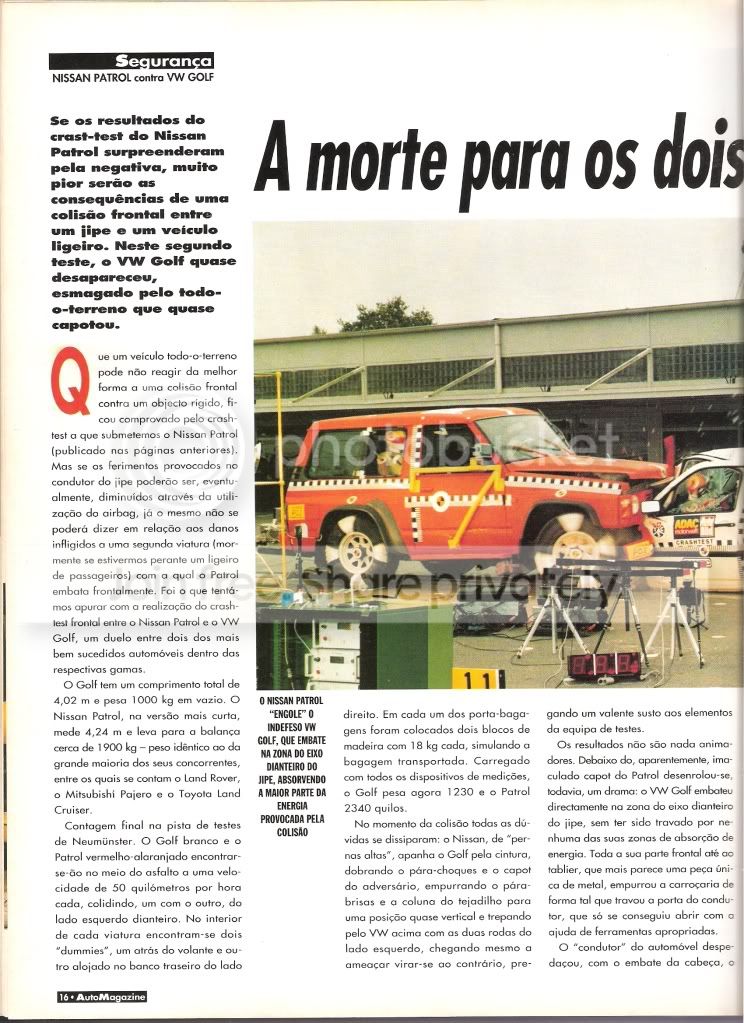
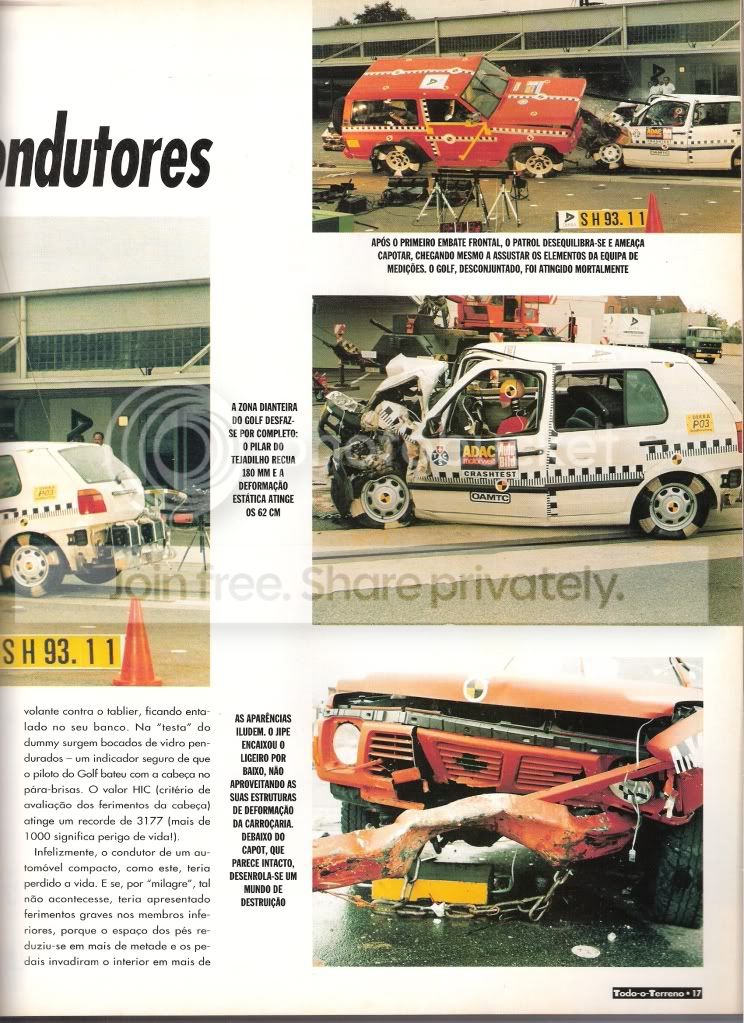
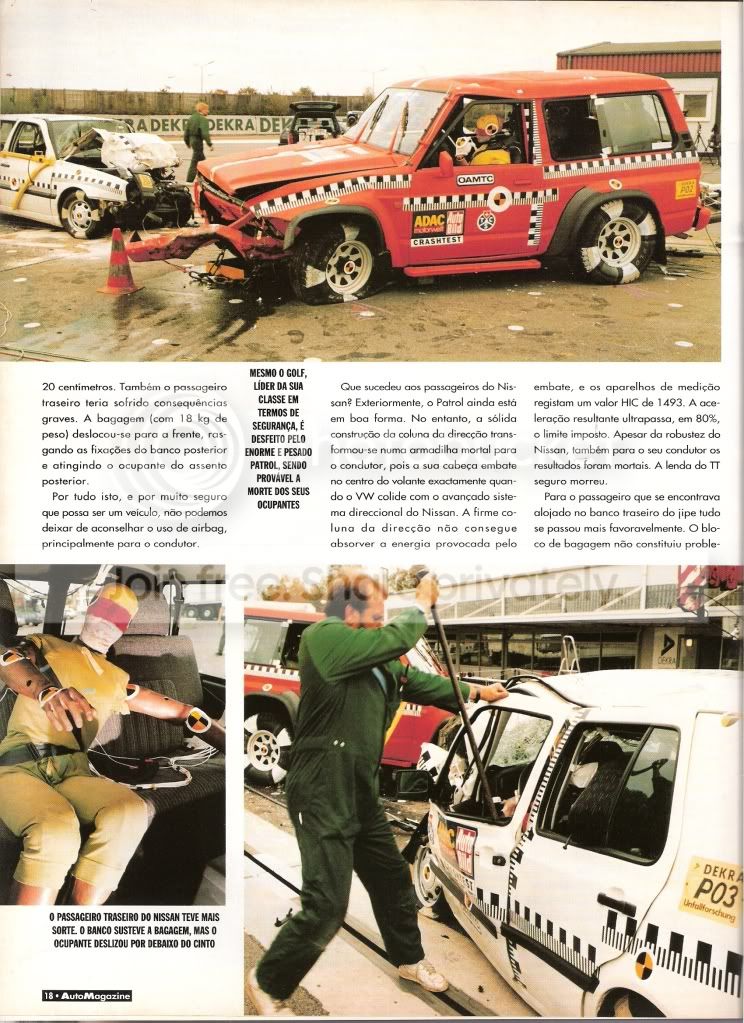
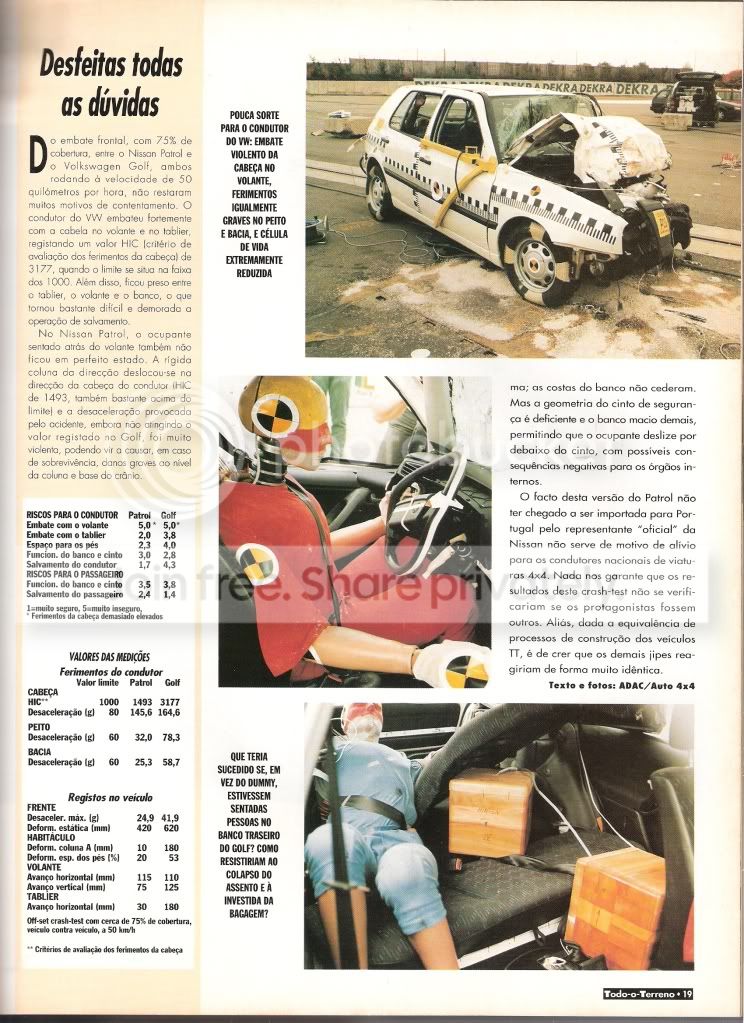
    In 1993 the ADAC crash tested a Nissan Patrol vs a VW Golf, both doing 50 km/h. Patrol was twice the weight of the Golf. Both drivers would have died from head contact with the steering wheel. The Golf was very badly damaged. The Patrol was outwardly far better and the driver would have suffered fewer injuries than the Golf driver but would still be dead.

    A modern small car would be considerably stronger than a Mk3 Golf, protect its own occupants better and be more aggressive to its "opponent".

    Digitalizar0062.jpg

    Digitalizar0063.jpg


    Digitalizar0064.jpg


    Digitalizar0065.jpg


  • Registered Users, Registered Users 2 Posts: 4,354 ✭✭✭Montage of Feck


    Lifes too short to be driving boring "safe" cars.

    🙈🙉🙊


  • Registered Users, Registered Users 2 Posts: 1,343 ✭✭✭MrCostington


    A further thought on the 911 I posted. I wonder if the fact it was rear engined had a big effect on the outcome for the driver?

    I do understand that in modern cars there is engineered crash structures up front, and they, not the engine provide protection. But as someone here mentioned it was a 60's design, evolved (I'm still assuming this was an 80's 911 - correct??) so perhaps Porsche figured it did not have to be so strong up front since there were lighter loads in normal operation?

    Another possible factor is that the mass of the engine/gearbox is behind the driver. So, that mass was pushing all ahead (including driver) of it into the BMW. Whereas in front engined cars this mass would have been pushing into the BMW.

    So, would a similar vintage, premium brand (Merc, BMW, Jag etc) have done better in this case?


  • Registered Users, Registered Users 2 Posts: 9,014 ✭✭✭BrianD3


    It's hard to say if the engine position made any difference, a rear engined car has some potential advantages for safety but it's unlikely that much effort went into realising these advantages when the 911 was being engineered in the early 1960s.

    Having said that, even though a 1980s 911 is based on a 1960s one, it's likely that some structural improvements happened in that time.

    When the ADAC tested a Beetle (rear engine and obviously ancient design) and Golf Mk2 using a EuroNCAP procedure, the Beetle performed slighty better than the Golf but the result would still have been that the Golf driver was "more dead"

    Old and old design cars are basically various levels of terrible for safety, the "least unsafe" would probably be Mercedes, crumple zones from the 1950s on and offset testing from the late 70s on. A 1980s W201, W124 or W126 would almost certainly be safer than a 1980s 911.


  • Registered Users, Registered Users 2 Posts: 5,531 ✭✭✭Leonard Hofstadter


    Bigus wrote: »
    Good post,
    And apparently that model e46 was not the safest in its class , contrary to my original understanding.

    They got 4 stars in the NCAP test, which was the then maximum.

    They came with 6 airbags (still pretty decent by modern standards), traction control and after 2001, ESP, as standard. Same as in a new car. They could be had with bi-xenon headlights (though obviously nobody in Ireland bothered with that). Not bad for a car that first saw the light of day 23 years ago.

    With a superbly balanced chassis and outstanding handling thanks to its 50:50 weight distribution, not to mention the outstanding levels of feedback from the hydraulically assisted steering, you always know what the car is doing and can thus drive accordingly, knowing full well what's safe and what's not. Plus, with none of the so-called 'driver assist' systems like supposedly intelligent speed adaptation or lane departure, you actually have to pay attention when driving because there is no computer to tell you that you're going too fast (you have to use your eyes and watch out for signs - imagine that!) and there is nothing beeping to tell you that you're wandering in and out of lanes (except for the feedback through the wheel every time you go over a catseye), or any of the other silliness that's there these days.

    I really do worry with the level of safety systems that are in the latest cars, of course I'm not arguing for going back to the bad old days when car companies wouldn't fit something like ABS let alone anything more sophisticated as standard, nor am I for a second suggesting the level of crash protection in many popular cars from the 90s is even remotely acceptable, but things have gone way too far in the opposite direction now. All it's going to result in is a dumbed-down driving experience, and with it a lower standard of driving, because with so much nannying people will become much more complacent (assuming the computer will take care of it), and personal responsibility is gone.

    E46 interiors are also blessed with this other truly incredible thing called buttons, everything is where you want it meaning you can operate all the controls with muscle memory (a task made even easier than usual because like so many BMWs, everything is so logically laid out and falls naturally to hand) and you don't lose any focus or concentration while on the move should you need to adjust something. If you want to adjust the wipers you just move the wiper stalk, not like in a Tesla Model 3 where you have to go into a sub menu to adjust some of the wiper settings.

    TLDR: a modern car is undoubtedly considerably safer if you're in an accident, but personally I'd rather avoid getting in one in the first place because of the excess dumbing down of the driving experience due to all the nannying and/or the unnecessary complexity of operating many of the key controls in modern cars.


  • Closed Accounts Posts: 22,457 ✭✭✭✭beauf


    Dunno if this was posted...

    https://youtu.be/mnI-LiKCtuE

    Apart from the safety in an accident, modern cars have much better brakes and road holding than older cars. Even the tyres are better.

    Until a few years back our 2nd car which we hardly used was an 18yr old car with no abs and one air bag. It's was only used for pottering around town. Low mileage and ultra reliable. Would have been fine for another 10yrs. But we started to need to use the M50 a bit and the difference between driving that and a newer car on fast roads was enormous, and especially out of it's depth in fast heavy traffic. So we got rid of it fit safety reasons alone.


  • Closed Accounts Posts: 22,457 ✭✭✭✭beauf


    ....
    TLDR: a modern car is undoubtedly much safer if you're in an accident, but personally I'd rather avoid getting in one in the first place because of the excess dumbing down of the driving experience due to of all the nannying and/or the unnecessary complexity of operating many of the key controls in modern cars.

    I would agree with you to a certain point. But in modern heavy daily traffic. That's what you need. Unless you have an opportunity to drive somewhere else, then a sports car is no fun in slow traffic.

    The whole touch screen thing though is ridiculous and dangerous. As is voice control. I want buttons. Personally I prefer dials but they can be on a screen.


  • Registered Users, Registered Users 2, Paid Member Posts: 1,662 ✭✭✭Turbulent Bill


    I wonder if active safety features (like collision avoidance) will start having a heavier weight in safety tests than passive ones like crumple zones. If you can avoid many of the accidents upfront, does it make the actual crash performance less important?


  • Advertisement
  • Closed Accounts Posts: 22,457 ✭✭✭✭beauf


    I wonder if active safety features (like collision avoidance) will start having a heavier weight in safety tests than passive ones like crumple zones. If you can avoid many of the accidents upfront, does it make the actual crash performance less important?

    There will always be accidents. So crash performance is always important. If you can avoid accident thats has to be the primary objective though.


  • Registered Users, Registered Users 2 Posts: 5,531 ✭✭✭Leonard Hofstadter


    beauf wrote: »
    There will always be accidents. So crash performance is always important. If you can avoid accident thats has to be the primary objective though.

    My thoughts exactly. The problem is some of the so-called active safety measures that are, or are about to become, mandatory, are counterproductive. I also find it truly extraordinary in this day and age given the level of focus on road safety that there's basically no regulations about how easy the controls in a car are to operate.

    Nowadays it's all about style over substance, a nice looking interior is prized more over one that's made to last and one that can be operated by normal human beings as opposed to tech heads or teenagers. The other reason of course why touch screens have become more popular is because it's cheaper for the manufacturers to not install buttons.

    The other point I found interesting above was about how normal cars perform against EVs in accidents. The logical conclusion is that all cars should become much heavier so we're all equally well protected. But that means we all need to own big SUVs - which have inferior driving dynamics (they weigh more and have a higher centre of gravity), and that is hardly good from a safety perspective. More importantly, given that we are all quite rightly concerned about the planet these days, how can it be good for the environment to be encouraging the manufacture of cars that weigh well in excess of two tonnes, only a few years ago cars rarely weighed more than about 1600 kilos. Even something VW ID3 weighs over 400 kilos more than a Golf, it's 1800 kilos - that's bordering on 5 series territory but a 5 series is two classes of car above size wise. I fail to see how this is 'progress' either from a safety or environmental perspective.


  • Closed Accounts Posts: 22,457 ✭✭✭✭beauf


    Heavier does not equal better protected.


Advertisement
Advertisement