Advertisement
Please note that it is not permitted to have referral links posted in your signature. Keep these links contained in the appropriate forum. Thank you.

https://www.boards.ie/discussion/2055940817/signature-rules
Help Keep Boards Alive. Support us by going ad free today. See here: https://subscriptions.boards.ie/.
https://www.boards.ie/group/1878-subscribers-forum

Private Group for paid up members of Boards.ie. Join the club.
Hi all, please see this major site announcement: https://www.boards.ie/discussion/2058427594/boards-ie-2026

Classic cars vs modern crash tests the latest evidence

  • 29-07-2020 08:51AM
    #1
    Registered Users, Registered Users 2 Posts: 4,755 ✭✭✭


    As a car enthusiast with an engineering background I find it increasingly difficult to ignore the advances in car safety, over my passion for classic cars.

    Over the years I’ve seen many crashed cars in bodyshops here in Ireland, and have had more than a passing interest in studying these wrecks(as a hobby).

    Only this week I saw a 12 Renault Megane that took a massive side swipe yet the shell remained remarkably intact. So much so it’s unbelievable how strong modern car shells are. Even taking a ball peen hammer to some of the modern high strength steel fabrications you’d have job to impact them.

    On the same day after viewing the Megane , I saw an old saloon Fiat inm the body shop stripped back for refurb , and Myself and the panel beater, concluded that if the same family had been in the Fiat, under the same crash circumstances as the modern Renault they would be All dead and buried....... yes dead and buried , no coming back from that.

    The poor old Fiat (1970’s)had what would seem like the strength of a Jacob’s biscuit tin ( even though it had no corrosion)., with almost zero side impact/side swipe protection.

    The first time, that I, copped the factory strength of modern cars when they crashed was about 20 years ago ,ironically this was a crashed Fiat too.
    It was a “modern” 2001 newish Punto that had been stuffed into a solid wall, by a young lad. My thoughts were that he didn’t realize how lucky he was to be in a car that was less than 2 years old and was so strong compared to its predecessors. When it hit the wall it folded to the suspension turrets, but from the turrets back was completely solid and unyielding, protecting his human body.
    At that time I was involved with a business preparing Uno race cars , and what shocked me was the fact that the two generations newer road car Punto appeared a LOT stronger than previous generation race prepared Uno with a full cold rolled seamless all steel,roll cage welded in.

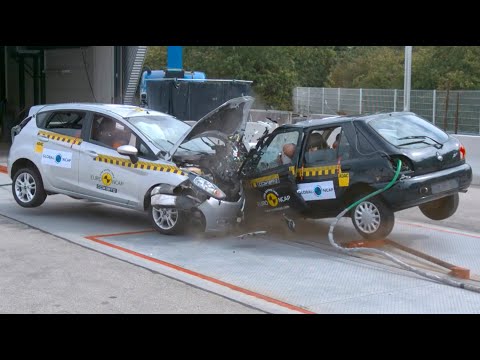
    Anyway don’t take my word for it , modern cars are way way superior in crash safety as witnessed in below video . If you haven’t got 4 and a half minutes to watch all of the video skip to 3.22 to see a 2000 Fiesta vs a 2020 Fiesta shot 2 weeks ago.

    No wonder insurance companies here are penalising older cars with much higher premiums, for claim reasons, and in my mind are now fully justified from a general safety point of view.

    And if you’re using your classic as a daily driver have a good think about the advances in safety you are foregoing.

    Happy motoring !


«13

Comments

  • Registered Users, Registered Users 2 Posts: 86,596 ✭✭✭✭Atlantic Dawn
    GDY151


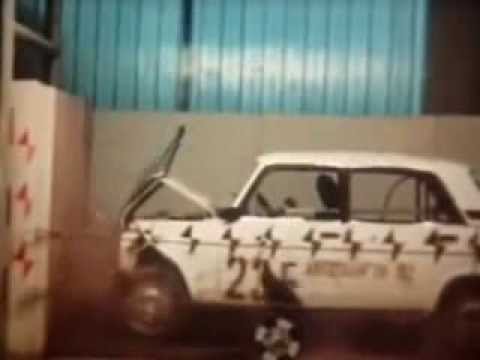
    Get yourself a Lada, the windscreen detaches at impact :D...


  • Registered Users, Registered Users 2 Posts: 41,316 ✭✭✭✭ohnonotgmail


    Get yourself a Lada, the windscreen detaches at impact :D...

    that is actually a safety feature. it makes it easier for you to climb out in the event of an accident. Clever lot those lada designers.


  • Registered Users, Registered Users 2 Posts: 9,014 ✭✭✭BrianD3


    Great first post and one of my favourite car related topics. The comment about the road going Punto appearing stronger than a caged Uno race car is very interesting.

    I suppose I first got interested in car safety in the early 90s when Auto Motor und Sport did its offset crash tests (less stringent than EuroNCAP's test) on E segment cars with several of them doing appallingly. Subsequently, offset tests were carried out on smaller cars with several of them such as the Fiat Tipo, Honda Civic EG and Renault Twingo also doing very badly.

    The ADAC also had their version of an offset test. The Fiat Tipo, Peugeot 405 and 1986-1990 Ford Escort did badly.

    Car safety was becoming "a thing" from the early 90s on due to upcoming new statutory test procedures. There were improvements in engineering, CAD etc. that probably made things feasible in an average priced car that previously would have made it too expensive.

    There was a big scramble to fit side impact bars to cars that that didn't have them. They probably didn't do much good in reality IMO. Airbags and seatbelt pretensioners were also limited in their effectiveness if the structure of the car was too weak. The aformentioned Civic was one of the earlier cars in its class to have an airbag but it's not much good having one if the steering wheel ends up behind your head.

    The Mk1 Mondeo, Golf Mk3 and new Astra seemed to be designed with a more holistic approach to safety and did perform well when tested by AM&S.

    People might remember the "Sledgehammer" ad for the the facelifted Opel Vectra circa 1993. The entire ad was a crash test showing how marketing was becoming important.

    I well remember back in early 1997 I couldn't wait to get my hands on What Car? for the results of the first EuroNCAP tests. It was big news at the time, made the main news bulletins in the UK. Roger King from the SMMT was everywhere trying to debunk the results. There was obviously consternation in the industry, much of the attention focused on the poor old Rover 100 but other cars were badly shown up too. It was eye opening to see the Nissan Primera do considerably better than the Saab 900.

    Even considering all of the above, it still took me a few years to cop how critcial the design age of the car was. It was clear that the likes of a 1998 Mk2 Clio was considerably safer than a 1996 Mk1 Clio but what would happen if the Mk2 hit a 1975 Volvo 240. When 5th Gear started doing its "old vs new" tests that was another eyeopener.


  • Registered Users, Registered Users 2 Posts: 20,235 ✭✭✭✭jimgoose


    I think this video says a lot - old American Chevy land-yacht versus it's modern-ish stable mate. There really is no comparison:


  • Registered Users, Registered Users 2, Paid Member Posts: 16,438 ✭✭✭✭loyatemu


    there are other factors in overall risk though. Classics are generally doing low mileage, driven carefully by on-average older drivers. I don't know if such statistics are available but I'd be interested to know if classics are over-represented in fatal crash figures. Obviously this is different to young lads driving around in 20 year old bangers.

    If you are overly worried about the crash-worthiness of your classic, then logically you should never get on a bike, or even cross the road.

    Put your money where yer mouth is... Subscribe and Save Boards!

    https://subscriptions.boards.ie/


  • Advertisement
  • Registered Users, Registered Users 2 Posts: 7,475 ✭✭✭Cordell


    that is actually a safety feature. it makes it easier for you to climb out in the event of an accident. Clever lot those lada designers.

    What it makes it even easier is that they didn't have seat belts as standard, so climbing out was effortless and usually performed automatically.


  • Registered Users, Registered Users 2, Paid Member Posts: 9,292 ✭✭✭cml387


    Would it be remiss of me to mourn the sacrifice of the Bel Air, at least?


  • Registered Users, Registered Users 2 Posts: 1,343 ✭✭✭MrCostington


    Yes, I have often wondered that myself. I don't think you can compare the strength of a modern shell vs old, never mind all the airbags etc.

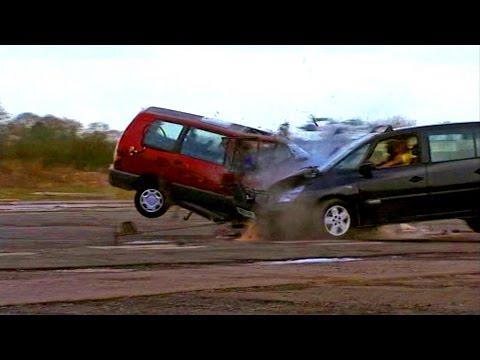
    This is a comparison of two Espaces 9 years apart (sorry not sure of actual years), not nice viewing and it's not even an old car


    Hopefully I'll be OK if I drive off a cliff on my way home


  • Registered Users, Registered Users 2 Posts: 7,475 ✭✭✭Cordell


    I was expecting an explosion there :)
    It's not just the strength, it's how it's distributed, weak front that crumbles and absorbs the energy, and strong cabin that protects the occupants. If the car is strong all over, then the occupants will crumble, because something has to.


  • Registered Users, Registered Users 2 Posts: 4,755 ✭✭✭Bigus


    loyatemu wrote: »
    there are other factors in overall risk though. Classics are generally doing low mileage, driven carefully by on-average older drivers. I don't know if such statistics are available but I'd be interested to know if classics are over-represented in fatal crash figures. Obviously this is different to young lads driving around in 20 year old bangers.

    If you are overly worried about the crash-worthiness of your classic, then logically you should never get on a bike, or even cross the road.

    That’s why I qualified my point to consider safety when DAILY driving classics.

    What got me really thinking about this again was seeing an Austin A40 being driven in traffic on the 3 lane Nass road yesterday. It really was like a dinky car amongst the moderns , and god help those inside if there was any sort of minor tip . Never mind being hit by a truck or an SUV. It was actually toy like in size.

    Certainly if I had something as delicate , I’d be trailering it , rather than driving, for safety not preservation.


  • Advertisement
  • Registered Users, Registered Users 2 Posts: 5,723 ✭✭✭zilog_jones


    My first car was a '98 Fiesta just like in the video. I considered safety when I was buying (this was in 2006), the Mk4 Fiesta got 3 stars in the 1997 Euro NCAP and compared favourably to its rivals (only the Polo scored as highly). Even in the original report it mentioned various issues like how "deformation of the footwell was excessive" (as shown in the video) and how the knees were in close contact to various hard components. But within my budget at the time there wasn't really anything better out there.

    It had one airbag (passenger airbag like in the video wasn't standard), seatbelt pre-tensioners, no ABS, front disc brakes, side impact beams, and really not much else in terms of safety features. It predated requirements of even simple things like a third brake light and three-point seat belt for the rear centre seat by a few years. But this was deemed adequate to me at the time, even above average. It's funny how standards and expectations change over time.

    Now my current car has so many airbags I couldn't tell you how many - it's even got one for my knees. And ABS, VSC, and all the acronyms. And structural integrity is far superior.


  • Registered Users, Registered Users 2 Posts: 4,236 ✭✭✭Pkiernan


    that is actually a safety feature. it makes it easier for you to climb out in the event of an accident. Clever lot those lada designers.

    Its to climb out when the doors get stuck!


  • Registered Users, Registered Users 2 Posts: 41,316 ✭✭✭✭ohnonotgmail


    Pkiernan wrote: »
    Its to climb out when the doors get stuck!

    exactly. that kind of foresight on the part of the designers is to be applauded.


  • Registered Users, Registered Users 2 Posts: 9,014 ✭✭✭BrianD3


    Much older cars are not necessarily that much worse (from a structural POV) than those from the 80s. No crumple zone on the older cars and invariably very unforgiving interiors but if hit by a modern car the very lack of crumple zones might help (a bit).

    When the OAMTC did a EuroNCAP test on a Mk2 Golf and a VW Beetle the Beetle actually performed slightly better :eek:

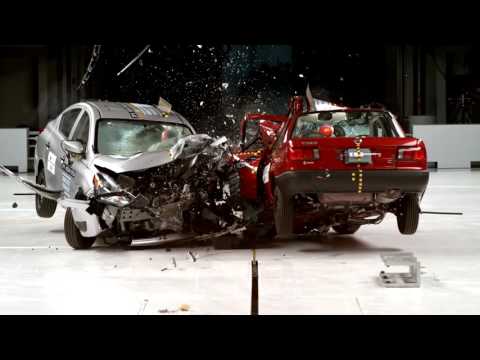
    Also if we look at this new (but 1980s design) Nissan vs a New Nissan - that's not much better than how the Chevy Bel Air did in its test with a modern car.


  • Registered Users, Registered Users 2 Posts: 2,349 ✭✭✭Miscreant


    As another poster has said, Classic cars tend not to be daily driven by many so I think the point is more in line with the "older" cars than Classics TBH.

    I had an early 90s Suzuki Cappuccino insured on a classic policy and did less than 2000kms a year in it. I was acutely aware of how vulnerable I was in it and the fact that the car had no ABS, Airbags, traction control or safety aids to speak of didn't put me off using it. I knew I would be severely injured in the case of a crash but you can't live your life worrying about that kind of thing, otherwise you would not go outside your home.

    My first car was a Daewoo Lanos and it had passenger/driver airbags along with ABS but even that would have been a death trap compared to the cars today.
    I think the main reason that some insurance companies have introduced this "10 year rule" is because they were seeing a lot of claims coming in for older cars as they are cheaper to buy relative to the minimum insurance injury pay-out of about €19k these days (for breaking a nail!).

    I would like to see the official statistics on older cars involved in collisions and how many of them are fatal or have life changing injuries for the occupants. I do most of my driving around the Dublin area and it is becoming less common to see a car older than 2008 these days (not saying they are not out there), so quite a lot of the driving stock in the city at least will have been EURO NCAP tested in the last 15 years anyway.

    The video from the OP is very interesting however, and shows just how far technology advanced in the last 50 years but I guess the same can be said of most things we buy now. :)


  • Registered Users, Registered Users 2 Posts: 2,561 ✭✭✭extra-ordinary_


    BrianD3 wrote: »
    Much older cars are not necessarily that much worse (from a structural POV) than those from the 80s. No crumple zone on the older cars and invariably very unforgiving interiors but if hit by a modern car the very lack of crumple zones might help (a bit).

    When the OAMTC did a EuroNCAP test on a Mk2 Golf and a VW Beetle the Beetle actually performed slightly better :eek:

    Also if we look at this new (but 1980s design) Nissan vs a New Nissan - that's not much better than how the Chevy Bel Air did in its test with a modern car.


    Title of the video is totally misleading - the red Tsuru is 1992 not 2015.


  • Registered Users, Registered Users 2 Posts: 9,014 ✭✭✭BrianD3


    Title of the video is totally misleading - the red Tsuru is 1992 not 2015.
    No the example used in the test was a 2015, a Mexican built car I believe.

    if the point that you are making is that it is an old design, yes it is which is also the topic of this thread. Older designs are very unsafe - even before they have been subjected to 20+ years of wear and tear, rust etc.


  • Closed Accounts Posts: 2,655 ✭✭✭i57dwun4yb1pt8


    amazing thanks for the clips , i cant believe they killed the chevy though


  • Registered Users, Registered Users 2 Posts: 5,723 ✭✭✭zilog_jones


    BrianD3 wrote: »
    No the example used in the test was a 2015, a Mexican built car I believe.

    if the point that you are making is that it is an old design, yes it is which is also the topic of this thread. Older designs are very unsafe - even before they have been subjected to 20+ years of wear and tear, rust etc.

    The Tsuru was built in Mexico until 2017, but based on the B13 Sunny which was new in 1990 in Japan - not the same as the Sunny sold in Europe at the time, which was a rebadged N14 Pulsar, but probably structurally similar. Even at the end of production it still had no airbags and no ABS.


  • Registered Users, Registered Users 2 Posts: 821 ✭✭✭The chan chan man


    Of course modern cars are safer. I don’t think anyone said they’re not?!

    Why are insurance companies penalising cars > 10 years old though? Do they think the 2009 Mercedes E-Class will fold like a 70s Fiat in a crash?


  • Advertisement
  • Registered Users, Registered Users 2 Posts: 786 ✭✭✭aw


    Fascinating topic. Great insights so far.

    A question, from what year would we see safety standards at a modern acceptable standard?
    For example, is a 2006 car still considered 'unsafe' compared to a new car, or did standards improve from the early noughties onwards (which would be my perception)?


  • Registered Users, Registered Users 2 Posts: 17,239 ✭✭✭✭whisky_galore


    amazing thanks for the clips , i cant believe they killed the chevy though

    That makes me wince, along with classics deliberately crashed for movies. :(


  • Registered Users, Registered Users 2 Posts: 26,242 ✭✭✭✭Eric Cartman


    id love to see an 87 Mercedes 500 SEL against a new Dacia duster.

    My money would still be on the merc.


  • Moderators, Category Moderators, Music Moderators, Politics Moderators, Society & Culture Moderators Posts: 22,424 CMod ✭✭✭✭Dravokivich


    When you look at safety features in modern cars, it's very much set by market requirements (unless your Scandanivian). "Modern" cars in India are still pretty soft in that regards.
    That makes me wince, along with classics deliberately crashed for movies. :(

    They tend to be fabricated shells over a rolling chasis. An Insurer won't underwrite a movie where a valuable asset is set to be destroyed.


  • Closed Accounts Posts: 2,280 ✭✭✭CrankyHaus


    It's interesting to consider if the safety of cars will continue to increase at the rate it has in the past few decades, now that manufacturers are increasingly pursuing active safety measures after nearly exhausting passive ones.

    I've seen a few accidents with modern cars and have always been impressed with how well protected the occupants are: roll-overs with the family crawling out with barely a scratch, early morning concertina collisions on the M50 with everyone going on to work afterwards. Older cars are death-traps in comparison, though obviously the most important safety feature is am attentive and prudent driver.


  • Registered Users, Registered Users 2 Posts: 7,475 ✭✭✭Cordell


    id love to see an 87 Mercedes 500 SEL against a new Dacia duster.

    My money would still be on the merc.

    If they crash into each other, maybe, because of its weight and nothing else.
    If they crash into a pole, tree, or incoming lorry, then you'd be safer in a Duster.

    It's fair to mention that they were doing crash tests before pretty much anyone else, but have a look here https://www.youtube.com/watch?v=QFk2ve0s0w0 and compare with modern cars with good results. See how the merc have a sudden stop and how the modern cars decelerate much smoother as they crumple. Even the Duster looks better, and it only got 3 stars https://www.youtube.com/watch?v=wzQMHbI60TQ


  • Closed Accounts Posts: 2,280 ✭✭✭CrankyHaus


    LIGHTNING wrote: »
    However since car manufactures really don't like working together unless really forced to I don't see a cross platform setup. We have all the tech for this already and the infrastructure is there (4G, GPS etc).

    Good point.

    Tech unlike motors tends towards monopolies or duopolies and the manufacturers may eventually integrate a shared solution similar to Android Auto or Apple Carplay if they find that their own bespoke solution doesn't cut it.


  • Registered Users, Registered Users 2 Posts: 9,014 ✭✭✭BrianD3


    aw wrote: »
    Fascinating topic. Great insights so far.

    A question, from what year would we see safety standards at a modern acceptable standard?
    For example, is a 2006 car still considered 'unsafe' compared to a new car, or did standards improve from the early noughties onwards (which would be my perception)?
    It's hard to say - everyone would have a different take on acceptable and crash tests keep evolving. The Fiat Grande Punto was a 5 star EuroNCAP car in 2005 and looked a strong car in the frontal impact. When tested again in 2017 it still looked like a strong car but scored zero stars.

    The marking systems keep changing with cars penalised for things that they would not have been previously. The tests themselves have also changed e.g. the pole and side impact tests are lot tougher than they used to be. The sled used for the side impact is heavier now and this change happened just a few years ago.

    In around 2012 the US IIHS introduced its new small overlap test. At the start many cars did very badly in it, now most do very well. There has probably been a step change in frontal safety as a result of that.

    To sum up, major improvements in basic structural integrity happened around 1998-2005 however there have definitely been further improvements since. A pillars are deforming less in frontal impacts than they used to. A 2020 car and a 2005 car may look to have similar body strength when they are crashed into an immovable object but in a car to car collision it may be that the 2020 is relatively "aggressive" to the 2005.

    The move to electric cars may be bad news for the safety of older cars that could be be hit by them. E.g. the Volvo v70 in the video below is an early 00s design that was on sale until 2007. Check out the buckling of the passenger compartment at about 35 seconds when it is hit by a Renault Zoe


  • Registered Users, Registered Users 2 Posts: 6,368 ✭✭✭kirving


    LIGHTNING wrote: »
    Other features include if cars use active detection systems (wet roads, ice etc) that could be sent to other cars. This could warn the drivers, step up traction control levels, reduce music/sound levels/end calls adjust the cars setup etc.

    In terms of active detection, modern cars will actually uses information from say a temperature or rain sensor for far more than just showing you on a display.

    In low temperatures, adjusted traction control and ABS and ESP would be commonplace already. They're no longer dumb systems that just sit there and wait for a wheel to lock, and haven't been for a long time.

    Some Mercs will take data from the rain sensor, and automatically rub the brake pads against the disc so that they're clear of water when you do go to brake.

    In 2004, Volvo had a system that would delay warning lights and phone calls to the driver if they were indicating to turn or braking heavily. Not networked as you suggested, but manufacturers are working on similar stuff.


  • Advertisement
  • Registered Users, Registered Users 2, Paid Member Posts: 8,859 ✭✭✭ongarite


    aw wrote: »
    Fascinating topic. Great insights so far.

    A question, from what year would we see safety standards at a modern acceptable standard?
    For example, is a 2006 car still considered 'unsafe' compared to a new car, or did standards improve from the early noughties onwards (which would be my perception)?
    Totally depends on car and when it was introduced to market.
    2 different cars both registered in 2006, first one that model was first available in 2005 and 2nd has been on market since 1998.
    Going to have been built to very different standards and expectations


Advertisement
Advertisement