Advertisement
Help Keep Boards Alive. Support us by going ad free today. See here: https://subscriptions.boards.ie/.
https://www.boards.ie/group/1878-subscribers-forum

Private Group for paid up members of Boards.ie. Join the club.
Hi all, please see this major site announcement: https://www.boards.ie/discussion/2058427594/boards-ie-2026

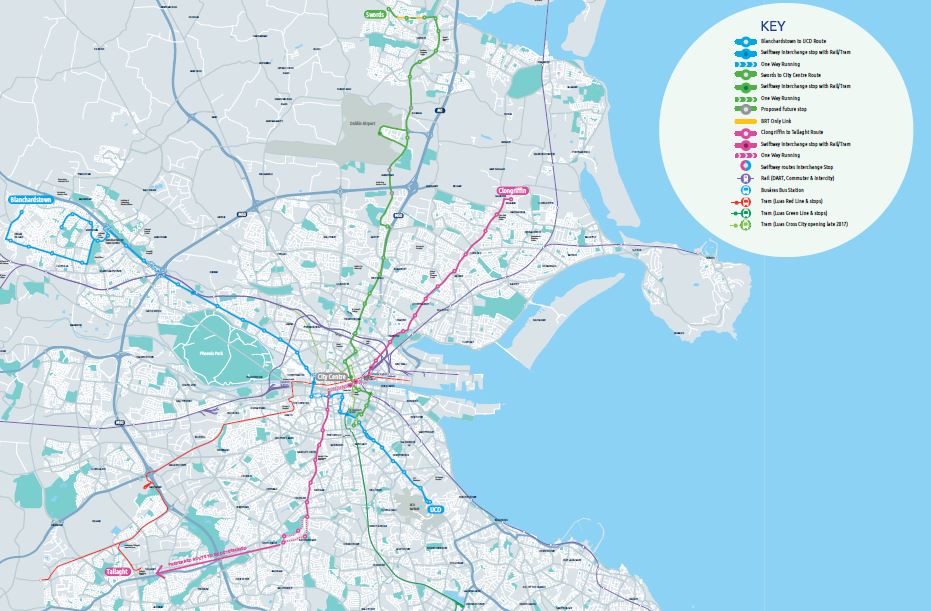
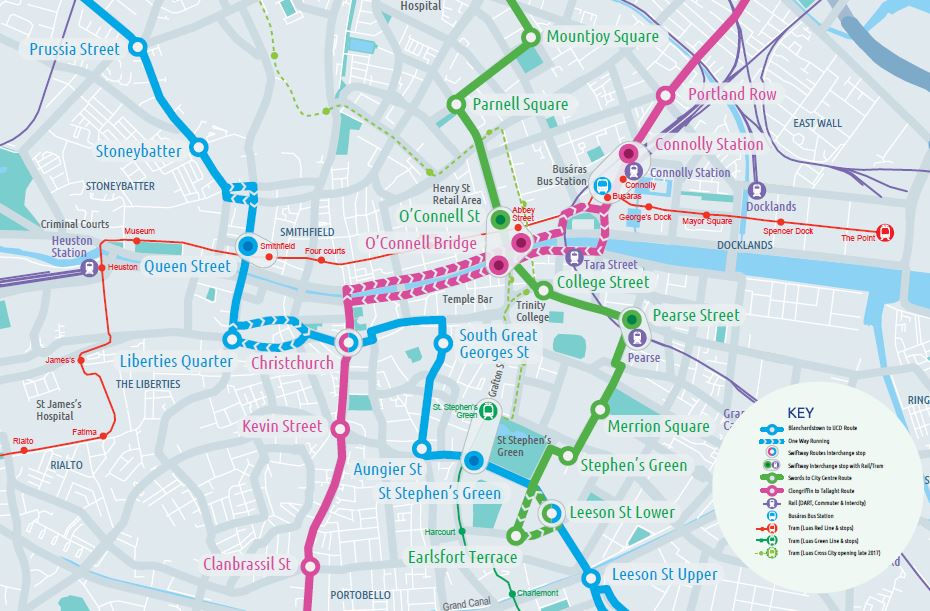
Swiftway - Bus Rapid Transit (BRT)

1246721

Comments

  • Registered Users, Registered Users 2 Posts: 426 ✭✭Jack Noble


    Here's what the NTA had to say about BRT in its Draft Integrated Implementation plan for Dublin 2013-2018.
    6.7.2 Analysis
    The Authority published areport in October 2012, “Bus Rapid Transit - Core
    Dublin Network”, setting out two cross city routes for development as BRT schemes.

    These are:
    Blanchardstown to N11 (UCD);
    and
    Clongriffin to Tallaght.

    The report recommended the progression of these two routes with further work being required to establish the exact routes and terminal points. In addition, that report also examined the potential for BRT to serve the Swords/ Airport to City Centre corridor. It identified that while BRT does not have sufficient capacity to serve this link over the longer term, it would provide
    an interim transport solution in the shorter term, pending the development of
    a higher capacity rail solution, such as a metro, on this corridor. It would complement any rail-based solution in the long term, and continue to perform strongly in terms of passenger usage. Further work carried out since the publication of that report has confirmed the feasibility and likely usage of a BRT from Swords/Airport to City Centre.

    http://www.nationaltransport.ie/wp-content/uploads/2011/12/Draft-Intergrated-Implemation-Plan-2013-2018.pdf

    Page 30

    When you examine the 2012 study Bus Rapid Transit - Core Dublin Network document from the NTA, it has this to say about demand on the Swords-Airport-City Centre line:
    The AM peak passenger loads on the Swords to Tallaght BRT service are given in Figure 37 and Figure 38.
    From Figure 37, it can be seen that demand in the Base Year AM peak will likely be strong in this direction, with a peak lineflow of approximately 3,500 passengers at Drumcondra. This far exceeds the capacity of a 15vph service and is also very close to the ultimate capacity of 3,600 ppdph. In the absence of Metro North, the 2030 Current Infrastructure scenario shows a peak
    lineflow of approximately 5,900 at St. Patricks College. This far exceeds the ultimate capacity of 3,600ppdph.
    The 2030 draft NTA Strategy scenario shows a lower level of demand for the service, which is due primarily to the presence of Metro North in this scenario. In this case the peak lineflow is approximately 4,000, again at St. Patricks College. This also exceeds the ultimate capacity of 3,600ppdph.

    In the opposite direction (Figure 38), all scenarios show a demand for BRT that will again exceed the service capacity of 15 vph and 20 vph. In both the Base Year and 2030 NTA Strategy scenarios the peak lineflow exceeds 3,000 ppdph at approximately 3,100ppdph and 3,300ppdph respectively but are below the ultimate capacity of the BRT system, while the 2030 Current Infrastructure scenario has a peak lineflow of approximately 4,200 at St. Stephen’s Green.
    It is on the northern section of this corridor – between Swords and the City Centre – that the high levels of demand arise. The southern section – Tallaght to City Centre – is within BRT capacity. This section of the corridor is common to the Clongriffin to Tallaght proposal which is dealt with in subsequent paragraphs. Overall, the link between the city centre and Swords
    has demand levels that exceed the capacity of a moderate capacity BRT system, in the longer term. While BRT may provide an interim partial transport solution in the shorter term, a higher capacity rail solution, such as a metro system, will ultimately be required on this corridor. In light of this, the Swords to City Centre BRT section has not been progressed to the later costing and appraisal sections of this feasibility study report.


    http://www.nationaltransport.ie/wp-content/uploads/2011/12/Bus-Rapid-Transit-Core-Network-Report.pdf

    Pages 53 and 54

    So, according to the NTA's own study in 2012, A Swords-City Centre BRT does not have the capacity to cope with peak demand from day one - and thus it was not progressed to more detailed study.

    The NTA also tells us that such a Swords-CC BRT would only be an 'interim' solution pending the construction in the longer-term of a higher capacity rail system, ie Metro North.

    Yet now the Irish Times tells us the NTA is going to proceed to planning with a BRT line it only two years ago deemed not capable of meeting demand.

    So why has something that did not meet projected demand and deemed not feasible to proceed to planning in 2012 suddenly become feasible in 2014?

    And why has the Irish Times failed to point out these rather important points?

    It took me a few minutes to find and read the relevant documents on the NTA website - could the IT reporter not have done the same?


  • Closed Accounts Posts: 299 ✭✭Copyerselveson


    Jack Noble wrote: »
    Here's what the NTA had to say about BRT in its Draft Integrated Implementation plan for Dublin 2013-2018.


    When you examine the 2012 study Bus Rapid Transit - Core Dublin Network document from the NTA, it has this to say about demand on the Swords-Airport-City Centre line:


    So, according to the NTA's own study in 2012, A Swords-City Centre BRT does not have the capacity to cope with peak demand from day one - and thus it was not progressed to more detailed study.

    The NTA also tells us that such a Swords-CC BRT would only be an 'interim' solution pending the construction in the longer-term of a higher capacity rail system, ie Metro North.

    Yet now the Irish Times tells us the NTA is going to proceed to planning with a BRT line it only two years ago deemed not capable of meeting demand.

    So why has something that did not meet projected demand and deemed not feasible to proceed to planning in 2012 suddenly become feasible in 2014?

    And why has the Irish Times failed to point out these rather important points?

    It took me a few minutes to find and read the relevant documents on the NTA website - could the IT reporter not have done the same?

    You would think so. Unless they are planning to have dedicated bus only streets in the city centre this is a very poor substitute for a rail based transport solution for Swords etc.


  • Registered Users, Registered Users 2 Posts: 426 ✭✭Jack Noble


    You would think so. Unless they are planning to have dedicated bus only streets in the city centre this is a very poor substitute for a rail based transport solution for Swords etc.


    The more I look at this, the more it appears to be the NTA delivering a political project to a political timetable and a political budget.

    It smacks of a short-term scheme so ministers can say 'Look - we're doing something' and also giving them a ribbon to cut on a shiny something - without any considerations for the medium to long-term.

    What I really can't get my head around is that in the DTO's Platform for Change study of 2000, a 'metro' was deemed necessary to serve the Sword-airport-city centre corridor because LRT/Luas did not have the capacity to serve the projected demand.

    In PFC, the population of the GDA in 2016 was estimated at 1.75 million. In the 2011 Census, the actual GDA population was 1.85m.

    But somehow, what required a metro in 2000 - the Sword-airport-CC-Tallaght route - can now be served by a BRT with one third the capacity.

    Can someone please explain this to me because it doesn't compute in my head.


  • Registered Users, Registered Users 2 Posts: 10,552 ✭✭✭✭cgcsb


    Jack Noble wrote: »
    The more I look at this, the more it appears to be the NTA delivering a political project to a political timetable and a political budget.

    It smacks of a short-term scheme so ministers can say 'Look - we're doing something' and also giving them a ribbon to cut on a shiny something - without any considerations for the medium to long-term.

    What I really can't get my head around is that in the DTO's Platform for Change study of 2000, a 'metro' was deemed necessary to serve the Sword-airport-city centre corridor because LRT/Luas did not have the capacity to serve the projected demand.

    In PFC, the population of the GDA in 2016 was estimated at 1.75 million. In the 2011 Census, the actual GDA population was 1.85m.

    But somehow, what required a metro in 2000 - the Sword-airport-CC-Tallaght route - can now be served by a BRT with one third the capacity.

    Can someone please explain this to me because it doesn't compute in my head.

    The nta still concludes that brt has insufficient capacity to serve swords, however it is proposed as an interim measure. In other words its political


  • Registered Users, Registered Users 2 Posts: 426 ✭✭Jack Noble


    cgcsb wrote: »
    The nta still concludes that brt has insufficient capacity to serve swords, however it is proposed as an interim measure. In other words its political

    Indeed. Thing is, Taoiseach Leo Varadkar in 2020 may end up cursing some of Minister for Transport Leo Varadkar's decisions of 2011-2014.

    The IT somehow missed out on that 'insufficient capacity' bit from the NTA's own studies.

    Are there no editors in Tara St capable of asking basic questions of reporters?

    Or was it deliberately ignored?


  • Advertisement
  • Closed Accounts Posts: 21,717 ✭✭✭✭Godge


    cgcsb wrote: »
    heres a basic

    This does not make any sense at all.

    It essentially is the same as getting the train from Clonsilla/Coolmine/Castleknock to Broombridge, switching to the Luas and going to St. Stephen's Green.

    If the bus is faster, why are we building the Luas as far as Broombridge?


  • Registered Users, Registered Users 2 Posts: 1,008 ✭✭✭MrDerp


    cgcsb wrote: »
    The nta still concludes that brt has insufficient capacity to serve swords, however it is proposed as an interim measure. In other words its political

    The thing is though, it might still represent a reasonable medium term strategy, even if it is of insufficient capacity from day one.

    Take an example of Vancouver

    http://en.wikipedia.org/wiki/File:Vancouver_SkyTrain_Map.svg

    I lived in Vancouver during 2004, before the Canada Line was built. There was a similar system called the B-Line which ran along Broadway, right from UBC in the extreme West suburbs over into East Vancouver and beyond. In between, it connected with the Skytrain at Commercial drive.

    It was jammers. No matter what time of the day you got on it, it was jammed for most of the journey. But that never stopped people using it.

    Now, it connected, in turn with another similar high-frequency, fewer stops, bus line running south to Richmond, which in turn connected with a high frequency shuttle running west from the area roughly around Bridgeport on the above map to YVR airport.

    Sure, everyone bemoaned the lack of a skytrain to the airport, but everyone heavily used the bus corridors to get there. The bendy buses servicing the airport (not the B-line) were very frequent and had extra room given over to standing and luggage.

    It was under capacity for the demand for airport transfers, but that doesn't mean it was a bad idea. Then, a full 24 years after the Expo line opened, there was finally a sky train to YVR.

    I know Vancouver is a very different animal, with its grids and what have you, but the principles remain the same. Prioritize buses and get out and enforce it.

    Most people hate a buses, but a good service can work well. You just need smart transfer points, with adequate shelter. Anyone who's been inbound on the red line Luas as it pulls up to Heuston station in the morning will tell you - there's more than enough people who are willing to use a crowded service.

    It's the least desirable solution but to be honest its the best we're likely to get in the next few years, as an interim solution.


  • Registered Users, Registered Users 2 Posts: 10,552 ✭✭✭✭cgcsb


    Jack Noble wrote: »
    Indeed. Thing is, Taoiseach Leo Varadkar in 2020 may end up cursing some of Minister for Transport Leo Varadkar's decisions of 2011-2014.

    The IT somehow missed out on that 'insufficient capacity' bit from the NTA's own studies.

    Are there no editors in Tara St capable of asking basic questions of reporters?

    Or was it deliberately ignored?

    of that I am unsure but it seems dishonest of the times to present brt as something that is almost the same as metro at a fraction of the cost while ignoring the massive capacity gap between the two. The article only compares the two on journey time. I might add that a 35 min journey time will not be possible, considering the bottle neck in santry. I suspect most Joe publics might now see brt as some sort of viable alternative to metro.


  • Registered Users, Registered Users 2 Posts: 10,552 ✭✭✭✭cgcsb


    Godge wrote: »
    This does not make any sense at all.

    It essentially is the same as getting the train from Clonsilla/Coolmine/Castleknock to Broombridge, switching to the Luas and going to St. Stephen's Green.

    If the bus is faster, why are we building the Luas as far as Broombridge?

    the bus will be slower, the old cabra road section can take 15 mins to complete in rush hour


  • Registered Users, Registered Users 2 Posts: 426 ✭✭Jack Noble


    cgcsb wrote: »
    of that I am unsure but it seems dishonest of the times to present brt as something that is almost the same as metro at a fraction of the cost while ignoring the massive capacity gap between the two. The article only compares the two on journey time. I might add that a 35 min journey time will not be possible, considering the. Bottle neck in santry. I suspect most Joe publics might now see brt as some sort of viable alternative to metro.

    There is an anti-metro agenda in the IT and anything that contradicts or undermines that agenda simply does not get reported.

    'Dishonest' doesn't cover it at this stage.


  • Advertisement
  • Registered Users, Registered Users 2 Posts: 426 ✭✭Jack Noble


    Going through the NTA's own documents, I'm struck by the fact its cites BRT examples in Nantes and Rouen in France, and Swansea and Cambridge in the UK - all cities with smaller areas, populations and densities to Dublin. In fact, they are more comparable to Belfast in the French cases and Cork for the UK examples.

    Dublin needs to be compared to capital cities like Stockholm, Copenhagen, Helsinki, Oslo, Amsterdam, Brussels, Munich* and Vienna - not second and third tier provincial cities in France and the UK.

    Dublin's existing and future public transport needs are on a par with these major cities.

    *I include Munich as a 'capital' in the context that it is the capital is Bavaria - which has a greater population than each of the countries of which the other cities are capitals, bar The Netherlands.


  • Closed Accounts Posts: 299 ✭✭Copyerselveson


    Jack Noble wrote: »
    There is an anti-metro agenda in the IT and anything that contradicts or undermines that agenda simply does not get reported.

    'Dishonest' doesn't cover it at this stage.

    There is in my opinion an anti-rail agenda in the Irish Times - it's as if all those anti-rail lectures in the seventies from various well known economic "experts" have been digested and regurgitated.

    Try writing two letters to the IT on transport matters. The first letter should be to urge an integrated transport policy and provide sufficient public transport infrastructure across the whole state to allow economic and social development. The second letter should be to urge the nation to tighten its belt but build more motorways and shut the rail network.

    I guarantee only the second letter will be published.


  • Registered Users, Registered Users 2, Paid Member Posts: 19,633 ✭✭✭✭LXFlyer


    Until we see the detailed plans, it's impossible to judge this proposal. Anything else at this stage is conjecture, and I'm prepared to withhold judgement until we actually see what is proposed - that will happen in two weeks time.


  • Registered Users, Registered Users 2 Posts: 4,749 ✭✭✭irishmover


    cgcsb wrote: »
    the bus will be slower, the old cabra road section can take 15 mins to complete in rush hour

    The bus will definitely be going that route? The idea of a busway is that it will mostly be on a route only built for buses so won't have traffic issues.


  • Registered Users, Registered Users 2 Posts: 10,552 ✭✭✭✭cgcsb


    irishmover wrote: »
    The bus will definitely be going that route? The idea of a busway is that it will mostly be on a route only built for buses so won't have traffic issues.

    well the route outlined in the NTA report on BRT shows it going down old cabra road. The entire route has a price tag of 250mil, according to the times, so we can forget tunnelled sections. the only other way to separate it from private traffic is to ban cars from old cabra road, which is politically impossible as is elevated sections. Consequently the only remaining option is shared running with private cars, which means 15 minute jams as with the current 39 routes.

    So essentially we are paying 250mil, and the only improvement will be reduced dwell times due to pre purchase tickets only, and an increased frequency. The bus will also be sharing road space at Church street which is a bottle neck and can add 5 to 10 mins in peak times on top of that.

    I would be all ears to see if there's a solution to these issues, but on the face of it, the Blanchardstown route looks weak, in terms of route viability. Still no movement on rail feeder systems in suburban Dublin.


  • Registered Users, Registered Users 2 Posts: 13,511 ✭✭✭✭expectationlost


    how much of the route has to be bus only to qualify for it to be BRT


  • Registered Users, Registered Users 2 Posts: 13,511 ✭✭✭✭expectationlost


    lxflyer wrote: »
    Until we see the detailed plans, it's impossible to judge this proposal. Anything else at this stage is conjecture, and I'm prepared to withhold judgement until we actually see what is proposed - that will happen in two weeks time.

    doesn't stop local politicians

    Tom OLeary ‏@tomolearycllr Jan 27 https://twitter.com/tomolearycllr/status/427856993970561024

    Nta have just announced BRT a Bus Rapid Transport system from Swords to Aiport and City Centre . NTA firmly said METRO NTH stll required


  • Registered Users, Registered Users 2 Posts: 1,096 ✭✭✭xper


    Irish Times:"A “BRT only” lane may not be feasible in the city centre,but could be incorporated on major roads on the outer sections of the routes."
    Oh ... dear ... god!
    Jack Noble wrote: »
    ...And why has the Irish Times failed to point out these rather important points?

    It took me a few minutes to find and read the relevant documents on the NTA website - could the IT reporter not have done the same?
    It wouldn't be because employees of revenue starved papers like the IT are more likey these days to have just enough time to cut and paste a press release or transcribe briefing notes into that glaringly empty column than even google some basic facts? I think they can only dream of maintaining any sort of agenda on a topic ... unless it affects their bottom line ... *cough* ...property...*cough*
    MrDerp wrote: »
    The thing is though, it might still represent a reasonable medium term strategy, even if it is of insufficient capacity from day one.
    Opportunity cost, for one reason. Money, planning and design resources and expertise, political wrangling, construction disruption that will have to be spent/endured again for Metro North which will still be required but delayed by such an interim solution ( of insufficient capacity).

    By all means proceed with proper, full BRT on the other proposed routes but leave the MN corridor for Metro North. The interim solution there should be to ensure the existing bus services for the MN corridor are properly run and resourced, which won't cost a nine-figure amount.


    Ok, I'm going to offer another conspiracy theory , just for the craic, like:
    The boys in the NTA have cast their minds back to the 90's when Luas was being kicked around and, with funding being a bit of an issue for that project too at the time, the idea of developing the green line as a "busway" first and later being upgraded to light rail was suggested. This had the effect of keeping the project moving ahead, other political shenanigans notwithstanding, until it came to the time of actually making decisions and spending cash and at that stage the game changed back to building a tram straightaway with the argument that it would be more cost effective to go straight for the desired end product. The fact that stamp duty tiger revenue was beginning to make funding more realistic helped, of course. Maybe they're trying a repeat performance with Swords BRT/ MN?

    .... No, I'm not convinced either.


  • Registered Users, Registered Users 2 Posts: 4,749 ✭✭✭irishmover


    So basically it's not a BRT then.


  • Moderators, Motoring & Transport Moderators, Technology & Internet Moderators Posts: 24,122 Mod ✭✭✭✭bk


    cgcsb wrote: »
    The entire route has a price tag of 250mil, according to the times, so we can forget tunnelled sections.

    I wonder if cut and cover would be possible?

    Wouldn't need to be anything too fancy or expensive. If they were able to do it in London 100 years ago for the tube, I don't see why we can't do it today.


  • Advertisement
  • Registered Users, Registered Users 2 Posts: 502 ✭✭✭Pixel Eater


    I actually think this a welcome development; Rapid Bus Transit is a well proven transport mode that takes the flexibility of a bus but greatly increase the capacity but far easier and cheaper to implement than a light rail or metro system. It is an excellent and very feasible transport mode for a city like Dublin.

    However that is not the issue here. The National Transport Authority actually rejected the Swords route several years ago on the grounds of capacity. Although this system can significantly increases the amount of people it carries compared to a bus it still cannot deliver the same capacity as a light rail system, such as the Luas. It comes no where near the capacity of a heavy rail system however; only about a third or even a quarter the amount.

    It seems strange than that the NTA would all off a sudden come out and push a route they themselves rejected. It seems to me that it's a cheap alternative to building the Metro North.


  • Registered Users, Registered Users 2 Posts: 4,905 ✭✭✭Aard


    I'd take nothing thejournal.ie says as gospel, but they have published two maps of the indicative routes:

    routes-2.jpg

    cent.jpg


  • Registered Users, Registered Users 2 Posts: 13,511 ✭✭✭✭expectationlost


  • Registered Users, Registered Users 2 Posts: 10,552 ✭✭✭✭cgcsb


    bk wrote: »
    I wonder if cut and cover would be possible?

    Wouldn't need to be anything too fancy or expensive. If they were able to do it in London 100 years ago for the tube, I don't see why we can't do it today.

    cost, I dont think the 200 mil budget would allow cut an cover for a km or more


  • Registered Users, Registered Users 2 Posts: 10,552 ✭✭✭✭cgcsb


    For the Tallaght-City Centre commute could the proposed route beat luas in terms of journey time?


  • Registered Users, Registered Users 2 Posts: 10,552 ✭✭✭✭cgcsb


  • Registered Users, Registered Users 2 Posts: 997 ✭✭✭Colm R


    Given some of proposed streets simply do not have the space for two lanes of traffic, and a separate BRT in each direction, I'm thinking a considerable amount of this will have a single lane of segregated bus way. This would probably be in the center of the road and would reverse flow in the middle of the day.

    Given the space restraints, I think thats the best we could hope for, and may actually work quite well.

    Take the Navan Road for example. Bueses make considerably better progress inbound in the mornings than the do outbound in the evenings.


  • Registered Users, Registered Users 2 Posts: 26 Steve Allen


    Looking at the journal.ie overall map, the Swords/Airport line appears to be running via Santry and not Ballymun/DCU as the Metro would.

    It also highlights the big gap between the N3/Maynooth line and the proposed BRT on the N1. There's a couple of 'spokes' missing in the wheel there. But that's for another thread.


  • Registered Users, Registered Users 2 Posts: 426 ✭✭Jack Noble


    Looking at the journal.ie overall map, the Swords/Airport line appears to be running via Santry and not Ballymun/DCU as the Metro would.

    It also highlights the big gap between the N3/Maynooth line and the proposed BRT on the N1. There's a couple of 'spokes' missing in the wheel there. But that's for another thread.

    The NTA does not see this as an 'alternative' to Metro North, as reported by the Irish Times and then copied by The Journal and The Herald.

    In fact, until the appearance of this IT report yesterday, the NTA didn't even see a Swords-airport-city centre BRT as feasible because its own studies suggested peak demand would exceed capacity from the day it opened.

    So why it's suddenly become feasible and about to go to public consultation and planning is a bit of a mystery.

    Actually, it's not - it's to give Leo (or his successor) a few photo opportunities and a bit of PR that the government is doing 'something' ahead of the next general election.

    It will be interesting to see what the NTA is putting out to public consultation on February 17 - and what the likes of Dublin City Council, Fingal County Council and the new Transport Infrastructure Service (merged NRA/RPA) have to say about it.


  • Advertisement
  • Registered Users, Registered Users 2, Paid Member Posts: 19,633 ✭✭✭✭LXFlyer


    Jack Noble wrote: »
    The NTA does not see this as an 'alternative' to Metro North, as reported by the Irish Times and then copied by The Journal and The Herald.

    In fact, until the appearance of this IT report yesterday, the NTA didn't even see a Swords-airport-city centre BRT as feasible because its own studies suggested peak demand would exceed capacity from the day it opened.

    So why it's suddenly become feasible and about to go to public consultation and planning is a bit of a mystery.

    Actually, it's not - it's to give Leo (or his successor) a few photo opportunities and a bit of PR that the government is doing 'something' ahead of the next general election.

    It will be interesting to see what the NTA is putting out to public consultation on February 17 - and what the likes of Dublin City Council, Fingal County Council and the new Transport Infrastructure Service (merged NRA/RPA) have to say about it.

    To be fair to the NTA - they did indicate last year in their Integrated Implementation Plan 2013 - 2018 that the Swords corridor would be re-examined for BRT. It's not quite something that has suddenly changed.

    6.7.2 Analysis

    The Authority published a report in October 2012, "Bus Rapid Transit - Core Dublin Network", setting out two cross city routes for development as BRT schemes.

    These are:

    Blanchardstown to N11 (UCD); and

    Clongriffin to Tallaght.

    The report recommended the progression of these two routes with further work being required to establish the exact routes and terminal points.

    In addition, that report also examined the potential for BRT to serve the Swords / Airport to City Centre corridor. It identified that while BRT does not have sufficient capacity to serve this link over the longer term, it would provide an interim transport solution in the shorter term, pending the development of a higher capacity rail solution, such as a metro, on this corridor. It would complement any rail based solution in the long term, and continue to perform strongly in terms of passenger usage. Further work carried out since the publication of that report has confirmed the feasibility and likely usage of a BRT from Swords / Airport to City Centre.

    6.7.3 Proposals

    It is proposed to progress the development of three BRT routes as part of
    this Plan. These are:

    Swords / Airport to City Centre;

    Blanchardstown to N11 (UCD); and

    Clongriffin to Tallaght.

    It is envisaged that planning consent will be achieved for each of these projects in the early years of the Plan.

    Subsequent implementation of these schemes will be progressed on an incremental basis in accordance with available funding.


This discussion has been closed.
Advertisement
Advertisement