Advertisement
Help Keep Boards Alive. Support us by going ad free today. See here: https://subscriptions.boards.ie/.
https://www.boards.ie/group/1878-subscribers-forum

Private Group for paid up members of Boards.ie. Join the club.
Hi all, please see this major site announcement: https://www.boards.ie/discussion/2058427594/boards-ie-2026

Why are the British so anti Europe?

1202123252658

Comments

  • Registered Users, Registered Users 2 Posts: 2,398 ✭✭✭McDave


    In fairness, saying “the old EUSSR canard” isn’t an argument.
    Certainly the characterisation of the EU as the EUSSR or a Marxist nomenklatura (as Bernard Connolly does) is not an argument. Yet many on the anti-EU side use that characterisation as a matter of course. And as a rallying call for Eurosceptics. As they are entitled to do. But by the same token, EU advocates are entitled to draw inferences from such characterisations.


  • Registered Users, Registered Users 2 Posts: 2,398 ✭✭✭McDave


    It would be an interesting argument to make that the Euro has had no hand or part in the current predicament of Greece and I look forward to you making that argument.
    You're more than welcome to make that argument yourself. But in the process, please be honest enough to take into consideration Greece's legion failings as a sovereign entity, maybe outlining what Greece should have done in recent decades to improve its governance and provide for its people. Maybe at that point you might be better placed to offer some perspective on the role of the Euro in Greece's long and slow decline relative to most of its neighbours.


  • Registered Users, Registered Users 2 Posts: 2,398 ✭✭✭McDave


    The FT has an interesting article on the UK’s possible exit from the EU and concluded that, on balance, the UK would be better off economically as a result of leaving the EU.
    The FT has lots of interesting articles. But in the end it's an organ of the City. And the City is under direct threat from the Euro.


  • Site Banned Posts: 64 ✭✭thomas.frink


    McDave wrote: »
    In fairness, no-one is expecting my post is directed solely at you. There are others reading these posts. I'm communicating to others my doubts on your Love Europe, Hate the EU line. That line crops up with predictable regularity on this and other fora. And in the main it's code for Euroscepticism of various hues. We got it here with Ganley and Libertas, and we also get it from UKIP types attempting to stir it up in Ireland. I never bought Ganley's federal Europe posturing. And in the end he had nothing to sell other than anti-EU obstructionism. Similarly, I don't buy UKIP's nasty, destructive populism.

    I'll make my own mind up on you in due course, as you are welcome to do about me. But in light of the absence of a constructive working alternative to the EU, I'm afraid I'm not going to buy at face value the bona fides of critics of the EU who snipe from the sidelines without offering competing visions on how to help Europe overcome its differences and make its way in the global economy.

    This is probably where we disagree. I have no need to make up my mind about you, and am only concerned about your arguments and have no wish to become embroiled in personalities.

    While I have stated my views on Europe, my personal views are not in any way important to a discussion about Britain and the EU. If you choose to disbelieve that I love the EU, that’s a matter for you, and in any case I am not sure what you want me to do about it. Entering some pantomime along the “oh yes I do” … “oh no you don’t” lines seems inappropriate, pointless and, in the context of the thread, irrelevant.

    This is a discussion about Britain and the EU, and what matters to me are the arguments and discussions, and not the personalities. It’s a shame you cant make up your mind on the basis of the arguments, rather than making up your mind on personalities, but that’s your choice.
    McDave wrote: »
    I never said the EU was perfect or path on the way to nirvana. So what's your net point here? If you have any.

    Let’s agree that neither of us said the EU was perfect or path to nirvana.

    This is a discussion and has many points, and not just one. If you want know everyone’s points, then you’ll have to read their posts.


  • Registered Users, Registered Users 2 Posts: 454 ✭✭KindOfIrish


    As the EU changes and pushes for further integration, it is more and more likely the UK will vote to leave the EU, which in itself poses an interesting question for Ireland as to what Ireland's response is going to be.
    If UK will vote to leave the EU, Ireland will benefit hugely as thousands of UK companies, dependent on EU trade, will move here. Also European business who trade with UK will set up headquarters in Ireland, as we definitely will have some kind of special trading agreements with UK. Tens of thousands new jobs. Our unemployment crisis will be solved in a matter of months!


  • Advertisement
  • Registered Users, Registered Users 2 Posts: 2,398 ✭✭✭McDave


    It seems the argument has moved on from why Britain is so anti EU, to why others have such an apparently irrational preference to cling on to what looks like an out of date, largely non-working and disastrous EU.

    The debate in the UK has moved on from the rhetoric about “better in than out” and “we’d lose more by being out than in”. Facts are so much better than rhetoric and the facts seem to show that the UK would be better off outside the current EU, and saving the UK over £5billion per annum in fees, as a start. As the EU exports more to the UK than the UK exports to the EU, there is no reason to suppose the EU will want to cut off its nose to spite its face and impose tariffs, (even if that were possible as most trade agreements are now made through the offices of the WTO). Those Germans will not want to stop selling Mercedes, BMW’s and Volkswagens to the UK.

    What will happen Ireland when the UK votes to leave the EU (as I believe it will) is a question not yet answered.

    While I love Europe and the countries of Europe, I see now the EU as an organisation which is detrimental to the Europe I love; wasteful, not accountable (think of all those budgets where our money is not accounted for and can’t be signed off) and unwieldy.

    Worse still it is arrogant, and when the UK, and others, warned that the creation of the Euro would lead to disaster, the arrogance of the EU in putting its political desires above common sense has largely led to the current situation. The story is the modern day equivalent of the tower of Babel.

    What is obvious is that the EU has no ability to reform itself, no ability to account for its reckless handling of our money, and seems to have no ability to do other than follow events it has started, unable to control them and unable, even, to accept any responsibility.

    The best thing that can happen to the EU is for other countries, like the UK, to leave, and to start a new organisation which is accountable, controllable, and answerable to the people of Europe, and for the current day EU to implode into itself, as the damage it has inflicted across the continent is heart wrenching, and the lack of accountability disgusting.
    This is your first post. Combining diatribe with insults of those who support the EU. It's clear to me that you're an UKIP style shill. From the get go, it's pretty obvious that you're not really interested in discussion. So please spare me the faux outrage about 'personalisation'. If you live by the sword...


  • Site Banned Posts: 64 ✭✭thomas.frink


    If UK will vote to leave the EU, Ireland will benefit hugely as thousands of UK companies, dependent on EU trade, will move here. Also European business who trade with UK will set up headquarters in Ireland, as we definitely will have some kind of special trading agreements with UK. Tens of thousands new jobs. Our unemployment crisis will be solved in a matter of months!

    You seem to be assuming that if the UK leaves the EU that all trade between the two will cease? I can't say I remember any companies leaving Switzerland or Norway, who are not members of the EU and who seem to trade perfectly normally with other countries in the EU.

    Why do you think these thousands of companies who are dependant on the EU will not be able to continue trading with other EU countries if the UK is no longer a member of the EU?

    Do you think it will work the other way and where might all those thousands of companies in the EU who trade in reverse with the UK will also have to move to Ireland? Or another country?

    Do you think the WTO rules on trade, to which the EU is a signatory, will be abandoned and breached to prevent these thousands of UK based companies from trading with other EU companies?


  • Registered Users, Registered Users 2 Posts: 1,169 ✭✭✭dlouth15


    If UK will vote to leave the EU, Ireland will benefit hugely as thousands of UK companies, dependent on EU trade, will move here. Also European business who trade with UK will set up headquarters in Ireland, as we definitely will have some kind of special trading agreements with UK.
    Should Britain decide to leave without such assurances of favourable trade with the EU generally, Ireland as a member of the EU would be unable to maintain favourable terms with Britain as it would have to play by the rules of other EU countries.
    Tens of thousands new jobs. Our unemployment crisis will be solved in a matter of months!
    I think you may be being a little overoptimistic here about benefits to Ireland. Remember that the UK is unlikely to leave without assurances that it can remain in the EEA or EFTA or at least establish good trading terms with the EU. Britain in the EFTA might even be more attractive to foreign multinationals than the present full EU membership.


  • Registered Users, Registered Users 2 Posts: 23,283 ✭✭✭✭Scofflaw


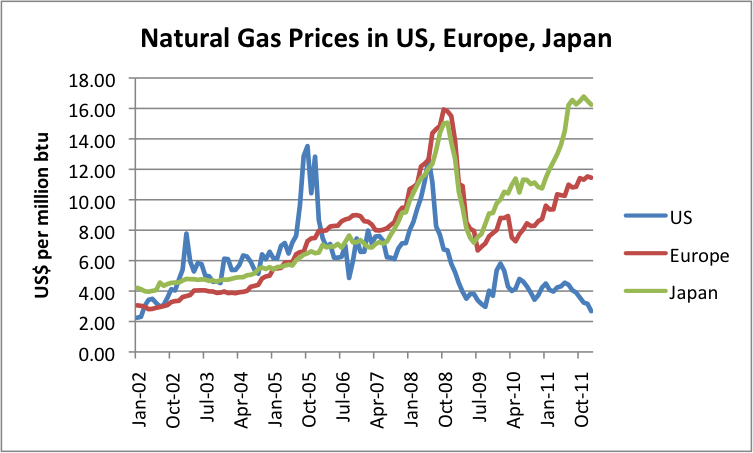
    Unfortunately, though, the difference in price has, according to analysts, nothing to do with "EU energy policy" as you claimed:
    There are several reasons why US natural gas prices are so low:

    Our pricing system is based on short-term supply and demand, and storage facilities are limited. It is very easy for supply to overwhelm the system, and prices to drop very low in response, if there is a mismatch.

    US demand for natural gas has been fairly flat for the last 10 years, regardless of price. Of the four major uses for natural gas ((1)residential heating, hot water, and cooking; (2)commercial heating, hot water, and cooking; (3) industrial demand; and (4) electricity), only electrical use has been growing.

    Supply does not drop very quickly, even if prices fall, because producers need to continue to extract natural gas in order to repay loans and to comply with use-it-or-lose-it lease terms.

    Nor is it a long-term feature, something your chosen graph misses out:

    natural-gas-prices-in-us-europe-japan.png

    I would therefore have to regard your claim as unsupported or even contradicted, and possibly specious.

    cordially,
    Scofflaw


  • Registered Users, Registered Users 2 Posts: 23,283 ✭✭✭✭Scofflaw


    dlouth15 wrote: »
    Should Britain decide to leave without such assurances of favourable trade with the EU generally, Ireland as a member of the EU would be unable to maintain favourable terms with Britain as it would have to play by the rules of other EU countries.

    True enough.
    dlouth15 wrote: »
    I think you may be being a little overoptimistic here about benefits to Ireland. Remember that the UK is unlikely to leave without assurances that it can remain in the EEA or EFTA or at least establish good trading terms with the EU. Britain in the EFTA might even be more attractive to foreign multinationals than the present full EU membership.

    How so? EFTA get access to the EU single market by complying with the single market rules, and otherwise face trade tariffs. If a company set up in an EFTA UK to access the EU single market, it would be in the same position as setting up in an EU country - and if it set up there to access non-EU markets, it would be in the same position as at present in compliance terms, and most probably a worse position as regards trade terms, because as far as I know it wouldn't benefit from EU free trade agreements with those third countries, and would be subject to whatever terms a separate UK could negotiate.

    I appreciate that there's a widespread belief that the UK would negotiate better terms of trade outside the EU, because those terms of trade "would pay more attention" to the UK's particular trade needs - but even leaving aside whether there's any truth in that at all, there is from a company's particular perspective not much that's better than a full free trade arrangement as per the EU's current agreements.

    cordially,
    Scofflaw


  • Advertisement
  • Registered Users, Registered Users 2 Posts: 1,169 ✭✭✭dlouth15


    Scofflaw wrote: »
    How so? EFTA get access to the EU single market by complying with the single market rules, and otherwise face trade tariffs. If a company set up in an EFTA UK to access the EU single market, it would be in the same position as setting up in an EU country - and if it set up there to access non-EU markets, it would be in the same position as at present in compliance terms, and most probably a worse position as regards trade terms, because as far as I know it wouldn't benefit from EU free trade agreements with those third countries, and would be subject to whatever terms a separate UK could negotiate.

    I appreciate that there's a widespread belief that the UK would negotiate better terms of trade outside the EU, because those terms of trade "would pay more attention" to the UK's particular trade needs - but even leaving aside whether there's any truth in that at all, there is from a company's particular perspective not much that's better than a full free trade arrangement as per the EU's current agreements.
    Two arguments are being made here.

    1. Companies setting up in Britain in the EFTA would have the same benefits but also suffer the same regulations when selling into the EU.

    The important point is that leaving the EU does not mean losing access to EU markets as some posters here have suggested. They retain full tariff-free access to the entire EU/EEA/EFTA zone.

    Furthermore although they are need to comply with EU regulations for products, these regulations are largely technical. There are far fewer of them than full EU members need to adopt.

    EFTA membership would also allow certain industries to operate in ways that might not be approved in the future by the EU. I'm thinking here of banking and finance mainly.

    A final remark on this is that having to comply with regulations when selling into a market is not particularly unusual. A company in any country selling to the US, for example, must comply with whatever regulations they have for that product.

    2. The second argument is that bi-lateral trade agreements made by Britain to favour the specific needs of British industry may not be that much better than the benefits of EU trade agreements with non-EU countries and trading blocs.

    This is a more interesting question, imo. It depends on the degree to which British interests are aligned with those of the EU in general. I think there would be an advantage to Britain being allowed to negotiate bilaterally with the rest of the world while still maintaining free trade with the EU. When the EU negotiates it must take into account a myriad of conflicting interests from the various member states and this is likely to see negotiations getting bogged down. Britain as a single country can avoid these complications and conclude negotiations more efficiently. I could see, for example, trade relations established very quickly with Commonwealth countries for example.

    I think the best situation for Ireland would be for Britain to leave the EU but join the EFTA. We keep our free trade with Britain and Britain then trades with the rest of the world so we indirectly benefit from that trade.


  • Registered Users, Registered Users 2 Posts: 721 ✭✭✭MarkK


    dlouth15 wrote: »
    The important point is that leaving the EU does not mean losing access to EU markets as some posters here have suggested. They retain full tariff-free access to the entire EU/EEA/EFTA zone.
    It is tariff free but the UK would be outside the EU customs wall which means more red tape for exporters and importers.
    dlouth15 wrote: »
    Furthermore although they are need to comply with EU regulations for products, these regulations are largely technical. There are far fewer of them than full EU members need to adopt.
    EU Regulations are 'largely technical' anyway.
    Swallowing EU regulations whole may be ok for smallish countries like Switzerland and Norway, who would have little sway in negotiations within the EU anyway, but for a country as large as the UK to have their laws decided outside their control is untenable in my opinion.
    dlouth15 wrote: »
    A final remark on this is that having to comply with regulations when selling into a market is not particularly unusual. A company in any country selling to the US, for example, must comply with whatever regulations they have for that product.
    True but I don't think Single Market regulations would just apply to to UK companies selling into the EU. They would also apply to UK companies which only sell in the UK.


  • Registered Users, Registered Users 2 Posts: 23,283 ✭✭✭✭Scofflaw


    dlouth15 wrote: »
    Two arguments are being made here.

    1. Companies setting up in Britain in the EFTA would have the same benefits but also suffer the same regulations when selling into the EU.

    The important point is that leaving the EU does not mean losing access to EU markets as some posters here have suggested. They retain full tariff-free access to the entire EU/EEA/EFTA zone.

    Furthermore although they are need to comply with EU regulations for products, these regulations are largely technical. There are far fewer of them than full EU members need to adopt.

    EFTA membership would also allow certain industries to operate in ways that might not be approved in the future by the EU. I'm thinking here of banking and finance mainly.

    A final remark on this is that having to comply with regulations when selling into a market is not particularly unusual. A company in any country selling to the US, for example, must comply with whatever regulations they have for that product.

    I think that contains an erroneous assumption that the single market regulations would only be required in an EFTA/EEA UK by those companies that wanted to sell into the single market - and I appreciate my own post doesn't clarify that - but that's not the case. The country adopts the legislation in question, not individual companies. That is, the UK would have adopt all the single market legislation, and it would apply across the board. Theoretically you might get an exemption for a specific industry, but I can't see "banking and finance" being exempt in such a way, since it has large collateral effects on all other industries.


    As MarkK says, the vast majority of EU regulations are "technical" - it's first and foremost a trade/customs union rather than anything else, but the way the EU makes legislation doesn't necessarily discriminate between legislation with a single market purpose and without, and the way the EEA have to adopt legislation is that if the EU thinks some part of a piece of legislation may affect the single market, the EEA have to adopt it. Technically, an EEA country doesn't have to adopt EU legislation the EU thinks is relevant - practically, no EEA country has ever exercised that right. So the UK wouldn't get away from, say, the Working Time Directive through EEA/EFTA membership, because failure to implement such a directive would result in the suspension of single market access.

    Where the UK would be able to opt out - and for many this is, I think, the driver for opting out - is areas like justice, but the claim that the UK would benefit from EEA arrangements in terms of industry and commerce seems to me to be an ancillary argument designed to hide the likely costs of EU exit. If EEA/EFTA membership were genuinely that attractive on purely economic grounds, the UK wouldn't have given it up in the first place.
    dlouth15 wrote: »
    2. The second argument is that bi-lateral trade agreements made by Britain to favour the specific needs of British industry may not be that much better than the benefits of EU trade agreements with non-EU countries and trading blocs.

    This is a more interesting question, imo. It depends on the degree to which British interests are aligned with those of the EU in general. I think there would be an advantage to Britain being allowed to negotiate bilaterally with the rest of the world while still maintaining free trade with the EU. When the EU negotiates it must take into account a myriad of conflicting interests from the various member states and this is likely to see negotiations getting bogged down. Britain as a single country can avoid these complications and conclude negotiations more efficiently. I could see, for example, trade relations established very quickly with Commonwealth countries for example.

    The EU has already spent a long time getting trade deals in place, the UK would be starting from scratch again. And what complicated trade deals these days is not multilateral haggling in the EU - the Commission negotiates such deals, for the whole EU - but primarily WTO agreements, which will still apply to the UK.
    dlouth15 wrote: »
    I think the best situation for Ireland would be for Britain to leave the EU but join the EFTA. We keep our free trade with Britain and Britain then trades with the rest of the world so we indirectly benefit from that trade.

    There's no reason for the EU to accept an EFTA arrangement with the UK, though. The current bilateral EFTA-EU deal with Switzerland is seen as something to be eliminated, not replicated.

    There's a lot of wishful thinking happening in the debate, which seems to me to be a bad basis on which to make an important decision.

    cordially,
    Scofflaw


  • Registered Users, Registered Users 2 Posts: 1,169 ✭✭✭dlouth15


    Scofflaw wrote: »
    I think that contains an erroneous assumption that the single market regulations would only be required in an EFTA/EEA UK by those companies that wanted to sell into the single market - and I appreciate my own post doesn't clarify that - but that's not the case. The country adopts the legislation in question, not individual companies. That is, the UK would have adopt all the single market legislation, and it would apply across the board. Theoretically you might get an exemption for a specific industry, but I can't see "banking and finance" being exempt in such a way, since it has large collateral effects on all other industries.
    But note that I have been restricting my argument so far to the EFTA not the EEA. Switzerland, for example, is a member of the EFTA but not the EEA. Switzerland's free trade with the EU is the result of bilateral negotiation. They have not, as far as I'm aware, agreed to transpose EU directives into national legislation on an ongoing basis. This arrangement, in my opinion, is what the UK should seek.
    As MarkK says, the vast majority of EU regulations are "technical" - it's first and foremost a trade/customs union rather than anything else, but the way the EU makes legislation doesn't necessarily discriminate between legislation with a single market purpose and without, and the way the EEA have to adopt legislation is that if the EU thinks some part of a piece of legislation may affect the single market, the EEA have to adopt it. Technically, an EEA country doesn't have to adopt EU legislation the EU thinks is relevant - practically, no EEA country has ever exercised that right. So the UK wouldn't get away from, say, the Working Time Directive through EEA/EFTA membership, because failure to implement such a directive would result in the suspension of single market access.
    However even the EEA the number of directives required to be transposed is far fewer. The figures I've seen say that Norway has had to transpose 5000 directives since 1982 whereas the EU country transposes 3000 each year. Again however, we are talking about the EFTA and not the EEA here.
    Where the UK would be able to opt out - and for many this is, I think, the driver for opting out - is areas like justice, but the claim that the UK would benefit from EEA arrangements in terms of industry and commerce seems to me to be an ancillary argument designed to hide the likely costs of EU exit. If EEA/EFTA membership were genuinely that attractive on purely economic grounds, the UK wouldn't have given it up in the first place.
    Again EFTA not EEA.

    The other point is that the argument is not so much that Britain would directly benefit from the new relationship but that it would retain most of the advantages of it. The benefit would come from being able to conduct outside trade deals tailored to the requirements of the country.
    The EU has already spent a long time getting trade deals in place, the UK would be starting from scratch again. And what complicated trade deals these days is not multilateral haggling in the EU - the Commission negotiates such deals, for the whole EU - but primarily WTO agreements, which will still apply to the UK.
    This is a fair point, but remember that the process of leaving is unlikely to happen over night. There would most likely be a transitionary period during which various bilateral negotiations would take place.
    There's no reason for the EU to accept an EFTA arrangement with the UK, though. The current bilateral EFTA-EU deal with Switzerland is seen as something to be eliminated, not replicated.
    This is another fair point imo. Nevertheless, in my opinion, this is what they should strive for initially. Failing that the EEA I think might be a better option economically than, say, membership of the EFTA but without a decent trade deal with the EU.
    There's a lot of wishful thinking happening in the debate, which seems to me to be a bad basis on which to make an important decision.
    What I hope I've done is counter some of the more extreme predictions of economic disaster posted on this thread of what would happen should Britain leave the EU but join the EFTA (or failing that the EEA). A lot of your argument, if I may say so, has been that the benefits would not be as great as some might imagine. I think these are fair points, but then I didn't start out with the view that things would be plain sailing. No move like this would be without its challenges and no one can say exactly what will happen.


  • Registered Users, Registered Users 2 Posts: 23,283 ✭✭✭✭Scofflaw


    dlouth15 wrote: »
    But note that I have been restricting my argument so far to the EFTA not the EEA. Switzerland, for example, is a member of the EFTA but not the EEA. Switzerland's free trade with the EU is the result of bilateral negotiation. They have not, as far as I'm aware, agreed to transpose EU directives into national legislation on an ongoing basis. This arrangement, in my opinion, is what the UK should seek.
    However even the EEA the number of directives required to be transposed is far fewer. The figures I've seen say that Norway has had to transpose 5000 directives since 1982 whereas the EU country transposes 3000 each year. Again however, we are talking about the EFTA and not the EEA here.Again EFTA not EEA.

    I'm afraid those figures can't really form a proper basis for an opinion, though, because they are a startlingly long way out of the ballpark - there are only 5191 Directives in total, according to EUR-Lex.
    dlouth15 wrote: »
    The other point is that the argument is not so much that Britain would directly benefit from the new relationship but that it would retain most of the advantages of it. The benefit would come from being able to conduct outside trade deals tailored to the requirements of the country.

    And I have to ask again - what beats a complete free trade agreement? How does the UK get something more advantageous than that from the point of view of UK companies?
    dlouth15 wrote: »
    This is a fair point, but remember that the process of leaving is unlikely to happen over night. There would most likely be a transitionary period during which various bilateral negotiations would take place.

    But that's likely to be only a couple of years - how long has been spent negotiating the EU-US free trade agreement?
    dlouth15 wrote: »
    This is another fair point imo. Nevertheless, in my opinion, this is what they should strive for initially. Failing that the EEA I think might be a better option economically than, say, membership of the EFTA but without a decent trade deal with the EU.

    I would agree - I genuinely don't see an EFTA-bilateral arrangement as on the cards, though.
    dlouth15 wrote: »
    What I hope I've done is counter some of the more extreme predictions of economic disaster posted on this thread of what would happen should Britain leave the EU but join the EFTA (or failing that the EEA). A lot of your argument, if I may say so, has been that the benefits would not be as great as some might imagine. I think these are fair points, but then I didn't start out with the view that things would be plain sailing. No move like this would be without its challenges and no one can say exactly what will happen.

    Sure - I'm not of the opinion that some kind of armageddon awaits the UK if it leaves the EU. To be honest, I'd be quite surprised if there were a dramatic change in the short term - I would expect the effects to be relatively subtle, and longish term.

    I'd agree, too, that no-one can say what would happen, but I think a lot of the debate is being conducted without that salient point in mind. I don't think I'm being blinded by my pro-EU stance when I say that it's primarily those in favour of leaving who are most busily pretending that the outcome is predictable, and is not merely OK but positively rosy. I don't think that's the case - I don't expect the City to suffer over-much, and I doubt I'll be seeing any great hardship on the streets of London, but I would expect to see a speeding up of the gradual erosion of the UK's manufacturing and export base, with concomitant demographic/economic downshifts everywhere north of London.

    Maybe that's worth it, given the dominance of the City in the UK economy, but maybe it isn't - there used to be more to the UK than a rusty shell sucking London's hind teat, and I don't see an EU exit improving that situation. I think there's a lot of blaming the EU for what are actually UK problems - and maybe in that sense an exit is a good thing, because it might force that realisation into the public consciousness.

    Similarly with immigration. A good bit of UKIP's appeal on Europe seems to be based at least partly on the idea that EU membership is a driver for immigration, but even if the UK managed to close those doors (and it won't under the EEA, which observes the four freedoms), it doesn't change the long-term issue that immigration addresses, which is an aging and declining native population. Well, unless they go the Japanese route of avoiding immigration by concentrating on robotics, that is.

    cordially,
    Scofflaw


  • Registered Users, Registered Users 2 Posts: 23,283 ✭✭✭✭Scofflaw


    By the way, a good impression of EEA governance is given by this EEA equivalent of the EU Presidency agenda: http://www.efta.int/~/media/Documents/eea/eea-institutions/Liechtenstein_Chair_Work_Programme_1st_half_of_2013.pdf

    For example:
     Processing of EU acquis in the EEA Agreement

    Ensure the continued good functioning and homogeneity of the EEA Agreement through the efficient incorporation of pending and new legislative acts into the Agreement. Implement the revised procedures for the incorporation of EU acts into the EEA Agreement and assess the potential for further improvements of working methods.

     Single Market Act II and other EEA relevant EU initiatives

    Follow closely the implementation of the Single Market Act II. Monitor further development of EU initiatives related to the Single Market such as on better governance and the ‘Services Package’. Ensure participation in the development of EEA relevant measures and submit EEA EFTA Comments where relevant.

     Economic and Monetary Union and EU economic policy coordination

    Monitor closely the development of EU initiatives regarding Economic and Monetary Union and strengthened economic policy coordination and consider their impact on the EEA, in particular the new proposals for a ‘Banking Union’ and its impact on the Single Market in financial services, and the possible inclusion of the Single Market into the European semester.

    Climate Change and environment

    Finalise outstanding acts related to the third phase of the Emissions Trading Scheme (ETS) starting on 1 January 2013. Finalise preparations for the incorporation of the 2011 ETS Union Registry Regulation. Finalise preparations for the incorporation of the Directive on the Protection of the Environment through Criminal Law, the Regulation on CO2 emissions from passenger cars and light commercial vehicles, the Timber Regulation, the Directive on Clean Road Transport and the Directive on the Industrial Emissions into the EEA Agreement. Assess the Marine Strategy Framework Directive and the Directive on the Assessment and Management of Flood Risks.

    Public health
    Ensure a timely incorporation of the Directive on Patients’ Rights in Cross-Border Healthcare into the EEA Agreement and follow the implementation process on the EU side.

    In brief, watch what the EU does closely and prepare to incorporate the legislation it produces. That's going to grate, I'm afraid.

    cordially,
    Scofflaw


  • Site Banned Posts: 64 ✭✭thomas.frink


    Scofflaw wrote: »
    Unfortunately, though, the difference in price has, according to analysts, nothing to do with "EU energy policy" as you claimed:


    Nor is it a long-term feature, something your chosen graph misses out:

    [IMG]file:///C:\DOCUME~1\Jonathan\LOCALS~1\Temp\msohtml1\01\clip_image002.gif[/IMG]

    I would therefore have to regard your claim as unsupported or even contradicted, and possibly specious.

    [/QUOTE]


    Bruno Lafont, La Farge’s CEO (one of the biggest Cement manufacturers in the World), has already pledged record cost cuts this year as rising energy prices have seen earnings falling. “An additional concern is that cement will be imported into France”, the Union’s spokesman, Carrilero, said. Lets hope they take some comfort from your view that its just a temporary blip, although 5 years is quite a long blip, and there seems little prospect of lower prices on the horizon.

    The high energy prices in Europe are contributing to La Farge considering importing cement into, for example, France, rather than producing in France.

    Lets hope companies like La Farge, and others, take some comfort from your views that the enormous difference in gas prices is temporary, and lets hope any who lose their jobs as a result take equal comfort.

    The fact is that gas in the EU is now about 400% higher than gas in the US, and there has been a large gap now for over 5 years.

    You don’t say what policies or factors are in the pipeline to make you think that EU gas prices will get to US levels, or in what time scale you see that happening, and it would be great if you could say what leads you to the conclusion that price differentials will narrow, or when you expect the price in the EU and US to equal out.


    I don't think this issue is one which is top of the agenda in the UK for voters, but across the EU it is a critical issue for manufacturers.


  • Registered Users, Registered Users 2 Posts: 23,283 ✭✭✭✭Scofflaw


    I would therefore have to regard your claim as unsupported or even contradicted, and possibly specious.


    Bruno Lafont, La Farge’s CEO (one of the biggest Cement manufacturers in the World), has already pledged record cost cuts this year as rising energy prices have seen earnings falling. “An additional concern is that cement will be imported into France”, the Union’s spokesman, Carrilero, said. Lets hope they take some comfort from your view that its just a temporary blip, although 5 years is quite a long blip, and there seems little prospect of lower prices on the horizon.

    The high energy prices in Europe are contributing to La Farge considering importing cement into, for example, France, rather than producing in France.

    Lets hope companies like La Farge, and others, take some comfort from your views that the enormous difference in gas prices is temporary, and lets hope any who lose their jobs as a result take equal comfort.

    The fact is that gas in the EU is now about 400% higher than gas in the US, and there has been a large gap now for over 5 years.

    You don’t say what policies or factors are in the pipeline to make you think that EU gas prices will get to US levels, or in what time scale you see that happening, and it would be great if you could say what leads you to the conclusion that price differentials will narrow, or when you expect the price in the EU and US to equal out.


    I don't think this issue is one which is top of the agenda in the UK for voters, but across the EU it is a critical issue for manufacturers.

    You attributed the difference to EU energy policy, but haven't shown that the cause of the divergence is anything of the kind - I can't think of any major change in EU energy policy that took place in 2008, and neither, it seems, can you. So I don't think what you've posted here has any relevance to your original claim, I'm afraid - it looks rather more like a smokescreen to disguise the unsupported nature of that original claim.

    cordially,
    Scofflaw


  • Registered Users, Registered Users 2 Posts: 1,169 ✭✭✭dlouth15


    Scofflaw wrote: »
    I'm afraid those figures can't really form a proper basis for an opinion, though, because they are a startlingly long way out of the ballpark - there are only 5191 Directives in total, according to EUR-Lex.
    Thanks for that information. What I should have said was EU legislative acts in total (binding instruments i.e. directives, regulations, decisions etc.)

    Information on this is quite hard to find but here's a link to the answer to a parliamentary question in Iceland.

    Google translates it fairly well.

    http://translate.google.com/translate?sl=is&tl=en&js=n&prev=_t&hl=en&ie=UTF-8&eotf=1&u=http%3A%2F%2Fwww.althingi.is%2Faltext%2F131%2Fs%2F1373.html

    In response to the question of how many instruments were adopted by the EU in the period 1994-2004 the minister responded:
    Accordingly, the European Union approved a 38.936 types during the period. Keep in mind that this is a total number of actions that the European Union has agreed in the period, including models that deletion or have only a temporary effect.
    Also be emphasized that the greatest proportion of acts adopted by the European Union concerning the implementation of the common agricultural and fisheries but also the number of acts adopted each year of implementation of trade policy, including customs.
    The next question was: How many of these acts have been incorporated into the EEA Agreement, cf. Law on the European Economic Area, no. 2/1993, and introduced in the country in accordance with Iceland's obligations under the contract?

    To which the response was
    Into the EEA Agreement are only summarized the types that fall under its coverage contract. The scope of the EEA Agreement is limited to the so-called the four freedoms (free trade in goods, free movement of services, free movement of capital and the free movement of workers) and the areas other explicitly considered concerning the four freedoms (competitive, social, environmental, consumer protection, statistics and company law). According to information EFTA Secretariat have 2,527 directives, regulations and decisions taken in the EEA Agreement during the period, or about 6.5% of the total EU actions in the period.
    The linked page has tables of figures that show breakdown by year.

    What I hope this shows is that only a small fraction of EU binding instruments are adopted by the EEA. You can see why a country seeking to maximise sovereignty might choose the EEA model over the full EU one.

    I will answer the rest of your post tomorrow as it's late now.


  • Site Banned Posts: 64 ✭✭thomas.frink


    Scofflaw wrote: »
    You attributed the difference to EU energy policy, but haven't shown that the cause of the divergence is anything of the kind - I can't think of any major change in EU energy policy that took place in 2008, and neither, it seems, can you. So I don't think what you've posted here has any relevance to your original claim, I'm afraid - it looks rather more like a smokescreen to disguise the unsupported nature of that original claim.

    This thread is about the British and their position re the EU.

    If you want to focus on one specific issue where you have decided I have (i) made a claim and (ii) that claim is wrong, and ignore everything else, that’s your choice.

    For the sake of accuracy I have never claimed the difference is gas price is the fault of EU energy policy.

    What I said was that EU energy policy is not working and the obvious proof is the fact gas prices are 400% higher across the EU than in one of the main competitors, the US.

    The result of that, which is clearly working, is that the large energy users are costing their business models inside the EU compared to outside the EU, and when one compares the costs high energy (400% higher in the EU that outside in the case of the US), comparatively restrictive work practices, labour laws, higher personal taxes and social charges amongst others, then it’s easy to understand why unemployment in the EU is higher than anywhere else, and growing.

    Up to now it is the effect of these sorts of policies which have seen Greece, Ireland, Portugal, Spain & Italy crumble into insolvency on monumental levels, and seem to be consigned to a generation of austerity.

    The Eurozone has now seen six successive quarters of negative growth, which is a disaster.

    Up to now France has been seen as one of the strong economies, side by side with Germany (and the UK) propping up the whole house.

    If one looks at France today, the situation is increasingly worrying.

    The French government spends 56% of GDP, the highest in the Eurozone and amongst the highest in the developed world. There is every reason to be worried that the French Government’s policy of buying all things French looks like it might be the French’s equivalent of the Irish housing boom, as this policy has contributed in masking the increasing uncompetitive nature of the French labour force.

    While Germany’s unit labour costs have risen by 10% since 1999, France’s have risen by 30%.

    Unemployment in France is 11% and rising. Germany is 5.4% and not rising. While France has created 90000 new jobs in the last two years, to put it into perspective the UK has created 400000 in the same time).

    France’s employers are forced, by law, to give all employees a 35 hour week. The social taxes add extra costs of about 50% on top of wages, and employment protection legislation makes it almost impossible for an employer to sack anyone, resulting in employers who are are keen to employ as few people as possible.

    All of this might not matter if France had politicians who recognised the problems and had a plan to tackle them. Unfortunately France has a socialist government which not only doesn’t want to deal with the issue, but is adding to costs and making France even more uncompetitive with, for example, legislation to reduce the retirement age.

    What this means for the EU is more quarters of negative growth, and an EU economy likely to be in the doldrums for years to come.

    It’s possible to ignore all of this and focus on any one single issue one chooses, but the UK has to make a choice. I notice the weekends opinion polls in the UK show the overwhelming majority would vote to leave the EU (almost a 15% gap and widening since the last polls).

    Anyone of us may well judge them to be misguided, unpatriotic to the EU or just plain bonkers, but that’s what their polls suggest currently.


  • Advertisement
  • Registered Users, Registered Users 2 Posts: 23,283 ✭✭✭✭Scofflaw


    This thread is about the British and their position re the EU.

    If you want to focus on one specific issue where you have decided I have (i) made a claim and (ii) that claim is wrong, and ignore everything else, that’s your choice.

    For the sake of accuracy I have never claimed the difference is gas price is the fault of EU energy policy.

    What I said was that EU energy policy is not working and the obvious proof is the fact gas prices are 400% higher across the EU than in one of the main competitors, the US.

    The result of that, which is clearly working, is that the large energy users are costing their business models inside the EU compared to outside the EU, and when one compares the costs high energy (400% higher in the EU that outside in the case of the US), comparatively restrictive work practices, labour laws, higher personal taxes and social charges amongst others, then it’s easy to understand why unemployment in the EU is higher than anywhere else, and growing.

    Up to now it is the effect of these sorts of policies which have seen Greece, Ireland, Portugal, Spain & Italy crumble into insolvency on monumental levels, and seem to be consigned to a generation of austerity.

    The Eurozone has now seen six successive quarters of negative growth, which is a disaster.

    Up to now France has been seen as one of the strong economies, side by side with Germany (and the UK) propping up the whole house.

    If one looks at France today, the situation is increasingly worrying.

    The French government spends 56% of GDP, the highest in the Eurozone and amongst the highest in the developed world. There is every reason to be worried that the French Government’s policy of buying all things French looks like it might be the French’s equivalent of the Irish housing boom, as this policy has contributed in masking the increasing uncompetitive nature of the French labour force.

    While Germany’s unit labour costs have risen by 10% since 1999, France’s have risen by 30%.

    Unemployment in France is 11% and rising. Germany is 5.4% and not rising. While France has created 90000 new jobs in the last two years, to put it into perspective the UK has created 400000 in the same time).

    France’s employers are forced, by law, to give all employees a 35 hour week. The social taxes add extra costs of about 50% on top of wages, and employment protection legislation makes it almost impossible for an employer to sack anyone, resulting in employers who are are keen to employ as few people as possible.

    All of this might not matter if France had politicians who recognised the problems and had a plan to tackle them. Unfortunately France has a socialist government which not only doesn’t want to deal with the issue, but is adding to costs and making France even more uncompetitive with, for example, legislation to reduce the retirement age.

    What this means for the EU is more quarters of negative growth, and an EU economy likely to be in the doldrums for years to come.

    It’s possible to ignore all of this and focus on any one single issue one chooses, but the UK has to make a choice. I notice the weekends opinion polls in the UK show the overwhelming majority would vote to leave the EU (almost a 15% gap and widening since the last polls).

    Anyone of us may well judge them to be misguided, unpatriotic to the EU or just plain bonkers, but that’s what their polls suggest currently.

    I picked up on a specific claim you made as an example of the kind of unsubstantiated general ranting your posts contain, and having shown how your original claim was wrong, all I get in response is more unsubstantiated ranting about different things.

    I would strongly recommend you have a look at dlouth's posts - he made a claim, I challenged it, he's shown his claim to be valid. You, on the other hand, are simply trying to obscure your original claim with bluster and goalpost shifting.

    The question of whether the UK leaves the EU will not be settled in this forum, which is a forum for political discussion. The tactic of blustering when caught out, so beloved of politicians, is not something that adds value to discussion.

    Please re-read the warning I posted earlier. It applies quite specifically to you.

    regards,
    Scofflaw


  • Site Banned Posts: 64 ✭✭thomas.frink


    Scofflaw wrote: »
    I picked up on a specific claim you made as an example of the kind of unsubstantiated general ranting your posts contain, and having shown how your original claim was wrong, all I get in response is more unsubstantiated ranting about different things.

    I would strongly recommend you have a look at dlouth's posts - he made a claim, I challenged it, he's shown his claim to be valid. You, on the other hand, are simply trying to obscure your original claim with bluster and goalpost shifting.

    The question of whether the UK leaves the EU will not be settled in this forum, which is a forum for political discussion. The tactic of blustering when caught out, so beloved of politicians, is not something that adds value to discussion.

    Please re-read the warning I posted earlier. It applies quite specifically to you.

    The only part of my post you mentioned was you said I had made a claim. I responded to that in my post.

    This thread is about the EU and the UK, and it's interesting to actually look at what the polls tell us about that (changing) view, and what influences the polls. If you think such conversations should be banned, and only conversations of which you personally approve should be permitted, then that's your view.

    If you think saying unemployment is 11% in France and 5.6% in Germany is ranting or attempting to analyse why France has such high levels of unemployment is ranting, or how that might affect the UK's position, then we disagree.

    By most definitions, it is the lack of facts which or usually judged as ranting, and that you seem judge facts about unemployment or social taxes or gas prices, in an effort to better understand the issues, to be ranting, seems unusual.


  • Registered Users, Registered Users 2 Posts: 23,283 ✭✭✭✭Scofflaw


    The only part of my post you mentioned was you said I had made a claim. I responded to that in my post.

    This thread is about the EU and the UK, and it's interesting to actually look at what the polls tell us about that (changing) view, and what influences the polls. If you think such conversations should be banned, and only conversations of which you personally approve should be permitted, then that's your view.

    No, I'm quite clear that being able to back up one's claims is one thing, and not doing so is another. Again, attempts to claim that this is some kind of suppression are standard bluster.
    If you think saying unemployment is 11% in France and 5.6% in Germany is ranting or attempting to analyse why France has such high levels of unemployment is ranting, or how that might affect the UK's position, then we disagree.

    By most definitions, it is the lack of facts which or usually judged as ranting, and that you seem judge facts about unemployment or social taxes or gas prices, in an effort to better understand the issues, to be ranting, seems unusual.

    My problem is that you're not doing analysis. What you're doing is mentioning some facts, throwing out a related claim which isn't supported by those facts, and responding to challenge by moving on to new ground and/or blustering.

    Again, look at dlouth's post. He says the EEA members adopt far less EU legislation than EU members, and provides a figure - from memory, I presume - to substantiate the claim. When that figure is challenged, he doesn't bluster or start talking about another claim, he goes and finds a detailed discussion of EEA/EU legislation adoption figures by the Icelandic parliament which shows his original claim to be correct.

    Do that, and you're contributing to discussion. Continue what you're doing, and you're not.

    regards,
    Scofflaw


  • Registered Users, Registered Users 2 Posts: 1,169 ✭✭✭dlouth15


    Scofflaw wrote: »
    And I have to ask again - what beats a complete free trade agreement? How does the UK get something more advantageous than that from the point of view of UK companies?

    But that's likely to be only a couple of years - how long has been spent negotiating the EU-US free trade agreement?
    But then the template would already be in place which would shorten the negotiation time. Britain would simply seek to continue trade on the same basis. Adjustments could come later if required. It may be the case that they have to operate under international WTO rules for a time but this is not necessarily disastrous and does not preclude future deals.
    I would agree - I genuinely don't see an EFTA-bilateral arrangement as on the cards, though.
    Yes, this would be the hardest to achieve. But, in my opinion, it is what the UK should aim for initially. Failing that: EEA membership. Someone earlier suggested that supporters of greater centralization might actually favour Britain's departure rather than have them as a continual thorn in their side. These people are more likely to agree to a deal of this sort to get Britain off their backs. On the other hand, those who see (perhaps privately) Britain as a moderating influence against this centralising tendency might make such a deal difficult.
    Sure - I'm not of the opinion that some kind of armageddon awaits the UK if it leaves the EU. To be honest, I'd be quite surprised if there were a dramatic change in the short term - I would expect the effects to be relatively subtle, and longish term.
    There may be a short term issue with trade agreements as you point out. (though perhaps not as severe as some might believe). But over a longer term many of these will be resolved. I could easily see future bilateral trade agreements happening at a greater pace than at present under the EU.
    I'd agree, too, that no-one can say what would happen, but I think a lot of the debate is being conducted without that salient point in mind. I don't think I'm being blinded by my pro-EU stance when I say that it's primarily those in favour of leaving who are most busily pretending that the outcome is predictable, and is not merely OK but positively rosy.
    I see wishful thinking on both sides of the debate but it is not my purpose to castigate one side or the other.
    I don't think that's the case - I don't expect the City to suffer over-much, and I doubt I'll be seeing any great hardship on the streets of London, but I would expect to see a speeding up of the gradual erosion of the UK's manufacturing and export base, with concomitant demographic/economic downshifts everywhere north of London.

    Maybe that's worth it, given the dominance of the City in the UK economy, but maybe it isn't - there used to be more to the UK than a rusty shell sucking London's hind teat, and I don't see an EU exit improving that situation. I think there's a lot of blaming the EU for what are actually UK problems - and maybe in that sense an exit is a good thing, because it might force that realisation into the public consciousness.
    A lot depends on Britain's ability to conduct international trade deals over the long term. There's been some comment on the cultural differences between Britain and, for want of a better word, the Continent. Overall I think Britain is more business friendly. Although the EU favours free trade with the world at present, one could see protectionist tendencies emerging due to political pressure from some continental countries if the current economic problems in Europe continues. Britain as a full EU member would be forced to comply with these, however as an EEA member, they could bypass a lot of these by doing independent trade deals with non-EU members. They could become more of a gateway country into Europe this way.

    But I'm not sure that should the UK vote to leave the EU it would be primarily on economic grounds. I think national self-determination would be the primary reason. Once they know that there would not be an economic meltdown they are likely to be reasonably happy with leaving in order to gain increased self-determination.
    Similarly with immigration. A good bit of UKIP's appeal on Europe seems to be based at least partly on the idea that EU membership is a driver for immigration, but even if the UK managed to close those doors (and it won't under the EEA, which observes the four freedoms), it doesn't change the long-term issue that immigration addresses, which is an aging and declining native population. Well, unless they go the Japanese route of avoiding immigration by concentrating on robotics, that is.

    I don't know too much about UKIP's policies but I'm not sure they will be the dominant factors in the typical UK persons decision to leave the EU should the vote go that way. Like I said earlier, from my experience of living and working in Britain, I don't regard the average person there as being particularly anti-EU (certainly not anti-Europe). As I mentioned, the topic rarely came up in conversation. As far as I'm aware, UKIP not only want Britain to leave the EU but they also want the EU to be disbanded. I would be very surprised if that was the view of the vast majority how might vote to leave the EU.

    Similarly with immigration. Although UKIP may draw support from anti-immigrant sentiment, I don't think this is true for Britain as a whole. For example, Britain was one of the few countries (along with Ireland and Sweden, I believe) to immediately allow full access to Poland, Hungary and the other accession countries when they joined.


  • Registered Users, Registered Users 2 Posts: 721 ✭✭✭MarkK


    For the sake of accuracy I have never claimed the difference is gas price is the fault of EU energy policy.

    What I said was that EU energy policy is not working and the obvious proof is the fact gas prices are 400% higher across the EU than in one of the main competitors, the US.

    The result of that, which is clearly working, is that the large energy users are costing their business models inside the EU compared to outside the EU, and when one compares the costs high energy (400% higher in the EU that outside in the case of the US), ...
    BIB:
    But the graph you provided showed that Japan pays far more for natural gas than the EU, so it was not proof that that Gas is cheaper outside the EU, just that it differs from place to place.
    Put simply, the main reason it's more expensive in the EU is because we are dependant on Russia for supplies.
    While the USA is over 80% self sufficient and gets almost all the rest by pipeline from Canada.


  • Registered Users, Registered Users 2 Posts: 2,398 ✭✭✭McDave


    What I said was that EU energy policy is not working and the obvious proof is the fact gas prices are 400% higher across the EU than in one of the main competitors, the US.

    The result of that, which is clearly working, is that the large energy users are costing their business models inside the EU compared to outside the EU, and when one compares the costs high energy (400% higher in the EU that outside in the case of the US), comparatively restrictive work practices, labour laws, higher personal taxes and social charges amongst others, then it’s easy to understand why unemployment in the EU is higher than anywhere else, and growing.
    Funny though how disproportionately the EU is represented in terms of industrial and multinational activity. And how many US companies successfully operate in the EU, even in relatively energy-intensive activities.

    As for the EU and energy, it has to obtain it as best it can. Supplies are available at market prices from nearby [Norway and the UK], and further afield [Russia and the Middle East]. Perhaps the EU could concentrate on subsidising manufacturers to offset energy costs, but core EU countries heavily involved in manufacturing realise it's better in the longer term to reduce consumption and make energy costs a diminishing proportion. And considering the success of EU manufacturing, it is at least partially successful in this regard.

    Another core plank of EU energy policy is to reduce overall reliance on fossil fuels. A sensible policy goal. Yet another is to develop alternative energies such as solar power.

    And yet another is to get EU citizens used to using, and avoiding wasting!, less energy. European cities are in the main more sustainable than the suburban settlements developed in the Anglo-Saxon societies. I wouldn't like to be living in southern California or New Mexico if the US cannot sustain low energy costs. Sombrero time!

    So, all in all, EU energy policy ain't half bad. And nowhere near the failure you so glibly portray with your one-dimensional application of a statistic on gas prices.


  • Registered Users, Registered Users 2 Posts: 23,283 ✭✭✭✭Scofflaw


    dlouth15 wrote: »
    But then the template would already be in place which would shorten the negotiation time. Britain would simply seek to continue trade on the same basis. Adjustments could come later if required. It may be the case that they have to operate under international WTO rules for a time but this is not necessarily disastrous and does not preclude future deals.

    I would have thought they would continue to operate under WTO rules for the foreseeable future - certainly I can't imagine the UK withdrawing from the WTO, and can't see what they would gain by doing so.
    dlouth15 wrote: »
    Yes, this would be the hardest to achieve. But, in my opinion, it is what the UK should aim for initially. Failing that: EEA membership. Someone earlier suggested that supporters of greater centralization might actually favour Britain's departure rather than have them as a continual thorn in their side. These people are more likely to agree to a deal of this sort to get Britain off their backs. On the other hand, those who see (perhaps privately) Britain as a moderating influence against this centralising tendency might make such a deal difficult.

    Interestingly, there's a Goldman Sachs briefing note which suggests that the UK's size militates against an EFTA-style deal:
    He (Kevin Daly, Goldman Sachs) dismissed those who argue that Britain could negotiate a trade deal with the EU once it had left. “Given the size and importance of the UK economy, it is unlikely that the UK could negotiate the same access to the EU single market that Switzerland and Norway have achieved,” he said. “In particular, the UK’s ability to conduct business in financial services across the European Union is likely to be severely compromised by a departure from the EU.”

    http://www.telegraph.co.uk/finance/economics/10069872/UK-exit-from-EU-would-be-lossloss-scenario-warns-Goldman-Sachs.html
    dlouth15 wrote: »
    There may be a short term issue with trade agreements as you point out. (though perhaps not as severe as some might believe). But over a longer term many of these will be resolved. I could easily see future bilateral trade agreements happening at a greater pace than at present under the EU.

    They would need to, certainly, but that doesn't mean they will.
    dlouth15 wrote: »
    I see wishful thinking on both sides of the debate but it is not my purpose to castigate one side or the other.

    It's not really designed to be a castigation of one side - those in favour of change are necessarily more likely to use wishful thinking than those in favour of the status quo.
    dlouth15 wrote: »
    A lot depends on Britain's ability to conduct international trade deals over the long term. There's been some comment on the cultural differences between Britain and, for want of a better word, the Continent. Overall I think Britain is more business friendly. Although the EU favours free trade with the world at present, one could see protectionist tendencies emerging due to political pressure from some continental countries if the current economic problems in Europe continues. Britain as a full EU member would be forced to comply with these, however as an EEA member, they could bypass a lot of these by doing independent trade deals with non-EU members. They could become more of a gateway country into Europe this way.

    That's a very "what if" argument. What if, on the flip side, the UK became protectionist? What if that's what's meant by "deals better in tune with the UK's needs"?

    And I can't see this gateway argument at all - for a company, there would be no difference between being in an EU country and being in an EEA UK, and I don't see international companies currently rushing to set up in Norway or Switzerland. Not that there's none, of course, but none of the EEA countries seem to be fulfilling a gateway role you suggest would fall to the UK as an EEA country.
    dlouth15 wrote: »
    But I'm not sure that should the UK vote to leave the EU it would be primarily on economic grounds. I think national self-determination would be the primary reason. Once they know that there would not be an economic meltdown they are likely to be reasonably happy with leaving in order to gain increased self-determination.

    I think that's why the "out" side is very determinedly claiming that there will be no economic meltdown - indeed, no harmful effects...positively beneficial in fact. I'm sure you'd accept that they can't know that to be the case, and the arguments adduced for it, while they're arguably correct (as I take it you believe) are arguable.

    I would say overall that the debate will really come down to economics, though, because in the absence of economic meltdown, I don't think there's any question that the UK would vote to leave. That, to me, makes economics the likely battleground for the debate.
    dlouth15 wrote: »
    I don't know too much about UKIP's policies but I'm not sure they will be the dominant factors in the typical UK persons decision to leave the EU should the vote go that way. Like I said earlier, from my experience of living and working in Britain, I don't regard the average person there as being particularly anti-EU (certainly not anti-Europe). As I mentioned, the topic rarely came up in conversation. As far as I'm aware, UKIP not only want Britain to leave the EU but they also want the EU to be disbanded. I would be very surprised if that was the view of the vast majority how might vote to leave the EU.

    Similarly with immigration. Although UKIP may draw support from anti-immigrant sentiment, I don't think this is true for Britain as a whole. For example, Britain was one of the few countries (along with Ireland and Sweden, I believe) to immediately allow full access to Poland, Hungary and the other accession countries when they joined.

    I think you'd find that many people who oppose "mass immigration" have exactly that fact in mind as a cause of anti-immigration sentiment. I don't think any of the governments in question have a problem with immigration, but I think that's rather the point.

    However, overall, I agree with you that anti-immigration sentiment will play a smaller role than might be expected from the current success of parties like UKIP, although if the proposed referendum happens at a time when the UK economy is still in recession, it's likely to feature to some extent.

    cordially,
    Scofflaw


  • Site Banned Posts: 64 ✭✭thomas.frink


    MarkK wrote: »
    BIB:
    But the graph you provided showed that Japan pays far more for natural gas than the EU


    Which is why, presumably, no heavy energy users in the EU are proposing moving to Japan.
    MarkK wrote: »
    BIB:
    Put simply, the main reason it's more expensive in the EU is because we are dependant on Russia for supplies.
    While the USA is over 80% self sufficient and gets almost all the rest by pipeline from Canada.

    The reasons why the price is 400% higher in the EU of gas are not, themselves, that important when it comes to making decisions about where to produce. Heavy energy users such as companies such as BASF & Bayer in the EU have to compete on world markets with US companies like Du Pont or Dow. If the American company’s energy bills are 25% of the EU companies, then they will be more competitive, more profitable, and at the same time able to invest more profits into R&D.

    That’s not good for the future of the EU chemical industry, as one example.
    McDave wrote: »
    Funny though how disproportionately the EU is represented in terms of industrial and multinational activity. And how many US companies successfully operate in the EU, even in relatively energy-intensive activities.

    That’s true historically. Looking to the future, we are currently witnessing a return of manufacturing to the US, from China, largely due to low energy prices. If I were the CEO of a multinational where energy was a significant input cost, and I could produce the same goods in the USA at a significantly lower cost in one of my plants in the US, or at a significantly higher cost in one of my plants in the EU, all things being equal, I’ll produce in the US.
    McDave wrote: »
    Perhaps the EU could concentrate on subsidising manufacturers to offset energy costs, but core EU countries heavily involved in manufacturing realise it's better in the longer term to reduce consumption and make energy costs a diminishing proportion. And considering the success of EU manufacturing, it is at least partially successful in this regard.

    I agree the EU has been successful, but its also worthy to note that up to now much of the EU manufacturing has gone to the East, particularly China, due to high labour costs in the EU. Add to that now the significantly lower energy costs in the US, and that has to be a further worry.

    The WTO might have something to say about the EU using taxpayer’s money to subsidise industry in the way in which you suggest.
    McDave wrote: »

    Another core plank of EU energy policy is to reduce overall reliance on fossil fuels. A sensible policy goal.

    Not if it leads to higher unemployment and a loss of industries which are made uncompetitive by the policy. Unfortunately EU industry competes with other countries who have not taken on the higher costs associated with renewables. Germany has woken up to this threat and will open 6 new coal powered electricity stations this year.

    Why do you think the Washington Post said recently “Europe has become the green-energy basket case. Instead of a model for the world to emulate, Europe has become a model of what not to do.” ?


    McDave wrote: »
    And yet another is to get EU citizens used to using, and avoiding wasting!, less energy. European cities are in the main more sustainable than the suburban settlements developed in the Anglo-Saxon societies. I wouldn't like to be living in southern California or New Mexico if the US cannot sustain low energy costs. Sombrero time!

    So, all in all, EU energy policy ain't half bad. And nowhere near the failure you so glibly portray with your one-dimensional application of a statistic on gas prices.

    I don’t portray the policy as a failure, but note the result on prices of energy, which is where the failure is. The policy is very good, for example, at getting citizens to use less energy.

    I really don’t know what “sustainable” means, and also don’t think it’s very sustainable to lose jobs, lose wealth and have successive quarters of negative growth. To me the goal of “sustainable” is not worth that, and I’d rather have a successful EU growing and sustaining its jobs and wealth. If you think it’s glib to mention that, then I don’t think it’s very responsible to not mention it to avoid the possibility that someone may think it glib.

    The thread is how all this affects the UK, and it seems apparent that the UK, having been itself poorly led for nearly the past 20 years, is looking for someone to blame, and that looks like it’s the EU. There is a view in the UK that the EU is set up to continue working as it has and that there is no mechanism to change that. The view argues that the UK has also been badly led for many years, but there is the possibility that someone will come along who can, and will, changes that.


  • Registered Users, Registered Users 2 Posts: 23,283 ✭✭✭✭Scofflaw


    dlouth15 wrote: »
    Thanks for that information. What I should have said was EU legislative acts in total (binding instruments i.e. directives, regulations, decisions etc.)

    Information on this is quite hard to find but here's a link to the answer to a parliamentary question in Iceland.

    That's an extremely useful bit of information.
    dlouth15 wrote: »
    Google translates it fairly well.

    http://translate.google.com/translate?sl=is&tl=en&js=n&prev=_t&hl=en&ie=UTF-8&eotf=1&u=http%3A%2F%2Fwww.althingi.is%2Faltext%2F131%2Fs%2F1373.html

    In response to the question of how many instruments were adopted by the EU in the period 1994-2004 the minister responded:
    Accordingly, the European Union approved a 38.936 types during the period. Keep in mind that this is a total number of actions that the European Union has agreed in the period, including models that deletion or have only a temporary effect.
    Also be emphasized that the greatest proportion of acts adopted by the European Union concerning the implementation of the common agricultural and fisheries but also the number of acts adopted each year of implementation of trade policy, including customs.
    The next question was: How many of these acts have been incorporated into the EEA Agreement, cf. Law on the European Economic Area, no. 2/1993, and introduced in the country in accordance with Iceland's obligations under the contract?

    To which the response was
    Into the EEA Agreement are only summarized the types that fall under its coverage contract. The scope of the EEA Agreement is limited to the so-called the four freedoms (free trade in goods, free movement of services, free movement of capital and the free movement of workers) and the areas other explicitly considered concerning the four freedoms (competitive, social, environmental, consumer protection, statistics and company law). According to information EFTA Secretariat have 2,527 directives, regulations and decisions taken in the EEA Agreement during the period, or about 6.5% of the total EU actions in the period.
    The linked page has tables of figures that show breakdown by year.

    What I hope this shows is that only a small fraction of EU binding instruments are adopted by the EEA. You can see why a country seeking to maximise sovereignty might choose the EEA model over the full EU one.

    I will answer the rest of your post tomorrow as it's late now.

    On the basis of sheer numbers I'd obviously have to agree - leaving CAP/CFP out of the equation evidently makes a huge difference to the amount of EU legislation involved. On that basis there's an obvious increase in sovereignty.

    And leaving CAP/CFP is something I'm sure the UK would be perfectly happy to do - but it's not something that's going to make a huge difference to people's lives, because farming and fishing are very much minority activities in the UK. So much so that it's the basis for the UK's "rebate".

    So what works very well for Iceland in providing sovereignty, because fishing is a mainstay of the economy, will have a rather more notional effect in the UK, where industry, services, and trade, are the mainstay. Is the trade-off between regaining control over an area of little relevance worth the loss of UK input to an area of primary concern?

    cordially,
    Scofflaw


  • Advertisement
  • Registered Users, Registered Users 2 Posts: 2,398 ✭✭✭McDave


    That’s true historically. Looking to the future, we are currently witnessing a return of manufacturing to the US, from China, largely due to low energy prices. If I were the CEO of a multinational where energy was a significant input cost, and I could produce the same goods in the USA at a significantly lower cost in one of my plants in the US, or at a significantly higher cost in one of my plants in the EU, all things being equal, I’ll produce in the US.
    It's either true or it's not.

    The putative return of manufacturing to the US is more down to the realisation that exported blue collar jobs can't really be replaced. At least the US is learning the lesson from European manufacturers, especially Germany where Schroeder explicitly brought down labour costs to prevent jobs leaking east. Moreover, the US is looking to avoidance of corporate tax abroad to undermine much of the incentive to move jobs abroad.

    Britain seems to have pretty much given up on manufacturing, and over-concentrated on services, not least in finance. I think Britain is going to pay for putting too many eggs in that basket, particularly as speculation and avoidance is controlled more.


Advertisement
Advertisement