Advertisement
Help Keep Boards Alive. Support us by going ad free today. See here: https://subscriptions.boards.ie/.
https://www.boards.ie/group/1878-subscribers-forum

Private Group for paid up members of Boards.ie. Join the club.
Hi all, please see this major site announcement: https://www.boards.ie/discussion/2058427594/boards-ie-2026

Heat Pumps - post here.

1129130132134135

Comments

  • Registered Users, Registered Users 2 Posts: 6,659 ✭✭✭championc


    There is the possibility that a floor could take a few hours to really start releasing it's heat and therefore, while heated from maybe 2 to 6, could really be nearer waking hours before heat is released


  • Registered Users, Registered Users 2 Posts: 244 ✭✭Grey123


    Do all heat pumps have a weather compensation curve? I have a Dalkin from 2017.

    From what I am reading here there is multiple ways to skin the cat and given the big variance iN rates energy efficiency does not equal cost efficiency.

    Solar and battery adds another angle. Solar energy is "free" but it's not really, it's worth 19c to me…. hmmm.

    We have two zones upstairs and upstairs with also includes the converted attic. However I feel we dont get consistent temperature in the kitchen and living room. The living room is where the thermometer is.

    Are there any digital thermometers I could add to the system or even non connected ones that would let me monitor and understand?


  • Registered Users, Registered Users 2 Posts: 9,787 ✭✭✭micks_address


    on the monitoring side of things loads of options.. i have purchased over time a bunch of aqara temp sensors and collect temp/humidity data in home assistant..


  • Registered Users, Registered Users 2 Posts: 194 ✭✭Jo Satan


    Almost all modern heat pumps have a weather compensation curve.
    As you say many ways to skin a cat.
    There are so many variables in levels of insulation, air tightness, heat loss, HP power and installation, radiator size and control, electricity tariffs, solar/battery etc
    It's a matter of recognizing what you have and what will work for you.

    For an example I have an A2 120m2 with a 3kw Heat pump, I added 8kwp solar and and a 16kwh battery.
    Two zones, up and down stairs, thermostats in the living room and master bed.
    I turned all the room stats up to max and all the thermo static valves to midway.
    I set my weather comp to come on at 13c outside temp with a flow temp of 20c
    I set the second outside temp point to -7c and a flow rate of 30c.
    I got a digital food thermometer and raised the flow rate temp until my living room, with tv and pc on measured 20c.
    This happened when the flow rate was set to 33c @ -7c.
    I then went around the house and adjusted the thermostatic valves to get each room where I wanted it.
    Bedrooms 18c and bathrooms 22c. Its not always exact as some rooms will warm up with solar gain or cool down with airflow.
    It suits me as with the battery I am paying 6c per kwh nearly all the time.
    I've ran out of battery a just couple of times when its been a long cold day with a lot of cloud.

    I suppose solar is worth 19c during the day, but I'd rather keep the house at a steady comfortable temp and use the efficiency of the heat pump rather than throwing load shifting heat. Plus the amount of solar available last January was 5kwh a day on average which would have mostly been consumed baseline usage that I cannot shift.


  • Registered Users, Registered Users 2 Posts: 49 dessertspoon


    If you have a Daikin it most likely has weather compensation settings.

    Weather compensation is independent from tariffs/batteries etc. It is from a physics perspective the most efficient and stable method of putting heat energy into a house.

    To add: if you are getting different temps between rooms then that is a hydraulic flow balancing issue. The valves on the radiators/UFH are where that is solved. Think of it like this: the weather compensation settings are used to get the overall average temp of the house, and the individual rooms are then balanced at radiator/UFH valves to distribute that average heat evenly.


  • Advertisement
  • Registered Users, Registered Users 2, Paid Member Posts: 3,234 ✭✭✭hold my beer


    Does anyone provide a service to come out to a house to assess it, and adjust the settings to suit. I'm having issues with UFH not heating rooms properly, or being very temperamental. An example being I manually boost all zones in house at 3pm every day, set them to hold at 22.5 for 2 hours. The kitchen never gets near it, only gets to 21.5 or so in the 2 hours. It doesn't even feel like the tiles are heating.

    I'm in way over my head with it. There's too many settings, and she's always giving out saying it's cold. I'm driven mad. She wants to go back to using timers, instead of setting temps. I remember us giving out about those last time we used them, but I can't remember why. It's crazy that Heatmiser systems can't combine a set temp with a timer. It's either or on their system.


  • Registered Users, Registered Users 2 Posts: 22,121 ✭✭✭✭Cyrus


    your flow temp obviously isnt high enough but that said what are you trying to do, UFH takes time to heat up, are you trying to go from 20 - 22.5 in 2 hours? Really with UFH you shouldnt have zones either.


  • Registered Users, Registered Users 2, Paid Member Posts: 3,234 ✭✭✭hold my beer


    Ah I'm lost with it all. We have 4 feckin zones on the ground floor, where the UFH is. The two floors above have 1 zone each floor, with rads in the rooms.

    She wants the floors to be warmer at the right times, and the house to be warmer. I think I'll have to go back to timers to do that.

    Yes I thought I could go from about 19.5 to 22.5 in 2 hours ha. Am I way off? I'm 3.5 years into this and still haven't got a handle on it.


  • Registered Users, Registered Users 2 Posts: 49 dessertspoon


    As mentioned you shouldn’t have zoning.

    You will never have “warm” floors - your body heat is 37C. Anything cooler than that will not feel warm and cosy underfoot! The purpose of UFH is not to have warm floors.

    You should have a mindset that it will take 24 hours for the rooms to reach set temperature. Timers are the wrong idea. Leave every zone on and adjust your flow temp curve to reach the desired temp in 24 hours. Adjust the curve it by 1 deg at a time.

    The first goal should be to achieve a stable room temp over days. Only then can you start to think about tuning for lifestyle / out of home etc.


  • Registered Users, Registered Users 2, Paid Member Posts: 3,234 ✭✭✭hold my beer


    We have a relatively stable temp at the minute, but it gets cold around when the sun goes down, and it needs a boost around then or you'd feel it.

    I have all the ground floor thermostats set to 21 and they stay there, unless I'm boosting them via the app (I always do around 3pm). I might try increase the temps on each of them to 21.5 or 22, and see if we still need to boost it at 3


  • Advertisement
  • Registered Users, Registered Users 2 Posts: 22,121 ✭✭✭✭Cyrus


    It must be warmer than 21 when the sun is shining then (although can't recall much of that lately 😆) heatpump are good for stable comfortable temps but you don't get the blast of heat , is it really getting cold or what do the stats say ?


  • Registered Users, Registered Users 2 Posts: 49 dessertspoon


    What exactly do you mean by boost?

    If your room temp is getting colder when the sun goes down then your weather compensation curve is not set correctly.


  • Registered Users, Registered Users 2 Posts: 19,851 ✭✭✭✭kippy


    Just wondering what people's real world electric bills are relative to their house size.

    I've heard some absolute horror stories in relation to heat pumps and electric bills. A bill of 1500 odd euro for December and January for example. It's a big (3000 square ft at a guess) A Rated house.

    I appreciate some of that bill could be attributed to additional winder use (cookers, washing machines, dryers etc) but the vast bulk of it appears HP related.

    I've heard a few such horror stories of 4 figure bimonthly bills in the winter and 400-500 odd rest of year or more.

    Is some of the cause of these bills the simple fact that these pumps aren't in any way adjustable on a room by room basis and that they are on at all times, even with no one in the house coupled with the fact that these houses are generally, what I would call huge, with unrealistic expectations from home owners in relation to wrapping themselves up a bit while inside?

    Linked to this I have seen rsome pieces on air to air system, which for smaller houses do look like and option for retrofit .....what are people's thoughts?


  • Moderators, Home & Garden Moderators Posts: 7,609 Mod ✭✭✭✭graememk


    end Nov/end jan bill was in around 600 euro for me. But that is House/Heat/Car/Farm - bill amount can be somewhat meaningless too. I do have a decent battery and solar, but not much sun in the winter! There was days I was charging the car outside the EV rate or running the barley crusher when my battery was empty etc.

    Heatpump, 80's bunglow, Still pretty original except for new windows and the forbidden candy floss in the attic. roughly 1500 sq ft. My stats: for jan (Nov & dec was less as it was milder) House still runs on a thermostat for calls for heat, but on colder days it will be just ticking along nicely, matching the heatloss of the house, getting to the set temperature but not overshooting it.

    https://emoncms.org/app/view?name=EcoAir&readkey=82a75750e2f56ccdc7e96768b9776268&mode=power&start=1767376800&end=1769977800

    used 944kwh of electric, 3043kWh of heat - which would be the equilivant of 380litres of oil (at about a 75% efficiency). Im not on a 24 hr rate, but if i was the cheapest 24 hr rate is 26c, and that monthly cost would be €245, Oil roughly 95c/litre €361 euro.

    In My house 700kWh was from solar/batteries (battery charged at 8-9c) and rest was at the expensive day rate at 38c.

    My house is very comfortable, sits around 20-21, and im in a tshirt and shorts 90% of the time.

    On only heating certain rooms.

    You heat your living room, kitchen, and bedroom. other bedrooms and hall are unheated, or heated less.

    the unheated rooms take heat from the heated rooms, thus making the radiators in the heated rooms need to work harder/be on for longer - doesnt really matter for gas and oil, they can do it by brute force and high temperatures (also losing efficiency).

    The non zoning of heatpumps, allows for all the radiators to work together, at a lower temperature, which then increases the heatpumps efficiency. your putting the same amount of heat into the house, but spreading it over the whole house, not focusing a lot of it to one room which then just leaks out into all the other rooms.

    My house radiators are all on smart TRVs but set as temperature limits not targets, eg I keep the bedrooms at 18-19 as thats most comfortable for sleeping, Kitchen, living room, Hall (it runs the middle of the house) at 20-21.

    I did have an old oil boiler, but basically I went from heating the house from solid fuel to heatpump. - I do not miss the ash, and keeping the fire running 24/7


  • Registered Users, Registered Users 2 Posts: 22,121 ✭✭✭✭Cyrus


    Firstly unless they are monitoring the heatpump separately then it's a bit difficult to comment on that , secondly what would you expect gas or oil to cost for a similar house over the same period ?

    For what it's worth my heatpump (so house heating and hot water ) cost me 160 from 1 dec to 31 Jan, that's for a 2100 sq foot A3 rated house.


  • Registered Users, Registered Users 2 Posts: 244 ✭✭Grey123


    I am pretty similar.

    A2 rated. 150m2 but 40m2 of that is converted attic that we don't use day to day but is on the same zone as the first floor.

    Thermostat in living room and Master bedroom.

    8kW heat pump (I think, could that be right?), 6.9kWp, 9kWh battery.

    Solar and battery only went in this week. I knew the battery wouldn't get me the full day in the middle of winter but it got from 8am to 11pm today (+3kWh from solar).

    When you say max for thermostats what do you mean? Mine keep going well in to the 30s, there doesn't seem to be a max.

    Are the thermo static valves the valves on the rads? I have them fully open at the moment.

    Why 13 and -7 degrees? Are they parameter the system uses, what would happen above 13 degrees (or below -7?)

    Can I ask what your day usage in kwh is given we have similar houses?


  • Registered Users, Registered Users 2 Posts: 6,659 ✭✭✭championc


    @hold my beer You are coming at this from the wrong angle. You cannot try and get the heatpump to adjust for different rooms - you hav to adjust the different rooms for the heatpump.

    If a room is cool, then you need to increase the temperature going into that room, by increasing the FLOW in that zone (via the adjusters on the UFH manifold). Take a photo of your starting point before making changes.

    If a room gets too warm, then you need to reduce the FLOW in that zone.

    You also have to be aware as to whether any zones control the turning on and off of the heatpump.

    The target scenario is all zones constantly calling for heat. But start by getting each zone downstairs hitting the same temperature


  • Registered Users, Registered Users 2 Posts: 886 ✭✭✭SodiumCooled


    Personally I think some are getting too caught up with COP rather that actual electricity usage. The more I think about it the more I conclude that COP or having the best COP is not really the golden egg. Maybe running the open loop non stat controlled method does yield a better COP but how much extra power are you using to generate extra heat above what you need in order to get that better COP.

    I am very happy with both the performance and control of running my 11 independent zones all thermostat controlled (with weather compensation on also to set the water temp but flow rate is the same in all zones and the stats decide when heat is called for in each zone). Living areas 22 degrees and bedrooms 19.5. My average daily heap pump consumption on heating only for December and January was 9Kwh. I don’t have the COP figure to hand but it doesn’t really matter as I kept the house at the temperature I wanted and used a very modest amount of electricity in doing so for a 270sqm house. Running open loop there is no way I wouldn’t use more electricity and nothing I’v read or see in the operation of my own system will convince me otherwise.


  • Registered Users, Registered Users 2 Posts: 1,116 ✭✭✭Mr Q


    For me I use under 2500kWh per year for the the heatpump and associated pumps and controls. That covers all heating, cooling and DHW.

    I don't see and point in stating cost as everyone will have different electricity prices. House is about 200sqm with an 8kW air to water.

    It's always under 20 degrees but comfortable.


  • Registered Users, Registered Users 2 Posts: 49 dessertspoon


    I disagree with your zoning strategy. A zone valve is on or off. You are not matching the heat loss of a zone using it, you are stopping and starting. What you think you are achieving can be done with a single open loop system and variable valves in each room ie the radiator/UFH flow valve.


  • Advertisement
  • Registered Users, Registered Users 2 Posts: 49 dessertspoon


    I don’t think it is right to compare usage as there are many variables but my heat pump costs €250 a YEAR to maintain 20-21 room temps all year and the house is 115 sqm.


  • Registered Users, Registered Users 2 Posts: 22,121 ✭✭✭✭Cyrus


    Ultimately what it comes down to is if you are happy with the temperature of the house and what it costs to maintain that temperature then it's all good, I still maintain that with UFH at least open loop makes the most sense, rads I'm not so sure. But my use case is different as I'm trying to put as much of the heating energy usage between 11pm.and 8 am as the cost is half.


  • Registered Users, Registered Users 2 Posts: 886 ✭✭✭SodiumCooled


    Yes I fully agree, I think it’s what you are happy with yourself from a house comfort and usage perspective. I suppose the better way to put it is for me I feel this is the best way of doing it rather than disagree with how others do it if you get me.

    The night loading does make perfect sense and while I do have the temp increase for the offices kick in around 7am to get the first hour on night rate (as I’m charging the battery at this time so it used from the grid) I don’t really need to load at night as it is very rarely that I can’t get from 8am to 11pm on the battery even just letting the heating work away as needed so I am using night rate all day. A lot of the time only the coldest 2 or 3 rooms call for heat on and off during the day anyway and very cold weather tends to be accompanied by clear sunny days (this lots of self generation) and solar gain so counter intuitively very cold weather isn’t the worst from an usage perspective.

    Out of interest I had a look at the heat pumps data on the indoor unit there as the app only gives energy usage but not heat generated. The average COP since install is 2.8. I reckon looking at the plot for Jan it is closer to 2.5 but it only gives a bar chart and not the actual number so have to estimate a bit as the axis has very few data points and of course my usage falls between two.


  • Registered Users, Registered Users 2 Posts: 49 dessertspoon


    Your COP is quite poor. I’m not surprised given all the zone valves!


  • Registered Users, Registered Users 2 Posts: 6,659 ✭✭✭championc


    @SodiumCooled you are correct that one size doesn't fit all, but you should somewhat consider the potential longevity of the unit.

    Stop start ing is not good for the compressor, and I think your COP is somewhat reflecting this.

    As you say, you are happy with 9kWh usage on average per day, but maybe it could go lower with better optimization ???

    I would suggest to anyone to focus on what zone or zones can trigger the call for heat and at least ensure that the call for heat is constantly there.

    Then adjust the flow rates on the UFH manifold for any zones getting too warm


  • Moderators, Home & Garden Moderators Posts: 7,609 Mod ✭✭✭✭graememk


    COP as it gets higher gets "less" important.. it's a bit of a diminishing returns

    Giving an extreme example, you moved from 2 to 3, house required 20kWh of heat a day.

    At 2, you'd need 10kWh

    At 3 you'd need 6.6

    At 4 it's 5.

    If the zone valves were setup as limits rather than targets and only having one or 2 large zones as the calls for heat, so most of the time, most of the loops are running, but once a room reaches the desired temperature it shuts off.

    If you were able to move the cop from 2.5 to 3 or even 3.5 (if 3.5 you'd reduce the energy use by nearly 1/3.

    Mine was 3.3 for Jan and I'm on radiators


  • Registered Users, Registered Users 2 Posts: 194 ✭✭Jo Satan


    When I say max the thermostats yes that is turn them up as high as they can go.
    This is so the room thermostats are not controlling the demand for heat.
    Instead the weather compensation curve is controlling the temperature in your house.
    This keeps the heat pump running constantly at the lowest temperature to replace the heat which leaving through the outer envelope of your house whilst maintaining a content temperature within that envelope.
    If you use room thermostats the heat pump is using more power/energy to heat the rads to get the room to temperature and then turning off, the room slowly loses heat to the outside. The rads cool down. When the room temp eventually drops the room thermostat calls for heat. The heat pump starts up again and heats the water in the rads to get the room back to 20c. The heat pump uses more power at the start of this cycle and uses more power to heat to a higher flow temperature.

    Regarding your attic, that should be kept the same temp as your upstairs bedrooms, even if its not used much.
    Think of your whole house as an envelope for heat to be kept within, if you use thermostats to control the temperature in each zone and you set downstairs as 20c and upstairs as 17c, heat will move from the hotter zone to the cooler zone and the heating system will use more energy to maintain the 20c in the downstairs.

    8 Kw seems oversized. Here is a heat pump calculator

    Heat Pump Size Calculator Ireland - Ireland's Heat Pump Comparison Experts

    My home has a HLI Heat Loss Indicator Value of 1.02 (You can find this value on your BER cert)
    If my home was 150m2 I would need a 4kw or 5kw Heat pump.
    The higher the power rating of the heat pump the more electricity it is going to use.
    Does your 150m2 include the attic?
    Anyway if it is oversized it will have some impact on efficiency but not enough to worry about.


    The thermostatic valves are the ones on the rads, I start them on the middle setting in my case 3 and turn them up or down to change the temp in each room.
    I have the bathrooms on 5 and the bedrooms on 2, the living room on 3 and the kitchen on 4 (mine go from 1 to 5)
    I don't think it makes that much difference in the bedrooms, but it does in the bathrooms.

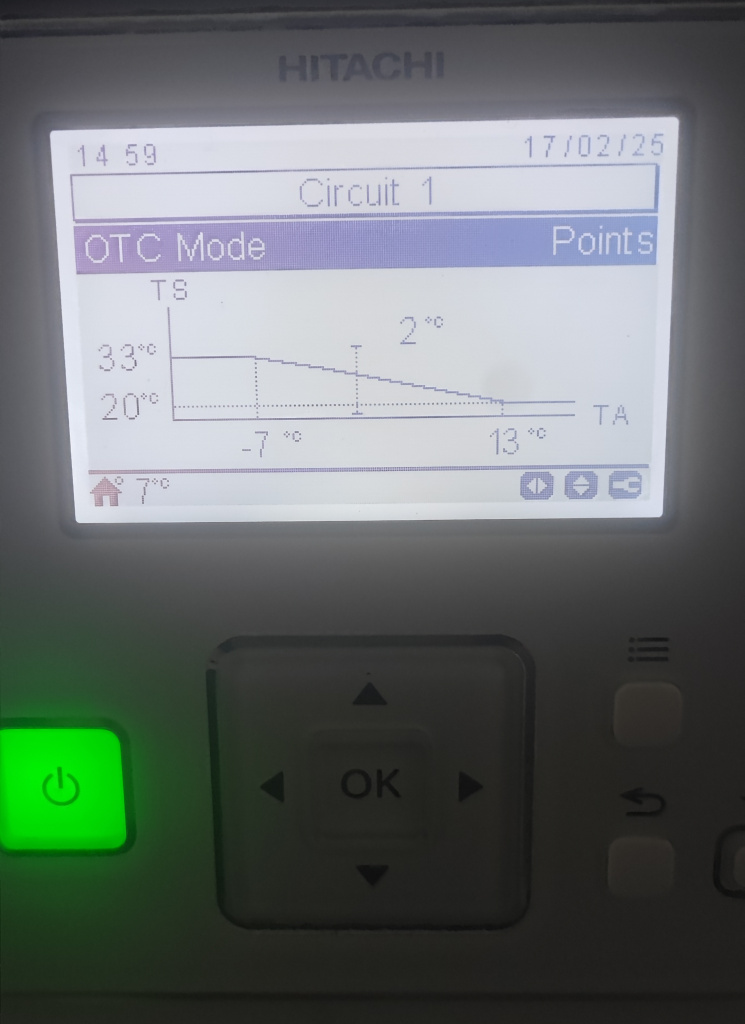
    13c outdoor temp is when I have set the heat pump to come on. It was set to 15c when it was installed but the house is well insulated and between solar gain, human and dog bodies, and all the electrical devices in the house giving off heat the house doesn't need any heating until the outside temp is 13c to maintain 18 to 20c inside. Your house may vary.

    -7c outdoor is just a point I picked as most cold outdoor temp, you could pick any temp that is lower than the coldest night where you live. This just sets the max flow temperature your heat pump goes to.

    IMG_20250217_145641.jpg

    So if you look at the sloped line. That indicates that when the outside temperature is between 13c and -7c (horizontal line on the bottom) the heat pump will heat the flow temperature to a corresponding temp from 20c to 33c (vertical line on the left)
    You need to set a temperature at -7 that will maintain the room temperature you want in your house as the outside temperature changes from 13c to -7c.

    Even if you want to use the thermostats to control the room temps, lowering the weather compensation curve temps will help efficiency, you will just have some stop starting of the heat pump as the room thermostats control demand.

    My daily usage for the heat pump (heating only) changes with the outdoor temp. I used 254kwh in January.
    So an average of around 8kwh per day. My heat pump is very basic so I don't get much info from it.
    My COP was 4.3 for the month, I would guess it goes down to 3.5? when the outside temps are below 0c
    If my house was 150m2 and had a 5kw Heat pump I would expect to use up to 400kwh?

    However the biggest money saver I would recommend to you would be to get enough battery capacity to cover your electricity usage for the coldest days and get a cheap night time tariff.
    I am on Pinergy EV tariff, 6c from 2am to 5am. I can charge my battery around 15kwh in that time.
    This covers almost all of the coldest days if I restrict use of my washing machine/dryer/dishwasher to also using cheap night time rate from the grid. My daily power usage in winter costs about 1 euro.
    In summer I can charge the battery for 6c and sell whatever I dont use at the end of the day back to them for 25c.

    If I needed more than 15kwh I would possibly go for a different tariff with a longer cheap time, although Pinergy pay 25c per kwh export, so maybe not.


  • Registered Users, Registered Users 2 Posts: 6,659 ✭✭✭championc


    @Jo Satan why do you have the 2°c offset at around 0°c on the heat curve ?

    @everyone when you max the thermostats, if your room temperatures go higher than you want the room to be, then the heat curve is too high. Keep lowering maybe one degree per day until you feel chilly, then bump it back up by 1 degree

    @everyone. If you have some downstairs zones warmer / cooler than others, then adjust the flows on the UFH manifold.

    Increase flow to increase heat output, reduce flow to reduce heat output. Be aware that reducing in one zone could naturally increase the flow to another zone.

    ALWAYS take photos of things before making changes, so you can easily go backwards and start again


  • Registered Users, Registered Users 2 Posts: 244 ✭✭Grey123


    Thanks for the detailed response. I needed to get to my laptop to respond. I had another look and my house is A3 actually, I can't find the BER cert but I understand it is invalid due to an extension being put on before I bought but I think I have one included as part of my solar installation.

    You have given me a much better understanding of how it should work and it certainly makes sense for the weather compensation curve to do the work.

    My January results don't seem to be showing but I used about 300kWh in December, the same last February, I can just see 12 months and they are my highest too, but I would say we haven't been keeping the house as warm as we would like all the time, although it might just be the case of wearing a jumper when wfh.

    Oh the battery, I have just gone for a 9kwh battery which I knew wouldn't be enough over the coldest 3 months. I wasn't convinced regarding the pay back on the second battery but I didn't really think about changing how I use my HP. Having live energy use dats is very powerful, even with smart meter data on esb website you are a couple of days behind and broken down by the hour only. There was somewhere I saw my data that had the weather temp graph next to it and it was very interesting, strong alignment. I can't recall where. Either ESB or Electric Ireland.

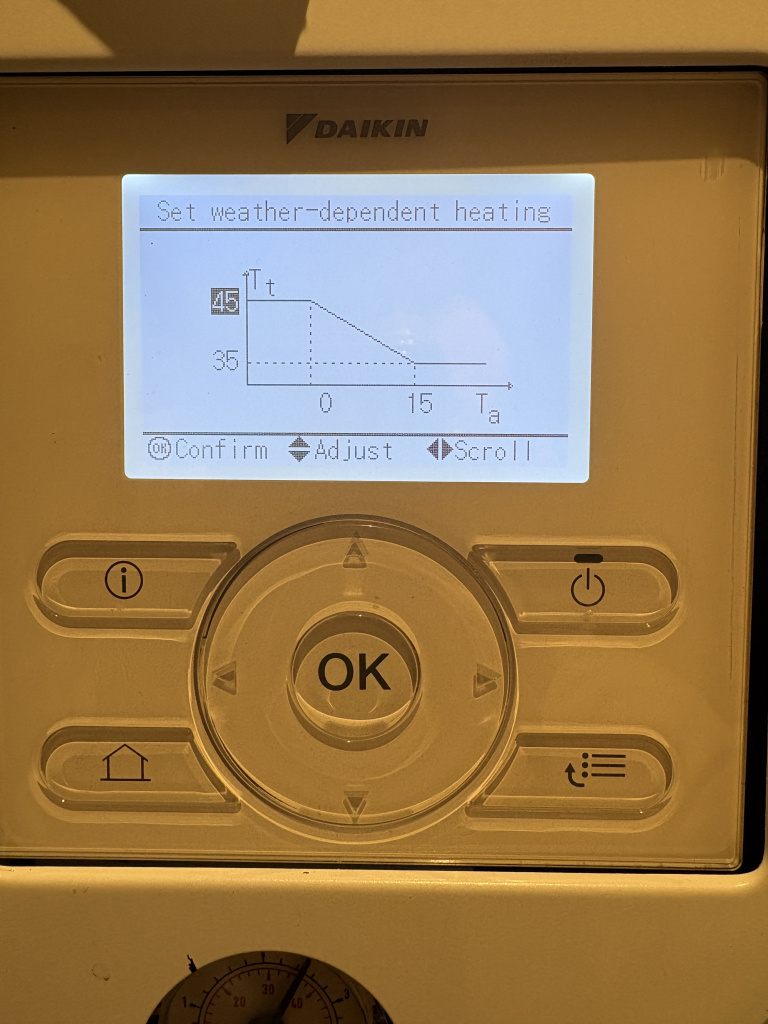
    Below is my curve, I take it the horizontal is outside temp. and the vertical is LWT? Too high?

    Does the 15 mean off?

    IMG_1705.jpeg


  • Advertisement
  • Registered Users, Registered Users 2 Posts: 6,659 ✭✭✭championc


    With an A3 house, that is WWWWAAAAYYYYY to high


Advertisement
Advertisement