Advertisement
Help Keep Boards Alive. Support us by going ad free today. See here: https://subscriptions.boards.ie/.
https://www.boards.ie/group/1878-subscribers-forum

Private Group for paid up members of Boards.ie. Join the club.
Hi all, please see this major site announcement: https://www.boards.ie/discussion/2058427594/boards-ie-2026

Energy infrastructure

1223224226228229233

Comments

  • Registered Users, Registered Users 2, Paid Member Posts: 15,602 ✭✭✭✭josip


    As regards the counter flows, back on the 13th of Feb I asked on here why the UK was both importing and exporting at the same time. With a possible explanation given by @KrisW1001 in the next post.

    Since both France and UK are single bidding zones, this was an exceptional event and not something you would expect to see very often?


  • Registered Users, Registered Users 2, Paid Member Posts: 14,394 ✭✭✭✭machiavellianme


    That particular event is one that is causing great friction in Europe. Basically the GB system operators are sometimes trading to resolve local GB issues which often result in flows in the opposite direction to the expected flows based on market schedules.

    Save boards.ie by subscribing: https://subscriptions.boards.ie/


  • Registered Users, Registered Users 2, Paid Member Posts: 15,602 ✭✭✭✭josip


    Another one of those days where we regret how long it's taken us to develop offshore wind in the Irish and Celtic Seas.

    image.png


  • Registered Users, Registered Users 2 Posts: 9,126 ✭✭✭Markcheese


    Have we sorted our planning system for offshore developments , is there a stable pathway for developers to plan , build and connect to the grid ?

    The cost of buying the components and physically installing them must be fairly similar off the irish coast to off the UK coast, or Northern European coast.. ( assuming similar depth and seafloor conditions) ,

    Possibly the scale of projects counts , with a huge development,and a guaranteed pipeline of work stretching 5 or 10 years into the future , probably affects costs as well ,

    We know how much new offshore wind off the Uk coast is ,( not cheap ,but what is these days ), how does ireland compare ..

    Slava ukraini 🇺🇦


  • Registered Users, Registered Users 2 Posts: 9,126 ✭✭✭Markcheese


    Source: The Guardian https://share.google/WaAWWQWMyEvJKF2TL

    Apparently considerably cheaper than new build gas (combined cycle ?? ) ... Although obviously if you built a GW of wind power , you'd likely have to build a GW of gas too ? ( Slightly cheaper open cycle ?? ) ,

    but you'd likely need to do at least a portion of that backup for the new build gas too …

    Slava ukraini 🇺🇦


  • Advertisement
  • Registered Users, Registered Users 2 Posts: 9,126 ✭✭✭Markcheese


    Fears that wind turbines off Waterford coast will be of ‘no benefit’ to county - Waterford Live https://share.google/djqVF572I3ExW80ee

    And then theres this type of shite

    Slava ukraini 🇺🇦


  • Registered Users, Registered Users 2 Posts: 1,260 ✭✭✭Exiled Rebel


    I passed a new solar farm outside kilmacthomas the other day. Cooltubrid it's called. I don't know if it has been connected to the grid as of yet but looking at it online they state it's 4.2MVA which is what 4MW? Then there's the monster solar farm on the copper coast. I think it's known as Rathnaskilloge. Not sure if that's operational yet but looks to be close.

    There's another site outside tramore but not sure of its status.

    EDIT: I see Rathnaskilloge solar farm connected to the grid just over 12 months ago.

    Although they won't be operational in 2026 we're going to see a plethora of solar farms with BESS - of up to 5MW each - commencing once the private wire bill is enacted. Only this week was I looking up the ~1MW solar farm coca cola built outside Wexford town which connects directly into their adjacent plant. They are currently in the process of awaiting a decision from ACP to install BESS.


  • Registered Users, Registered Users 2, Paid Member Posts: 15,602 ✭✭✭✭josip


    This week's noob question.

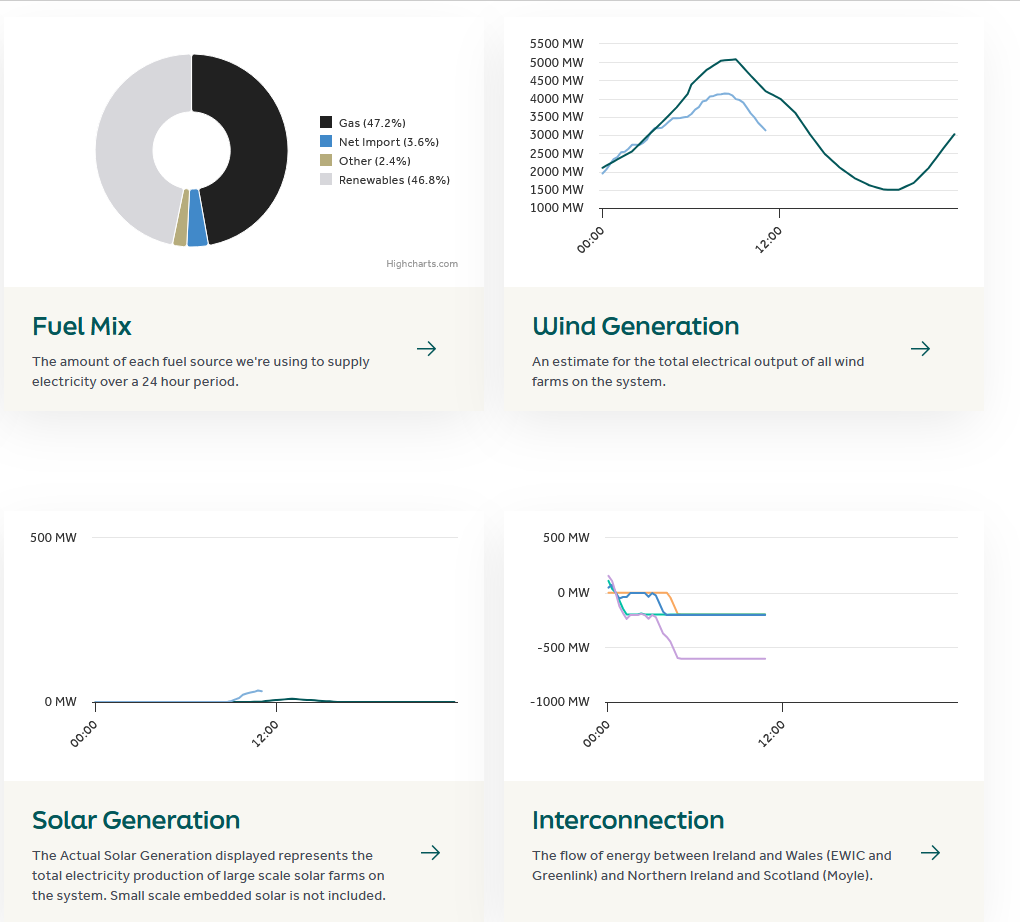
    We're using only 47% renewables in our mix, yet we're exporting and burning gas instead?

    https://www.eirgrid.ie/grid/real-time-system-information

    image.png

    Is that because the UK are prepared to pay more for our electricity at the moment than how much it costs some generator here to burn gas?


  • Moderators, Science, Health & Environment Moderators Posts: 20,712 Mod ✭✭✭✭Sam Russell


    Solar only generates when the sun shines which is 50% of the time on average for the year. More in summer, less in winter. Even then, real power is generated when sun is above 30 degrees. The sun is can be occluded by cloud and rain, and that is quite often.

    Wind can generate all day and night, but is very weather dependant. Now, there can be significant periods when the wind may not blow for weeks, or alternatively blow too hard and turbines need to be shut down to protect them.

    To average 48% is good. More turbines and solar farms are needed to get a higher average. Off-shore wind would open areas of wind that are more fruitful than just land based areas. Of course, domestic installations are not included.

    To get to 90% would be excellent, but to require 100% would be the perfect being the enemy of the good.


  • Registered Users, Registered Users 2, Paid Member Posts: 15,602 ✭✭✭✭josip


    Thanks Sam, I've rephrased my original poorly presented question.

    At 11:00 we were only generating 3GW of wind and with 6GW of demand that's 50% and well below the SNSP limit.

    Is the flow of electricity over interconnectors completely fixed 24 hours in advance due to pricing? Or are there more dynamic pricing mechanisms also at play?


  • Advertisement
  • Registered Users, Registered Users 2 Posts: 21,872 ✭✭✭✭cnocbui


    The capacity factor for solar in Ireland is 11%. Onshore wind is about 30%.

    Interestingly, we now have some numbers out of the UAE for configuring solar as base load by adding battery storage, where the capacity factor for solar is 24%

    The Masdar project consists of:

    5.2 GW solar plant with a 19 GWh battery storage. The system aims to provide one gigawatt of continuous, “renewable” energy on a 24/7 basis.

    So finally we have a costing for what it takes to make solar match a base load source where the capacity factor is more than double that in Ireland. $6 billion per GW. I haven't seen a cost breakdown, but if the batteries cost double what the panels did, then the cost of getting solar to base load standards in Ireland would likely be $8.36 B per GW for a system where the expensive bit would be unlikely to last more than 10 years.

    So solar as base load for a 30 year system in Ireland might be around $16.36 B per GW, assuming 3 lots of batteries and the panels.

    So much for solar being 'cheap' as is often claimed.

    Turning intermittents into base load using energy storage, which is Ireland's intended method of achieving net zero, would be very, very expensive and foolish if batteries were used for the storage part.

    Kind of running out of options here: hydrogen is a no go on several levels and the cheap storage battery myth has been exploded. We don't have the geography for pumped storage.


  • Registered Users, Registered Users 2, Paid Member Posts: 15,602 ✭✭✭✭josip


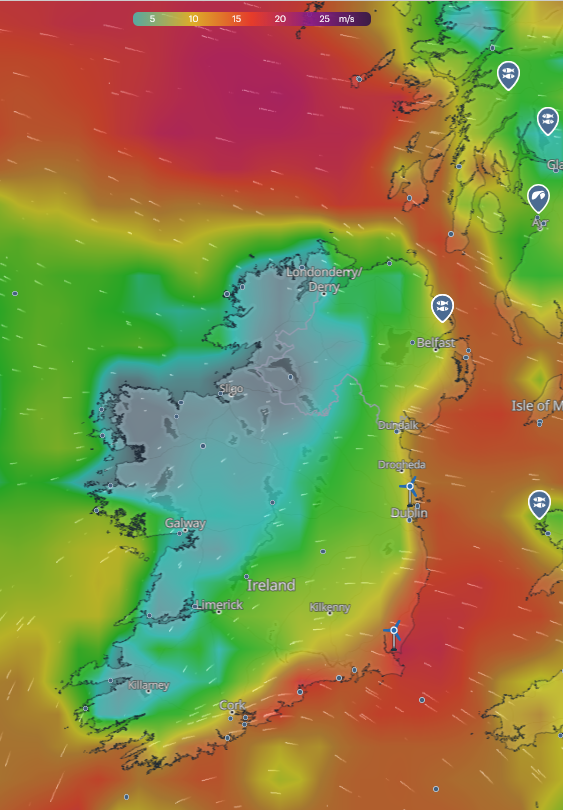
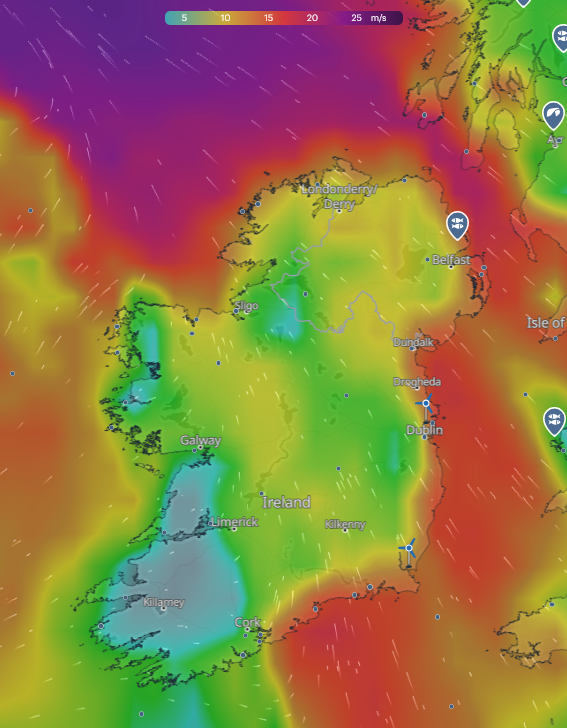
    You'll be relieved to be reminded then that fixed offshore wind will have a capacity factor considerably in excess of onshore wind. Instead of 5-10m/s wind speeds that we have on land, it's 15-20 m/s in the Irish and Celtic Seas.

    image.png


  • Registered Users, Registered Users 2 Posts: 316 ✭✭tppytoppy


    Where do you site them? France has great offshore wind resource in the Med but it gets steep quickly. There is only a small strip of exploitable Irish sea. Forget about the Atlantic.


  • Registered Users, Registered Users 2 Posts: 316 ✭✭tppytoppy


    UAE has over double hours of sun per year and is at about 24 degrees north. If it isn't economic there, it certainly isn't economic in Ireland.


  • Registered Users, Registered Users 2 Posts: 316 ✭✭tppytoppy


    Don't rely on interconnect from France as the most number of Datacentres in the world has been added there in the last year. They need their own electricity.

    https://legrandcontinent.eu/fr/2026/01/24/la-france-est-le-pays-qui-a-recu-le-plus-dinvestissements-etrangers-pour-la-construction-de-centres-de-donnees-en-2025/


  • Moderators, Motoring & Transport Moderators, Regional East Moderators, Paid Member Posts: 6,552 Mod ✭✭✭✭liamog


    Designing a base load supply using a solar and battery project from UAE, seems a bit like designing a Dublin sewer system based on rainfall in Dubai. I don't think anybody would propose a solution like that here whilst ignoring any supply from wind.


  • Registered Users, Registered Users 2 Posts: 316 ✭✭tppytoppy


    Our Minister seems to think that Ireland will be at the vanguard of a Hydrogen economy and is chairing some talking shop today.

    https://amp.rte.ie/amp/1555045/


  • Moderators, Education Moderators, Technology & Internet Moderators Posts: 35,329 Mod ✭✭✭✭AlmightyCushion


    Batteries and panels don't completely die after 10 years. Capacity would be worse sure and there might need to be some work done to replace some cells but it is not like you dumb the whole battery system and buy a new one. The same as how gas power stations would need maitenance. So your assumption that you would need 3 sets of panels and batteries for a system to last 30 years is way off.

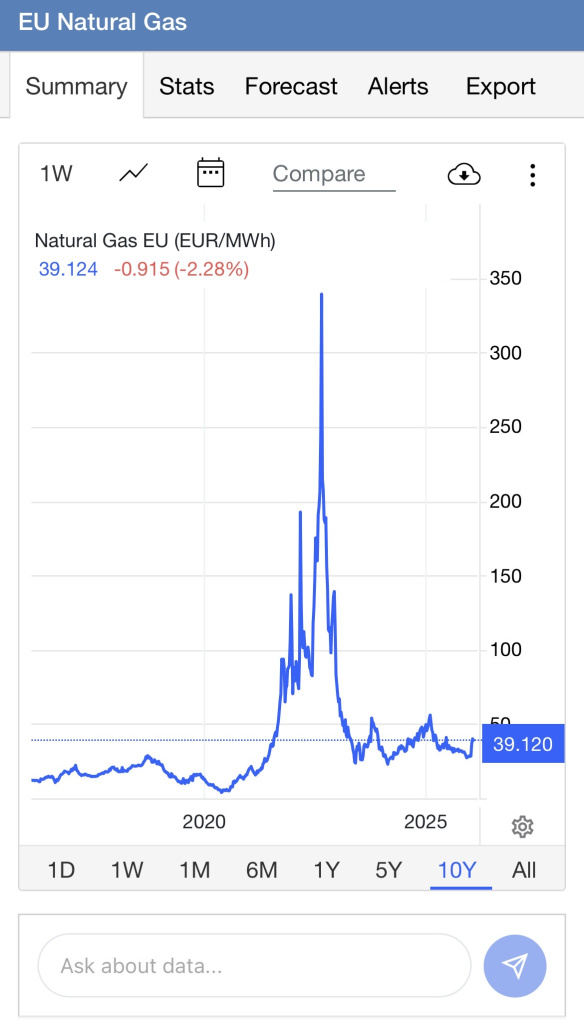
    You also don't factor in fuel costs for gas. I don't know what a 1GW gas power station would cost but this link (https://questions-statements.parliament.uk/written-questions/detail/2024-04-22/23004) says £114 per MWh. 114 * 1000 * 24 * 365 is just under a billion pounds. So for 30 years that is £30 billion ($41 billion). This link (https://protonsforbreakfast.wordpress.com/2025/04/14/the-cost-of-electricity-a-model/) says gas alone costs £400 million a year, so going by that 30 years worth of gas (just the fuel, nothing else) is £12 billion ($16.4 billion) .

    So fuel alone over 30 years covers the cost of the solar and battery system which scraps the whole system and builds a new one every 10 years. So, if anything your example makes solar look cheap compared to gas.


  • Registered Users, Registered Users 2 Posts: 21,872 ✭✭✭✭cnocbui


    I am aware of the capacity factor of recent SOA UK offshore wind farms. East Anglia One is 46.8%. East Anglia TWO is costing £4 B for 960 MW, or £4.16 B GW. You are looking at north of £12 B per GW to get OSW plus BESS to replicate a base-load source, roughly, where the batteries will at best last 10 years. Oh, and add to that the minor inconvenience of OSW requiring 25-30% of the initial capital outlay in operation and maintenance costs over it's 30 year lifespan. So getting OSW to perform as baseload for 30 years using back of the napkin math works out at something like £23 B per GW - in the UK.

    Do some research on the two floating offshore wind farms off Scotland - Hywind and Kincardine. They had great capacity factors of around 54% I think. However, the turbines couldn't take the punishment and didn't last 10 years before needing to be replaced. One turbine didn't last 2 years before needing to be towed back to the Netherlands, which is how all of them ended up.

    Oh, and cost does matter. Kincardine cost £500m for 50 MW - that's £10 B per GW. Hywind Scotland cost £8.8 B per GW. These numbers ignore O&M costs that arose after construction.

    This is relevant to Ireland because our west coast fixed offshore wind farms are predicted to have >50% capacity factors, which suggests wind and sea states comparable to the floaters. This suggests everything about them would cost more, from the foundations on up and the turbine longevity would be equally short.

    As I have been saying for years, renewables are far more expensive than other zero CO2 options.


  • Registered Users, Registered Users 2 Posts: 21,872 ✭✭✭✭cnocbui


    Lol. I am not an advocate of gas. My preferred comparison is verboten.


  • Advertisement
  • Registered Users, Registered Users 2 Posts: 21,872 ✭✭✭✭cnocbui


    I'm all ears - how is Ireland going to get to net zero using wind and solar? The BESS component from the Dubai example seems very relevant to me, as it's real world and the first time I have seen renewables configured as a base-load replacement, which is exactly what Ireland has to do, given the stupid course it's set.


  • Registered Users, Registered Users 2 Posts: 15,031 ✭✭✭✭Red Silurian


    Fine Gael councillor Pat Nugent expressed similar concerns, saying that Waterford people will be looking at the turbines, but the benefits will go to Cork and Wexford.

    While from a distance point of view it is a bit odd that the power from the farms are going to make landfall in Cork and Wexford the grid id a national one so cheaper energy on the grid will see bills reduced across the country, including in Waterford

    Also he's a Fine Gael councilor, he should raise his issues with his boss in Fine Gael


  • Moderators, Motoring & Transport Moderators, Regional East Moderators, Paid Member Posts: 6,552 Mod ✭✭✭✭liamog


    Seems like an odd argument for them to make when considering a landfall site, it's not like the chosen location will result in large number of jobs as people shovel the electricity from the turbines into rail carts to be delivered to the grid.

    The only advantage I can think to having the landfall in your county is for the small number of landowners who will receive payments for any new overhead electrical wires required.


  • Moderators, Education Moderators, Technology & Internet Moderators Posts: 35,329 Mod ✭✭✭✭AlmightyCushion


    Well, it is still a relevant comparison because if we don't use wind, solar or batteries it is going to be gas that we will be using. You might prefer something else but it is the reality of the situation here in Ireland.


  • Moderators, Motoring & Transport Moderators, Regional East Moderators, Paid Member Posts: 6,552 Mod ✭✭✭✭liamog


    I'm not sure where that requirement comes from? Why do we need to get to net zero using only solar and wind? We're already using storage and interconnection, I don't see that changing.

    Any approach to achieving a net zero system should use the most suitable tools, giving us all some interesting discussion along the way.


  • Registered Users, Registered Users 2, Paid Member Posts: 15,602 ✭✭✭✭josip


    In May 2023 the ORESS auction was for 3GW of wind. Daragh O'Brien in the Burlington last week finally said what everyone already knew. This won't be ready by 2030; 2033 is the earliest possible date and that's as long as there are no JRs.

    The problem is not the technology. Last week the UK had a successful auction for 8.4GW of offshore wind. Although not everyone will welcome this positive news. It will be operational by 2030.

    Why do infrastructural projects take so long in this country, JRs aside?


  • Registered Users, Registered Users 2 Posts: 1,260 ✭✭✭Exiled Rebel


    for the record Sungrow advertise their titan 5MWh BESS at €500k supplied, fitted and commissioned. taking the catalogue price, 1GWh = €100m. Obviously discounts apply for volume purchases.

    Even allowing for all the other bits of equipment and infrastructure (solar farm, grid upgrades etc ) I'm struggling to see how 1GWh of storage could cost billions.


  • Moderators, Recreation & Hobbies Moderators, Science, Health & Environment Moderators, Technology & Internet Moderators Posts: 98,112 Mod ✭✭✭✭Capt'n Midnight


    image.png

    At present we can only take a maximum of 75% non-synch generation on the grid at any one time for stability reasons. (The plans are to increase this to 95% over time by adding big flywheels / synchronous compensator things.) That means at least 25% is coming from gas (with a few % from hydro, biomass, CHP).

    On top of that high inertial devices (big heavy spinning things) need to be on at all times near the main cities , again for stability. So more gas.

    On the plus side for every watt of gas we can have up to three watts of renewables. And if the total is more than local demand it can be exported.


  • Advertisement
  • Registered Users, Registered Users 2, Paid Member Posts: 15,602 ✭✭✭✭josip


    Stupid vanilla didn't commit my edit 🤬 to my original noob question. And I'm not going to spend another 10 minutes nicely formulating it.

    I'm aware of the 75% SNSP. At 11:00 this morning we were generating 3GW from renewables, had 6GW of demand and exporting 624 MW over the interconnectors. So could have consumed that 624MW even allowing for grid constraints/SNSP.

    Is the flow of electricity over interconnectors completely fixed 24 hours in advance due to pricing? If not, then why were we exporting at that time?


Advertisement
Advertisement