Advertisement
Help Keep Boards Alive. Support us by going ad free today. See here: https://subscriptions.boards.ie/.
https://www.boards.ie/group/1878-subscribers-forum

Private Group for paid up members of Boards.ie. Join the club.
Hi all, please see this major site announcement: https://www.boards.ie/discussion/2058427594/boards-ie-2026

Improving attic insulation

  • 22-12-2025 02:46PM
    #1
    Registered Users, Registered Users 2 Posts: 8


    Hi All,
    My attic has the required 300mm of insulation so when I enquired with SEAI contractor about improving it, he said there was nothing more to do with it. However the house is cold and I was wondering if I could improve it myself by putting rock wool between the rafters? There is nothing in the rafters currently apart from the felt under the roof (attaching a photo).

    Would I likely see an improvement by making this change? Many thanks


Comments

  • Registered Users, Registered Users 2 Posts: 1,885 ✭✭✭Deagol


    If the house is cold, and you have 300mm in the attic already, insulating between the rafters will make no difference except to maybe promote condensation in your attic.

    What are the walls like? Windows? i find a sigificant amount of cold air gets into houses because the windows aren't sealed to the boards.

    What type of house is it? Concrete block or timber frame?

    How cold is cold? Do you have any proper thermometer?

    Heating type?


  • Registered Users, Registered Users 2 Posts: 1,633 ✭✭✭DC999


    +1 to that. In Ireland, it's often wind that robs the heat. So making the house more airtight keeps in a lot of heat.

    Expanding foam is your friend in the 1st instance. Loads more to it but that is a good start to fill all gaps on external walls. And into the attic where all the water pipes go.


  • Registered Users, Registered Users 2 Posts: 1,775 ✭✭✭monseiur


    The attic insulation is not the problem. Insulate internal (external) walls with minimum 60mm insulated plasterboard and upgrade all windows & external doors with triple glazed uPVC. Ideally all the floors should come out and underfloor insulation fitted before wall insulation & new windows are fitted but this may be bridge too far😉


  • Registered Users, Registered Users 2 Posts: 97 ✭✭greenbin2


    Insulation is not a form of heating....

    If you have a stat controlling your heating turn it up a degree or 2 and it should make the place warmer, leave it at the temp and see how much it costs over 12 months to heat the place, should be around €1000, if it's well over €1000 then look into investing in improving the houses effeciency

    If you don't have a stat controlling the boiler then get a stat to control the boiler

    If it costs less then €1000 then you don't need to do anything

    If your leaving the house unoccupied for a few days turn the stat down maybe 2 or 3 degrees should do it


  • Registered Users, Registered Users 2 Posts: 8 anon a moose


    Thanks very much to you all for the very helpful information. It's a 70's bungalow with a 90's extension, the wall cavities have been filled with beads before I bought it. I've upgraded the windows and in terms of wall insulation I was trying to avoid the high cost of external insulation as the SEAI grant was already claimed for the cavity insulation. The internal finishes are good and the house is small, in spite of an extension so I was trying to avoid doing internal walls with plaster board and losing more space. I do think there is scope to make the house more airtight alright but clearly the attic isn't my issue! Thanks all for your valuable opinions.


  • Advertisement
  • Registered Users, Registered Users 2 Posts: 8 anon a moose


    Forgot to add, it's oil heating and the heat retention in the house seems very poor so while it warms up, it loses heat very quickly.


  • Registered Users, Registered Users 2 Posts: 1,885 ✭✭✭Deagol


    Heat retention is probaby down to lack of air tightness from what you've described. I would go around the whole house on a windy day and see if you can find drafts coming from outside. I did it here and found a few of the windows had lost sealing over the years. I bought some simple P insulating strips and sealed them up.

    I also found a few places where holes had been drilled for things like satellite cable and the like that were open.

    When I bought the house it was C3, with some fairly cheap and basic additions I've got it to A3 and it retains heat much better than when I bought it. I would't go paying a fortune for internal insulation as it'll probably not turn out to make as much of a difference as simply sealing up leaks.


  • Registered Users, Registered Users 2 Posts: 97 ✭✭greenbin2


    I still wouldn't be messing with insulation or ventilation,If you turn the heating on and off manually, the boiler warms the air,then you turn off the boiler as it now fells warm, maybe even too hot, wasting your expensive heating oil

    But the several tons of concrete inside your house is still stone cold, the furniture, the cups, plates, tins of beans, everything are all still at the lower temperature from before you turned the heating on

    They will soak up this heat like a sponge, and your air will soon start feel cool again in minutes

    You need a stat to turn the boiler back on when the air temperature starts to drop, after a few days, when everything inside your insulation is up to "room temperature" you will find the boiler will be on for about half the duration a day that it was on the first day

    If you set the oil boiler itself to its lowest temp cut off it will be much more efficient (if it's a condensing boiler)


  • Registered Users, Registered Users 2, Paid Member Posts: 279 ✭✭User567363


    Fully agree with greenbin, insulation is never going to heat your house, blocking vents wont make a room warmer, you need to burn something, be it oil, wood, coal, turf, electricity, etc

    If that is working out too expensive then you need more insulation, different vents, better boiler,which will also be very expensive, so for now just heat more, preferably using a thermostatic controller, it doesnt even need to be wifi controlled as you just set and forget

    If you find my comment funny, useful, interesting or even annoying then please like and subscribe to boards.ie


  • Registered Users, Registered Users 2 Posts: 3,111 ✭✭✭Static M.e.


    Did anyone ever try one of those Heat cameras to see where the cold spots are? I've seen someone use them on Heat My Home show, and I don't think they are too expensive.


  • Advertisement
  • Registered Users, Registered Users 2 Posts: 97 ✭✭greenbin2


    Thermal imaging cameras are good at spotting bits missed by the builder but takes a lot of practice to spot bad insulation

    you would want to put an electric heater in the middle of the room with the stat set to a good bit higher then it is outside and leave it there for about a day

    Plug it out for 2 hours when it's dark and then enter the room and look around with your camera

    You will notice .

    Bad wall and ceiling insulation is usually uniform for the entire surface so it won't stand out as being an an issue

    Lower to the ground will always be colder, so allow for that, and external walls will be cooler then internal walls this time of year so allow for that

    double glazing pvc windows and velux are very cold and the cold spill down the wall under the window and spreads across the floor like water,

    Actually op.…

    A roller blind and a thick curtin will make a huge improvement to windows and is an easy enough DIY as long as Dermot Bannon didn't influenced your builder,

    I did this to my house and I definitely noticed I buy less oil per year to maintain the temperature thermostically


  • Registered Users, Registered Users 2 Posts: 8 anon a moose


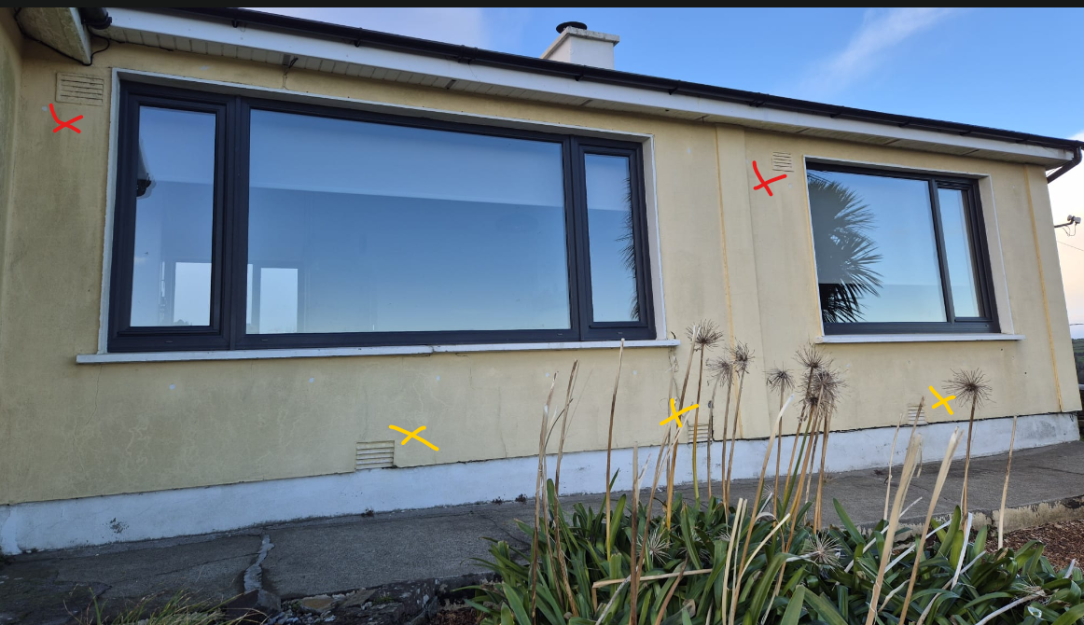
    Thanks to all for the really helpful comments. What I'm really trying to do is minimise the heat loss, when the heat goes off we can feel the place cool down very quickly. Also we're coastal and when there's wind we can feel air coming in through the sockets (walls were pumped). I'm not sure what the options are around electrical sockets, is it safe to use expanding foam to close off those kinds of gaps? Another question is about vents. Each room has 3inch vents high up on the wall which have covers on the inside (marked in red). I'm wondering about the lower ones, marked yellow - can I block these up with expanding foam?

    External insulation isn't an option for us, the cost is just too high and the wall grant was claimed before we bought. I've been reading about cork sol external spray as something that could help to reduce the heat loss (not to the same degree as external insulation but it's also about a third of the cost). Anyone have any experience or recommendations on using that? Thanks again all for the valuable opinions.


  • Registered Users, Registered Users 2 Posts: 1,775 ✭✭✭monseiur


    As your house is a bungalow you can solve the issue with draught in sockets by going up into attic and sealing around the top of conduits where it protrudes up thru ceiling with expanding foam. You will have to lift insulation to get to them. While up in the attic double check that there's at least 300mm insulation there and it's properly laid.

    As you have pumped the cavity you should seal off the vents at ground level. I am of the opinion that externally insulating a house with cavity wall is a total waste of money - once the heat passes thru the internal leaf of the cavity wall meeting probably badly fitted insulation then patchy beads - that's your heat gone. In your case the only way to retain heat for longer is internal wall insulation, heavy woolen curtains with thick underlay under all carpets. Ideally all floors should come out with 100 mm insulation placed under new floor with strip of insulation around perimeter to meet wall insulation - but this is not exactly practical.


  • Registered Users, Registered Users 2 Posts: 1,475 ✭✭✭dathi


    the yellow vents are there to ventilate the space under your timber floors to prevent rot. the problem with them is that they cause huge air leakage into the room, if you think about it all you have between the inside space and the cold external air is 20mm floor boards and what ever floor covering you have in the room. the solution is to either lift the floor boards and fill between the joists with rockwool and install a airtight membrane before replacing floor boards, or remove the timber floor entirely and replace with an insulated concrete slab.


  • Registered Users, Registered Users 2 Posts: 2,986 ✭✭✭MicktheMan


    when the heat goes off we can feel the place cool down very quickly.

    This is not an insulation issue. It is heatloss by convection, aka draughts, aka air leakage. I see it day in and day out.

    Without knowing an awful lot more about your house it is not possible to really advise other than to say you might be best to have a proper heat loss survey done to find/highlight the primary issues and how best to address. Otherwise you will likely be chasing your tail for years trying to get it sorted (that is if you ever manage to).

    Also, there are far better and quite cost effective ways of ventilating your house than those 'hole in wall' type vents.


  • Registered Users, Registered Users 2 Posts: 9 Lovomina


    If you’ve already 300mm at ceiling level, adding rockwool in the rafters might not make a huge difference tbh. It can help a bit with drafts, but ventilation’s important too. Might be worth checking for air leaks first.


Advertisement
Advertisement