Advertisement
Help Keep Boards Alive. Support us by going ad free today. See here: https://subscriptions.boards.ie/.
https://www.boards.ie/group/1878-subscribers-forum

Private Group for paid up members of Boards.ie. Join the club.
Hi all, please see this major site announcement: https://www.boards.ie/discussion/2058427594/boards-ie-2026

Solar for Beginners [ask your questions here]

1141143145146147

Comments

  • Registered Users, Registered Users 2 Posts: 6,033 ✭✭✭GhostInTheRuins


    This is probably a stupid question, but I'm looking for a new power contract for my parents.

    Can you sign up to an EV rate without an EV charge point? Parents have 5kWp of panels and a 5kWh battery and I think the EV plans I see on energypal are the best value. They don't have an ev though.

    Looking at pinergy in particular.


  • Registered Users, Registered Users 2 Posts: 2,777 ✭✭✭oleras


  • Site Banned Posts: 2,997 ✭✭✭Markus Antonius


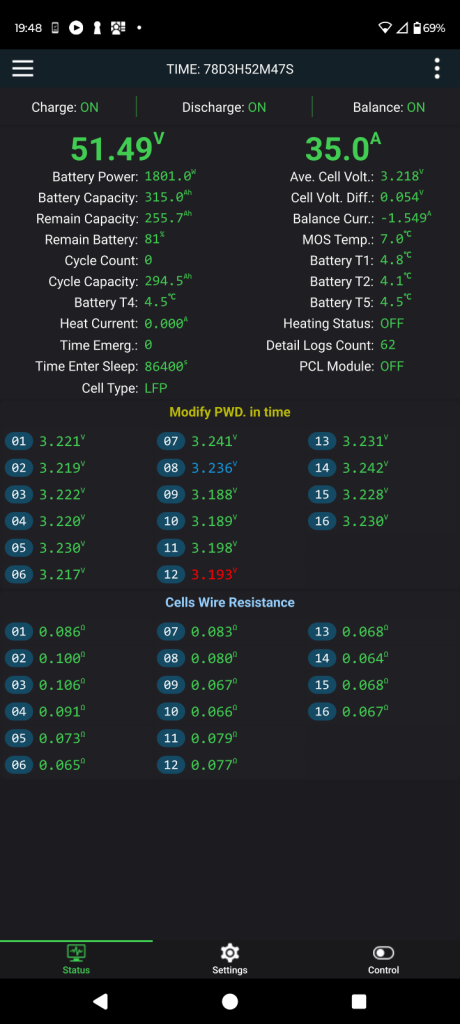
    I have 16x 3.2V Enphase batteries hooked up to an 8K Deye hybrid inverter. I'm not currently using the batteries at the moment so have them held at 80% charge. Just noticed this evening the voltage has dropped to 48.7V.

    Should I be concerned about this drop or is it just due to cold? Would I be best to disconnect the batteries or cycle them regularly?

    Edit: I started charging them up to 95% to see if that would resolve it and the voltage has now increased to 52.6V. Maybe the BMS lost track of one of the cells. Everything seems ok now|:

    Screenshot_20260105-194829.png
    Post edited by Markus Antonius on


  • Registered Users, Registered Users 2, Paid Member Posts: 10,141 ✭✭✭✭10-10-20


    Battery temps are ~4.5 degrees there, that will cause a capacity and voltage drop as the chemistry can't do the atom dance as effectively.


  • Site Banned Posts: 2,997 ✭✭✭Markus Antonius


    Thought low temps affected the battery's ability to deliver current so wasnt all that concerned about having them sitting there in the cold given they are not serving any function at the moment and are charged. Do you think I should put some kind of heater in there? Batteries and inverter are in the shed.


  • Advertisement
  • Moderators, Home & Garden Moderators Posts: 7,614 Mod ✭✭✭✭graememk


    Jk needs regular full charges to keep the soc in check. Keep charging until it's full, until it doesn't take any more power (eg held at your charge voltage) and amps are zero


  • Site Banned Posts: 2,997 ✭✭✭Markus Antonius


    I see. Does it need to be discharged to a low level or could it be cycled between 80 and 100%? Are we talking once a week or month? I could create a routine in home assistant to handle this. Otherwise could disconnect them altogether until I start utilising them.


  • Moderators, Home & Garden Moderators Posts: 7,614 Mod ✭✭✭✭graememk


    it doesn't need to be discharged to a low level, just a good full charge every few weeks Id say once every 2 weeks.

    you will notice it will keep charging with the soc at 99% for a good while before it will start to slow, this is the SOC being pulled back into line.

    I only discharge to 40% as I cant currently completely fill the battery on night time charging, also always leaves me a reserve if the power goes out.


  • Site Banned Posts: 2,997 ✭✭✭Markus Antonius


    You are right. It has been stuck at 99% for ages now despite pulling 35A. I was afraid to charge to 100% in case i'd blow a cell or something.


  • Moderators, Home & Garden Moderators Posts: 7,614 Mod ✭✭✭✭graememk


    thats the reason for the BMS to protect the cells.


  • Advertisement
  • Registered Users, Registered Users 2 Posts: 292 ✭✭kig


    We have a Huawei system, installed in 2022, and would like to have a switch installed to be able to use the batteries when there is a power outage. The original installers have quoted me almost as much as the whole system cost us, so they are obviously not interested in our business. I don't want it done by a fly-by-night, but with the current instability I would like it done, has anyone got any recommendations?


  • Registered Users, Registered Users 2 Posts: 14,470 ✭✭✭✭SteelyDanJalapeno


    I made the mistake of installing a Huawei inverter with my panels a few years back and I now want to add batteries but I can't justify the cost of the Lunas.

    I was thinking either swap out the Huawei with an inverter that has more flexibility with the batteries it supports, or maybe just add a 2nd inverter to manage the batteries only.

    I was considering 3 of these units, price seems ok at 2100 each?

    http://www.adverts.ie/38265162

    Anybody got thoughts on how you would proceed?

    Not that it matters a whole heap, but my array and inverter are ground mounted about 40mtrs from the house, so adding a 2nd inverter would mean I could house them in the garage without running additional cabling to the array.


  • Registered Users, Registered Users 2 Posts: 1,150 ✭✭✭Rulmeq


    It's not quite a DIY job, but if you were friendly with an electrician, it looks like something that would be easy enough to do.


  • Registered Users, Registered Users 2, Paid Member Posts: 15,614 ✭✭✭✭josip


    We are considering getting some panels on a hipped semi-d roof. Unfortunately we’re on the north side of the semi-d pairing so we’ll have to get panels on the front & back East/West facing parts of the roof.

    Neighbours in similar houses have 5 panels on their roofs. I have the following questions.

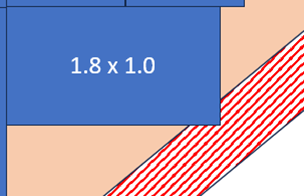
    1. Corners of some of their panels are closer than 50cm to the ridge line between the front and side roofs as in the diagram below. Does the 50cm setback rule apply to these ridgelines or is it 20cm the same as for the top of the roof? Or do the corners of panels get a free pass?
    2. image-ef7b1696624a48-80db.png
    3. Their panels are usually aligned with the edge of the chimney stack. Do they have to be aligned this way or can they be installed closer to the roof midpoint?
    4. From my measurements, I think we can fit 6 panels instead of 5 on each of the front and back if they are installed 10cm away from the centre line of the 2 houses. We’d be keen to maximise the number of panels.
    5. Is the 50cm from the bottom edge, 50cm from the edge of the bottom tile or edge of the gutter?
    6. Do installers give you a choice of panel size to maximise your surface area or do installers typically only work with 1 size of panel?
    7. Both sides of the roof will suffer from some shading, back more so than front so my understanding is that we’ll be best to go with microinverters per panel?
    8. If we go with microinverters then we can mix different sized panels to maximise output?
    9. Do the different sized panels have the same output per square metre, just differing in overall size ?
    10. Is it a no-brainer to get a battery supplied now also to avail of 0% VAT?

    Any answers appreciated thanks.


  • Registered Users, Registered Users 2, Paid Member Posts: 15,614 ✭✭✭✭josip


    I’m also thinking of getting solar panels on my mother’s house.

    My mother is in a nursing home, so the house is only occupied some weekends and the storage heater is the only regular consumer.

    Don’t need to save/make any money but if I broke even after 10 years I’d be happy with that.

    The roof is E/W facing. Each side has room for up to 20 panels

    What’s the best configuration of panels + battery to get considering we’d be exporting almost everything?

    Is there any point getting a battery?

    I’d like to get a 5kWh battery now to have it in case someone starts living in the house in the coming years and to avail of 0% VAT.

    Am I right that with battery arbitrage we can recoup roughly 50c per day, €200 per year?

    For the roof, the maximum we can export is 5.75kW ? How many panels should we put up on each side?

    There is a chimney which will shade the panels on one side or the other for some of the time so I’m guessing we should have 2 strings and a hybrid inverter?

    Is there a limit to how many panels we can attach to an inverter ? Should we over dimension by some factor?

    Thanks


  • Registered Users, Registered Users 2 Posts: 3,930 ✭✭✭boccy23


    Hi All

    Looking at jumping into the Solar space. Annual usage is high at 7500 Kw/Hr.

    I have similar prices from OHK and Ecoplex for 16 x panels and 10 KW battery.

    Anyone any experience of which would be a better installer?


  • Registered Users, Registered Users 2 Posts: 690 ✭✭✭m4r10


    Hi all. I was told by an installer that the EDDI cannot be installed alongside a mechanical DHW timer. I was hoping to have the timer as a backup in case the EDDI stops working. Would that be correct or is it just that he doesn't want the hassle of installing both?


  • Moderators, Home & Garden Moderators Posts: 7,614 Mod ✭✭✭✭graememk


    Assuming it's the immersion timer, no you can't have both. There is a manual override switch on the eddi to manually turn on the immersion if it does fail though.


  • Registered Users, Registered Users 2 Posts: 690 ✭✭✭m4r10


    Thanks for that.


  • Registered Users, Registered Users 2 Posts: 247 ✭✭daveville30


    Solis 2000 4g inverter.

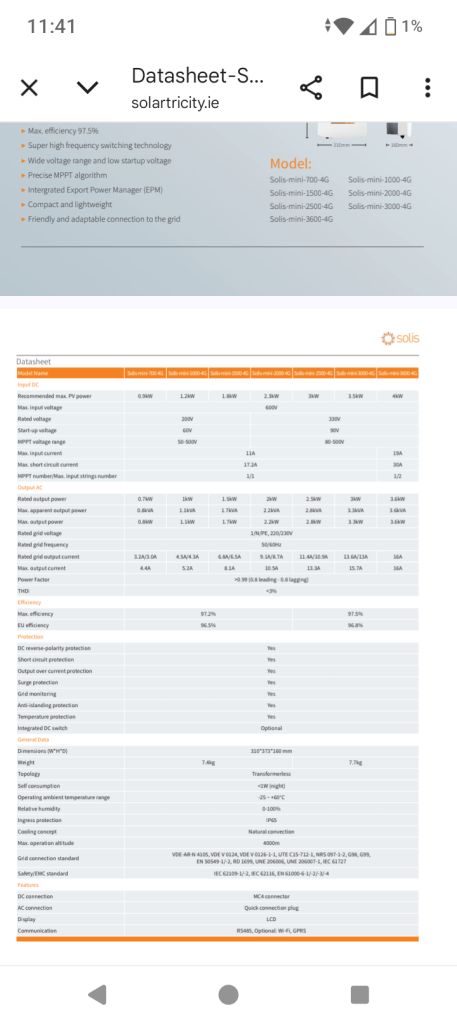
    Hi I bought a solis inverter.im just wondering what panels would suit the inverter.cheers

    1000017285.png


  • Advertisement
  • Registered Users, Registered Users 2 Posts: 247 ✭✭daveville30


    Picture.of specifications


  • Registered Users, Registered Users 2, Paid Member Posts: 8,455 ✭✭✭deezell


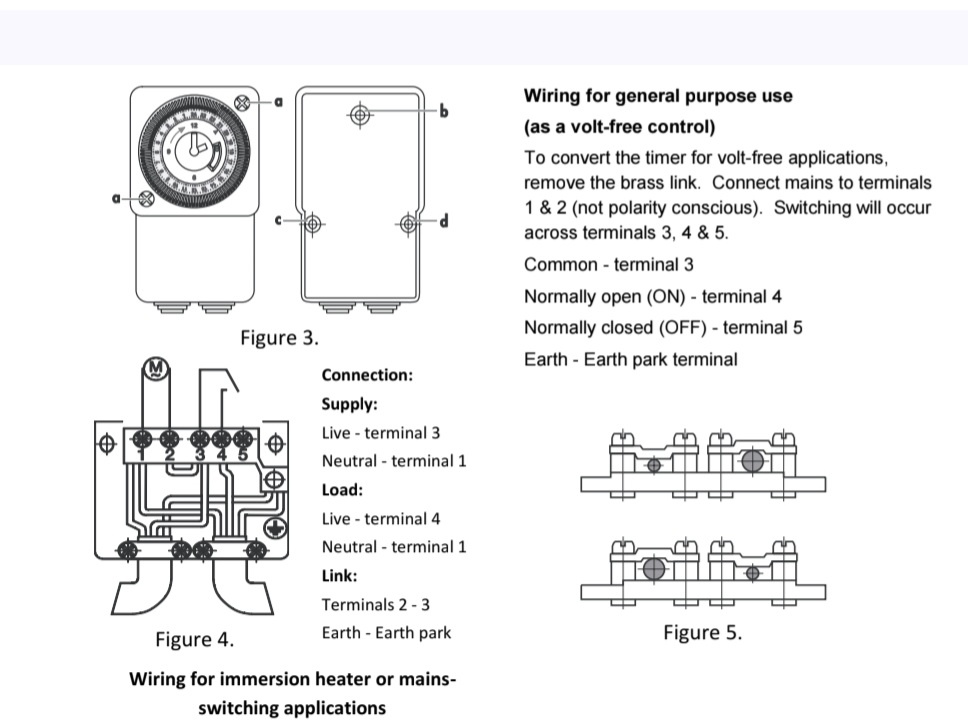
    You'd imagine the EDDI should be able to provide power to the immersion from the grid if there was insufficient power from solar. Perhaps this is available in the configuration. Meanwhile, its possible to wire a two pole mechanical timer switch as a changeover switch to one immersion element (Eddi can operate old style sink/bath dual elements). A timer with a volt free two pole switch can have the EDDI output on NC, and direct mains on NO, with the choice of either going to the immersion element on COM. When the mechanical timer is on, it powers the element, otherwise the Eddi is connected and can power it, if it detects solar. Here's an illustration of a mechanical timer whose live link to the Internal switch can be removed and rewired as a two pole switch.

    Screenshot_20260205_140053_Chrome.jpg

    The live link would be moved to 4, NO, the Eddi live to 5, NC, and an immersion element to COM.

    If you have a dual element immersion, you can also just give one element each to Eddi and the timer, say Bath to Eddi and Sink to the timer.


  • Moderators, Home & Garden Moderators Posts: 7,614 Mod ✭✭✭✭graememk


    The eddi has a boost mode akin to a normal immersion timer.

    There could be issues with the shared neutral of the 2 element immersion with the way the eddi chops up the AC to reduce the power consumed by the immersion. Not worth the hassle.

    Can press the boost button on the eddi or in the app.

    I've done what you've suggested as well with a 4 pole relay. It did work but would trip it's rcbo on occasion if both was trying to operate at the same time. Didn't dig too much more into it, just removed the eddi from the second immersion in the tank.


  • Registered Users, Registered Users 2 Posts: 1,514 ✭✭✭FastFullBack


    Planning to get solar system in 2-3 months. One thing I never see in Irish setups is bird protection. Some solution to stop birds getting under panels. I follow some UK electricians on YouTube and they put that feature high up as a key thing to look for when getting quotes.

    Is it not a done time here?


  • Registered Users, Registered Users 2, Paid Member Posts: 472 ✭✭JonMac


    I had a Sigenergy system installed last month; 20 panels, 2 9kWh bayberries, 5kW inverter, gateway.

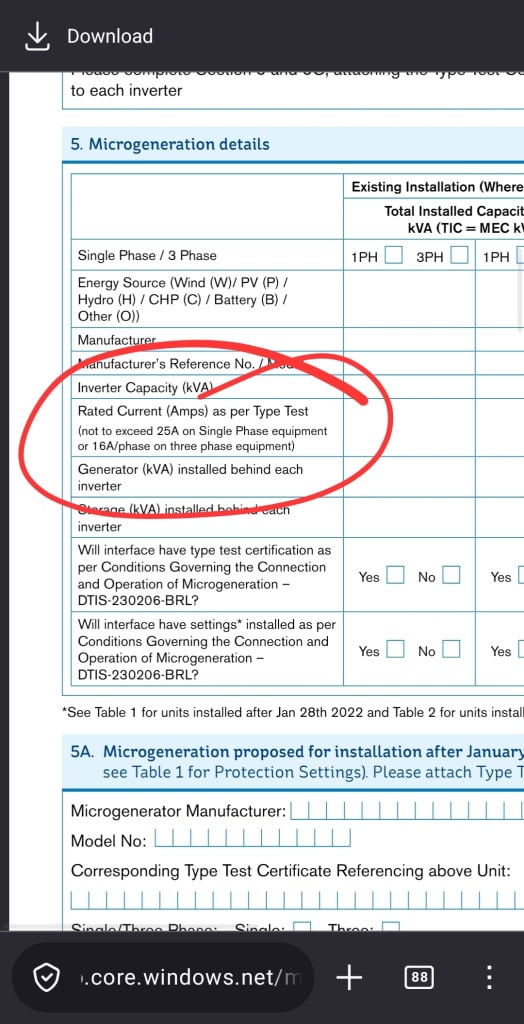
    They quoted a 5kW inverter and I asked for a higher rating. Their response was: For the domestic system we are capped at using a 5kW (25amp) inverter in Ireland, You can apply for what's called an NC7 if you wish to put in a bigger inverter. "

    However ESB's website says: Micro-generator is a source of electrical energy which operates in parallel with ESB Networks LV System and rated up to and including:

    • 25 amperes (≈6kVA) at low voltage [230 volts] when the connection is single phase."

    For most of the day time my house uses 0.5 to 1.0kW, so I am limited to 4.5kW or less export.

    Any idea why they wouldn't sell me a 6kW inverter?

    Thanks.


  • Registered Users, Registered Users 2 Posts: 2,865 ✭✭✭ECO_Mental


    Because for an NC6 connection they legally cant, its limited to 25Amps. This way your supplier can just install your inverter and "inform" ESB Networks its connected and then you can get an export connection. This is the limit ESBN set that they reckon if installed it wont cause any problems to the grid…This is normal for all countries, count yourself luck the UK connection G98 is limited to less than less than 16Amps.

    If you want a bigger inverter then you will have to pay a significant amount (€1000 for NC7) so ESBN can do a technical review the grid and your local transformer to see what it can handle. NC7 you can have an inverter up to 16kVA.

    If you got a connection 3 or 4 years ago it was higher they limited it to 6kVA, but a few years ago they realised the domestic market is getting a lot bigger so they readjusted it to 25Amps is actually about 5.5 kW.

    6.1kWp south facing, South of Cork City


  • Registered Users, Registered Users 2, Paid Member Posts: 10,141 ✭✭✭✭10-10-20


    The installer is correct, 25A is the limit at NC6.

    Screenshot_20260213_101003_Firefox.jpg

    The difference in watt values is an allowance for voltage variability within the supply system (and power factor/real/apparent power).

    25×230v= 5.75kW

    25×245v=6.125kW

    No point in trying to argue against a defined standard. Go to NC7 if you need >25A. Simple.


  • Registered Users, Registered Users 2, Paid Member Posts: 472 ✭✭JonMac


    OK, your arithmetic is correct, but my house is currently drawing 1.45kW, ranges mostly 0.5 to 1.0 during the day.

    The highest export I have seen is 4.8kW which is 20A. A 6kW inverter would take me close to the limit, and the export limit can be set in the app.


  • Registered Users, Registered Users 2, Paid Member Posts: 10,141 ✭✭✭✭10-10-20


    The app based export limit is a soft limit and provides no protection to the grid. The inverter limit of 25A is a hard limit and offers a level of predictability to the grid owners. ESBN don't allow for soft limits as it increases the risk of some fool connecting a 15kW inverter to the grid and changing the soft limit to suit their needs.


  • Advertisement
  • Registered Users, Registered Users 2 Posts: 2,865 ✭✭✭ECO_Mental


    "some fool connecting a 15kW inverter to the grid and changing the soft limit to suit their needs"….strong words there for some peoples NC7 Application that might be lost in the system!!!..😋😯

    6.1kWp south facing, South of Cork City


Advertisement
Advertisement