Advertisement
Help Keep Boards Alive. Support us by going ad free today. See here: https://subscriptions.boards.ie/.
https://www.boards.ie/group/1878-subscribers-forum

Private Group for paid up members of Boards.ie. Join the club.
Hi all, please see this major site announcement: https://www.boards.ie/discussion/2058427594/boards-ie-2026

Irish Property Market chat II - *read mod note post #1 before posting*

1933934936938939944

Comments

  • Registered Users, Registered Users 2 Posts: 1,798 ✭✭✭spillit67


    ”We need”

    Cite the assumptions used by the CEO of the Dublin Chamber that makes you have such a definitive opinion that we need 60,000? Do they have a model or is that just their opinion based on what they’ve read?

    Why not the 93,000 that Davy suggested?

    Why not the complete flipside of this argument from someone like JP McCartney from TUD an ex BNP who disagrees with the basic assumption that we have low supply?

    Again this is what annoys me about this discussion. Doom loopers who provide little in the way of substantive argument beyond circulating negative stories.

    It’s very easy to shout out a number but when you have 10s of thousands of differences in assumptions, it warrants an assumption as to why you come down on a number or range.


  • Registered Users, Registered Users 2, Paid Member Posts: 22,113 ✭✭✭✭Bass Reeves


    Retrofitting will have an impact going forward. Seeing a few small builders starting to to do a few of these. In a local village there was two houses fire damaged 3 years ago, owners had no insurance. A bit back a builder bought and refurbished them, I am not sure if he got the grant for them, but he is doing up what will be 4 at present that are all grant compliant. An old pub and two dwellings next door. Seeing a bit going on here and there. Definitely more interest in these types of properties that used to sit around before.

    So on a 500k+ house land cost is 100k. Not exactly out of kilter

    Post edited by Bass Reeves on

    Slava Ukrainii


  • Registered Users, Registered Users 2 Posts: 1,798 ✭✭✭spillit67


    It’s also not like land costs puts us out of kilter with peer countries.

    It strikes me as one that gets an airing (like some others line a “state building company”) as it fits into an overarching ideology.

    That said, everything contributes to cost so it should be a factor considered. And the fact that we have low density suggests we have some way to go until scarcity drives prices as much as it does. The real issue for me is tue artificial zoning and targets of the NPF just create an imaginary world where projects happen and there aren’t micro or macro factors that influence things. DCC for instance recently came out and claimed there was more than enough land zoned for units, but you can’t look at the number of units built in DCC and suggest that’s true. There’s more complications with building in a more dense area and clearly that’s impacting delivery. The pattern has gone on too long to suggest it’s a short term thing- more available zoned land is needed to give more opportunities for development (some will fail, as the always do).


  • Registered Users, Subscribers, Registered Users 2 Posts: 6,803 ✭✭✭hometruths


    Well said, too many people accepting the garbage in, garbage out models.


  • Registered Users, Registered Users 2, Paid Member Posts: 6,583 ✭✭✭straight


    I have heard it described as generation rent getting themselves into the newscycle every which way they can. That was in England and I'd day its worse here.


  • Advertisement
  • Registered Users, Registered Users 2, Paid Member Posts: 22,113 ✭✭✭✭Bass Reeves


  • Registered Users, Registered Users 2 Posts: 3,526 ✭✭✭Blut2


    You're the one claiming 32k units a year is good going, and not abject failure.

    When the government's own stated goal is in excess of 50k units a year, its really quite something to try and argue that consistently hitting low 30,000s is any sort of success.

    As I said, anyone working in the private sector hitting that % of a stated KPI would be getting fired very quickly. As should be happening for those in charge of our housing policy.


  • Registered Users, Registered Users 2 Posts: 1,798 ✭✭✭spillit67


    Are you incapable of answering a question or just continuing to deflect when you struggle?

    Me calling out your lies on our housing output change over the last few years is not me saying it’s enough, again please just quit the misrepresentation and outright lies here.

    Tell me why you said “we need” 60,000 houses a year and why you like that particular number. Why not the 93,000 from Davy?


  • Registered Users, Registered Users 2 Posts: 1,798 ✭✭✭spillit67


    It’s pretty clear that 90% of people who “engage” on the topic don’t have much interest in discussing it properly.


  • Registered Users, Registered Users 2 Posts: 5,046 ✭✭✭Villa05


    We built circa similar numbers in the late 80s early 90s in what were difficult times with significant outward migration and half the population

    In 1985 we had 1.03 million in employment rising to 1.23 million in 1995. In 2025, we have 2,818,100 in employment

    Based on these figures alone, would you think it would be prudent to be building double the current output.


  • Advertisement
  • Registered Users, Registered Users 2 Posts: 5,046 ✭✭✭Villa05


    No

    Government sources cited regulations governing environmental impact assessments as being significantly gold-plated beyond what the EU requires.

    For example, Ireland requires an environmental impact assessment for a water treatment plant for a population of 10,000 or more. EU regulations call for an assessment when the plant is serving 150,000 people or more


  • Registered Users, Registered Users 2 Posts: 1,798 ✭✭✭spillit67


    But again;

    Where were these homes built?

    What was the quality (size, energy rating etc)?

    What services were provided?

    What was the purpose of these homes (primary residence, holiday home)?

    Bungalows and detached houses were over half of the housing stock built in 1981, for example. Single dwellings amounted to just 18% in 2024 per the CSO. Some of this is less space in more urban areas for detached homes, but a lot of it is also less homes being scattered in more remote locations (ie many of them second homes).

    We are in the process of retrofitting many of the homes from that era, none of that comes into the unit by unit comparison.

    “Double the homes” is just a throwaway line. What does that mean? Current unit sizes, more studios? More one beds?

    Quite clearly we have a massive deficit, such that any form of increase in a short term would be gobbled up.

    But if we built double the current rate of crude numbers of homes, our output per capita would be about 12 per 1,000 citizens. In 2023 the country ranked just below us was 5.88 (we were 6.12) per the Deloitte Housing Development intensity review of 19 European countries. Is that realistic? I would say again that we are too beholden to the idea of perfect planning. The dream of having all the infrastructure there for new builds is delusional. That’s part of the problem, we’ve swung the other way. This is constraining supply to a degree but you are overegging the comparison with prior decades.

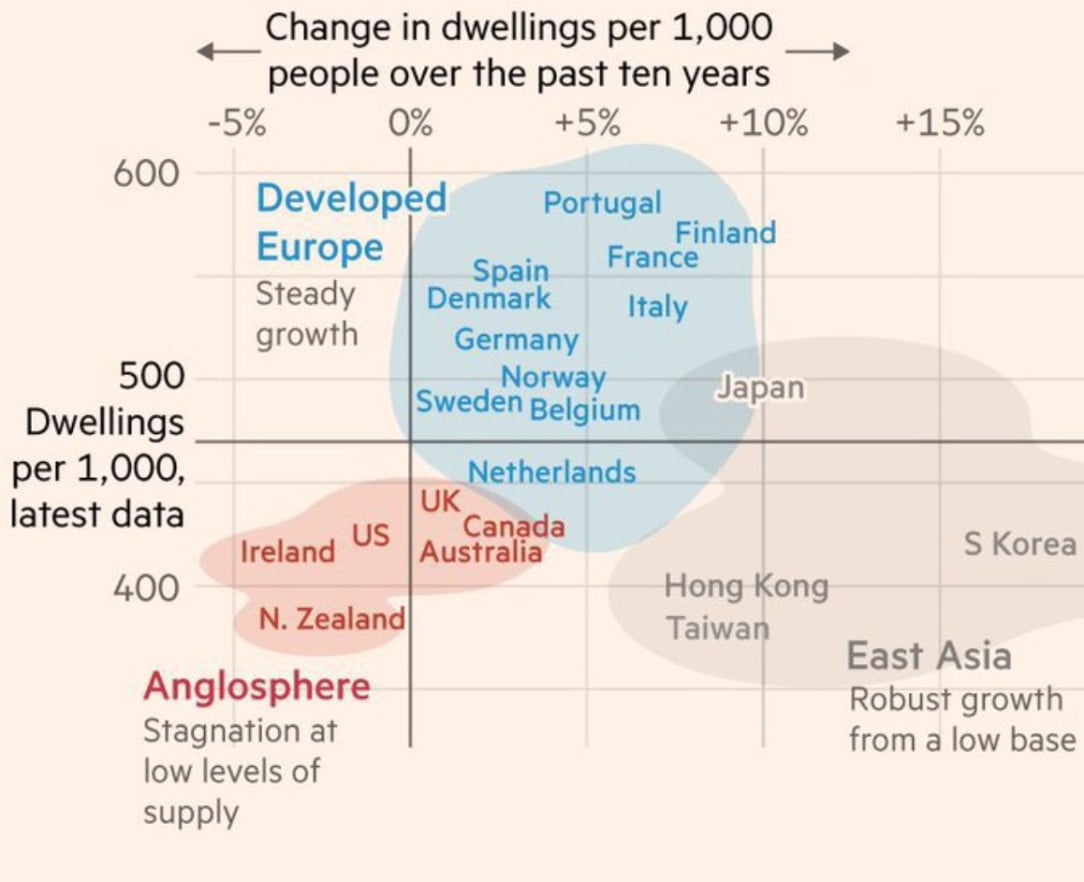
    My personal opinion is we need about 8 per 1,000 consistently over the next decade which is basically at the 41k figure in the latest housing plan. The current number of houses in Ireland is 395 per 1,000 people, 73 below the OECD average and implies about 350k units below what’s required. In crude terms over a decade with a growth of 7 per 1,000 (the 8 to he built minus 1 for obselecence) we’d be there or thereabouts with the OECD average. But I’d go further and say that might be actually be too many given the number of under-occupied homes in Ireland. We have a rate of 67% in Ireland vs. an European Average of 33%, the implication is that of occupied housing that we have at least 650k more rooms available within our existing housing stock than our peers. Even if we got halfway to that EU average, we’d free up 325k rooms. At say 3.5 rooms per housing unit, that’s not far off 100k less housing units needed here than any “average” implies.


  • Registered Users, Registered Users 2 Posts: 5,878 ✭✭✭BlueSkyDreams


    Is this under occupancy rooms figure calculated from occupied housing?

    A 4 bed house with one person living there counts as 3 unoccupied bedrooms?


  • Registered Users, Registered Users 2 Posts: 1,798 ✭✭✭spillit67


    The definition of Under-Occupied per Eurostat.

    https://ec.europa.eu/eurostat/statistics-explained/index.php?title=Glossary:Under-occupied_dwelling


    The precise number of rooms is impossible to tell, I just went for 1. Another EU measure says we have one of the highest number of rooms per member of the population at 2.1, the EU average is 1.6. This implies 2.6m ish extra rooms…(Eurostat excludes kitchens, halls, bathrooms from this as well).

    Ireland also has a lower “over-crowded accommodation” rate at 3.2%, versus 17.2% in the EU.

    Oddly we of course have a high household size relative to most of these countries, which is counter intuitive to the above but is likely largely to do with our massive supply of 3 bedroom houses used in house shares.

    So my point above on supply is that we also have to look at the type of supply and the capacity we have. I don’t believe for us to have a “normal” market that we necessarily need to be at the OECD average number of dwellings per 1,000. Sure we might prefer to all be like the Swedes and living alone at 18 but we have the housing stock we have and solutions have to be tailored to both our strengths and weaknesses. We absolutely need more studios and 1 beds but we also do have a higher proportion of higher capacity homes that are available right now and ones we are investing it to give them a longer lifespan. As much as I think it’s a waste to have UCD students in 3 bed semi Ds in Stillorgan with overgrown gardens, it’s a perfectly fine way to live in your college years as long as the rent is affordable.

    It’s one of the reasons why I’m so critical of the constant range of “we actually need X” number of houses with people not putting much further thought or detail into said statement. This is even the case with some of the Housing Commissions work, as detailed as it was.

    In order to help single people which I think is an acute issue, I’d actually argue we’d be better off building 30,000 studios and one beds a year for 3 or 4 years rather than say 30,000 of mixed studios to 5+ bedrooms (and as such, having a lot more capacity) houses as we do now. But we aren’t even having those discussions…sure it’s easier to just say “we should be building 60,000!”.


  • Registered Users, Registered Users 2 Posts: 3,526 ✭✭✭Blut2


    I presented you with the very clear CSO data on housing completions. Which show them both as stagnant over the last 3 years, and at a per capita figure far below historical achievements.

    You calling it "lies" doesn't change the fact that its the definitive data for housing in Ireland.

    The government stated target for 2025-2030 was 303,000 homes, or 50k+ per a year. A target thats undoubtedly on the lower, "more achievable" end of estimates.

    The fact every other industry analysis has shown even higher figures would point to 60k being a bare minimum.

    Which, again, suggests that 2025's figure of 24.5k homes to date, is an utter failure. Do feel free to keep tying yourself in knots writing lengthy, highly emotional, posts because you don't like the cold, hard, data though.


  • Registered Users, Registered Users 2 Posts: 1,798 ✭✭✭spillit67


    Back for more. You aren’t serious about this topic.

    Again you misrepresented the picture and it’s fairly clear you are happy to deliberately degrade any discussion on this.

    The new targets are a seperate point.

    Again I ask you to outline why you think we need 60,000 and not 93,000 homes. Based on the level of your input I don’t have much hope of an intelligible response but I’ve asked you several times now.

    Coming back every couple of days repeating the same misrepresentation and avoiding the topic just doesn’t cut it I’m afraid.


  • Registered Users, Registered Users 2 Posts: 5,046 ✭✭✭Villa05


    Timestamp

    20251108_222610.jpg


  • Registered Users, Registered Users 2 Posts: 5,046 ✭✭✭Villa05


    If your figures are correct, it would be necessary to have a functional market for it to work. The property market in Ireland has been dysfunctional for over 3 decades and that's not going to change under "no alternative" current leadership as they are doubling on policies that make the situation worse.

    In the 80s you had far more people in each residential unit, little or no short term lets. There was little price difference between Dublin and rest of the country and agriculture was the dominant industry hence the one off homes at 50% in 1981. I don't know where you were in the 80s, 2nd homes were certainly not a thing

    Again I'll say it if the government did nothing, we would build more homes as the future picture is much clearer with 0 or close to 0 interference.

    Currently the developers are well aware that the bigger the problem gets the more they can extract from the taxpayer. Provision of most expensive "social/affordable" homes in the world is far more lucrative than meeting open market demand at the highest employment/wage rate the country has ever seen. They have there people/lobbyists dictating policy. The ministers are communications trained to hoodwink the public and the dysfunction continues.

    I'm aware of several state subsidised 3 bed affordable purchase homes going to a single applicant. There is no will to tackle under utilised housing in the public sector, nevermind the private sector

    I live in an estate built in the late 60s early 70s, it's has 3,4, and 5 bed units. Many of the 3 bed units have been extended over time. At least 50% of the homes are occupied by 1 person or a couple, 3 homes are empty. The estate is walking distance to every amenity and is located in the fastest job growth region in the country.

    1 home has multiple families living with a local business nearby (Asian)

    I agree we need to be more inventive on efficient use of housing, unfortunately that's not going to happen under the current regime. It, like everything else housing related is being made worse


  • Registered Users, Registered Users 2 Posts: 5,878 ✭✭✭BlueSkyDreams


    If retired couples want to stay in their family home, thats up to them.

    Its not their fault there is a housing shortage.

    Higher LPT for larger property may help incentivise people to downsize but i dont see the govt making this change & attacking its voter base in that way.


  • Registered Users, Registered Users 2, Paid Member Posts: 24,877 ✭✭✭✭Sleepy


    With our demographics how they are, we really need to start looking at developing more retirement communities and/or assisted living facilities for aging retirees to downsize to where there could be medical assistance on-call etc.


  • Advertisement
  • Registered Users, Registered Users 2 Posts: 5,046 ✭✭✭Villa05


    I'm not calling for them to be moved. I'm looking across the pond in the UK at my uncles and aunts whose quality of life has been immensely improved by having the opportunity to downsize.

    Here in a market dictated by developers, downsizing is an expense not an equity release like it is in th UK

    If we want the worst outcomes in the worst system then Ireland is your home

    20251109_174406.jpg


  • Registered Users, Registered Users 2 Posts: 1,798 ✭✭✭spillit67


    Second homes were a thing. There were still people in Ireland quite well off, inequality was higher.

    Your argument comes down to a world of libertarian policies. I wouldn’t disagree that this would yield more homes, but I also live in the real world and that’s simply not going to happen. It’s kind of pointless having debates with people who argue the extremes on these points.


  • Registered Users, Registered Users 2 Posts: 1,798 ✭✭✭spillit67


    I am seeing a fair few two beds getting built to be fair. People could downsize to them. I know a few people who did it (one from a 4 bed to a 3 bed, another from a 3 bed to a 2 bed). In our are you could go from a fairly tired 130sqm-140sqm 3/4 bed with larger garden and get c. €700k-€750k, and move to a 95sqm 2 bed with a smaller garden for €500k. If you measure out the square metres and loss of garden & the investment needed in a new home (transaction costs and flooring), you are arguably losing out, but you are also getting an A Rated home with everything new. Cash in your pocket as well and that is far more valuable at that age than useless bedrooms and a garden too big for you to manage. It seems most don’t want this (inertia and fear of change the main thing imo) but a nudge from taxation would encourage it more.


  • Registered Users, Registered Users 2, Paid Member Posts: 24,877 ✭✭✭✭Sleepy


    I wouldn't be opposed to a reduction in or waiver of stamp duty for downsizers as a carrot to incentivise better utilisation of existing housing stock.

    My point, however, was that with our aging population, we should be looking at developing assisted living facilities. Not only do they encourage downsizing but they should alleviate some of the pressure on our health service as it would enable more retirees to live in their own home with the assistance they need at hand instead of blocking beds in hospitals or nursing homes that they don't want, and often don't need, to be in yet.


  • Registered Users, Registered Users 2 Posts: 390 ✭✭Bocadilloo


    This story of the housing estate in Meath is outrageous. A company called 'Spudmuckers'.....!!!!! The country that keeps on giving.


  • Registered Users, Registered Users 2 Posts: 2,475 ✭✭✭mrslancaster


    It’s crazy that this has been going on for so long. Its an awful situation for those buyers. Raised in the Dail.

    Report from the Meath chronicle.

    https://www.meathchronicle.ie/2025/11/19/families-face-losing-homes-and-e250000-in-deposits-as-rathmolyon-estate-developer-moves-to-liquidate-company/

    Post edited by mrslancaster on


  • Registered Users, Registered Users 2 Posts: 5,046 ✭✭✭Villa05


    An exceptionally good piece from Michael Green (known for the giant mindless robot theory on passive investing) on substack. He details how the middle classes in the USA are being wiped out. The parallels with Ireland are obvious, well worth 10 minutes of your time to read. Michael is by no means a left winger just detailing facts.

    His musings are normally behind a pay wall, this article is free

    This week, while trying to understand why the American middle class feels poorer each year despite healthy GDP growth and low unemployment, I came across a sentence buried in a research paper:

    “The U.S. poverty line is calculated as three times the cost of a minimum food diet in 1963, adjusted for inflation"

    The market isn’t just expensive; it’s broken. Seven units available in a town of thousands? That isn’t a market. That’s a shortage masquerading as an auction

    And the system is designed to prevent them from escaping. Every dollar you earn climbing from $40,000 to $100,000 triggers benefit losses that exceed your income gains. You are literally poorer for working harder


  • Registered Users, Registered Users 2 Posts: 5,046 ✭✭✭Villa05


    I had to look up the term libertarian to see what it means. Posters here longer got a laugh out of Villa05 being labelled this

    If you acknowledge that more homes would be built if the government spent nothing on demand side Imagine what could be achieved if the state switched to supply side measures with the state the buyer of last resort on unsold compliant properties removing a significant risk for builders/developers. This would encourage new entrants and reduces risk and cost of capital, thereby instantly reducing build cost

    The state could then refrain from handing over state land to developers to deliver more unaffordable homes or the most expensive social homes in the world..

    The state itself should engage builders to build on this land for affordable rental purposes thereby creating cash flow from idle land. This cash flow could potentially be reinvested to increase the pool of affordable rentals


  • Registered Users, Registered Users 2 Posts: 5,878 ✭✭✭BlueSkyDreams


    Ahead of the tenancy changes in March, a large estate agent reports that 3 out of 10 home sales this year are landlords selling up and 1 out of 10 sales are landlords buying new property.

    How deeply is this pattern affecting national rental stock?


  • Advertisement
  • Registered Users, Registered Users 2 Posts: 1,798 ✭✭✭spillit67


    The point is more about interventions vs non interventions. The evidence is quite clear that more liberal intervention across the spectrum leads to more supply. The 2000s here a clear example of that.

    But that’s not the reality of today. I don’t agree with the point on the State using the First Time Buyers grant or pre purchasing developments. If the State did not do that then we would have basically no supply right now. The evidence of that is clear when you look at how the pre funded Build To Let market collapsing resulted in apartment construction completely stagnating. If the State goes to a “buyer of last resort” I don’t think that means much in the current context beyond being a moral hazard that will backfire when inevitably the property market collapses. If the State goes for a more pro supply sided approach then I don’t think the demand point would be needed at all. By that I mean stopping the excessive regulation of apartment size, removing the effective Co-Living Ban, removing NPF targets, removing LAPs, permanently reducing the tax burden on building etc then yeah you wouldn’t need the demand side interventions. But that’s not what people want in Ireland. The CEO of Hines basically described this as the public demanding Mercedes standards for all and as such it requiring Mercedes funding for all.


Advertisement
Advertisement