Advertisement
Help Keep Boards Alive. Support us by going ad free today. See here: https://subscriptions.boards.ie/.
https://www.boards.ie/group/1878-subscribers-forum

Private Group for paid up members of Boards.ie. Join the club.
Hi all, please see this major site announcement: https://www.boards.ie/discussion/2058427594/boards-ie-2026

Who are buying all the new houses?

1171820222330

Comments

  • Registered Users, Registered Users 2, Paid Member Posts: 6,586 ✭✭✭straight


    What's wrong with a rental as a pension? I looked into it myself but decided against it. I'd prefer to own it outright myself...


  • Registered Users, Registered Users 2 Posts: 5,879 ✭✭✭BlueSkyDreams


    How many people aged under 40 today will retire with a pension that will allow them to live a comfortable retirement on that pension income alone?

    Not very many at all.

    Renting a property to supplement pension income will become very common, I expect.


  • Registered Users, Registered Users 2 Posts: 3,057 ✭✭✭donaghs


    The CSO says total “net” inward migration is closer to 80,000.
    https://www.cso.ie/en/releasesandpublications

    Based on a total of almost 150,000 inward migration.


  • Moderators, Business & Finance Moderators Posts: 11,191 Mod ✭✭✭✭Jim2007


    There are a couple of issues that makes the Irish situation different to most EU states:

    • The lack of a strong rental market with adequate protection for both landlords and tenants
    • We primarily encourage private wealth accumulation through home ownership
    • Those seeking housing will not accept any solution that does not include them getting to own a house
    • There is this notion that unlike any other consumable (like a hotel stay) renting has no value
    • The current housing policy based on the taxpayer financing the entire thing through huge debts and social housing is not sustainable.

    Under these circumstances it's impossible to make any realistic headway in addressing the housing situation. To ensure all those seeking housing could obtain a house you'd need to reduce the pricing significantly but to do so would put current owners into negative equity, reduce household wealth and cause a new banking crisis as T1 ratios would be significantly impacted. And the voters are not going to vote to make themselves poorer - younger voters more so as they have more to loose. The housing crisis is a theoretical problem for most, but negative equity is not.

    A well developed and highly regulated rental market, financed through investors is probably the only solution that remains that is likely to get the majority of the voters on side as they will not see any significant loss in household wealth. But it could take decades to get there.


  • Registered Users, Registered Users 2 Posts: 1,592 ✭✭✭Emblematic


    I think it is about 60,000 net-inward migration for this year, but the discussion was what number was for EU/UK as opposed to non-EU/UK.

    https://www.cso.ie/en/releasesandpublications/ep/p-pme/populationandmigrationestimatesapril2025/


  • Advertisement
  • Registered Users, Registered Users 2 Posts: 41,205 ✭✭✭✭Mellor


    I doubt there is any data to make it up. I suspect the poster worked it out himself and made an error.
    It’s not 7%, but ironically the 25-30% figure quoted from CSO is also no the rate. At a guess, it’s somewhere in the middle, around 15%.

    Property investing doesn’t remove houses from the market, but it also drives construction of new houses. Can’t ficus in one side only.

    Why do you think that’s a terrible idea? There are risks, like all investments but there are also some pretty strong advantages.


  • Registered Users, Registered Users 2 Posts: 2,723 ✭✭✭combat14


    will be some fun here in 10-15 or so years time when renters start to retire en masse and cant afford to pay the rents anymore


  • Registered Users, Registered Users 2 Posts: 179 ✭✭thenuisance


    A few quick reasons -

    1. Investing in property if you already own a property means that most of your wealth is in a single industry sector.
    2. Investing in a single property (as most do for retirement purposes) means you have narrowed your focus to one asset in one sector - you have no diversification - do you pick urban/suburban/rural? apartment/terrace/semi-detached/detached?
    3. In a property crash a property can be completely unsellable - plenty of examples of that in the last crash - stocks, shares etc are usually sellable at some price - they also bounce back pretty quickly
    4. Are you prepared for the responsibilities of being a landlord? And being so for the rest of your life? Or are you prepared to pay a significant sum to someone else to do the work for you?
    5. What will you do if you decide to sell the property? Where will you invest the money? Note that you will also, probably, have to pay a capital gains tax bill.
    6. Have you put as much as possible in your pension fund? That is the most tax-efficient thing that you can do. You still have to make investment decisions but you can diversify and use lower/higher risk funds as you choose. You also get a 25% tax free lump sum from your fund when you retire


  • Registered Users, Registered Users 2 Posts: 41,205 ✭✭✭✭Mellor


    Thanks for the response.

    1. It actually doesn't mean that at all. There's no reason that investing in property means you only invest in property. It is an aspect of a portfolio, not a whole portfolio.
      I also think for most people your PPR is not a true investment, although it can used that way.
    2. Similarly. There's no reason to be limited to a single property. A single property is unlikely to sufficient to meet portfolio targets.
    3. A crash is a bad time to liquidate any assets to be fair. If you need to liquidate in a crash, then choose the easily liquidate assets. Gold crashed in 2011 and it was 10 years making it back. I think its a mistake to assume shares will always bounce back. An individual stock is pretty risky.
    4. If you are asking me, Yes. I think you obviously have to be prepared to be a landlord (regardless of who manages it).
      Not sure why you think it's a "rest of your life" situation. I think that's very shorts myopic.
    5. I would invest it in whatever is appropriate at the time. CGT is not unique to property.
      Somebody buying shares is faced with the same scenario if they sell.
    6. That's applies no matter what you invest me. Don't see how it's a criticism of property specifically.

    All of those issues are criticism and risk of investing generally. Nothing there is a reason to avoid property (not to say there are no reasons). Putting everything in one property is overly risky. So it putting it all in gold. Or on Tesla stocks. Diversification is a given. The pension fund hat you mention maximising , likely includes a property portfolio.


  • Registered Users, Registered Users 2, Paid Member Posts: 28,401 ✭✭✭✭Peregrinus


    Mellor — I take your points. You're right to say that people who bought in at high interest rates profited mainly because house prices grew rapidly, but in fact the house prices and the interest rates aren't independent variables — they're both associated with the high inflation rates that prevailed during that period, which of course signficantly eroded the real burden of repaying the principal they had borrowed. High interest rates charged on a principal whose real value is rapidly declining become less burdensome quite fast.

    The people who really made out like bandits are those who bought in the mid-90s. They have benefitted from long periods since then of low interest rates and low inflation, but explosive growth in house prices. And of course those people are now in the their 50s and 60s; they're the parents of people who would now like to buy but, mostly, can't.

    And, we mostly find, they're the people among whom we find the avocadoism that I came into this thread to denounce.

    You say that . . .

    Nobody is competing with their parents.

    . . . and you're right. But they are comparing themselves with their parents. And their parents are making the same comparison. Avocadoism is one response to the comparison ("my kids are still living at home because, unlike me at that age, they spend all their money on fancy phones and trips to Barcelona") but I think we've established at this point that that's nonsense. But people may embrace it because it's more comforting than the truth — your kids being unable to leave home is a consequence of the things that have made you yourself wealthy. (In that sense, in fact, people in their 20s may be competing with their parents, in that policies which would reduce real house prices and so make housing more affordable for them will necessarily also make their property-owning parents poorer in real terms.)

    There are, of course, other possible responses, apart from avocadoism. One is the phenomenon of parents leveraging the wealth tied up in their own homes to assist their children in buying a house. But if parents do this in the expectation that the problem is a transient one — that in a relatively short period of time their children will have accrued wealth through house purchase in much the way that they themselves did — that's not going to happen.

    Another possible response is a rise in the number of multi-generational family homes — people leverage the value in their houses to adapt those houses so that they become more suitable to the purpose they now serve, and will probably have to continue to serve — e.g. by adding a granny flat, or otherwise extending the property and dividing it into more self-contained areas. I think we'll see more of this. But of course not all home lend themselves to adaptation in this way.

    Post edited by Peregrinus on


  • Advertisement
  • Registered Users, Registered Users 2 Posts: 927 ✭✭✭littlefeet


    The vast majority don't have the income to invest like that. It's more the person who, instead of having a pension from a pension provider, decides to buy a property to rent, thinking it's a great idea with no risk, and believes they will make a lot of money.


  • Registered Users, Registered Users 2 Posts: 927 ✭✭✭littlefeet


    Culture has a lot to do with it, cultures where leaving home at 18 is the norm tend to have different attitudes to renting and buying.


  • Registered Users, Registered Users 2 Posts: 41,205 ✭✭✭✭Mellor


    Somebody who does or thinks that is an idiot.
    But it's a pretty bad conclusion to take that idiot and decided that investing in property is a terrible idea.

    The same way putting everything in a single stock is overly risky. Doesn't mean that shares are a terrible idea.


  • Registered Users, Registered Users 2 Posts: 179 ✭✭thenuisance


    I think we might be at cross purposes here as I was replying to a post that included a specific point that " however, an individual investing in a property to rent as a pension is a terrible idea." Your points address a situation where an investor creates a diversified property portfolio and I would say your advice is absolutely fine in that context. For most people thinking about rental property investment for a pension they will most likely only have the funds for one or two properties. I'm not sure how many properties you would have to invest in to create a diversified portfolio but at 375k a pop or nearly 500k in Dublin you would need quite a lot in your pension pot to do that.
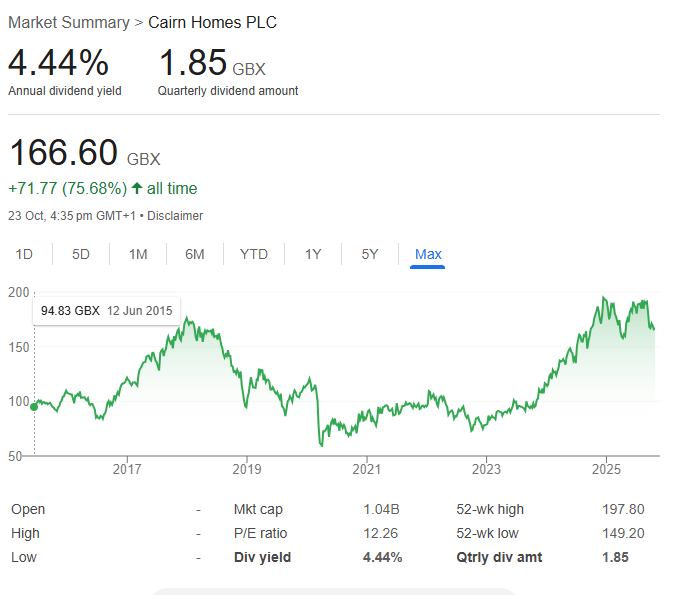
    As you point out my pension is likely (I hope) invested in property as part of a diversified portfolio and I would assume that that property investment is diversified within itself. A property fund is probably a better and more manageable investment than a property for someone with a smaller amount to invest. Even taking a single property company could do well - if you invested in Cairn Homes you would have made 115% in capital appreciation alone - dividend history shows between 4 and 7% as well.

    Out of curiosity I looked at house prices in the 5 year period - they rose by 44% nationwide 375k vs 260k and 35% in Dublin 500k vs 370k.

    Rents for a 2 bed in Dublin were 1950 (23400 pa) in 2021 (I couldnt finde earlier figures), 2500 (30000 pa) now. Assuming you bought the 370k house in 2020 and spent nothing on it (maintenance repairs, rent collection etc) you were getting 7% yield in 2021 and 8% now. And you would hope that over time that % yield would rise. Note that you would also be due property tax and any other ancillary costs that you don't pay on shares.


  • Registered Users, Registered Users 2 Posts: 41,205 ✭✭✭✭Mellor


    I think we might be at cross purposes here as I was replying to a post that included a specific point that " however, an individual investing in a property to rent as a pension is a terrible idea." 

    You replied to my post. And that's exactly the point I was referring to.

    Your points address a situation where an investor creates a diversified property portfolio and I would say your advice is absolutely fine in that context.

    Investing in property the situation where a persons portfolio includes some property elements, which is far more likely for a personal investor.

    For most people thinking about rental property investment for a pension they will most likely only have the funds for one or two properties. I'm not sure how many properties you would have to invest in to create a diversified portfolio but at 375k a pop or nearly 500k in Dublin you would need quite a lot in your pension pot to do that.

    Having a diversified portfolio, doesn't require you to own several diverse properties so that the property component is diverse. You can invest in a single property, and diversify the portfolio via other holdings: pension, shares, EFT, Crypto, Gold.

    But the massing flaw in your thinking is assume that you can only invest in property when 375-500k to buy properties outright. Are you forgetting that mortgages exist? You don't need to invest in whole properties at a time.

    A property fund is probably a better and more manageable investment than a property for someone with a smaller amount to invest. Even taking a single property company could do well - if you invested in Cairn Homes you would have made 115% in capital appreciation alone - dividend history shows between 4 and 7% as well.

    A property fund is the easy option, Spreads risk, diverse. But you have to consider that they are taking their own costs and profit out of the total gains before you see a penny.

    Cairns homes have great returns the last 24 months. But I'd not like to be somebody who bought in 2018.

    image.png

    Out of curiosity I looked at house prices in the 5 year period - they rose by 44% nationwide 375k vs 260k and 35% in Dublin 500k vs 370k.

    For completeness, what were they in the 8 year period above? I assume significantly better the the 5% loss Cairns show on the graph above.

    Rents for a 2 bed in Dublin were 1950 (23400 pa) in 2021 (I couldnt finde earlier figures), 2500 (30000 pa) now. Assuming you bought the 370k house in 2020 and spent nothing on it (maintenance repairs, rent collection etc) you were getting 7% yield in 2021 and 8% now. And you would hope that over time that % yield would rise. Note that you would also be due property tax and any other ancillary costs that you don't pay on shares.

    7-8% Yield is very good plus 6% annual average growth. Are you suggesting that that's not a great return? Not sure I follow. That's an amazing opportunity.


  • Registered Users, Registered Users 2 Posts: 927 ✭✭✭littlefeet


    An interesting piece on RTE Radio 1's Morning Ireland interview with the Irish Banking Federation and the Mortgage Brokers Association.


  • Registered Users, Registered Users 2 Posts: 4,085 ✭✭✭Rocket_GD


    Thanks for the insight and analysis of the interview, great help.


  • Registered Users, Registered Users 2 Posts: 927 ✭✭✭littlefeet


    You would find it on the catch-up, second item, I think, the people with the statistics on what's happening in the housing market, as opposed to gossip.


  • Registered Users, Registered Users 2 Posts: 4,085 ✭✭✭Rocket_GD


    You essentially did a link dump without actually providing a link.

    What's your opinion on it? What was being discussed? You're giving us nothing at all.


  • Registered Users, Registered Users 2 Posts: 927 ✭✭✭littlefeet


    I think this thread has run its course, especially when it goes off topic or those with preset agendas post, most especially if they have a political agenda. I see young people buying houses, young to me, being under 40, and that not reflected in the narrative around housing.


  • Advertisement
  • Registered Users, Registered Users 2 Posts: 2,055 ✭✭✭Stephen_Maturin


    It’s not reflected by the figures or reality either, but sure ignore that and go with the personal anecdotal observations that affirm your opinions


  • Registered Users, Registered Users 2 Posts: 179 ✭✭thenuisance


    You're shifting the goal posts again - Yes you can borrow to let but mortgage interest will reduce your yield, and increase your risk. For me, as a person with a wholly owned property, some savings and a pension fund the figures for a single property investment don't work - it will be different for others and obviously it is for you - I was sympathising with a person who suggested that 'an individual investing in a property to rent is a terrible idea' and suggesting reasons why I felt that might be the case, having come to the same conclusion - however, as one of the mods has pointed out, this thread is probably not the place for a discussion of this so feel free to create a new thread for this.


  • Registered Users, Registered Users 2 Posts: 41,205 ✭✭✭✭Mellor


    Where have I moved the goalposts? lol. The statement that I responded to “was investing in a property is a terrible idea”. If anything, talking about overcommitting to a single investment is moving the goal posts.

    Yes you can borrow to let but mortgage interest will reduce your yield, and increase your risk.

    Reduces yield, of course, but massively reduces you’re capital investment. You might need only 100k rather than the 370k+ you outlined.

    For me, as a person with a wholly owned property, some savings and a pension fund the figures for a single property investment don't work -

    Except the figures you gave suggest that it does work, even without money to invest outright. The reasons you gave didn’t hold much water imo.

    Obviously, whether it’s property, shares, etc there needs to be capital to invest. If we’re discussing whether discussing whether it’s a terrible investment, I think we should assume that there’s money to invest in one of the options.


  • Registered Users, Registered Users 2, Paid Member Posts: 6,586 ✭✭✭straight


    First time buyers are 66% of mortgage drawdowns. Through highest rate since 2007.

    https://www.podbean.com/ea/dir-wqdv8-28467968


  • Registered Users, Registered Users 2 Posts: 1,565 ✭✭✭csirl


    Older people who have their mortgages paid off are not thinking about their wealth being devalued if house prices drop. House prices are irrelevent to someone who is planning on staying in their home until they die. In fact, a drop in house price makes it easier to pass the house onto a child when they die - lower or no inheritance tax. I


  • Subscribers, Paid Member Posts: 44,928 ✭✭✭✭sydthebeat


    With inheritance tax at 400k per child, it's only a very select few ever actually get caught for it.


  • Registered Users, Registered Users 2 Posts: 41,205 ✭✭✭✭Mellor


    they're both associated with the high inflation rates that prevailed during that period, which of course significantly eroded the real burden of repaying the principal they had borrowed. High interest rates charged on a principal whose real value is rapidly declining become less burdensome quite fast.

    Agree completely. The higher the inflation leads to both - or more accurately inflation is a measurement of the change in value of the currency used to value the asset. The property value outstripped Central Bank rate + margin. Leading to banditry you mentioned.
    Inflation was so high, that the principle was so left in the dust and became increasingly trivial. But I agree that the mid 90s were the sweet spot. Escaped the high rates and inflation of the 80s, rode the property boom on the back of the tiger.

    One of the issues with looking back at how great that turn out, it that it leads people to assume that history will repeat itself. When in reality, high interest and high inflation is not a great out look for the future.

    . . . and you're right. But they are comparing themselves with their parents. And their parents are making the same comparison. Avocadoism is one response to the comparison ("my kids are still living at home because, unlike me at that age, they spend all their money on fancy phones and trips to Barcelona")

    Avocadoism is a good word to describe it. It's unfair entirely. Lift is simply a more complicated financially now. We have more outgoings, they are not isolated to Gen Y or Z. Boomers have netflix, internet and mobile phones too.
    And sure, people are going out for brunch more now. But they are probably going out sinking pints less. People did save better back in the day. The target was simply close to their income. Income to cost ratio is the only fair measure.

    As an aside. I failed to purchase at an auction on Saturday. Outbid by 1 increment. Went for brunch afterwards, considered ordering avocado on toast, but bacon and egg won me over.

    e.g. by adding a granny flat, or otherwise extending the property and dividing it into more self-contained areas. I think we'll see more of this. But of course not all home lend themselves to adaptation in this way.

    A major issue with that approach is compliance. There are many of the companies offering garden rooms, that are subverting planning law and building regulations by classing these structures as essentially sheds - while clearly marketing them as liveable spaces. The planning issue might resolve itself. But the long term value of a structure will a 12 month warranty is pretty poor. Very quickly people will find out that the $50k investment in the garden adds little value and is an insurance risk


  • Registered Users, Registered Users 2 Posts: 4,072 ✭✭✭Ozymandius2011


    Most legal non-EEA immigration is now from the work permit system. They need somewhere to live, which means they buy or rent houses. The laws of demand and supply dictate the price goes up.

    As with the previous boom, the politicians are doing this to push up house prices in my opinion. The Daily Mail and other publications have named people linked to FG who have become millionaires from providing accommodation.

    A number of providers of asylum accommodation are offshore companies.

    It may be true that the government cannot fully control asylum numbers, but they can control how many work permits they issue.


  • Registered Users, Registered Users 2, Paid Member Posts: 28,401 ✭✭✭✭Peregrinus


    A major issue with that approach [multi-generational homes] is compliance. There are many of the companies offering garden rooms, that are subverting planning law and building regulations by classing these structures as essentially sheds - while clearly marketing them as liveable spaces. The planning issue might resolve itself. But the long term value of a structure will a 12 month warranty is pretty poor. Very quickly people will find out that the $50k investment in the garden adds little value and is an insurance risk.

    Yeah, there are serious issues here. But in the end political pressures to do something about housing affordability combined with market pressures from people who have money, just not enough to buy a house, will have an impact. The regulatory regime may adapt well or badly to this, but it will have to adapt to some extent. Multi-generational housing is an obvious possible response to housing unaffordability; in countries where housing has historically been expensive, relative to earnings, multi-generational homes are a familiar phenomenon. Australia, famously, builds the largest new houses in the world, and it increasingly sells them to people whose children are already, or will soon be, old enough to leave home. It looks to me as though there must be some potential there. So I suspect this is something we will see more of, and it won't just be a matter of prefabricated garden rooms.


  • Advertisement
  • Registered Users, Registered Users 2, Paid Member Posts: 28,401 ✭✭✭✭Peregrinus


    I gotta say that this is verging on conspiracy theory territory. The cromulent explanation for the issue of work permits is that it's a response to the needs of the labour market. If you want people to take seriously the notion that it's actually a scheme to inflate house prices, step one is to assemble some evidence suggesting that it isn't a response to labour market pressures.

    Even with that, I'd be very sceptical. The political price paid by the last generation of politicians to preside over a house price bubble was huge. There might be individual politicians who are stupid enough to want for corrupt personal reasons to stoke another house price bubble, but at the level of the government or the party it would be instantly recognised as suicidal madness. And, while you can point to "people linked to FG" who have become millionaires from providing accommodation, you can point to many more who have not; why would they play along with such an obviously corrupt and self-harming scheme, from which they would derive no benefit and for which they would pay a high political price?


Advertisement
Advertisement