Advertisement
Help Keep Boards Alive. Support us by going ad free today. See here: https://subscriptions.boards.ie/.
https://www.boards.ie/group/1878-subscribers-forum

Private Group for paid up members of Boards.ie. Join the club.
Hi all, please see this major site announcement: https://www.boards.ie/discussion/2058427594/boards-ie-2026

Nuclear - future for Ireland?

1838486888999

Comments

  • Registered Users, Registered Users 2, Paid Member Posts: 15,604 ✭✭✭✭josip


    How are the fines calculated and how is it already known we will pay €28 Bn in 2030?


  • Registered Users, Registered Users 2 Posts: 9,127 ✭✭✭Markcheese


    Projections, I suppose. ?

    The current generation mix is likely to stay much the same ..

    There's nothing radical going to be built or bought by 2030, ( could argue that the increase in electricity use by data centers , and their projected increase by 2030 is pretty radical )

    So greenhouse gas emissions from electricity generation is likely to be fairly predictable..

    Slava ukraini 🇺🇦


  • Registered Users, Registered Users 2, Paid Member Posts: 15,604 ✭✭✭✭josip


    The only place I can find the €28bn in fines mentioned is in a report in April from the Irish Fiscal Advisory Council and the Climate Change Advisory Council. It said between €8bn and €28bn. But my understanding that was for all carbon emissions. Not just electricity generation. Unlike the following statement which implies it's solely due to a lack of NPP. And also chose the maximum value in the 8-28bn range in the report for some reason.

    Nuclear is not the reason we will be paying €28 Bn. in fines in 2030 and at least €8 Bn a year for every year after that until the end of time. The reason is the lack of nuclear and a failed generation policy on renewables…


  • Registered Users, Registered Users 2 Posts: 16,599 ✭✭✭✭charlie14


    We are not going to avoid fines in 2030 or in 2050 following this current plan.

    The EPA has made it clear that even if all present plans for 2030 were implemented we would only have 23% of the 51% emission reductions required. And that was before the Sceirde Rocks 450MW fixed wind farm debacle, so the fine will be highly likely to be even greater for 2023 than €28 Billion. Something anyone with even a vague knowledge of the West of Ireland had warned would happen, but was ignored by idiots dreaming of floating wind farms off the West coast.

    The current plan is for 37GW of an offshore wind/hydrogen hybrid to get us to our projected demand of 14 -15GW for 2050 and I have posted here already how that would still leave us - after spending economically ruinous money with addition capital investment required every 15 -20 years - still burning the same volume of gas every year as we are now, paying fines of €8 Billion+ every year, and having the highest priced electricity on the planet from a strike price of double that of Hinkley c.


  • Registered Users, Registered Users 2, Paid Member Posts: 1,513 ✭✭✭riddlinrussell


    Yes I am well aware we are not going to avoid fines with the current plan, that is not what I asked

    Boards is in danger of closing very soon, if it's yer thing, go here (use your boards.ie email!)

    👇️ 👇️


  • Advertisement
  • Registered Users, Registered Users 2, Paid Member Posts: 15,604 ✭✭✭✭josip


    Just to counter the disinformation being spread on this thread, Ireland is not certain to be fined €24bn in 2030 if it fails to meet its emissions targets. The potential fine is in the range of €8bn to €28bn. The emissions targets are a 51% reduction compared to 2018 across all sectors, not just electricity. So to imply that we will be fined €28bn due to not having NPP generation is absurd.


  • Registered Users, Registered Users 2 Posts: 16,599 ✭✭✭✭charlie14


    I didn`t say the €28 Billion was just for electricity generation. Electricity generation accounts for 30% of emissions. €8.4 Billion of that €28 Billion, and for the last few years we have been disguising what the true level of emissions are by importing electricity (14% last year) from a country that is itself an importer of electricity. And that is not going to last.

    €8.4 Billion being thrown away on fines isn`t far off from what Finland paid for a 1.6 GW nuclear plant that even being years late and over budget would have provided 25% of our current peak demand.

    Even that €8.4 Billion is highly likely to increase with Sceirde Rocks 450MW no longer going to figure in the 2030 emissions reductions


  • Registered Users, Registered Users 2 Posts: 16,599 ✭✭✭✭charlie14


    If you are then you must have some other plan in mind, or are you just in favour of continuing with the current plan that will not only leave us with the most expensive electricity on the planet and still have us paying fines forever and a day ?


  • Registered Users, Registered Users 2, Paid Member Posts: 1,513 ✭✭✭riddlinrussell


    I want to know how, going with your plan of Nuclear will avoid the fines we will endure from 2030 in the time between now and when the first Irish NPP is built.

    I have already said that I am not in favour of the current plan but you're the one who keeps going on about the fines, so surely you have the fix?

    Boards is in danger of closing very soon, if it's yer thing, go here (use your boards.ie email!)

    👇️ 👇️


  • Registered Users, Registered Users 2 Posts: 16,599 ✭✭✭✭charlie14


    To be clear, are you saying that you do not believe in the current plan that nobody that supports it can put a price too that will also have us paying at least €8.4 Bn. in 2030 and further billions for every year after that, but you have no ideas as to a possible alternative. ?

    TBH I could not be bothered with wasting my time with the crap search facility on this site checking, but were you not at one stage all in favour of that plan.


  • Advertisement
  • Registered Users, Registered Users 2 Posts: 4,208 ✭✭✭Ardillaun


    We’re not a huge country but we do live on a big island as far as islands go, the twentieth biggest. The vast majority of islands are smaller than Ireland. Britain is bigger but it’s not Greenland and they can manage nuclear power stations. Given our litigiousness and nimbyism, I doubt whether we could ever agree on a site for one. The other big question is, would it even be a good idea? I haven’t seen a consensus emerging to answer that question, just endless furious debate over the decades.

    Post edited by Ardillaun on


  • Registered Users, Registered Users 2, Paid Member Posts: 1,513 ✭✭✭riddlinrussell


    sigh you will never just answer a question...

    I have always maintained that the current plan is flawed, potentially fatally. Where we differ is that I feel renewable energy is and will going forward need to play a significant role in our energy make up, while you appear to want us to burn as much gas as we can until some unspecified time in the future where we:

    a) have politicians who want us to build nuclear (timeline for this is God knows how long, when are you and your pro nuclear party running for the Dáil?)

    b) have spent somewhere in the region of 5-10 years getting a Nuclear Plant through our incredibly slow planning process (all being well)

    c) have spent 7 years (optimistically) building a plant

    So we need solutions for the 12-17+ years until then. I say a bug part of that will need to be renewable to minimise (not avoid) fines. What say you?

    Boards is in danger of closing very soon, if it's yer thing, go here (use your boards.ie email!)

    👇️ 👇️


  • Registered Users, Registered Users 2 Posts: 1,599 ✭✭✭gjim


     you will never just answer a question...

    That’s how he rolls. He’s a bad faith participant who will never address even a vaguely challenging question or acknowledge the most simple and obvious factual error. And he seems to labor under the delusion that this behavior is not obvious the everyone.


  • Registered Users, Registered Users 2 Posts: 16,599 ✭✭✭✭charlie14


    The current plan is not just flawed and continuing with it is not just potentially fatal, it would be fatal for our economy spending money that nobody who supports it can put a figure to, that would leave us with a strike price twice that of Hinkley C, not even provide our projected demand for 2050 which would see us with the same emissions we have now and would require further capitalization every 15 -20 years.

    Politicians are notoriously lazy and will not rock the ship. Especially if they have backed a plan that is not working. A survey a few years ago showed a 50/50 split of those that favoured or did not favour nuclear here, with a higher percentage in favour by those under 25. If there was a real open discussion on this current plan and the costs I believe the percentage in favour of nuclear would increase to the level where politicians would have no option.

    If a nuclear plant can be constructed in 7 years I don`t see why it should take even up to 5 years to get through planning. Especially when there were no problems changing planning rules to speed up the installation of renewables.

    No business keeps pumping money into a proven failed strategy - and less than 23% for a target of 51% that is going to cost at least €8.4 Bn. - is a failure. Not just for 2030 but for 2050 as well where it will not even provide our projected needs and will have us paying billions in fines forever for no discernible reason. At least by investing in nuclear there would be an end in sight on fines, as well as - even if based on the most expensive nuclear those opposed could find - provide electricity at half the price that this current plan would.


  • Registered Users, Registered Users 2 Posts: 16,599 ✭✭✭✭charlie14


    Get over yourself.

    I have provided verifiable figures here that show how economically disastrous for our economy continuing with this current plan would be. You, as far as I know, or anybody else who supports this current plan has given a single figure as to what the financial cost would be, but now is your chance.

    Rather than pithy little comments, let`s see your figures to justify it. Plus the resulting electricity price and when we will get to the stage we would no longer be paying fines for emissions.


  • Registered Users, Registered Users 2 Posts: 4,062 ✭✭✭Ozymandius2011


    I used to be totally opposed to it in Ireland.

    However, some are saying that an accident or leak at a fusion Reactor would not produce Chernobyl type affects.

    If thats true, I would be more open to it.

    Post edited by Ozymandius2011 on


  • Registered Users, Registered Users 2 Posts: 4,208 ✭✭✭Ardillaun


    Most issues tend eventually towards a consensus, eg man-made climate change, but on the question of nuclear power I remain as confused today as I was decades ago. Is it a vital part of a fossil fuel-free future or an expensive and dangerous distraction? I can’t even grasp enough solid facts reasonable people agree on to have an opinion.

    Post edited by Ardillaun on


  • Registered Users, Registered Users 2, Paid Member Posts: 3,300 ✭✭✭KrisW1001


    Chernobyl was a Fission reactor; there’s no other kind of nuclear reactor in service.


  • Registered Users, Registered Users 2 Posts: 4,062 ✭✭✭Ozymandius2011


  • Registered Users, Registered Users 2 Posts: 21,873 ✭✭✭✭cnocbui


    France produced more zero carbon electricity in 2023 than the total amount it consumed, due to the large proportion of nuclear generation. That's the 2050 EU targets already exceeded. Ireland, Denmark and Germany haven't a hope, having bet on renewables.

    Nuclear is cheaper than renewables. It's anything but a distraction. Even Italy has woken up and is about to legislate to allow for nuclear. The Netherlands, Poland and Czech Republic are all in the process of acquiring reactors.


  • Advertisement
  • Registered Users, Registered Users 2 Posts: 4,208 ✭✭✭Ardillaun


    Yes, France seems like a good example to me until I read the next post. Is there anything you and your critics here can agree on when it comes to nuclear power? With power generation one would think there should be a lot of common ground. It is science and engineering.

    Let’s take just the challenges of getting a reactor up and running in this country. If a decsion was made tomorrow to go ahead, how long would it take to see power being generated, realistically speaking? In fairness that’s not just a technological question but anyway.

    Post edited by Ardillaun on


  • Registered Users, Registered Users 2, Paid Member Posts: 3,300 ✭✭✭KrisW1001


    Planning is the hard part, but that’s not a technological question, so here’s the technological answer:

    The fastest construction of a current generation nuclear power plant on a new site is eight years from breaking ground to grid connection (Barakah 1-4, Abu Dhabi).

    Excluding countries that routinely use slave labour, South Korea got Shin Kori #7 (a reactor of the same design as used in UAE) up and running in eight years, but that was an expansion of an existing facility, so there’s a time saving from using existing infrastructure. The average of all deployments of this model in Korea is about 9 years, all at existing nuclear facilities.

    The worst-case construction (excluding abandoned projects) is eighteen years at Olkiluoto unit 3, Finland - again, an extension of an existing site. Hinckley Point C in the UK is heading toward 14 years, but isn’t likely to be break that record.

    So, on a brand new site in a country with no existing nuclear infrastructure that obeys human rights laws, the best case is likely to be 10 years (8-9 for the reactor, 1-2 for the rest of the nuclear infrastructure) and worst case is 18.


  • Registered Users, Registered Users 2, Paid Member Posts: 15,604 ✭✭✭✭josip


    Unlikely to be a problem here when we eventually do get NPPs. According to the IEA

    In July 2025, electricity generation from nuclear power in Switzerland nearly halved year-on-year (-46.8% y-o-y, -1.0 TWh), due to environmental constraints caused by a severe heatwave. High temperatures made river water used for cooling nuclear reactors exceed regulatory safety limits. Despite this sharp decline, nuclear power continued to represent a significant share of total electricity generation in the country, accounting for 18.1%.

    But in some countries nuclear will need non-nuclear backup to deal with this scenario?


  • Registered Users, Registered Users 2 Posts: 16,599 ✭✭✭✭charlie14


    Not suggesting that data being somewhat misleading is anything to do with you, but as far as I can see the year on year percentage is just for the month of July 2025 where nuclear generation was down 1 TWh.

    Switzerland`s 4 reactors generate 24 TWh per year, so rather than the 46.8% the data suggests, that 1 TWh represents just ~4% of nuclear generation, and less than 1% of the total Swiss generation of 431.7 TWh in 2024.

    These things happen. You have only to look at our own generation from renewables this week to see how we also needed a lot of backup and imports due to very little sunshine or wind.


  • Registered Users, Registered Users 2, Paid Member Posts: 15,604 ✭✭✭✭josip


    Yes, that's the correct interpretation. It's the IEA monthly YOY update so only relates to July. But Switzerland will nevertheless have needed to cover for that loss from some other source, probably either gas or interconnectors. If a country went more all-in on nuclear than Switzerland then they would have to factor in a lot more alternatives for the overheating scenario.


  • Registered Users, Registered Users 2 Posts: 1,672 ✭✭✭Busman Paddy Lasty


    Dunkelflaute gets mentioned here a lot. The last few days have been a bit dark and not windy. But if every July and August are going to be too hot for nuclear then "Sonnenschein heiß" will be heard quote often.


  • Registered Users, Registered Users 2 Posts: 16,599 ✭✭✭✭charlie14


    Perhaps but not necessarily.

    Switzerland is a net importer of nuclear power, but not by much. The latest figure I could find is for 2022, and I doubt it has changed much since.

    In 2022 Switzerland exported 297 kWh and imported 331 kWh of nuclear generated electricity. Their exports are mainly during the Summer months and by far the largest are to Italy and Germany. So really the odds are that although the reduction in output during July may have put a small dent in the revenue they received for exporting nuclear, the didn`t need to factor in anything for the loss domestically, whereas Italy and Germany, presently neither of which generate using nuclear, had too.


  • Moderators, Recreation & Hobbies Moderators, Science, Health & Environment Moderators, Technology & Internet Moderators Posts: 98,142 Mod ✭✭✭✭Capt'n Midnight


    The contract for Barakah in UAE was awarded in 2009.

    The closing date for tenders was September 07, 2008 and the 4th reactor only started commercial operation on the 5th of September last year.

    That's 16 years from when the suppliers submitted their tenders.


  • Registered Users, Registered Users 2 Posts: 16,599 ✭✭✭✭charlie14


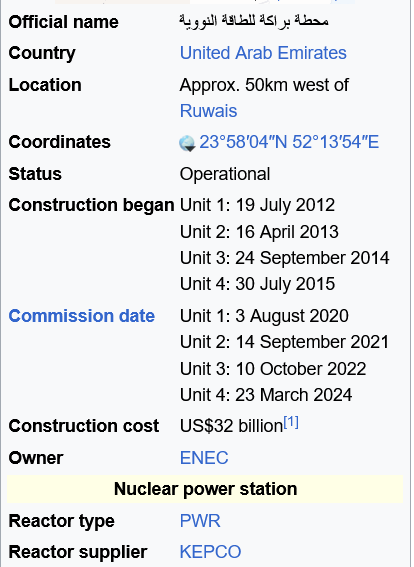
    Screenshot 2025-10-17 at 23-18-30 Barakah nuclear power plant - Wikipedia.png

    From the beginning of construction until commissioning the time for those four APR-1400 ranged from 8 years and 2 week to 8 years and 7 months. An average of 8.25 years.

    That is for not just a country that built it`s first four nuclear plants, but the first in the Arab world to do so.

    Those four reactors give the UAE an installed capacity of 5.6 GW - close to our present peak demand - for €27.44 Bn. At a capacity factor of 94% that is 1GW generated for €5.21 Bn. One third the cost of offshore wind turbines.


  • Advertisement
  • Registered Users, Registered Users 2, Paid Member Posts: 3,300 ✭✭✭KrisW1001


    Yes, I know this, but the question was only about the technical part of the process, so the times I gave were for how long it takes to build a reactor. That's the very fastest that the thing can happen if every other thing went right.


Advertisement
Advertisement