Advertisement
Help Keep Boards Alive. Support us by going ad free today. See here: https://subscriptions.boards.ie/.
https://www.boards.ie/group/1878-subscribers-forum

Private Group for paid up members of Boards.ie. Join the club.
Hi all, please see this major site announcement: https://www.boards.ie/discussion/2058427594/boards-ie-2026

Nuclear - future for Ireland?

1818284868799

Comments

  • Registered Users, Registered Users 2, Paid Member Posts: 1,513 ✭✭✭riddlinrussell


    I'll add "Time for the Irish government to enact Legislation to fix the Irish Government's poor record on processing projects and A(B/C)Ps planning failures" to that timeline then....

    You seem to operate under the misapprehension that the Irish legislative framework operates at anywhere near the efficiency of the Dutch system, which seems fairly optimistic to say the least.

    What is wrong with taking planning timelines from similarly large scale projects, similarly "new to Ireland, well established elsewhere", with similar budgets in Ireland as a rough estimate of the time to even get a shovel in the ground?

    I'm very in favour of an NPP, but that doesn't mean one has to be a fabulist regarding the realities of getting things to construction stage in Ireland, even where there is almost unanimous political support (Metrolink)

    Boards is in danger of closing very soon, if it's yer thing, go here (use your boards.ie email!)

    👇️ 👇️


  • Registered Users, Registered Users 2 Posts: 16,604 ✭✭✭✭charlie14


    Paddy I have no idea how long you have been on this forum, but there have been nuclear threads where originally many of the posters were comparing how much more financial sense renewables made as opposed to nuclear, but not many doing that for some time now. If it was ok then, I don`t see why it isn`t ok now.

    It`s not as if this thread is about building nuclear plants to create weapons of mass destruction. If it was then there would be little or nothing to discuss. It`s about nuclear plants for electricity generation, so if you do not want to see any other options in relation to that, what do you want to discuss in relation to nuclear. ?

    From what I can see @cnocbui has addressed that posters questions and is wait for a reply


  • Moderators, Recreation & Hobbies Moderators, Science, Health & Environment Moderators, Technology & Internet Moderators Posts: 98,171 Mod ✭✭✭✭Capt'n Midnight


  • Moderators, Recreation & Hobbies Moderators, Science, Health & Environment Moderators, Technology & Internet Moderators Posts: 98,171 Mod ✭✭✭✭Capt'n Midnight


    image.png

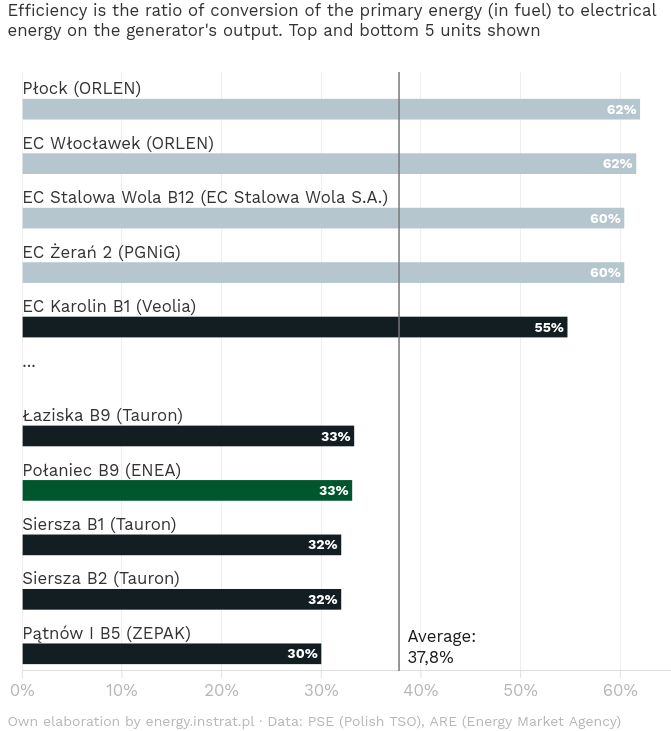
    Poland's newest gas plants have about twice the thermal efficiency as the oldest coal plants.

    Gas has roughly half the CO2 emissions as coal Because most of the atoms are hydrogen rather than carbon.

    So as a thought experiment (because gas supply is a political issue) if you replaced the coal plants with gas you'd have 1/4 of the CO2 emissions.

    Zero Emissions nuclear arriving in 15 years time to replace would take another 45 years to catch up with replacing the worst coal plants with gas now. And that's assuming no delays, there's always delays. And assuming there's no biogas or fuel to energy and that the gas plants are run constantly regardless of how renewables are producing.

    Nuclear is the wrong solution looking for a problem that no longer exists. We won't need GW's of baseload when our grid will operate with as little as 5% synch generators because hydro , CHP and biomass can already provide that much.


  • Registered Users, Registered Users 2 Posts: 16,604 ✭✭✭✭charlie14


    No idea where you are getting that $20 billion (€17.17).

    In April 2024 Jan Chadam, the commercial proxy for Poland`s power plant developer told an energy conference "Of course we do not have the final value of this project, but one can imagine it will be around PLN 150 Bn." That is €36 Bn. not the €17.17 you are claiming.

    At €46 Bn that would still work out at €13 Bn per GW. That is €4.5 Bn - €5 Bn per GW cheaper than Hai Long or Revolution Wind offshore and a plant that would have 3 times the operating life of either.

    Financially there really is no comparision


  • Advertisement
  • Moderators, Recreation & Hobbies Moderators, Science, Health & Environment Moderators, Technology & Internet Moderators Posts: 98,171 Mod ✭✭✭✭Capt'n Midnight


    image.png

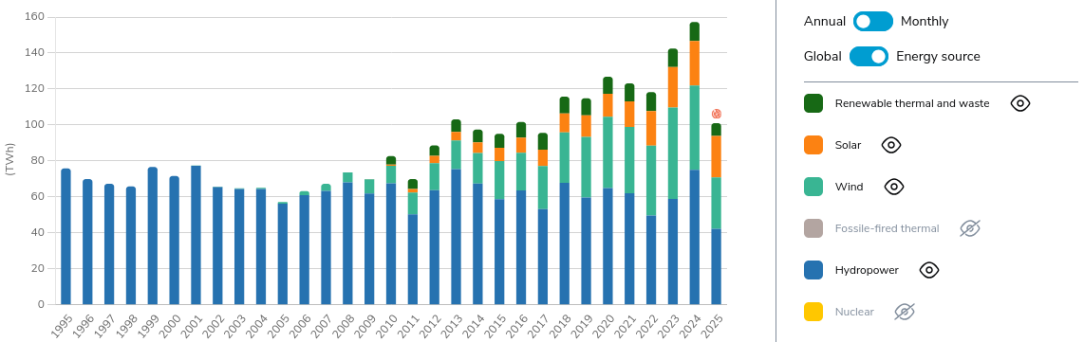
    France produced nearly 160TWh from renewables in 2024 vs nett exports of 89TWh.

    image.png

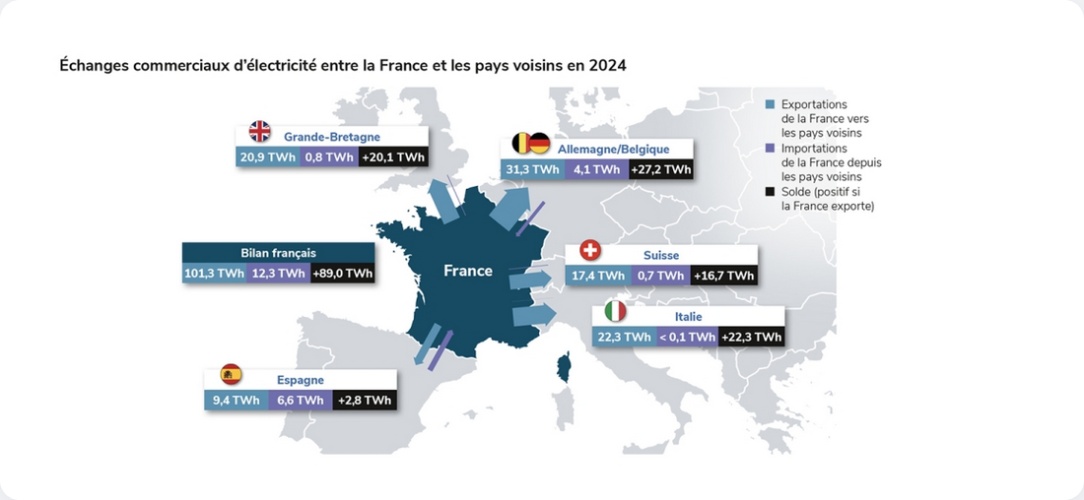
    France also imports electricity 12.3TWh last year. Nett exports in 2023 were 50.1TWh because of 25.3TWh of imports.

    In 2022 France exported 40TWh but also imported 57TWh

    Note Domestic demand fell 6% in 2024.

    Sweden has 7GW of nuclear, 16GW of hydro and 17GW of wind. So obviously it's the nuclear the were exporting :rolleyes:

    BTW Jellyfish disrupt French nuclear power plant for second time in a month - nuclear is just sooo dependable. This time it was Paluel. At this time of the year a third of the nuclear plants are offline so it would have greater impact on the grid , in addition to loosing a lot of generation locally.

    It's not unexpected as it's happened before to nuclear plants in Japan , Scotland , California, Florida , Sweden and South Africa. And it will get worse with climate change and overfishing.


  • Moderators, Recreation & Hobbies Moderators, Science, Health & Environment Moderators, Technology & Internet Moderators Posts: 98,171 Mod ✭✭✭✭Capt'n Midnight


    Maybe look at the link ?

    image.png

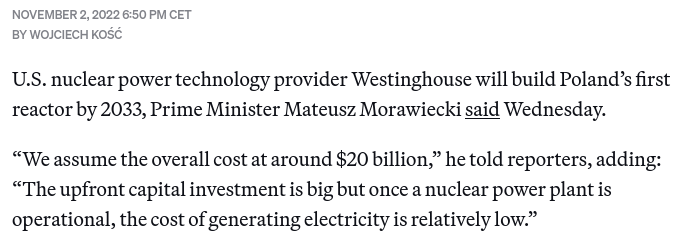
    The phrase used was Overall Cost and the date given was 2033

    You have to include the cost providing alternative power for the 15 years it will take to deliver the nuclear plant. You could use the insane subsidies for eco-disaster that is DRAX as a baseline.

    Replacing old coal with gas now would lead to carbon emissions now. Waiting for nuclear means waiting 60 years to achieve the same savings and that's only if don't use alternatives to gas like renewables or biogas during those 60 years.

    Nuclear will arrive too late to reduce carbon emissions here. The best it can do is increase them for at least 60 years.


  • Registered Users, Registered Users 2 Posts: 16,604 ✭✭✭✭charlie14


    Sweden has four electricity zones. The northern zones are supplied predominately by hydro. The southern zones by wind and nuclear. Last year when wind went for another of its prolonged snoozes all over Europe, Sweden included. Prices to Swedish consumers, due to Germany draining Sweden`s electricity during that prolonged period, were at times 190 times higher in the south than in the north. So what generation was Germany draining ? I`ll give you a hint. It wan`t wind.

    Sweden`s Energy Minister Ebba Busch had no doubts and didn`t mince her words when doing so. Or leaving anyone else in any doubts that it was due to Germany shutting down their nuclear plants for nothing other than an ideology.

    No chance of you having a bit of sense when it comes to France either I see. When demand is high for French electricity exports, France like the rest of Europe, has nothing to export from wind, and the idea that these exports are all from hydro or solar are farcical. It`s like a child insisting that 2+2 is 5.

    Nobody lost power either locally or nationally in France due e short amount of time it took to clean those jellyfish out of filters, and nuclear generation is not adding to emissions. Te direct opposite in fact.


  • Registered Users, Registered Users 2 Posts: 16,604 ✭✭✭✭charlie14


    Did you miss that price per GW is ~ €5 Bn. cheaper than wind and will generate at a capacity factor three times that of wind and have a generation life of three times longer ?

    Why do you keep mentioning Drax to me ? I have lost count of the number of times I told you I look on Drax as a complete con.

    Following our present plan will cost €425 Bn. for the offshore alone. With hydrogen thrown in nothing much short of half a Trillion, and we would still be paying €7Bn - €8 Bn annually in fines up to and beyond 2050. We would have by a country mile the most expensive electricity on the planet and have to refinance the whole shambles every 20 -25 years and still need that "something else" for the grid to function.

    For a population of 5 million odd that really is beyond insanity.


  • Moderators, Recreation & Hobbies Moderators, Science, Health & Environment Moderators, Technology & Internet Moderators Posts: 98,171 Mod ✭✭✭✭Capt'n Midnight


    17 years. That's the minimum time in Western Europe to go from tender to get a new new nuclear power plant in Finland, France, UK , Czechia and Poland. And we are nowhere near the tender phase.

    Our current plan is to use renewables to get down to a few % of our current emissions during that time.

    The maximum possible emission savings for a plant that starts full commercial operation in 17 years time is 8% in year one. 7% in year two, 6% in year 3 three etc. and down to nothing at all after 2050 because we should be nett zero by then.

    So the maximum total possible lifetime emissions saving from a nuclear plant here, if we put out the tender tomorrow, is 36% of one year of current emissions. A one year delay would reduce those emissions savings to 24% of one year ie. three months.

    Please clarify how we'd keep the lights on for 17 years while waiting for nuclear, without significantly more emissions than using renewables.

    Nuclear can't arrive in time to make any meaningful reduction to carbon emissions because we should be at net zero in 2050.


  • Advertisement
  • Registered Users, Registered Users 2 Posts: 16,604 ✭✭✭✭charlie14


    The average build stage is 7 years. Anything longer than that would be due to how long it would take us to get our asses in gear.

    What you are advocating is a spend of half a Trillion euro for a plan that would not only not see us at net zero by 2050 but also have us paying €7 Bn - €8 Bn every year in fines on top of that, and leave us with a strike price for the consumer that would be at least double that of the most expensive nuclear you could find.

    Are you so blinded by your hatred of nuclear or do you not have the first clue when it comes to finance that you cannot see how insane those figures are for a country with a population of 5 million.

    Our economy would be wiped out long before 2050 following what you are advocating.


  • Registered Users, Registered Users 2, Paid Member Posts: 1,513 ✭✭✭riddlinrussell


    Cool story on build stage, if your opinion of the Irish government's planning speed is as rosy as your projections for building the plant then you've got bigger issues...

    I don't really have any objections to your timelines on building a plant, even if they might be a little optimistic. But the Irish Government/Bureaucracy does not do novel major projects at anything more than a glacial pace, you cannot keep bigging up 7 year build times and pretending that is the entire time frame.

    We need to reduce emissions now, not in 7 years, not in 16 years. You cannot just say we can rely on gas alone until a NPP is built.

    What is your solution to emissions between now and then

    Boards is in danger of closing very soon, if it's yer thing, go here (use your boards.ie email!)

    👇️ 👇️


  • Registered Users, Registered Users 2 Posts: 21,876 ✭✭✭✭cnocbui


    A recent article still seems to imply that Westinghouse are confident in a 2036 start.

    The design of the nuclear reactor for Poland is ready! When will construction begin?

    May 20, 2025
    9:31 a.m.
    The design of the AP1000 reactor, which will power Poland's first nuclear power plant, has been finalized. Westinghouse is freezing the documentation and completing the design phase without further modifications. This is an important step towards the start of construction in Lubiatowo-Kopalino.

    Westinghouse has completed work on the AP1000 reactor design for Poland. As Lou Martinez Sancho, vice president of technology development, emphasizes: “The technology and complete documentation for the AP1000 reactor have undergone the licensing process in the US and have been verified. The design documentation is, as we say in the industry, ‘frozen’ and ready for implementation.”

    The company notes that it will no longer modify the basic design or safety systems, which will reduce the risk associated with possible changes to the documentation.

    Modular construction and digital documentation
    The AP1000 design consists of 52 main modules that will be prefabricated and assembled on site. The design for Poland is completely digitized. Westinghouse only anticipates optimizations in the area of assembly, using artificial intelligence, among other things.

    Construction of the first nuclear power plant will begin in Pomerania, in the Lubiatowo-Kopalino location. The investor will be Polskie Elektrownie Jądrowe (PEJ). The plan is to build three units, each with a capacity of 1,110 MW, and the first concrete will be poured in 2028. The first unit is scheduled to start operating in 2036.

    So Westinghouse are planning for an 8 year construction time, which is the same as the average time KHNP has taken to build 7 reactors to date. I have no confidence Westinghouse will meet that schedule, but I would have confidence KHNP could, however they have withdrawn from the plan to build 2 reactors in Poland, likely due to licensing pressure from Westinghouse, which would also be why they had to pull out of the Netherlands bid. They do seem to have a licence allowing the Czech project to go ahead. Looks like Westinghouse have stitched up the EU market as far as foreign built reactors go, apart from Czechia.

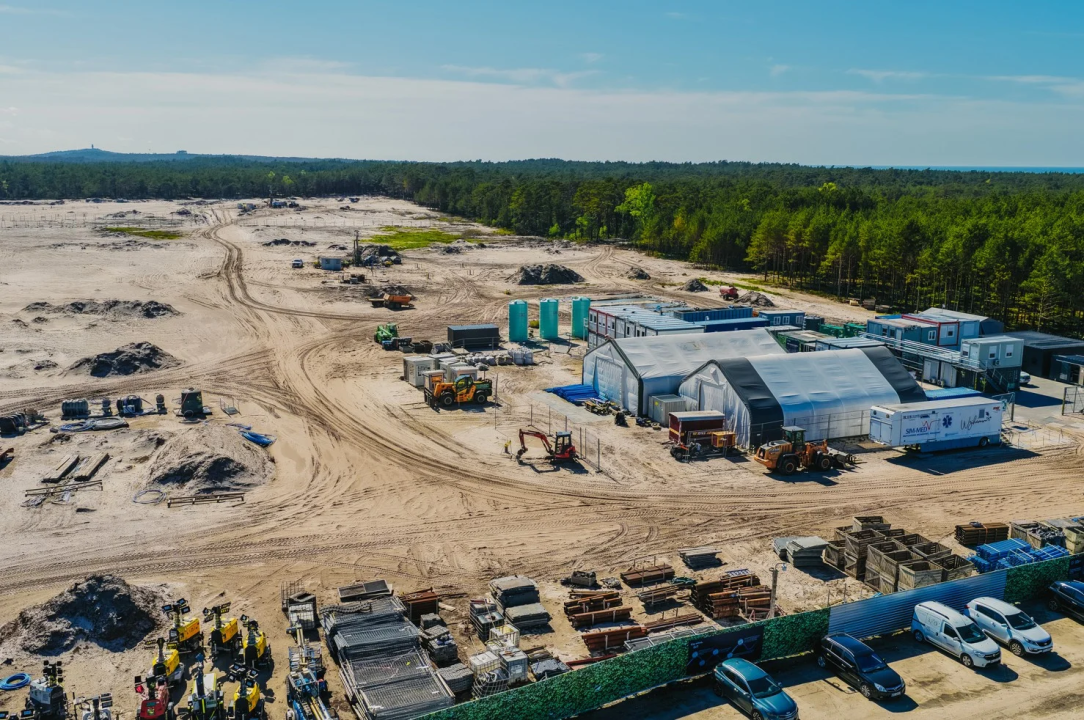
    The construction site as of June:

    image_2025-09-05_085942878.png


  • Registered Users, Registered Users 2 Posts: 21,876 ✭✭✭✭cnocbui


    As I predicted, offshore wind is unlikely to happen in Irish waters:

    This follows the abandonment of at least two major offshore wind projects in Australia very recently, one off the Tasmanian coast and another in NSW.

    Costs have escalated and without 0% finance there is no prospect of profitable generation with less than 50% capacity factors and 25% additional lifetime annual maintenance and operation costs relative to the initial capital outlay.

    You can forget any prospect of Ireland achieving net zero, ever, without nuclear.

    Post edited by cnocbui on


  • Registered Users, Registered Users 2 Posts: 16,604 ✭✭✭✭charlie14


    The big hype driving wind generation here was this supposed Klondike of wind off our West coast where floating wind farms would see turbines generating at capacity factors of 50% or more, which would generate a significant part of this 37 GW plan.

    With the massive increase of 60% - 70% in costs for fixed offshore turbines leaving them financially unviable, the game was up for floating offshore platforms that would have added a further 50% to costs.

    And that was before Eamon Ryan finally had to admit, that anybody who had even the slightest knowledge of our West coast had been telling him, that it was pie in the sky and floating platforms would end up as minced meat. Sceirde Rock proved how right those that said it were for even fixed turbines and with Corio Generation now having lost their €34.5m. bond, nobody is going to even look at building floating or even fixed turbines off our West coast.


  • Moderators, Recreation & Hobbies Moderators, Science, Health & Environment Moderators, Technology & Internet Moderators Posts: 98,171 Mod ✭✭✭✭Capt'n Midnight


    2036 is when the first of three reactors is promised. Snake oil salesmen are always confident.

    They are already 3 years late and $31 billion over the initial promise of 2033 and “We assume the overall cost at around $20 billion,”

    The clock started in 2022 and it'll be two years before they start actual construction.

    image.png

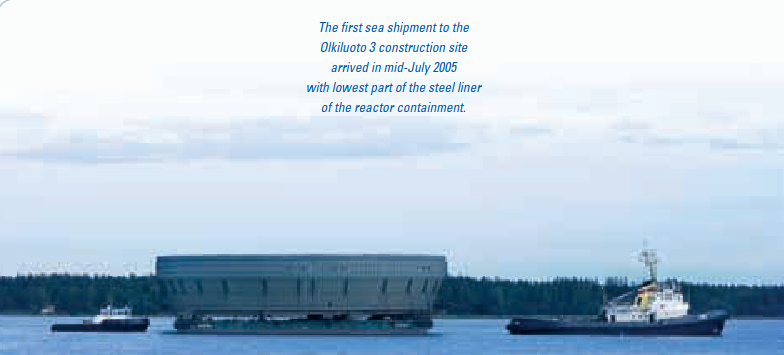
    Here is a picture I've already posted. 20 years ago they had large components on site in OLK3

    And it's took a while to get debugged https://www.dailyfinland.fi/business/37515/Glitches-delay-OL3-nuke-plant-resumption-for-4th-time

    https://www.tvo.fi/en/index/news/pressreleasesstockexchangereleases/2025/4996751.html

    A total of 63 days has been reserved for what is the second annual outage at OL3. This time, the service activities at the plant unit are designed in preparation for a longer operating cycle. The next annual outage at OL3 will not take place until in September 2026.

    As OL3 is the largest nuclear power plant unit in Europe, the amount of equipment and components to undergo maintenance is high.

    Riddle me this - if it there's a 63 day long outage every 18 months (548 days) - how is possible for this plant to ever get to 90% uptime , never mind the myth of 90% capacity factor, and completely ignore the years and years it was late.


  • Registered Users, Registered Users 2 Posts: 21,916 ✭✭✭✭Water John


  • Registered Users, Registered Users 2 Posts: 21,876 ✭✭✭✭cnocbui


    I have long held the view that renewables are not cheap and that the LCOE method of costing them is ridiculously inappropriate and biased in their favour. The only logical way to get an idea of the true cost of an energy source is to calculate what it would cost to use it as a 24/7/365 sole power source. Then one would have an even playing field for comparing the true cost of energy sources.

    Solar is touted as the cheapest source of electricity, but it works out to be very expensive if you try to power a country with it solely. Do the same exercise for Nuclear and it actually works out to be a lot cheaper.

    Looks like I am not alone in these thoughts, someone has written a paper that parallels my own:

    https://iaee2021online.org/download/contribution/fullpaper/1145/1145_fullpaper_20210326_222336.pdf

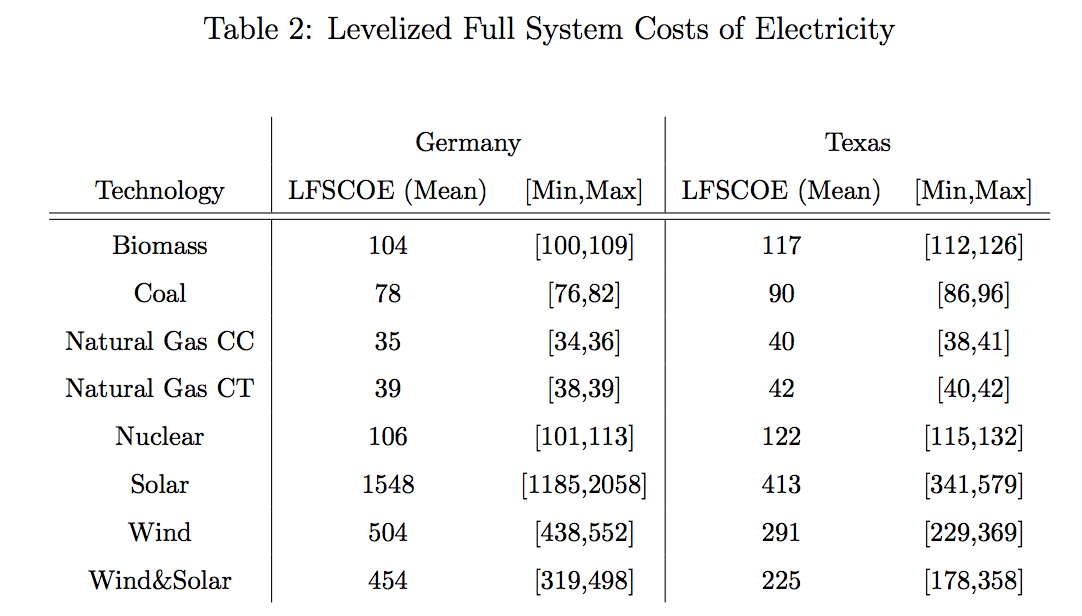
    Different electricity generating technologies are often compared using the Levelized Costs of Electricity (LCOE), which summarize different ratios of fixed to variable costs into a single cost metric. They have been criticized for ignoring the effects of intermittency and non-dispatchability. This paper introduces the Levelized Full System Costs of Electricity (LFSCOE), a novel cost evaluation metric that compares the costs of serving the entire market using just one source plus storage.

    So when you use the authors LFSCOE method to cost different sources, solar in Germany turns out to be 1,460% more expensive than nuclear. For Ireland it would be even worse due to poorer capacity factor.

    image.png

    Ireland's plan to reach net zero via renewables by 2050 is deeply flawed and is unworkable. The cost analysis in this paper also shows these technologies to by many times the cost of using nuclear to achieve the stated aim, which France has shown can be achieved, their grid having already achieved the 2050 aim, 25 years earlier than the Paris accord deadline. Ireland will not achieve net zero using renewables and interconnectors.


  • Registered Users, Registered Users 2 Posts: 1,599 ✭✭✭gjim


    I have long held the view that renewables are not cheap

    Your view about renewables is highly unconventional. Every single country in the world, under every different sort of political, social and economic conditions, whether centrally planned (China) or wild-west (like Texas) has switched nearly all electricity investment to renewables over the last 10 years or so.

    These days, globally 9$ out of every 10$ spent on electricity generation goes on renewables - and it's been above 80% for many years now.

    How about the simple question, if renewables are more expensive, why is everyone everywhere choosing to invest 90% of their money in renewables rather than cheaper alternatives?

    I mean the reasons look very implausible when you try to list them out:

    1. Hippies and tree huggers secretly run the world and are forcing renewables on everyone?
    2. Investors like losing money and are attracted by more expensive sources of energy?
    3. People everywhere are willing to put the environment above money (lol)?
    4. The entire world is full of idiots but I, cnocbui, am one of the very very select group of non-idiots who can see the "real truth"?

    I suspect, from your previous, it's really the last one.

    I mean you'd previously convinced yourself that you're smarter than 98% of scientists who work on climate related subjects by rejecting the idea that human activity is affecting the climate or that that pouring 40 billion metric tons of CO2 into the atmosphere every year could cause more heat energy to be trapped in the atmosphere. After that leap, I guess it's not a big step to convince yourself that you're smarter than 99.99% of the general population.

    It's just not so obvious to me. In fact it seems downright delusional.


  • Registered Users, Registered Users 2 Posts: 1,674 ✭✭✭Busman Paddy Lasty


    You left out "woke libs" from point no.1

    Disappointed with the thread so far. It was created for that one poster to discuss Nuclear for Ireland and it has been an anti-renewables whingefest.

    In the short term Ireland Inc. could hire our best and brightest engineers and scientists and do a cooperation agreement with the beloved France. Even skip a generation of reactors and join research for reactors that run on U-238 and be a customer for other countries waste problem.


  • Advertisement
  • Registered Users, Registered Users 2 Posts: 21,876 ✭✭✭✭cnocbui


    I have been championing the consideration of nuclear for Ireland as a superior alternative to renewables, not because I happen to like nuclear energy. Since I am arguing a case of A vs B, B has to be mentioned and why I consider A to be superior to B.

    Cataloguing the inherent limitations and problems with renewables is wholly consistent with arguing the case.

    The paper I posted shows that renewables are far, far more costly than nuclear and that the LCOE costing model that is usually used when costing them is deeply flawed and completely inappropriate, as it leads to gross underestimates of their true costs, particularly in the context of Irelands insane energy policy.


  • Registered Users, Registered Users 2, Paid Member Posts: 1,513 ✭✭✭riddlinrussell


    This is an infrastructure forum, we want to talk about infrastructure (nuclear and renewables included) if you want to sell nuclear to the Irish public and politicians make your case to your local TD, write it all up for the Infrastructure minister and tell them how they are doing it all wrong.

    I'd personally like this thread to discuss achievable nuclear solutions for Ireland and interesting developments in the field.

    Boards is in danger of closing very soon, if it's yer thing, go here (use your boards.ie email!)

    👇️ 👇️


  • Registered Users, Registered Users 2, Paid Member Posts: 15,609 ✭✭✭✭josip


    Does this count as a development in the field? Fusion on the US grid in 8-15 years. So we should hold off the fission I think.

    https://www.bbc.com/news/articles/cqlz5p314z0o

    It's the BBC so not a left field publication. But I do get Trump/RFK vibes from Chris Wright.


  • Registered Users, Registered Users 2, Paid Member Posts: 1,513 ✭✭✭riddlinrussell


    They are building an ITER style device I believe?

    A lot of promise in the alternative stellarator design, including a better practical fuel injection and energy recovery mechanism I believe?

    Also the inertial reactors (the laser compression(?) Ones deserve to continue being investigated because they are probably the best option for extra small scale.

    Boards is in danger of closing very soon, if it's yer thing, go here (use your boards.ie email!)

    👇️ 👇️


  • Registered Users, Registered Users 2, Paid Member Posts: 3,300 ✭✭✭KrisW1001


    Fusion has consistently been 15 years away for the last 60 years, and a gas fracker like Wright pushing it reminds me of when Elon Musk farted out the idea of the Hyperloop to sow doubt about California's high speed rail project. (Don't start me on the credulousness of the US press who lapped up such a clearly idiotic idea simply because "duh Elon Musk genius")

    I would love to see it happen, though, but I suspect I'll be dead long beforehand.


  • Moderators, Recreation & Hobbies Moderators, Science, Health & Environment Moderators, Technology & Internet Moderators Posts: 98,171 Mod ✭✭✭✭Capt'n Midnight


    Running on U-238 means converting it to plutonium. They started construction of 250MW reactors to do that back in 1943.

    82 years later there's only been modest increase in the amount of energy that can be got from natural uranium vs breeding plutonium, at the price of a lot more reprocessing and waste.

    Skipping a generation ?

    We are on Gen III. Gen II was what they were building 40 years ago.


  • Moderators, Computer Games Moderators, Recreation & Hobbies Moderators Posts: 11,315 Mod ✭✭✭✭CatInABox


    I've gone through that paper, and it's interesting. It doesn't really seem to be as pro-nuclear as you seem to think that it is. Even reading the conclusions, where it implies using not LFSCOE as a measure, but LFSCOE-95 (or even LFSCOE-90) as a measure instead.

    For anyone not all that interested in reading it (it's pretty boring), LFSCOE measures the cost of generating 100% of electricity using only that technology, i.e. 100% nuclear, 100% wind, 100% Wind & Solar. The main cost involved with renewables is energy storage, as that's how the paper deals with the intermittency problem. Of course, no one is going to generate 100% of electricity with only one type of source (although the paper does mention that some countries may do so with hydro, but they're very unusual), so the paper proposes LFSCOE-95, where only 95% of the electricity is generated by the one source.

    LFSCOE-95 has 95% Wind and Solar generation being as cheap as nuclear in Texas. LFSCOE-90 (which the paper mentions, but doesn't examine indepth) would almost certainly have renewables as having a better LFSCOE-90 than nuclear.

    Honestly, I'd agree with cnocbui that LCOE is a bit misleading, but using LFSCOE over LFSCOE-90/95 is also a bit misleading. I don't think anyone apart from the most ardent green party spokesperson is proposing that we generate 100% of our electricity from only renewables, the vast majority of people would be ok with 90% of our electricity coming from renewables with the rest coming from gas plants.

    Note that this paper was written in 2021, with 2020 data. It doesn't take into account the price reductions on grid scale batteries since then (about 50% in the last decade), with every sign that prices will continue to drop, as that's where the research money is going.


  • Moderators, Recreation & Hobbies Moderators, Science, Health & Environment Moderators, Technology & Internet Moderators Posts: 98,171 Mod ✭✭✭✭Capt'n Midnight


    I'd also question the costs of nuclear.

    The history of US nuclear power plants that stated construction after 28 Jan 1978 (nearly half a century ago) was a 50% failure rate leading to $46.8Bn spent to get two working reactors , which were 7 years late also Westinghouse went bankrupt.

    Vogtle was 7 years late and cost $36.8 billion, Virgil C. Summer was cancelled after $10Bn was spent.

    Texas is the place that's not connected to other grids because then they'd have to build to code. This resulted in hundreds of deaths and massive profits for some of the power companies a while back.


  • Moderators, Recreation & Hobbies Moderators, Science, Health & Environment Moderators, Technology & Internet Moderators Posts: 98,171 Mod ✭✭✭✭Capt'n Midnight


    Roughly the total spend on the ITER so far ~20Bn is the same as Japan spent on their fast breeder program including the 280MW Monju power plant and the reprocessing facilities.

    Monju provided power to the grid. For one hour. Possibly the most expensive electricity so for.

    Building it on the Urazoko fault line was probably not the best idea but hubris is a nuclear industry trait.


  • Advertisement
  • Registered Users, Registered Users 2 Posts: 21,876 ✭✭✭✭cnocbui


     I don't think anyone apart from the most ardent green party spokesperson is proposing that we generate 100% of our electricity from only renewables, the vast majority of people would be ok with 90% of our electricity coming from renewables with the rest coming from gas plants.

    But that is exactly the situation Ireland is aiming for - all energy, including transport and heating, is supposed to be coming from zero CO2 sources by 2050. That does not allow for any burning of gas or fossil fuels.

    It's all explained in this video.

    It can't be done, yet the cost of failure is potentially enormous:

    The fines levied on the State by the EU for failing to meet targets in reductions of carbon emissions by 2030 could soar to €20 Billion, according to the Irish Fiscal Advisory Council  – who also warned that continuous overruns in government spending is unsustainable.

    The estimate of €20 Billion from the watchdog is more than twice the previous estimate of €8.2 billion made by the Climate Change Advisory Council in August of this year when the Council’s Chair, Marie Donnelly said that while €8.2 billion the baseline estimate but that the “higher end is really a question of how long is a piece of string”.

    The Irish plan is to hope that storage gets to near zero in cost, something that will not happen due to basic economics. As the video explains, the amount of storage needed to turn variable renewables into the equivalent of base load sources, like nuclear, is gargantuan.

    The paper in question is absolutely relevant to Ireland's renewables only policy because it shows the cost of this approach is at least 400% times that of nuclear, for wind, and more than 1,460% for solar.

    No country has achieved what Ireland is aiming for under the 2050 CO2 obligations using variable renewables. France's grid already effectively met those targets at least 2 years ago based on nuclear power.


Advertisement
Advertisement