Advertisement
Help Keep Boards Alive. Support us by going ad free today. See here: https://subscriptions.boards.ie/.
https://www.boards.ie/group/1878-subscribers-forum

Private Group for paid up members of Boards.ie. Join the club.
Hi all, please see this major site announcement: https://www.boards.ie/discussion/2058427594/boards-ie-2026

Irish Property Market chat II - *read mod note post #1 before posting*

1858859861863864943

Comments

  • Registered Users, Registered Users 2 Posts: 7,777 ✭✭✭timmyntc


    And they would have paid over 100k had they not been given the rebate.

    The HTB does not achieve anything good. It is simply good optics for govt (in the eyes of FTB who don't understand market dynamics). Everyone else can see that HTB is just a demand subsidy that inflated prices for everyone.


  • Registered Users, Subscribers, Registered Users 2 Posts: 6,803 ✭✭✭hometruths


    That's great for the individual but it's still funded by all tax payers.

    In any event Fianna Fail are promising that in future if you haven't paid enough tax to qualify you can get it nonetheless if you have spent it in rent.


  • Posts: 0 [Deleted User]


    I didn't know FF had pledged to extend to people that had paid rent, I know they said they would increase it to 40k. Is there a link to that?


  • Registered Users, Subscribers, Registered Users 2 Posts: 6,803 ✭✭✭hometruths


    It's in their 2024 election manifesto:

    Protect and extend the Help to Buy Scheme out to 2030 and include a ‘Rent Back Boost’ in assessing the payment level.

    along with other inflationary gems such as:

    Protect and extend the First Home “Bridge the Gap” Scheme to 2030 and expand it to support purchasing second-hand homes.

    I think we can safely expect to see both measures as part of housing policy in next government.


  • Registered Users, Registered Users 2 Posts: 4,132 ✭✭✭RichardAnd


    And unlike many promises made during election cycles, I feel very, very confident that these will be upheld.


  • Advertisement
  • Registered Users, Subscribers, Registered Users 2 Posts: 6,803 ✭✭✭hometruths


    Particularly as FG have also promised the same on FHS extended to second hand homes


  • Registered Users, Registered Users 2 Posts: 5,037 ✭✭✭Villa05


    I suspect such a measure could spark a further landlord exodus particularly in rent pressure zones

    Its got the 100% mortgage effect feel about it

    Lots of denial and group think evident in the last few posts, all key ingredients in the last boom/bust cycle

    Happy New year


  • Registered Users, Registered Users 2 Posts: 4,132 ✭✭✭RichardAnd


    I would wager that it was a plan already on the table for some time.

    Maybe, but there are a few key ingredients that are quite different from 2008. Back then we did not have a shortage of houses at all. The enormous prices were the result of enormous levels of credit. Today, we have enormous levels of immigration, no where near enough housing and mountains of cash. These are fundamentals not present in 2008, and they are not factors that will easily change.

    This is not financial advice, but if I were considering buying a house, I would not be sitting around waiting for a crash just because one happened 15 years ago when prices were at a similar level.


  • Registered Users, Registered Users 2 Posts: 5,037 ✭✭✭Villa05


    Housing shortage for much of the early noughties that wasn't really addressed till 06.

    Taxpayer covering the riskest 30% of the price of homes if the state extends first home scheme to used properties

    Taxpayer subsidising half the rents in the country

    White House will be eyeing up our corporation tax and our multi national jobs

    The debt mountain from the last bust is still there, we entered the last crisis with little debt and the pension reserve fund. We are having far fewer children due to high cost of housing so we have fewer kids to throw under the bus when the next crash comes along

    Significant net migration to ireland from 04 to 07

    An upward trend in positive net migration can be observed up to 2007 with significantly large increases in the years 2004, 2005, 2006, and 2007, likely due to enlargement of the European Union. After the peak in 2007, there were huge drops in net migration up to 2010, when a return of negative net migration can be observed


  • Registered Users, Subscribers, Registered Users 2 Posts: 6,803 ✭✭✭hometruths


    Bank then prices were pumped up because banks were bringing forward demand with loose credit. Once the loose credit was gone, prices fell, because there was no demand for the higher prices without the loose credit.

    Now prices are pumped up because government is bringing forward demand with subsidies. If the subsidies go, prices will fall, because there is no demand at the higher prices without the subsidies.

    Today people believe that property prices are underpinned by strong fundamentals, just as they did in 06/07.

    But the fundamentals are only as strong as the government's ability to maintain and increase the subsidies.

    If our corporate tax boom continues so will the property price boom. No wonder the Taoiseach is talking about launching an all-out diplomatic and trade charm offensive with the Trump administration.


  • Advertisement
  • Registered Users, Registered Users 2 Posts: 461 ✭✭Rooks


    "Now prices are pumped up because government is bringing forward demand with subsidies."

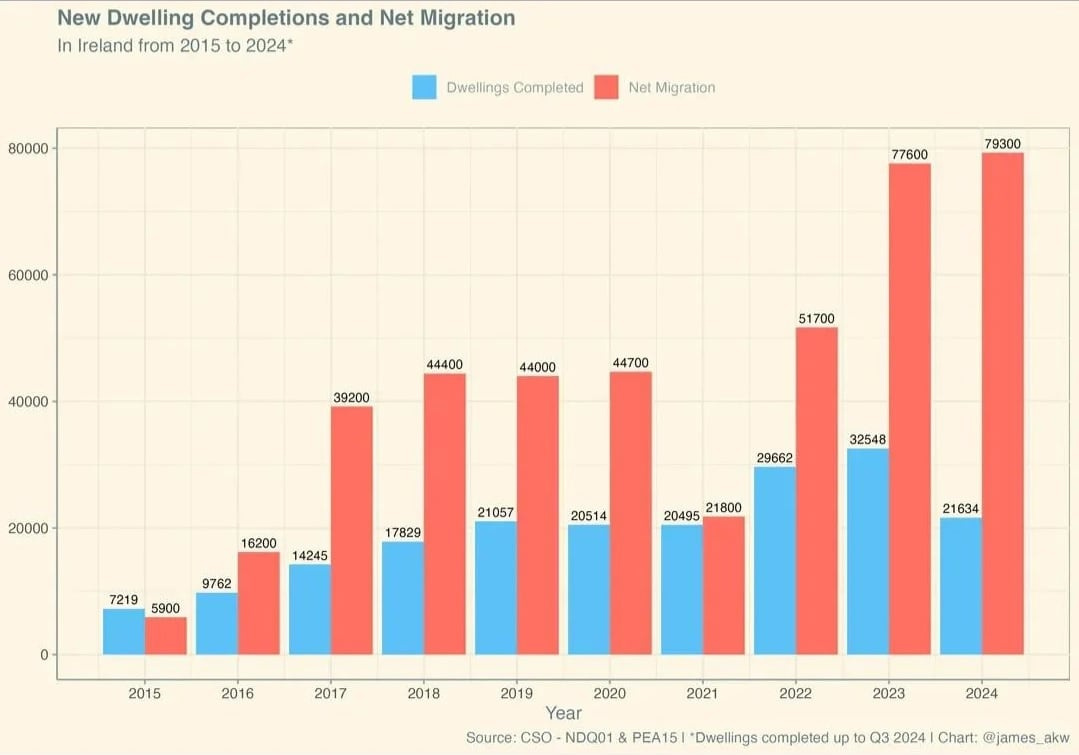
    housing123.jpg


  • Registered Users, Subscribers, Registered Users 2 Posts: 6,803 ✭✭✭hometruths


    I have seen you dump this picture repeatedly across multiple threads without any comment.

    Presumably the point is that in 2024, the increase in our housing stock of 21,634 was not enough to accommodate the increase in population size of 79300 people.

    But that's only meaningful if at end of 2023, our existing housing stock was not enough to accommodate the existing population.

    Given you're so fond of this image which goes back to 2015, can you share your opinion of what year our existing housing stock became insufficient to house our existing population?


  • Registered Users, Registered Users 2 Posts: 461 ✭✭Rooks


    You are aware of the concept of compounding? Each year doesn't delete the previous year's problems. It isn't difficult to work out the driving force behind our housing market issues, both for renting and purchasing. Too many people, not enough housing.


  • Registered Users, Subscribers, Registered Users 2 Posts: 6,803 ✭✭✭hometruths


    It is very easy to say too many people, not enough housing, but it seems to be very difficult to answer the question of when in the past we had enough housing.

    It's not just you, nobody else has been able to answer this question either.

    You'd think it would be straightforward enough.


  • Registered Users, Registered Users 2 Posts: 21,325 ✭✭✭✭Donald Trump


  • Registered Users, Registered Users 2 Posts: 5,037 ✭✭✭Villa05


    The migration to Ireland from 04 to 07 was >= to the migration in 22 to 23.

    The natural population increase (births over deaths) was also far greater in the noughties than now. Far greater housing challenges were faced from 04 to 07 than now

    In Ireland, an estimated 70,000 Ukrainian immigrants arrived in the year to April 2023. In fact, 2022 and the early part of 2023 saw two of the largest net migration figures since the period 2005 – 2008.  


  • Registered Users, Registered Users 2 Posts: 1,861 ✭✭✭poker--addict


    Why do you need to answer what year we had enough housing, totally and utterly irrelevant. We are where we are, the problem is clear, and it is at a level where major employers (with good jobs) hold it against the country when it comes to investment and expanding employment, so the issue is more critical today even if it has existed since the 1920s.

    😎


  • Registered Users, Registered Users 2 Posts: 461 ✭✭Rooks


    Net migration. That's half the chart. Now show me Paul Allen's card.


  • Registered Users, Subscribers, Registered Users 2 Posts: 6,803 ✭✭✭hometruths


    In the context of a discussion about a shortage of housing in Ireland, I find it genuinely astonishing how many people believe that the number of houses in Ireland is a totally and utterly irrelevant figure. It beggars belief.

    In this specific instance it is relevant to @Rooks chart posted, because the graph is total and utterly meaningless without that knowledge - it doesn't tell us anything other than since 2015 there has been sufficient net dwelling completions to accommodate net migration.


  • Registered Users, Registered Users 2 Posts: 37,675 ✭✭✭✭o1s1n
    Master of the Universe


    You could always emigrate to do your part in improving those figures?


  • Advertisement
  • Registered Users, Registered Users 2 Posts: 461 ✭✭Rooks


    Nah, I own a house so all's good with me. 😊


  • Registered Users, Registered Users 2 Posts: 1,861 ✭✭✭poker--addict


    If you want to be accurate to 1000 houses fine, maybe you need the year and every recorded year since. In reality its trivia. We know we need 35-40,000 homes per year just to stop the gap opening wider on average. We have then had 10 years of 10-20,000 short, so the gap is at least 100,0000 homes, the state can watch the average people per house reduce from 2.8 to 2.2, and average age people leave return to early 20s not 30s, and that will define when to slow down.

    As such knowing if the shortage started in 1990 or 2012 is sort of irrelevant in the scheme of things, we are so far away from fine tuning the supply!

    😎


  • Registered Users, Registered Users 2 Posts: 461 ✭✭Rooks


    "it doesn't tell us anything other than since 2015 there has been sufficient net dwelling completions to accommodate net migration."

    Typo? It says the complete opposite.


  • Registered Users, Subscribers, Registered Users 2 Posts: 6,803 ✭✭✭hometruths


    No typo. That's exactly what it is telling us.


  • Registered Users, Registered Users 2 Posts: 461 ✭✭Rooks


    😂 Ok, I finally understand why you have a problem with the chart.

    All the best buddy.


  • Registered Users, Subscribers, Registered Users 2 Posts: 6,803 ✭✭✭hometruths


    OK, if I am misreading it, what is my error?

    If you have a net migration of 79,300 how many net completions do you need to sufficiently accommodate the 79k?


  • Registered Users, Registered Users 2 Posts: 461 ✭✭Rooks


    Let's examine pre-2016.

    The rent pressure zone regulations have been in place since 2016. In response to what? If there was sufficient or oversupply of housing there would be no pressure on rents. But the RPZ regulations were brought in during 2016. In response to what? If the supply of housing was so high then why was the price of rent rising? Why the need for government intervention in the market?

    The P in RPZ stands for pressure. Why was there pressure? Not enough housing supply. Too much demand. Very simple.

    This is the state of play pre 2016.

    Then, after 2016, net migration goes parabolic while new dwellings struggles to keep up. Remember now, we already have undersupply. See above. Pressure. Regulation. Market intervention.

    So rents continue rise sharply. And demand for house purchases increases as credit becomes available again. Demand increases further while supply doesn't keep up.

    This is why rents and house prices are so high. Not enough supply. Too much demand.

    The HTB stuff is just adding fuel to the fire, but the fire had been burning for years already.


  • Registered Users, Subscribers, Registered Users 2 Posts: 6,803 ✭✭✭hometruths


    We know we need 35-40,000 homes per year just to stop the gap opening wider on average. We have then had 10 years of 10-20,000 short, so the gap is at least 100,0000 homes

    But how are you defining the "gap"? Your statement doesn't make any sense without some attempt to define what this mythical gap was at the start of your decade of 10-20k of undersupply.

    It can only be calculated from the existing housing stock and existing population at a given point in time. That's why it is so crazy to disregard the number of existing houses as irrelevant.


  • Registered Users, Subscribers, Registered Users 2 Posts: 6,803 ✭✭✭hometruths


    Well, 2016 is a good year to go back to, because we had a census with an accurate count of both the population and the housing stock so we know definitively the problem was not a shortage of built housing stock.

    The problem was a shortage of that stock available on the market to rent or buy.

    Tinkering interventions such as RPZ compounded the problem rather than alleviating it.

    Then, after 2016, net migration goes parabolic while new dwellings struggles to keep up. 

    But in 2015 and 2016, according to your chart, there was enough of a cushion such that from 2015 to Q3 2024 new dwelling completions have kept up fine with net migration. Which proves my point that the situation starting point is far from irrelevant.


  • Advertisement
  • Registered Users, Registered Users 2 Posts: 461 ✭✭Rooks


    Oh, and I blocked hometruths a while back. So I've no idea what you're saying buddy.


Advertisement
Advertisement