6 to 8 hours is all the storage you're going to get for the near future - largely wind generation is dependant on the existing generation equipment as back up - and that'll continue , batteries and grid level storage will bring more ability to plan and reduce spinning reserve , but fossil fuel is planned to be a good chunk of our electrical mix going forward - so yes we'll be paying for wind turbines - for storage - for transmission - for interconnectors - and for fossil back up and it's fuel -
But if we went nuclear we'd be paying for the nuclear stations themselves , the storage to balance out the peaks - the transmission costs and interconnectors and spinning reserve as well as back up generation too...
So none of it is just simply this or that -
Add to the mix that even if we decided to go nuclear in the morning the first reactor would likely be 10 to 15 years out ( if we're lucky) ..
Assuming that we won't be getting any nuclear before 2040 , and knowing you're really not keen on wind turbines ,what's your plan for de-carbonising the electricity system in the short term ?
There'd have been fewer protests at Carnsore Point if it was in a desert controlled by a tribal autocracy that uses sharia law and torture. Besides that power station was supposed to go on line in 2017 and the Korean nuclear industry has a history of bribery and fake parts and hiding issues. Nuclear can't contribute towards 2030 and will be eclipsed by 2050. Fusion power fuelled from seawater or lithium may even arrive before the next generation of nuclear plants are paid for.
Besides if we were to remove the "usual planning nonsense" to subsidise nuclear then instead we could greenlight the interconnectors, grid upgrades and windfarm projects that are almost ready to roll. It could be a case of offering landowners a choice of the either the going rates for disturbance or a CPO and starting construction now while waiting for their answer.
One problem with solar and to a lesser extent wind is that in the short term prices can fall by more than the return in investment. I can remember not replacing CFL's for LED's until the price dropped to €1 per Watt.
I get that you think that human caused climate change ect is over blown ( you could even be right ) , and I get that you're not a fan of wind as an overcomplication / extra cost on the grid -
The bit I don't get is why your in favour of nuclear in Ireland , when it has a stupidly high strike price and a lot of the same infrastructure and back up costs as renewables ?
Will it need grid level storage to balance out the peaks and troughs of demand-yes - will it need massive investment in the grid to accommodate the change In production distribution -yup
Will it need most of our current generators kept as back up - yeah
So guaranteed prices via the state is "Capitalism"?? No wonder our energy market is screwed up🙄
What I don't get is your type slagging off proven tech in favour of spending endless amounts of money on windfarms whose performance across Europe this year has been pretty hopeless. All the grids that have large elements of Nuclear such as France, Czech Rep have had nothing like the energy supply issues or costs that the likes of the UK and Germany have had.
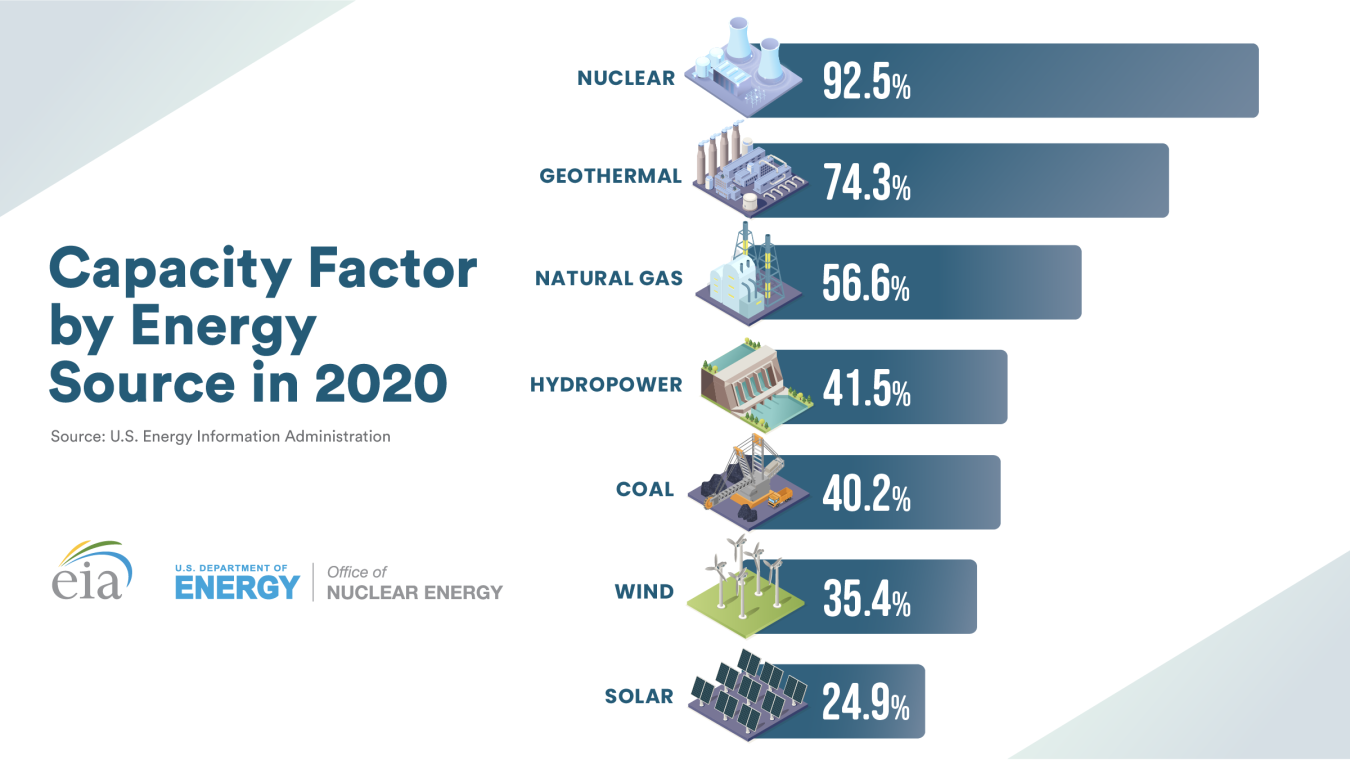
Half as cheap as nuclear, but only available 40% of the time. WTF is it with people not getting that cheap randomly available electricity is not cheap and that such claims are inherently dishonest?
I am with Airtricity - you know, those wind farm people, and the electricity charge in my most recent bill skyrocketed from 17.c per Kwh to 20.5c.
Cheap some of the time is expensive.
Nuclear is about to boom again, it isn't slowly dying. There isn't any renewables+ storage (without huge hydro) system currently available that is as cheap as nuclear. French consumers have amongst the cheapest power bills in Europe precisely because they have Nuclear, not because they have expensive and subsidised renewables.
"Half as cheap as nuclear, but only available 40% of the time."
You know Nuclear power plants aren't available 100% either. Look at Dungeness in the UK, offline for 3 years and look at the new EPR plant in China offline for 4 months so far (and will be offline for many more) due to radiation being found in the coolant.
Or look at France in 2016 when 20 of their 56 reactors had to be taken offline due to the discovery of weakened steel in their manufacture.
There is no perfect power generation, as we have seen over the past few years, any of them can fail, Natural gas plants, Coal plants, Nuclear plants. That is why they all have a capacity factor and they all need backups.
"Nuclear is about to boom again, it isn't slowly dying."
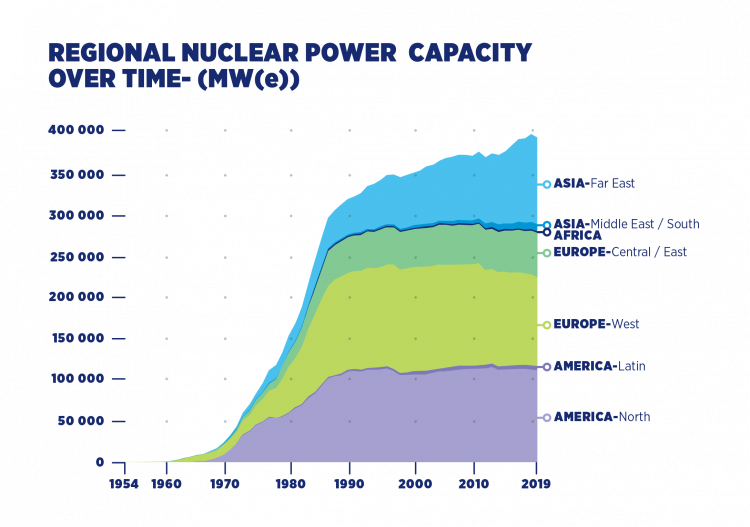
That is simply not true. The amount of Nuclear power around the world has dropped drastically over the past 20 years.
Take the UK for instance, Nuclear power peaked in 2000 with 14GW of capacity. This year it has dropped to just 9GW, 2025, even with Hinkley Point C opening, it will drop to 5GW with the closure of 4 ageing Nuclear power plants. It really doesn't look good for the industry, the EPR's have basically been a disaster (economically speaking).
Or take a look at France that you seem to like so much. If Nuclear is so great, why has it dropped from 87% of their electricity in 2004, to 70% now and planned to be just 50% by 2035?
"There isn't any renewables+ storage (without huge hydro) system currently available that is as cheap as nuclear. French consumers have amongst the cheapest power bills in Europe precisely because they have Nuclear, not because they have expensive and subsidised renewables."
Just to be clear, Nuclear faces the same challenge. France never got 100% of it's electricity from Nuclear. It is about 70% today. Even their Nuclear power plants need to be backed up by Gas power plants in case one goes off line.
By 2030 we will be at the same level of 70 to 80% zero carbon energy as France is at. The challenge for both us and France for the 2050 goal will be how to decarbonise that last 20% or so of gas power plants that we all use as backups. This is as much of a challenge for French Nuclear as it is for Irish wind.
You mentioned hydro, but it isn't the only option. Hydrogen, CCS, flow batteries, liquid air batteries and of course interconnectors and demand shedding with smart meters, etc.
Even if we built a Nuclear power plant or two, we would still need a backup to them. Either natural gas plants or a lot more interconnectors. Nuclear power is far from the silver bullet you think it is.
It's amazing that you can write a paragraph where every single sentence is factually incorrect, but you've managed it - bravo.
Nuclear is dying by any metric you chose - particularly raw GWh produced globally or number of operating reactors. There are no plans for any expansion of nuclear outside of regimes with a "strategic" interest in nuclear technology.
Nuclear (new build) is clearly vastly more expensive per kWh than any utility scale alternative by quite a margin - there isn't a credible study anywhere in the world which says otherwise. In LACE terms, nuclear is even worse as it's constant output is worthless (like wind and solar) when demand isn't there but you can't "turn a reactor down".
French consumers DO NOT have the cheapest power bills in Europe - household consumers pay almost the exact European average (20c/kWh) and that's only because a previous generation of tax payers paid for the construction of reactors.
This stuff is easy to check but you just repeat the same falsehoods over and over - I guess hoping people will get tired of correcting you?
The capacity factor for nuclear in the US is running at about 93%
" Nuclear Power is the Most Reliable Energy Source and It's Not Even Close"
https://www.energy.gov/ne/articles/nuclear-power-most-reliable-energy-source-and-its-not-even-close
COP26 has been a wake up call and there has been renewed interest given the realisation that net zero emissions by 2050 are not achievable without it.
"the International Energy Agency say that the nuclear industry, which has been shrinking for years, will need to nearly double in size over the next two decades in order for the world to meet net-zero emissions targets."
France has announced it will increase it's nuclear generation capacity this month - do you nuclear hating ostriches not read anything current?
"November 10, 2021 — 9.56am
London: France will construct a series of large nuclear power plants for the first time in decades, as the nuclear powerhouse seeks to neutralise carbon emissions by 2050 and reduce its reliance on unreliable gas imports." https://www.smh.com.au/world/europe/macron-backs-nuclear-power-to-meet-france-s-net-zero-ambitions-20211110-p597kk.html
And it's not just France:
"In the midst of the COP26 climate talks yesterday, U.S. and Romanian officials stepped aside for a session in the conference’s Blue Zone, establishing an agreement for U.S. company NuScale to build a new kind of modular nuclear power plant in the southeastern European country. The company’s plants—designed to be quickly scaled up or down based on need—are intended to be quicker and cheaper to build than the traditional kind, with some considering them to be a promising alternative for countries seeking to wean themselves off fossil fuels."
The UK:
"UK to invest in low-cost nuclear reactors to reduce dependency on fossil fuel"
They announced joint government/private financing of RR to design their SMR in detail which could lead to up to 16 reactors being built in the UK. https://www.bbc.com/news/business-59212983
Poland: "Mr Guibourgé-Czetwertyński also said the government is working on new legislation for enabling and streamlining investment in the country’s ambitious nuclear programme. The nuclear investment legislation is being finalised and should be ready in the first quarter of 2022 for approval by the council of ministers.
In July, press reports said the new legislation could speed up the country’s first commercial nuclear project by 18 months. Poland is planning to choose a supplier of nuclear plant technology next year, with the supplier becoming a partner with a stake of up to 49% in the country’s nuclear project company PGE. Mr Guibourgé-Czetwertyński said this “shared risk” was crucial and because of the complexity of investment any partnership will be a long-term one.
...
Poland wants to build from 6,000 to 9,000 MW of installed nuclear capacity. Commercial operation of a first nuclear reactor unit in a proposed set of six is planned for 2033." https://www.nucnet.org/news/warsaw-aiming-to-complete-eia-and-site-report-by-end-of-year-11-3-2021
Sweden: Instead of phasing out 4 reactors by 2024, they have extracted the digit on spent fuel storage, expanding their facilities allowing the reactors to continue operation.
Czech Republic:
The Czech Republic is building two new nuclear reactors
March 9, 2021
Two new nuclear reactors will be built at a power plant near the village of Dukovani. Their construction was approved by the Czech nuclear energy regulator, which worked on a detailed assessment of this project for a year, the agencies reported...
According to the national plans of the Czech Republic, a large increase in the use of nuclear energy is planned for 2060. "https://tekdeeps.com/the-czech-republic-is-building-two-new-nuclear-reactors/
And so on for several other countries.
This stuff is easy to check, I suggest you stop living in the past and do some checking yourself.
I admit to being wrong about French electricity prices being the cheapest, which are only slightly below the EU average but are still 24% cheaper than Ireland: https://ec.europa.eu/eurostat/statistics-explained/index.php?title=Electricity_price_statistics
Nuclear is not more expensive than renewables when you factor in the other costs associated with their low capacity factors and unreliability. You can't even cost grid scale multi-day storage as it doesn't even exist, it's just uncosted wishy-washy hopium at the moment.
Stop picking one off incidents and using them to construct bogus and dishonest images of unreliability:
"Unit performance. Even as the nuclear power fleet ages, operational nuclear power plants continue to demonstrate high levels of overall reliability and performance."https://www.iaea.org/newscenter/news/iaea-releases-2019-data-on-nuclear-power-plants-operating-experience
And as for your statement about a decline in nuclear generation capacity over 20 years; seems to be news to the IAEA:
"Near and long-term capacity growth prospects are centred in Asia, which at the end of 2019 reported some 36.5 GW(e) of nuclear power capacity (35 reactors) under construction."
Perhaps you could send them the data you invented in your mind so they can fix their knowledge base. As I have proven in my other post, you are simply wrong.
More recently, the IMF concluded that invesment in Nuclear energy had greater beneficial economic impact than other sources:
"International Monetary Fund estimates show that investments in nuclear power generate a larger economic impact than those in other forms of energy, making it among the most effective actions for a sustainable economic recovery as well as the transition to a resilient net zero energy system." https://neutronbytes.com/2021/10/15/iaea-report-on-nuclear-energy-for-a-net-zero-world/
Nuclear will continue to decline.
The French nuclear sector is massively subsidized.
Nuclear energy is the most toxic option from the point of view of private investor.
Strip out all allowance and Govt money and nuclear is still the worst from economics.
Aspirational BS like that is not going to support or power modern grids. The tech you describe either doesn't exist or is simple not up to the job
China and India are expanding nuclear and have even bigger plans in the area over the coming decades - even the German EU commissioner who up to last year was following the old tired line about the likes of wind powering a giant Euro grid, is now saying Nuclear will have to be a major part of the equation if we are to de-carbonise. I guess the sorry state of the UK and German Grids in terms of increasing dependency on coal and Russian gas has softened alot of coughs on that one
"Stop picking one off incidents and using them to construct bogus and dishonest images of unreliability:"
Nothing dishonest about it. It is a very real problem with the idea of using Nuclear power in Ireland.
On the one hand France got economies of scale from Nuclear by building lots of the same types of reactors. But the danger of this approach is if you find a manufacturing flaw later, all of yor reactors might need to go offline at the same time. The only reason France got away with it in 2016, is because they are part of the EU mainland wide grid with massivs amounts of AC interconnectors to their neighbours. They survived the 2016 outage by importing vast amounts of power from their neighbours when the reactors were offline.
If we built Nuclear power plants, we don't have the same interconnection support being an island. We would absolutely have to build Natural Gas plants and/or DC interconnectors to Europe to back it up.
You get that the options available to us are not:
Either way you need the same back up.
Wind is VASTLY cheaper and quicker to build then Nuclear. We can get to the same 70 to 80% net carbon as France has, with Wind, at a fraction of the cost and much faster then we could with Nuclear.
Again, I've nothing against Nuclear, I hope we see more in mainland Europe and around the world. But it really doesn't make sense for a small disconnected island like ours, which has such a wealth of wind power.
"Half as cheap as nuclear, but only available 40% of the time." £41.61/MWh will be a third of the index linked price of Hinkley C by the the time it comes on line. So a storage system that costs less than £80/MWh trumps nuclear.
And France has a fair bit of hydro and importing 9,781MW at this time The mix is here it's a much flatter demand curve through the day than ours to make it fit non-dispatchable nuclear.
For hours of storage Compressed Air Energy Storage reduces the fuel burn of turbines. For weeks/months of storage green hydrogen in old gas wells is one way to go and the oxygen produced could be used for CAES too.
Long report on the state of nuclear here - lots and lots of figures and graphs and bad news and correlation with corruption.
Nuclear isn't on-time, on-budget not even in China. Nuclear's share of electricity has fallen from from 17.%% in 1996 to 10.1% in 2020 and lots of plants are scheduled to close by 2030, and the recent history in the US especially is that plants close early if gas or renewables make them uneconomic.
Annual investment in nuclear power $18bn is one eighth of the individual investments in wind $142 billion and solar 149 billion. Since 1970 one in 8 of the 783 construction started was abandoned or suspended. A huge hidden cost of nuclear.
Korea had to shut down multiple plants because of a fake parts scandal. (even Japan had issues were parts weren't inspected) EPR construction delays because of multiple issues. Heat exchangers and transformers fail way too often. The UK will loose most of it's nuclear power by 2030 because they can't fix the graphite problems.
France lost multiple reactors in 2005 because rivers were too warn for cooling during Summer. Winter storms have taken out nuclear power stations and or transformers. And icing up equipment and freezing rivers. Autumn is when the floods happen. Italy and Germany halted nuclear power development after public referendums. Japan and a few other countries have governments that use nuclear against public opinion so no guarantees after elections.
France got economies of scale by using proven Generation II designs. Global construction of Generation III+ plants aren't going anywhere near as smoothly.
Last month we got 35% of electricity from wind with a peak of 76%. Because of the need for backup and voltage stability there needs to be geographically separated high inertia synchronous generators on the grid too. So there's virtually no demand guarantee for high cost non-flexible generators.
Yes if we increase wind we will need interconnectors or storage to adsorb surplus wind and balance when there is less wind.
Scotland is very similar to us in terms of geography, area, population and demand and is more or less 100% renewables because they can export to England and NI.
Hinkley just can't catch a break
Hinkley C is doing the world a great service by hammering home the point that generation 3 nuclear has been a complete failure in terms of delivery, cost and reliability. And that the flagship generation 3 design, the EPR, has been a complete disaster even having been worked on for nearly 3 decades.
The collapse of new nuclear reactor building in the west for the last 3 decades has created a space for people to forget why nuclear was effectively abandoned in the first place - cost, cost and more cost.
We should be grateful to the UK - the Tories in particular - for "taking one for the team" and paying for this GBP 24 billion+ experiment/white elephant (plus the additional GBP 50 billion lifetime cost to consumers that the National Audit Office has costed the guaranteed strike price). Even if it ever goes live, it'll represent the swan song for nuclear in western Europe. GBP 70 billion for 3.2GW capacity. It's mind-blowing that EDF and the Chinese managed to convince the UK government to back this.
An interesting quote from the article: -
'We’ve learnt, to our cost, if something goes wrong, picking up the pieces is costly in economic, environmental and human terms.'
I think that says it all - so nuclear reactors are completely safe, but if (when) they go wrong, they go horribly wrong.
It is not the first time extremely risky endeavours have been carried out for the supposed good of mankind. Reminds me of the apocryphal quotes from the astronauts about to be fired off towards the moon:-
I am not sure who is supposed to have said it but this is the quote:- 'There are three likely outcomes - we do not get to the moon, we get there but cannot get back, and we get back safely - and all three are equally likely!' and still they went. What heroes.
Alternatively, one astronaut to the other:- 'You do realise that we are stuck at the top of the largest collection of lowest cost quotations in the world!'
Nuclear waste is always the elephant in the room and its disposal really complicates things.
One company in the US has found a simple solution.....just pour it into the local bay and let nature sort it out
What is the design life time for these nuclear reactors? 25 years? 50 years?
What level of decommissioning costs are built into the budget for the lifetime of the projects?
Who is expected to live with the consequences? We have had plenty of unplanned biological disasters visited on us in the past, like DDT, asbestos, etc. And that is not including global warming, climate change, which nuclear energy is being put forward as a solution.
Peak construction dropped off after Three Mile Island. Those plants built in the mid 70's to mid 80's are getting to the point where they will need to be recertified to continue. From https://www.worldnuclearreport.org/reactors.html
One issue is whether a plant will meet safety standards or how much it would cost to upgrade or add things like generators, flood defences etc. to meet them. The other great unknown is how much renewables will cost during the rest of the life of the plant. Hint : Solar and wind prices keep dropping.
Back in 2013 the French reckoned it would cost €10Bn to upgrade safety at reactors vs. a cost of €430Bn for a major accident , most of the losses would be tourism and luxury goods exports. NB The French built a nuclear power plant on a site that had historic floods and guess what happened in 1999 ? No lessons were learnt by the nuclear industry then.
Why you should not take anything "nuclear fusion" related at face value.
Fusion is a future technology due in the next decade, as it has been for the last 60 years. For now, it is in the same bracket as self powered porcine aerobatics.
Well, your chart and associated comment shows that the failure to build more nuclear power plants since 1979 has more to do with erroneous public perception than reality. (Hint: Three Mile Island had no radiological consequences beyond the reactor site).
Good thing you mentioned France, it currently emits (although it fluctuates) 4-10 times less CO2 per kw/h than its next-door neighbour, Germany. https://app.electricitymap.org/zone/DE Not only that, it is much more energy independent than Germany. They also kill way fewer threatened bats with barotrauma and other windmill related causes than Germany. https://www.usgs.gov/faqs/how-are-bats-affected-wind-turbines
All of this despite the fact that Germany has been following a Cold-War era policy known as Energiewende. https://en.wikipedia.org/wiki/Energiewende That is, the current strategy of "replacing" fossil fuels and nuclear energy dates back to 1980 and originated in the former West Germany. By all objective measures, it is a failure. Cost? Trillions of euro and Germany has among the highest energy prices in Europe. Ecologically? Germans in their mad dash bid for "Green" energy seem content to literally drive bats to extinction. Saving the climate? 4-10 times worse CO2/kwh than their nearest neighbour indicates that they've got their work cut out for them. Geopolitical concerns? Up until recently, the German Greens seemed to be very keen on getting more gas from Russia. Maybe Russia's actions in and around Ukraine will focus minds ...
or not. The Greens need insane amounts of gas because wind mills and solar panels are not reliable. Full stop. And that applies no matter the cost of the panels/windmills. I don't know why the mainstream environmental movement wants to waste obscene amounts of money, drive all the bats to extinction, carpet bomb every coastline and hilltop with ugly bird chomping bat killing monstrosities, cause mind-blowing levels of needless CO2 emissions, and leave Europe wholly dependent on Vladimir Putin to keep the lights on, but that seems to be where they're taking us.
"Solar and prices keep dropping" maybe, but we've been promised that for decades. It was BS during the Cold War and it's BS now.
I'm honestly impressed that you managed to cram so many incorrect statement & falsehoods into a single post
Falsehoods? It's a fact that Germany emits dramatically more CO2 per kwh than nuclear powered France. It's a fact that windmills paralell only White Nose Syndrome as existential threat to world bat populations. https://wildlife.org/mortality-survey-shows-leading-causes-of-bat-deaths/ It's a fact that Germany's energy policy, the Energiewende was first conceived during the Cold War. It's a fact that German electricity prices are at the high end of things: https://en.wikipedia.org/wiki/Electricity_pricing It's a fact that windmills and solar panels only produce power when the wind is blowing or the sun is shining, and thus require backup.
We've been promised that renewables will be awesome for decades. It was BS during the Cold War era and it's BS now.
Though I do admit there is some personal opinion here. I regard those godawful wind turbines as being ugly monstrosities spoiling what would otherwise be a nice sea or mountaintop view, and I'm not keen on industrialising our environment in this way. Of course, to the large soaring birds and bats, the problem is a lot more ... life and death.
Your first post is so full of claims that are ludicrously at odds with simple-to-check facts, numbers and history, my immediate reaction would be just to ignore it but you seem to want to double down while adjusting your claims in a weasily manner.
Believing that it was just the Three Mile Island incident which caused the decline in nuclear deployment makes no sense given the average 12 year lead time for nuclear reactors in the US unless it resulted in the immediate cancellation of nuclear construction globally - which it didn't. Nuclear died because it costs too much.
Claiming that nothing about the economics of solar or wind electricity generation has changed since the cold war? I don't know where to start - it's like you've deliberately read absolutely nothing about what's happening globally to electricity generation for decades. https://www.lazard.com/perspective/levelized-cost-of-energy-levelized-cost-of-storage-and-levelized-cost-of-hydrogen/
If you believe that the adoption of renewable generation hasn't caused a HUGE reduction on the carbon emissions intensity of electricity generation in Europe, it's easily checked too. The CO2/kWh for Germany is 45% of what it was at its peak. https://www.eea.europa.eu/ims/greenhouse-gas-emission-intensity-of-1
German and French electricity costs both to consumers and non-households are roughly the same. The difference in prices is due to heavy taxation on electricity in Germany and little or none in France. https://ec.europa.eu/eurostat/statistics-explained/index.php?title=Electricity_price_statistics
And to cap it off, the old faux-concern about wildlife and birds being massacred by wind turbines - studies of bird deaths in the USA show that between 5 and 8 THOUSAND are killed by domestic cats for each ONE killed by wind turbines. https://abcbirds.org/blog21/wind-turbine-mortality/




![Photo of [Deleted User]](https://w6.vanillicon.com/v2/62877c35768f143f69acd7bb6cd43f3c.svg)


