99nsr125 wrote: » Nuclear is the answer
99nsr125 wrote: » Infrastructure is not the problem The energy source is the problem Nuclear is the answer Green advocates just need to cop the fųck on and realise this
TheBoyConor wrote: » Nuclear energy is illegal in Ireland. There is positive law prohibiting its development. Therefore , talk of nuclear energy for Ireland is pointless drivel. It'll never happen here. And the law is only one reason why it will never happen.
GT89 wrote: » Laws can be changed
Yurt! wrote: » The horse has long bolted with our dispersed population pattern (exacerbated over the years and getting no better) for a decent rail network. I think I read somewhere we're the most car dependant rich nation in the world second only to Qatar - yes, even more so than the USA. If one visits countries like Japan (different plate of sushi I concede), public transport is an absolute dream, and there's no need to own a car whatsoever, with the exception of the northern island of Hokkaido (and even that blows Ireland out of the water for public transport). I'd love to be optimistic, but I think we'll never even get close to countries like Sweden, never mind best-in-class countries for public transport like Germany / South Korea / Japan. Like a lot of things, we pretend this dysfunction is normal.
monument wrote: » The problem is the bit in bold does not really follow with cities which are in a comparable population range. The density in Dublin City and Suburbs is overall comparable to cities with rail-based public transport networks and there's loads of scope for building extra density around stations, as happened in many cities with or after services were provided. Dublin has overall higher density than cities with similar populations. And there's no great density in the towns around most S-tog stations in commuter towns and where there is a bit of density it was built recently or way after the train service was built.
Cookiemunster wrote: » fantastic PT doesn't take people out of their cars.
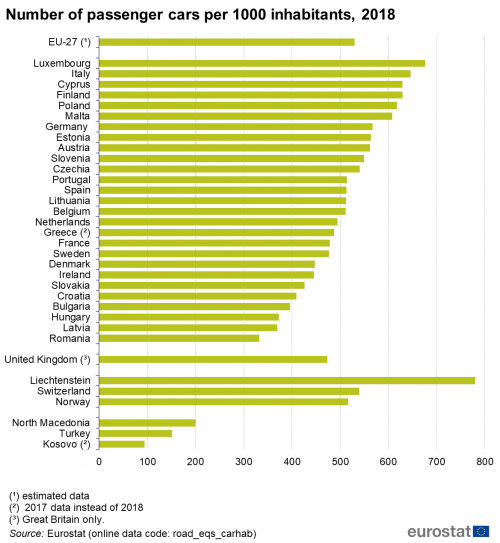
Cookiemunster wrote: » According to the EU, Germany and Sweden have more cars per capita than Ireland. We're actually 21st out of 27. We're also below Japan and South Korea. Yes our PT options are poor, but even in those countries, fantastic PT doesn't take people out of their cars.
Deleted User wrote: » The new Westport to Castlebar road currently under construction will shave about 2 minutes off a 15 minute commute. Well worth the billions of euro and massive destruction of landscape it is costing. Not.
Deleted User wrote: » There is an energy infrastructure thread on the infrastructure forum better suited to that topic so might be best to move there. The one thing I will say is this, if you want to talk about nuclear you need to bring 2 things to the conversation - How to manage the waste over a multi-millennia time period and - How to pay for that management
Isambard wrote: » only has to save one life to pay for itself
Cookiemunster wrote: » €241m. Not even close to a single billion, never mind billions.
[Deleted User] wrote: » If you are expecting a 100% modal switch, you'll be waiting a while Taking Galway as an example, 8% travel by bus. The biggest issues in terms of using PT are - Scheduled frequency i.e. a bus every 10 mins renders a timetable redundant - Consistent journey times i.e. getting a bus during rush hour or outside rush hour, the journey times should be as close to equal for both Right now GaCiCo are working on the 2 major projects to address the second point above. Once complete, BE will be increasing frequency thereby addressing the first point above. Nobody expects this to result in 100% switch to PT, however I would expect to see at a min, doubling of the current figures if not tripling.
Deleted User wrote: » The new Westport to Castlebar road currently under construction will shave about 2 minutes off a 15 minute commute. Well worth the quarter of a billion euro and massive destruction of landscape it is costing. Not.
GT89 wrote: » High frequency has to be put into practice and not only exist in theory. No point in having a bus scheduled to run every 10 mins if buses are bunched or there is an unrealistic timetable or PVR or buses commonly fail to operate due to staffing issues which seems to be a common occurrence on Bus Eireann.
[Deleted User] wrote: » As for staff shortages, well, automation will eventually take care of that. However once you have a sub 10 min frequency on routes that dont get stuck in traffic, if a single bus on a route is not running, its not the end of the world. Not ideal, but not a deal breaker.
Pete_Cavan wrote: » Do you think the road is only going to be rolled out for the hours 08.00 - 09.00 and 17.00 - 18.00?
PhilOssophy wrote: » I completely concur. I was merely emphasising the point that while everybody has some romantic dream of getting onto a train in their small village or town and being ferried off to their place of work, for most people if they could save 10 minutes by driving they'd drive. Are you referring to S-tog in Denmark or what is S-tog? As I said already, there has to be joined up planning regarding where people are living and working before rail can ever be economically viable. Putting a rail line into any big town, but putting most of the jobs in industrial estates around ring roads, is a folly. To be fair though, there's 2 separate discussions to be had. One about Dublin and its demand, one about beyond Dublin's commuter belt.
Deleted User wrote: » Er..., no Pete. No. I don't think that. Did someone tell you that is likely to happen?
monument wrote: » If density population is the metric needed (as was suggested in the post I was replying to), then most commuter towns in the GDA should have Copenhagen-style S-tog services. I’ve looked at Copenhagen’s commuter belt on a density population map, but it’s plan to see on google maps too and a live timetable at hand — unreal level of service to relatively small towns. Even if the if it doesn’t prove that GDA towns would support Copenhagen’s level of service, it at least suggests the level of service could be far higher in the GDA.

![Photo of [Deleted User]](https://w6.vanillicon.com/v2/62877c35768f143f69acd7bb6cd43f3c.svg)





![Photo of [Deleted User]](https://wb.vanillicon.com/v2/bd89cdce15309a6ec2dff928c865017a.svg)


