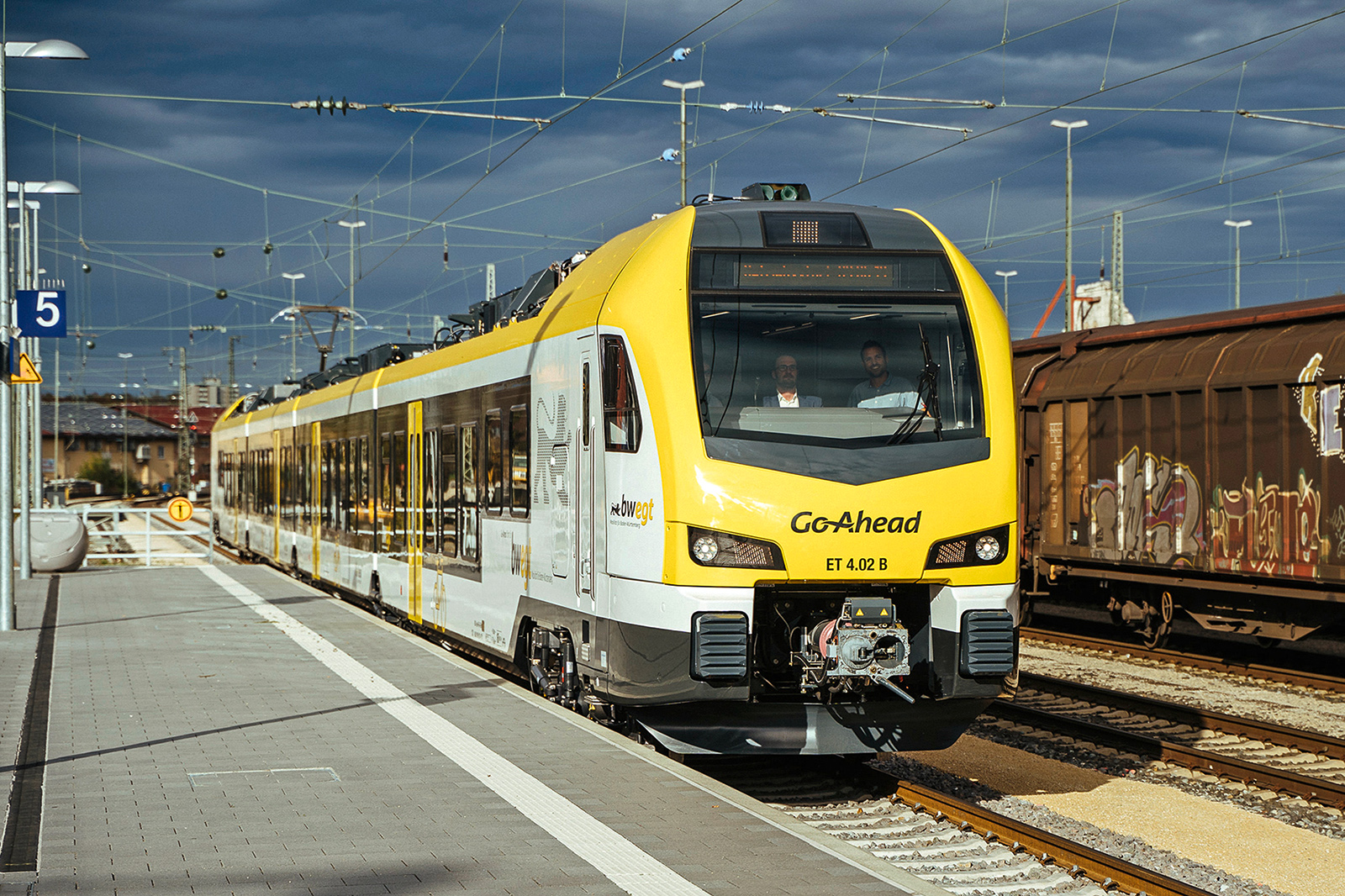
Bombardier’s Aventra is a modular, easily customisable single-deck train capable of operating in both diesel and electric modes. It is among the fastest, smartest and most economical platforms in modern rail. The vehicle can be equipped with MITRAC traction batteries to operate as a battery electric multiple unit (BEMU).
IE 222 wrote: » Can they be produced as BEMU? I thought Bombardier and others have a separate range/models on BEMU. Personally I think Siemens Mireo could be a good choice. Keeping in mind IE will be ordering a number of both EMU & BEMU. The Mireo comes in both forms and they are developing a hydrogen version.
prinzeugen wrote: » The issue with Bombardier etc is that they offer variants of existing models. It's why they and Adtranz lost the ICR contract. I would think any future DART units will come from Japan, Korea, CAF or Stadler. They are willing to custom build units rather than just offering a variation of an existing build.
Sam Russell wrote: » I rather like the look of the Stadler Flirt trains - fewer bogies and doors, with the option of a diesel power unit to make it operate without OH wires. Now given we need different bogies, that might be useful, and having the option of using them without OH wires might allow a significant level of flexibility. Having said that, I know nothing about trains.
roddney wrote: » Interesting looking train. Wales going for tri-mode which matches. A lot of the orders have been for fairly short sets with limited door access and higher speeds, which suggests suitability for longer commutes but not necessarily Dart, though. I really liked the feel of the Bombardier S8 sets used on London Metropolitan line when I visited, which covers 65 km distance (Drogheda is only 50km and Maynooth 26km). 3 Doubles doors, which made them easy to get on and off and huge standing capacity.https://en.wikipedia.org/wiki/London_Underground_S7_and_S8_Stock I'd say it will be a hard one to get right. Drogheda and Maynooth have quite different profiles to Dart. Commuter vs Rapid Transit.
Sam Russell wrote: » We will still have the current Dart stock which should all be good for another 20 years, the more recent ones for 40 years.
loyatemu wrote: » I thought the plan was to withdraw the LHB stock - it'll be 40 years old by the time the new carriages arrive.
Sam Russell wrote: » Maybe, but they have been extensively reworked once, why not do that again. Is it cheaper to rework than replace? Surely it is.
loyatemu wrote: » 40 years is about the lifespan of rail carriages, they're done.
GerardKeating wrote: » Tell that to the Isle of Wight.
IE 222 wrote: » They'll be replaced. The mid life refurbishment was completely 15 years ago at this stage.
roddney wrote: » From my reading, the plan to replace all DART carriages. The original 8100 carriages are almost 40 years old so end of life. The 8200 were scrapped (or stored for scrap) and the 8500's are 20 years old and due a midlife refurbishment, which is essential a complete rebuild from metal. The cost of the midlife refurbishment of the 8100's didn't appear very economic and given the 8500's are a tiny fleet (17 x 4 carriage sets) it would be more cost effective to just replace everything. Plus more economic maintenance at scale if all trains are the same.
Sam Russell wrote: » Their current Dart fleet is equivalent to 37 four car sets, with a further 6 sets scrapped or left to rot at Inchicore. They currently run the 8100 in sets of six, the the 8xxx run as eight car sets. They are all designed to be used for a long life, and if properly maintained, there is no reason to scrap them, as they are just a collection of parts in a strong metal tube with windows. However, they are worked hard with the 10 minute service, so they need more sets. However, I would see at least a decade more life in the 6100, and twenty years for the 8xxx ones. However, IR got rid of the old locomotive pulled trains which they could do with now, so maybe they will keep some just in case.
dublinman1990 wrote: » The Stadler FLIRT trains are on the Dallas Area Rapid Transit & also with Go-Ahead Deustchland. These are not fit for IÉ's platforms btw as they're too low.
highdef wrote: » Those two examples are clearly two different models. There are many many other models and Stadler will build a model to suit the customer. The UK has Stadler FLIRTs and platform heights there are similar to those in Ireland.
roddney wrote: » I'm a little confused at where the conversation is at. The Stadler FLIRT are commuter trains. The Dart+ is an upgrade of existing commuter lines to Dart, which is a metro train. The seating layouts and door configurations applicable to commuter trains are very different to whats required for metro trains. I doubt commuter trains are being considered. Everything in the literature on Irish Rail site, talks about upgrade to Dart, doubling capacity of existing line from 26k commuters per hour to 52k commuters per hour per direction. It talks about extending 52k per hour to all (i.e. new) lines. The complexity though, seems to be that metro trains are electric only, whereas commuter trains can be electric, diesel, battery, hybrid, tri-mode etc. How that fits into Dart+ is the question for those running the procurement. Get it wrong and there'll be crush loads, like the Dart pre covid. As a comparison a 4 car Saddler has a capacity of about 200 (400 if 2 joined together).https://en.wikipedia.org/wiki/British_Rail_Class_755 An 8 cars S8 has a capacity of 1350https://en.wikipedia.org/wiki/London_Underground_S7_and_S8_Stock The site also states that the majority of trains being purchased will be electric. It might have to be that the battery/diesel/hybrid options are dropped cause it conflicts with metro requirement
Sam Russell wrote: » Surely seating capacity can be altered and replaced by metro style side seats and increased standing room. If there is significant standing room egress at stations could be easier except in crush situations, where the number of doors would be an issue. IR are using IC trains for commuter at the moment on the PPT service.