patnor1011 wrote: » They will not be "filtered" out. They are recommended for people with asthma or people with mental issues who can not wear a mask. Get used to seeing them around.Ireland has the 4th highest prevalence of asthma worldwide. Approximately 470,000 people affected (1 in 8 of population) ... Asthma is the commonest chronic disease in childhood and the most common respiratory condition in Ireland. - 890,000 people in Ireland experience asthma at some stage of their life. - 380,000 people in Ireland currently have asthma. - 1 in 13 people in Ireland currently have asthma. - 1 in 10 children currently have asthma.
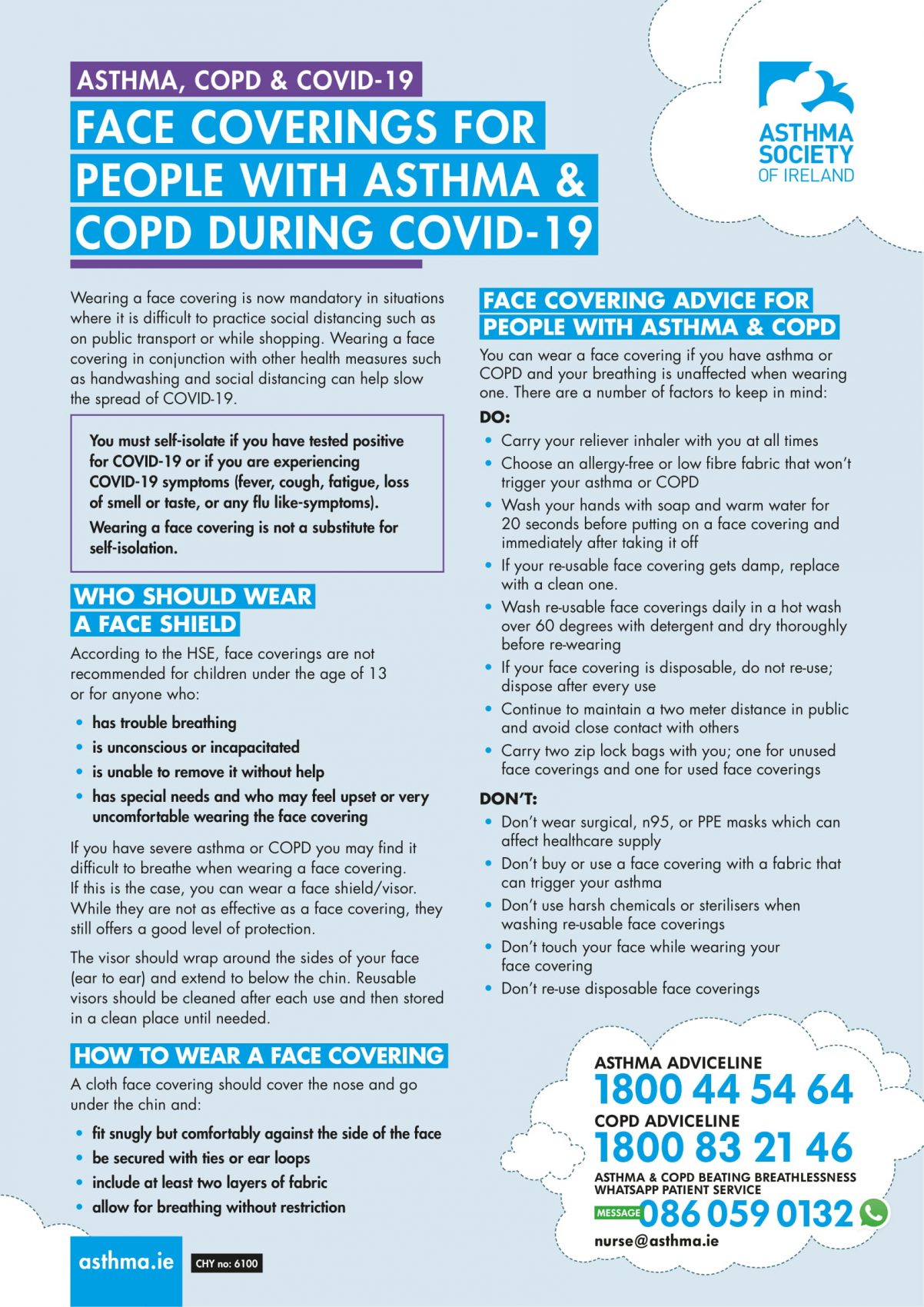
odyssey06 wrote: » The asthma society is advising don't use surgical masks? Is there really still a shortage of surgical masks? Our supermarkets and pharmacies have stocks and stocks of them...
Loafing Oaf wrote: » And of course you will be able to quote where in HSPC guidelines in states that if you don't follow all of these guidelines to the letter, wearing a mask is a waste of time.
weldoninhio wrote: » Hands up if you are following all of the below from the HSPC. Otherwise you are doing it wrong and your mask is pointless. ]
weldoninhio wrote: » The Irish govts independent expert Dr Heneghen has stated as much. He’s on post 10 in the Gareth O’Callaghan thread.
weldoninhio wrote: » Hands up if you are following all of the below from the HSPC. Otherwise you are doing it wrong and your mask is pointless. If you choose to use a cloth face covering:DoDo remember that proper hand hygiene is essential and remains a priority. Check that the face covering is made from a fabric that you are comfortable wearing. Check that the face covering is suitable for laundering at a temperature of at least 60 degrees celsius. Check that the face coverings are easy to fit and completely cover your nose and mouth. Carry the unused face covering in a sealable clean waterproof bag (for example a zip lock bag). Carry a second readily distinguishable sealable clean waterproof bag for storage of used face coverings. Practice fitting and removing the face covering so that you are comfortable applying and removing it readily. When you are about to enter a situation where face covering use is recommended put on a clean one and ensure it is covering your nose and mouth. Once the face covering is in place, try not to touch the front of it. Leave the face covering in place until you have left the situation where its use is needed or the face covering is damaged or wet. If your face covering is wet or soiled remove it and replace with a fresh one. When you remove the face covering do so without touching the front of it and place it in the bag for used face coverings. Clean your hands as soon as possible after removal of a face covering. Launder used face coverings on the evening of use at a temperature of at least 60 degrees Celsius. Check face coverings regularly for wear and damage and dispose of face coverings that are damaged. Dispose of face covering that are no longer required. Be aware that face covering use is not practical for everyone and that children under 13 year should not wear a face covering. Be aware that face coverings can pose a strangulation hazard and, in that context, may not be appropriate for use in certain settings If you choose to use a cloth face covering:Don’tDo not wear a face covering if under 13 years of age (unless specifically advised to do so by a healthcare provider). Do not wear a face covering if you have special needs or a disability that means that use of a face covering creates specific risks. Do not use face coverings instead of self-isolation. Do not use face coverings instead of keeping your distance of 2 m from other people whenever possible. Do not use face coverings instead of hand hygiene. Do not wear a face covering when you are alone in a room or in your car or in an open space away from other people. Do not allow other people to use a face covering that you have used (until laundered). Do not lower the face covering to speak, eat, and smoke or vape. If you need to uncover your nose or mouth remove the face covering and place in the bag for use face coverings. Do not place used face coverings on surfaces that are likely to be touched by other people in public places (for example on tables). Do not discard face coverings in public places other than into refuse bins. Do not criticise or judge people who are not able to wear a face covering.
robinph wrote: » So if one headlamp bulb on my car is blown then there is no point in me bothering to use the brakes to stop is your reasoning?
weldoninhio wrote: » Hands up if you are following all of the below from the HSPC. Otherwise you are doing it wrong and your mask is pointless. <snip>
weldoninhio wrote: » Again, not my reasoning. The opinion of Dr Carl Heneghan BM, BCH, MA, MRCGP, DPhil. He set up and directs the Oxford COVID Evidence Service, has over 400 peer-reviewed publications (current H Index 67); published 95 systematic reviews.
Sconsey wrote: » You're so full of crap. So you ae saying that the mask is pointless if for example I 'judge someone that is not wearing a mask'? The nonsense hyperbole from you is a joke at this stage.
Loafing Oaf wrote: » Or if you don't "Clean your hands as soon as possible after removal of a face covering", that retroactively renders the mask useless while you were wearing it. Yep, sounds scientific to me...
joeguevara wrote: » Or if Im not aware that a mask is a strangulation risk in some circumstances, id be better off going without.
odyssey06 wrote: » It's not Dr Carl Heneghan's reasoning either, based on what I have read of his publications. I'm waiting for you to provide your sources - actual article or publication - where Dr Carl Heneghan say that a mask is pointless at reducing transmission in public places if the guidelines you have quoted aren't followed exactly. Articles involving their use as PPE by healthcare staff are irrelevent to such a question.
weldoninhio wrote: » Post 10. Gareth O’Callaghan thread. He’s on video call to the Oireachtas committee.
odyssey06 wrote: » Right. So you cant produce the article. The article linked in post #10 says nothing of the sort. Claim unsupported and rejected without an article that explains its reasoning and evidence. Random quotes in a video dont count.
weldoninhio wrote: » Ok, arbitrator of what counts and what doesn’t. Hahaha. Not zealot like at all.
john4321 wrote: » Hopefully after reading the below you might reconsider if you are listening to the correct person.https://collegetribune.ie/ucd-doctor-makes-numerous-false-claims-about-covid-19/ "Cahill also claims that wearing face masks can lead to hypoxia which weakens the immune response. In other words, she is saying that the decreased amount of oxygen you inhale makes you less able to fight off the virus. Again, this has been thoroughly debunked. The use of masks does not result in hypoxia in healthy people, nor does it weaken the immune response. It is recommended that masks are not used on children under 2 with respiratory problems, but that is it. "https://www.irishtimes.com/news/ireland/irish-news/ucd-professor-asked-to-resign-from-eu-committee-over-covid-19-claims-1.4277698 "Ms Cahill also supported the use of hydroxychloroquine to treat Covid-19, one that has been supported, too, by US president Donald Trump. The drug, she said, is “safe and effective” in treating the disease."
[Deleted User] wrote: » So many people are touching and pulling at their masks. Pulling used masks from their pockets, handbags etc. Therefore contaminating their hands and then touching stuff that others will then touch. Masks used incorrectly may be doing as much damage as no masks and I say that as someone who has been using masks. Washing hands is especially important in these circumstances, and people should consider washing down their shopping.
Deleted User wrote: » So many people are touching and pulling at their masks. Pulling used masks from their pockets, handbags etc. Therefore contaminating their hands and then touching stuff that others will then touch. Masks used incorrectly may be doing as much damage as no masks and I say that as someone who has been using masks. Washing hands is especially important in these circumstances, and people should consider washing down their shopping.
odyssey06 wrote: » Are you thinking about masks as PPE for the wearer and or about something to protect others? The advice given early about masks and touching was framed re: masks as PPE for the wearer and when it was thought the virus spread primarily by contact \ surfaces. If they are covering their mouths and noses with the mask, they are using it correctly for its primary purpose. You can sanitise your hands if you touch a contaminated surface. You can't sanitise your lungs if you have inhaled infected droplets. If they aren't following mask discipline, do we really think they are being perfect at hand sanitising, not touching objects in their pocket, tissues, keys, their phone etc? And of course, people should follow mask discipline and hand sanitising discipline.
weldoninhio wrote: » Ah arbitrator of what is correct, you are now over-ruling the HSPC who have the current, up to date, do's and dont's of mask wearing on their website?? What are your qualifications?? :rolleyes:
odyssey06 wrote: » I see you have stopped inventing quotes from experts to justify this ridiculous line of argument... which leaves you with...nothing at all to back up what you say.
weldoninhio wrote: » Please share these qualifications that make you more of an expert in mask wearing than the Health Protection Surveillance Centre. I'm sure they are from all the top colleges. Or does the arbitrator get his knowledge from a higher power??
odyssey06 wrote: » I have to share no such thing to call you out on inventing and fabricating quotes by experts to support your argument. The HSPC do not say what you are attributing to them re: the effectiveness of masks at containing droplets. Nor did Dr Carl Heneghan. Your argument is a tissue of lies. If you want an argument from authority - all those people from 'top colleges' in the CDC, NPHET, ECDC are saying you should be wearing a mask. You are recommended by those experts to wear a mask. Are you doing so?






![Photo of [Deleted User]](https://w5.vanillicon.com/v2/5c014a6ccfbcc766be7a1899ed0f9420.svg)