the incredible pudding wrote: » She was stating that for the year forecast, this contraction was that for the quarter.
Jessica Swift Bearded wrote: » I didn't see any mathematical theories put forward. It was simple percentages of death by number in a particular age group only?? The graph with Irish and Swedish percentages strongly suggests no difference. Could be that Swedes are generally healthier or that they received better medical care than the Irish? If you were to argue that as the cause I could buy into it.
charlie14 wrote: » Is it not based on mathematical percentages to prove a theory. If it is what else would you call it other than a mathematical theory. You have spent time in Sweden so you should be in better position able to judge if the Swedes are healthier and receive better health care. The general perception in Ireland is that their health care is better. I do seem to recall that for diabetes, obesity and hypertension, three of the vulnerable Covid-19 conditions, our levels are higher.
Jessica Swift Bearded wrote: » I think this is true! The statistics don't show that Ireland did any better.
Jessica Swift Bearded wrote: » The general perception is that the Swedes pay a high tax and the country looks after then very well. Great maternity, unemployment, cold care etc Health care I have no experience of but I'd assume its excellent.
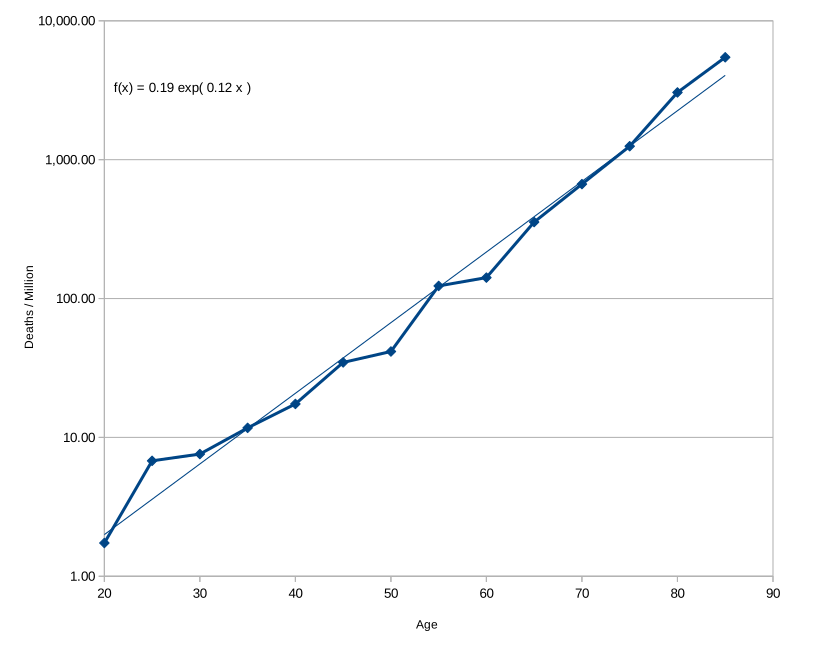
Bit cynical wrote: » Probably enough has been discussed about this but following on from an earlier post here, I thought the plot posted looked like an exponential curve, so plotting instead on a logarithmic scale, we get Sure enough we get a very straight line allowing us to fit an exponential curve with the equation indicated on the chart. Each data point is for Ireland (first) then Sweden alternating. We can observe that for the age group centred on 20, and again at 50 and 60, Sweden's deaths are a little higher. For the older ages, Ireland's and Sweden's rates are about the same. Ireland has a small edge but it is at the younger ages that this manifests itself. The picture is a little clearer if we separate out the two sets of data and fit a curve to each. We can see that Sweden is a little worse at the lower end of the age range but as you get older, the rates converge. This makes sense as Ireland's lockdown prevented infections and deaths across all age ranges at the expense of immunity for the younger age groups. In Sweden, schools were still open and younger age groups were still able to get out and socialise if they wished. Sweden did better at protecting the elderly considering the much higher rates of infection indicated by higher ICU numbers during the peak. However overall the lines are surprisingly similar for Ireland and Sweden across all ages despite the radically different approaches of the two countries.
charlie14 wrote: » ...and a theory based on mathematical percentages. A mathematical theory ?
FintanMcluskey wrote: » Excellent data here I must say, incredibly well presented. My own conclusion from the above and the economic data released today is that Sweden have led the way. One must remember, every % drop on GDP correlates to life years lost due to cuts in funding etc
ittakestwo wrote: » Thanks for graphs. But the the lockdown slowed the virus spreading. Which Ireland did quicker than Sweden. It was not really to give elderly a relatively better death rate compared with the younger. The graphs interestingly might suggest that no mater what you do, lockdown or not, you cant change the relative death ratios between the ages. But if you overall reduce the amount people with the virus you will automatically reduce the deaths in each age range which would protect the elderly as they are most likely to die if they catch it.
FintanMcluskey wrote: » I dont follow your synopsis. Does that graph support your last sentence?
cnocbui wrote: » Sweden's second quarter GDP figures are out; -8.6% for the quarter and -8.1% yoy. The EU 2Q GDP was -12.1%, so Sweden did 50% better economically. I think the kicker would be in the number of small businesses that fail permanently and the fall in incomes of the self employed, which I suspect will be far fewer, and less, in Sweden than in lockdown EU countries.
ittakestwo wrote: » Yeah. The graphs show the virus is more deadly to the elderly...agreed? by reducing the spread of it in a country would therefore protect the elderly more... agreed?
Bit cynical wrote: » What I think the graphs suggest is that overall if you are in a given age range, then you have the same chance of dying from Covid-19 whether you are in Sweden or Ireland, other things being equal, not merely that the ratios between young and old are the same within each country. But even if overall the same numbers in proportion to the population, regardless of age, died in Ireland as in Sweden, it still wouldn't mean that the lockdown had no effect in Ireland. Controlled for age, Ireland and Sweden produced very similar results by radically different methods. Ireland reduced deaths by reducing infections through lockdown. Sweden did not reduce infections to the same extent as Ireland but expanded ICU and hospital capacity greatly and used up to 80% of that capacity to reduce deaths. This means that Sweden's economy suffered less than it might and also the greater the infection rate meant that whatever immunity the virus might confer will help with preventing resurgence in the future. Lockdowns do reduce the rate of transmission and therefore deaths but they come with costs.
FintanMcluskey wrote: » Yes to the first point, Regarding the 2nd point, Sweden didnt reduce the spread, and still protected the elderly. Healthcare did assist somewhat, but remembering Ireland still had a similar death rate as Sweden, with surplus hospital space
ittakestwo wrote: » Regarding second point I dont think it did. Look at the daily deaths for the month of June in Ireland compared with April. Daily deaths in june here look less than 10% of April's. In Sweden June's daily deaths look about 40% of April's. If Sweden had locked down they could have got this down to less than 10% of April's in June. These extra deaths are old people so I dont know how you can say they let it spread and also protected the elderly
ittakestwo wrote: » It so happens that Ireland and Sweden's overall death rate ended up the same but this is just coincidence. In most countries with one jurisdiction government you will have big differences in rates between regions yet the country was governed by the exact same policy. If the rate of a country was all down to a approch it makes regarding lockdown or not, why do countries not have one uniform rate throughout the regions of the country? There is obviously so much inputs that contribute to a country/regions infection rate that comparing two countries that are not neighbour like Ireland and Sweden a problem.
One thing that is evident from sweden that its graph of daily deaths and new cases fall slower from April compared with countries that had a lockdown. To me this is proof that a lockdown did slow down the spread. And from your graphs you can see how more deadly the virus is to the elderly, by locking it down would have saved elderly lives here or by not having lockdowns in Sweden caused elderly lives.
Sweden’s light-touch lockdown failed to spare its economy from a historic plunge in GDP as Covid-19 triggered a collapse in exports and spending. Output contracted by a record 8.6pc in the second quarter compared with the previous three months, but the Nordic nation suffered a much smaller hit than many other European economies. Despite some of the most relaxed Covid-19 restrictions in the world, its exporters were hit by tumbling global demand and household spending slumped as the virus struck. “The economic crunch over the first half of the year is in a different league entirely to the horror shows elsewhere in Europe,” said David Oxley at Capital Economics. It is “still likely to be among the best of a bad bunch this year”, he said, pointing to signs of a rebound at the start of the third quarter. While the hit to GDP was lower than the 12pc slump in the eurozone in the second quarter, Sweden's Nordic neighbours have managed to avoid both a health and economic crisis.
Bit cynical wrote: » The initial motivation for me at least was to counter claims that individual elderly were more at risk in Sweden than in Ireland and I think that has been done.
biko wrote: » my quote "Sweden's Nordic neighbours have managed to avoid both a health and economic crisis"
I don't think that a lockdown does not slow down the spread of the virus and the graphs were not intended to prove that. Lockdowns are good for a specific task.
It is just that what do you do if the vaccine has not appeared within the sustainable time of the lockdown?
A balanced approach is needed: a combination of some restrictions to flatten the curve in conjunction with an expansion of hospital capacity to deal with serious cases. This allows for a degree of natural inoculation to occur in the healthy population and the increased hospital capacity reduces deaths to the same levels as some other lockdown countries. The balance might be different in Ireland than Sweden and, as we have seen and they have admitted, Sweden did not get everything right either. But I think Sweden's overall philosophy correct.
Jessica Swift Bearded wrote: » I'm sure a strict quarantine would stop the spread of any contagious disease. But we didn't do that. Our approach was half arsed, all the bad from lock down with none of the potential advantages.
Back in March, we were trying to flatten the curve. This, I understand, but once you flatten it, what then? The answer in Ireland is more of the same. Lets not worry about other illnesses, people's mental health or the economy.
Jessica Swift Bearded wrote: » Excluding prostate cancer, most people who get to age 75 won't die of a cancer. But the rest of the population could. 79% of all the covid deaths are in the over 75's (93% over 65) and we stopped all cancer screening in the rest of the populations. Why are the over 75's more important than everybody else?
tobefrank321 wrote: » Sweden's unemployment rate is now 9.8%https://tradingeconomics.com/sweden/unemployed-persons Not bad considering they are an open economy. Irelands unemployment is hard to judge because of PUP but its predicted to be between 14-15% in the second half of year.https://www.independent.ie/business/coronavirus-ireland-unemployment-rate-could-hit-15pc-for-second-half-of-year-donohoe-39426889.html
Bit cynical wrote: » Strict quarantine useful as a temporary measure to buy time so that you can get longer term solutions in place. The mistake I think many countries made is that they imposed fairly strict lockdowns without any idea of what they would put in place afterwards. The solution I would advocate is that you keep it always flat enough so that hospitals are not overwhelmed. You also expand ICUs and other capacities as much as you can so that less emphasis is placed on curve flattening than would otherwise be the case. With this strategy you don't try to stop infections dead; in fact, a certain amount of infections in the healthy population is desirable. Eventually infections and deaths start falling as they did in Sweden and hopefully a degree of immunity in the population helps guard against what is being called "second waves". I think the "then what?" question applies more to very strict unsustainable lockdowns. They buy time which can be very necessary but that is all they buy. We in Ireland may have started off with a curve flattening strategy (though I'm not sure we really had a strategy at all), but this quickly transitioned to what you might call an unrealistic eradication strategy where the goal was zero infections and zero deaths. We were successful in this but the problem is that it is the wrong goal as it is not sustainable. We have had zero deaths for the last 9 days or so but we can only sustain this by keeping restrictions in place and even with that we are seeing rising infections that will lead to more deaths in the future.
charlie14 wrote: » Somebody mentioned Bloomberg here in relation to an expected contraction of 7% or less of Sweden`s GDP for the second quarter. A few weeks ago Bloomberg made an interesting observation on Sweden`s unemployed figures. Apparently there are large number in Sweden listed as being on furlough, (a temporary leave of absence), and as such are not registered as unemployed. Taking those into account Bloomberg put the unemployment figure for Sweden at 17%.




![Photo of [Deleted User]](https://w8.vanillicon.com/v2/8a022abb175d445f2b5b8a1c545f3d3f.svg)

