patnor1011 wrote: » There is no second wave. What is being portrayed as "second wave" is in fact just a virus coming to states where population was not yet exposed to the virus. Even Ireland exposure was delayed by lockdown which in fact only prolonged inevitable. Better explained here: At the end of May there was a significant breakthrough in understanding of COVID antibodies which was not widely reported: a Swiss study from Zurich led by Professor Onur Boyman demonstrated that a large proportion of the population had a natural immunity through existing antibodies on the mucous membrane (IgA) or cellular immunity (T cells), likely to have been acquired through previous exposure to coronaviruses such as influenza or the common cold (the absence of exposure to previous coronavirus is now thought to explain the opposite effect in 1918). The study found that that the presence of (IgG and IgM) antibodies generated on infection which tests had previously focused on, were NOT in fact required to defeat the virus and that existing (IgA and T cell) antibodies that gave a natural immunity. Moreover, the population with this natural immunity was demonstrated to be five times greater than those with the IgG and IgM antibodies on which tests had hitherto focused. If this could be substantiated, then the population already exposed to COVID would also be five times greater than previously assumed. In other words, if a population sample showed 10% had IgG and IgM antibodies (which might be subject to decay) then it was likely that at least half of the population had already been exposed to COVID. It followed that antibody studies that measured only IgG and IgM that were now predicting population-based mortality risk of 0.1% to 0.5% (lower than the 1% in the elderly population aboard the Diamond Princess) could be even further reduced by a factor of five to 0.02% to 0.1% and the level of symptomatic exposure from 20% to below 5% (consistent with the flu season ironically predicted by Fauci in March). Not only would this mean a further similar reduction in the estimated true mortality rate but it meant that there were far fewer people in the population who had never had exposure to the virus, so a far lower number who could potentially catch the virus in the future. In short, the infamous herd immunity was much closer than previously realised. This explained why, by July, the virus had all but disappeared in populations like Sweden, New York (Fig. 7) and Wuhan (which reportedly tested its entire population of 11 million and found only 300 cases, all of which were asymptomatic) which were significantly affected by a “first wave”: if the ratio of those with IgA and T cell antibodies to IgG and IgM antibodies across population was confirmed at a factor of five then if 20% of the population had traditional IgG and IgM antibodies (such as New York with 21% and London with 17%) then the virus died out because there was simply no one left for it to infect. It followed that the virus could only survive in population samples where testing showed the presence of IgG and IgM antibodies was below 20% (and allowing for their decay probably well below). Nobel Prize winning biological scientist Michael Levitt had already come to the same conclusion based on a different approach: he predicted that the virus would “burn out” when it had infected 15-20% of the population though based on a pattern predicted by the “Gompertz curve” which indicated that the number of deaths after the peak is roughly double those from before resulting in Levitt accurately predicting the number of Chinese and Swedish deaths, months in advance. Levitt has recently bravely predicted that US COVID will “be done in 4 weeks [25 Aug] with a total reported death below 170,000”, compared to 149,000 today. Boyman’s theory on “IgA and T Cell immunity” explained the accuracy of Levitt’s “Gompertz curve” predictions and this was now being backed up by the empirical evidence which showed that the populations which were hit hardest with high initial rates of infection and mortality, were the ones where the virus had almost disappeared. Almost none of this was reported by a media which choose instead to attach the misnomer “second wave” to outbreaks of COVID infection in populations which had not yet experienced any meaningful “first wave”: the Sunbelt states in the US, Australia, Hong Kong, Japan. The irony was that the vulnerability of populations which had not yet seen meaningful infection outbreaks and therefore the fallacy of lockdown had already been predicted by Levitt and Giesecke. It was also logical that population groups where IgG and IgM antibodies were still significantly below 20% would continue to see infections.
bb1234567 wrote: » In hotspots such as New York , it is not consistent level of infection across the city. In working class districts up to 80% of the populations on those nieghbourhoods had antibdoes. It's not as if the often cited 1 in 5 figure was replicated throughout most of the city. Where does this leave this theory then? Why are some cohorts clearly so vulnerable to infection? The information provided appears to glean over this extremely important detail. Unless there is some valid theory given as to why working class people may have lower levels of immunity to other coronaviruses that has allowed such widespread transmission of COVID-19 in the last few months, then it very strongly suggests that there are simply large numbers of peple in these hotspots in other less affected areas still vulnerable to infection.
Can anyone point out any further glaringly incorrect 'facts' in the article that I may have missed?
Bit cynical wrote: » It may be more living and working conditions that account for higher antibodies in working class populations within hotspots than lower levels of prior immunity in these groups. They will be more exposed to the virus and also more likely to spread it in the initial stages. Living in more crowded conditions and less likely to work in sanitized office environments would mean they are hit first and hardest, but also be the first to acquire some degree of immunity. Therefore their immunity, to the extent it exists is more important that groups leading more isolated lives.
FintanMcluskey wrote: » But Ireland had the same loss of life, its just that most posters cant understand the statistics behind the numbers.
froog wrote: » what statistics are you using to come to that conclusion? Sweden deaths per 1M population: 568 Ireland deaths per 1M population: 357
bb1234567 wrote: » I think his point originally was that when you take into account the fact that if we had as high a proprtion of over 65's as Sweden we would likely have a larger number of deaths per capita But it's silly to say that though, it's just an incorrect statement standalone like that, Sweden has had far more deaths per capita than Ireland. Maybe if Ireland has as old a population we would have had more deaths, but that's nothing more than a theory, no real world evidence to back up this belief. The actual reality is a lot more people died in Sweden from COVID than Ireland both in total number and per capita, this is irrefutable fact
bb1234567 wrote: » But it's silly to say that though, it's just an incorrect statement standalone like that, Sweden has had far more deaths per capita than Ireland. Maybe if Ireland has as old a population we would have had more deaths, but that's nothing more than a theory, no real world evidence to back up this belief. The actual reality is a lot more people died in Sweden from COVID than Ireland both in total number and per capita, this is irrefutable fact
MerlinSouthDub wrote: » You think it's just a theory that older people are more likely to die of Covid-19? Every country has seen much higher rates of mortality in older people. The evidence is completely clear.
bb1234567 wrote: » Nope and I never disputed that. Saying that Ireland has higher number of deaths per capita than Sweden is still an indisputably wrong statement, however
bb1234567 wrote: » Yes, that is all very true and makes sense and explain why working class communities would have higher rates of infections as you'd expect. But it does not in any way clarify or ensure why or how the rest of the population of the city may have ay kind of existing immunity to the virus as theorised in the article posted earlier. As I have said the fact that 80-90% of people in some neighbourhoods of New York became infected would suggest that a similar proportion of the population of city overall is vulnerable to infection rather than the theory the author is getting at.
biko wrote: » 80,422 official cases 5,743 officially dead 7.1% of known cases have passed Numbers from FHMs own tracking pagehttps://experience.arcgis.com/experience/09f821667ce64bf7be6f9f87457ed9aa
FintanMcluskey wrote: » When calculatiing the infant mortality rate the data set used is only the population under 1 year of age. Would you think including the complete population age would return accurate data? What are you saying nothing more than a theory? its data presented in a way you cant undrstand obviously. Ill put it a different way Sweden has a fatality rate of 0.28 % of over 65's Ireland has a fatality rate of 0.27% of over 65s Covid is dangerous to a specific identifiable group of citizen's
Jessica Swift Bearded wrote: » How did you obtain these figures?
bb1234567 wrote: » Fintan you are not stating that Ireland's mortality rate among elderly is the same as Sweden
FintanMcluskey wrote: » It is exactly what I am/always have stated.
bb1234567 wrote: » ' Your statements of late have been far more vague. This statement above is completely wrong, it is irrefutably incorrect. More people have died in Sweden than Ireland per capita. Do you see why there is an issue with making this statement, and why you're being called out for it?
mcsean2163 wrote: » If you take it in context it's obvious what he is saying. E.g. "it's improbable I would lose my temper if someone hit me". Unfair quote, the poster said. "I would lose my temper if someone hit me".
bb1234567 wrote: » Sweden has more elderly people,that is a disadvantage in this situation that they must deal with. It needed to do more to prevent widespread transmission because of this issue. It didn't, therefore , more deaths.
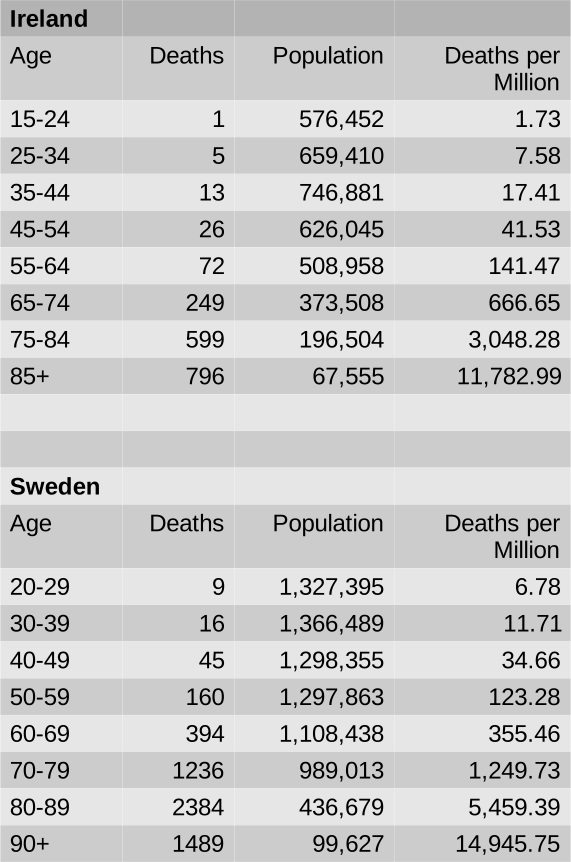
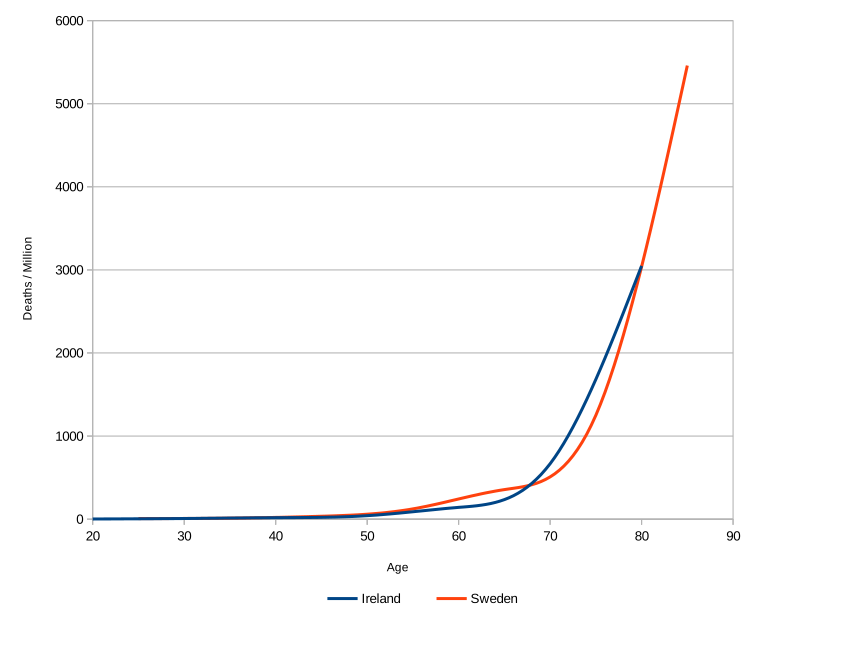
Bit cynical wrote: » Just on the age breakdown in Ireland and Sweden, This combines Covid-19 data from census population for each country. It is a little hard to interpret as the age brackets are different for Ireland and Sweden. However I plotted some of the data in Excel to produce: I left out the 85+ and 95+ brackets as these are of different sizes. Looking at the chart, there's not a lot of difference between Ireland and Sweden but it looks like between 70 and 80 you have a lower chance of death by Covid in Sweden than Ireland. Between 60 and 70, a slightly lower chance in Ireland. There's not a huge amount in the difference but I think we can say that Sweden was not worse in any significant way than Ireland in the treatment of its elderly. Both countries made similar mistakes and Sweden, at least, have admitted to this. There was someone on here saying he was glad he lived in Ireland because he was 70. But, in fact, it probably does not make a huge amount of difference. If we control for age, Ireland and Sweden have performed roughly the same.
Arghus wrote: » Sweden has twice our population but its deaths amongst the over 65's were three times as worse per capita. That's a pretty significant difference. And that doesn't even take into account the differences in reporting between the countries, we know Ireland reports deaths in settings that a lot of countries don't, so you'd wonder if those Swedish figures are actually an underestimate. It's a myth that Sweden looked after its elderly better. The numbers don't lie: they didn't.
FintanMcluskey wrote: » Id say your right. Sweden also has a higher per capita avalanche death figure over the past 10 year's compared to Ireland. Its nothing short of a roaring success by Ireland's anti avalanche squad