BonsaiKitten wrote: » Would supervision/insurance be a problem with base classes? Presumably when the teachers are moving about the school that means that the kids will be unsupervised during that transition. I'm primary so I don't know about the rules in secondary but it would be a big problem for us.
lulublue22 wrote: » Interesting - though how will it work in practical terms in school ?
Zahir Bitter Cellist wrote: » I'd imagine they'd coordinate everything from signage to hand sanitiser and oversee the logistics around premises, supplies and cleaning from a guidelines perspective. Also practically maybe there as a supervision for children who become ill, maybe temperature checks etc, implementing illness procedures, parent communications. It didn't go into much detail about the role but it would definitely help to have someone who's sole responsibility as overseeing covid guidelines in each school. Would make the schools safer for all anyway.
wirelessdude01 wrote: » Once again it comes back to the department, money will be an issue. Expect this to be delegated to an existing staff member as possibly an emergency AP2 post for just a year. Cheapest way for them to appear to be doing something.
Bananaleaf wrote: » If this happens, we need to be vocal about it. To be fair to parents and the public, half the time they are annoyed about what goes on in the schools, it's because they think we are provided for much much more than we are. Take the predicted grading as the most recent example. The dept of Ed said that teachers and principals would be fully trained up in the predicted grading process. I dont know what the principals got, but our staff had a 25min meeting online with the principal where every single question was answered with the line 'you guys are the professionals- trust your judgement' There was an online video and a book of guidelines. I'm not saying we got nothing, but I am saying that when people hear 'fully trained up', they are probably thinking we got more than we did. If we get a Covid assistant that would be great. But if it ends up being just another job tacked onto the list of jobs that an already overworked AP2 has, then that's not on. And when things start going wrong, the public will be outraged saying 'and they have a person whose JOB it is to look as after this ffs' and sure who could blame them? I'd be thinking the same myself if I didn't know any better
Bananaleaf wrote: » ... If we get a Covid assistant that would be great. But if it ends up being just another job tacked onto the list of jobs that an already overworked AP2 has.... And when things start going wrong, the public will be outraged saying 'and they have a person whose JOB it is to look as after this ffs' and sure who could blame them? I'd be thinking the same myself if I didn't know any better
daithi7 wrote: » I wonder how the continental countries who already have got their schools back have managed it so seamlessly? Can we not just copy best practice from their experience already?? I mean what's the big deal here. P.s. Or else let's just cancel next year's leaving cert exams also & totally cave to the public sector teacher unions......
Bananaleaf wrote: » Staggered breaks - As students are not with the same teachers all day, this wouldn't be easy to work out. Maybe not impossible, but I can't figure out how it would work. Let's say I've a class, we'll call them Maths 1. I teach them and they are then to take their staggered break. I am to take the break then too, but hold on, my other class, Maths 2 are just finished their break and they are waiting for me to teach them....
Bananaleaf wrote: » Team teaching - the SEN model in secondary schools is not all withdrawal anymore - it's more in-class support via a second teacher in the room. Team teaching = 2 adults in the room. Harder to social distance. Although, the team teaching model allows for teachers to split the class so hopefully if space allowed (herein lies the problem I guess) one teacher could take one half off to another room and it would be very easy to social distance then
Bananaleaf wrote: » Moving around the school - when the bell goes it is mayhem in our school. We have well over 1,000 pupils. Teachers have base rooms and students move. I'm thinking that surely it would make more sense for the students to be given base rooms and for the teachers to move? If the kids apparently don't transfer or carry it though, is it better for them to be moving around and not us?
Bananaleaf wrote: » Time to clean - Say you have class from 9-9.30. Your next class starts at 9.30. But should it start at 9.35 to give you time to sanitise the place before the next class come in? Or should you finish the lesson at 9.25 and get the students to sanitise for the next group? Or will we just not be santising?
Bananaleaf wrote: » Interactions with staff that you just can't avoid - queuing up for the photocopiers, needing to use a computer,
Bananaleaf wrote: » accessing a staff toilet - how are we going to do this while being socially distant. Everyone says that they can open the GAA pitches but not the schools, but even on the GAA grounds and athletics tracks, they're not opening the toilets!
Bananaleaf wrote: » What about department meetings? Still have them on zoom/microsoft teams maybe? But they'd have to be done in school via teams as it's unreasonable to expect teachers who are parents to drive home to log in and go again.
Bananaleaf wrote: » Sick days - lets say I've flu-like symptoms and I call in sick. Do I have to get a Covid test? If I'm waiting 5/6 days for the result of that, am I using up all my sick leave? This might seem like a selfish or greedy attitude, but I'm thinking more of those who will opt not to call in sick if they think it will eat into their leave
Random sample wrote: » I don’t know if you are seriously asking this or not, but other countries have not brought all kids back at the same time, have smaller classes in bigger classrooms to begin with and are having classes outside where possible. Public sector teacher unions have nothing to do with any of that.
BonsaiKitten wrote: » I think the easiest solution to the sanitising would be to get students to wipe down desks before/after each lesson. You can't really let the whole lot hang out unsupervised on corridors for 5 mins if you're trying to reduce transmission. No doubt some kids will kick up a fuss about it but I am sure many would see the need. Thinking back to my own secondary school, I don't think they'd have had the space to physically separate each year group at breaktimes. I assume a lot of other schools are similar and that's one of the biggest problems with it.
Lillyfae wrote: » I think a lot of the kids in most countries are back now. They have been here for weeks, having originally trialed 50% without problems
wirelessdude01 wrote: » All us people who work in schools know that the department deal in smoke and mirrors. Nothing is ever clear. Wishy washy communication wth the term local arrangements is what I expect at this stage.
beggars_bush wrote: » Holistic Child centred Bespoke
Random sample wrote: » What country is that and what is the student-teacher ratio?
Lillyfae wrote: » According to OECD figures for 2017, 16.6 to Ireland's 15.7
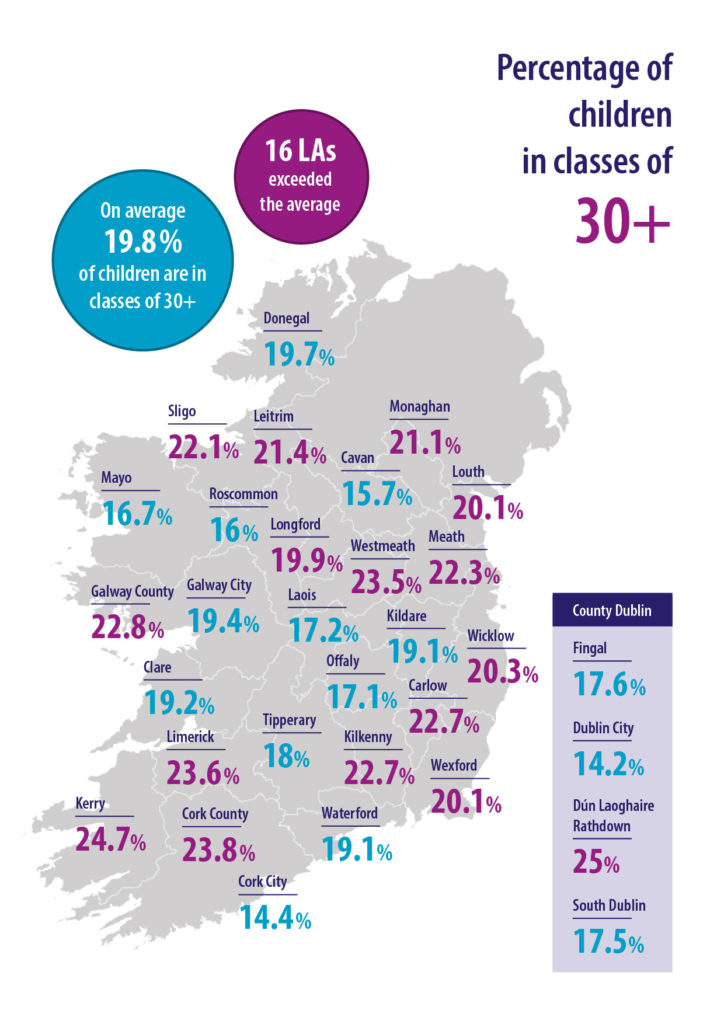
Boggles wrote: » This should give you a flavor of the problem.
Lillyfae wrote: » Source and date? I was quite surprised by the OECD numbers.
daithi7 wrote: » Imho, nphet & the dept have made a mess of this from the off.Firstly, kids under 12 aren't a covid risk at all (of either getting the infection or spreading it), therefore all primary schools should just go back pretty much as is, bar maybe controlling adults access to the school & extra hand sanitation and a bit of desk spacing. Secondary students carry more testosterone & therfore have to be managed better and social distancing, extra hygiene, restricting visitors and facemasks should be the norm imho. Then particularly at risk kids should be facilitated by video link and remote learning tools. Job done, get back to school and less prevarication and pandering to the stuck in the mud public sector unions.... they're only ever after another pay day anyway!!
The OECD’s Education at a Glance 2018 report notes that smaller classes are often seen as beneficial because they allow teachers to focus more on the needs of individual students. The average primary school class across the OECD during 2016 had 21 students, while some countries such as Costa Rica, Latvia and Lithuania have as few as 15 or 16 students per class.In Ireland, there were 25 students in primary classes, the fifth highest in the 36-member OECD. Only the UK, Japan, Israel and Chile had slightly larger class sizes. Large classes sizes extend into third level, with Ireland recording one of the highest student-teacher ratios in the OECD. In higher education, student-teacher ratios range from eight to one in Luxembourg and 10 to one in Norway and Sweden. While the OECD average is 15 to one, class sizes rise to more than 20 to one among a small group of countries including Ireland, India, Indonesia, Turkey, Belgium and Colombia.
Boggles wrote: » INTO, April 2019. Did you think I fashioned the map myself? Here is OECD Education at a Glance from 2018 Ireland lumps in everyone as a class teacher so the figures are false. What country did you say you were in?