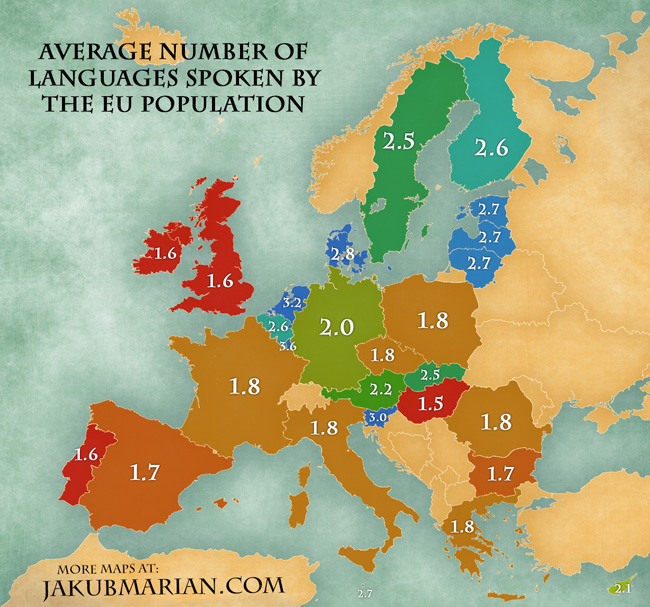
Hotblack Desiato wrote: » 5 or 6 useful languages (and that'd be a few very motivated people)
Hotblack Desiato wrote: » In Finland a lot of people are p!ssed off that they have to learn Swedish just because there's a small Swedish-speaking minority in Finland, they don't see a value in learning it. Most Scandinavian languages are similar to each other, just as English, Dutch and German share quite a bit, Italian/Spanish/French, etc. but Finnish is like Irish - not related to the languages around it, and not useful at all outside of its small home country. The difference between Finnish and Irish is that Irish isn't even useful within Ireland.
Hotblack Desiato wrote: » If the "learning Irish makes it easier to learn other languages" argument had any merit, then why are we so bad at learning other languages?
Gbear wrote: » If the average in places like the Netherlands is 3ish, presumably there are a decent number that speak 4,5,6 and so on, and they're not necessarily "useful" in as much as that means anything.
Dutch, Swedish, Danish, Finnish, Norwegian - they're scarcely much more useful than Irish themselves.
I don't know Irish well enough to comment, but supposedly it has structural similarities to French
which is why it tends to be the foreign language in gaelscoils, or so I have been told.
Again, I'm not that sold on Irish itself, but I think it's the most realistic option if we want to become a truly bi-lingual nation, and if we do that, I think that will have benefits enough of its own to justify it.
Hotblack Desiato wrote: » Like Welsh nationalists, like SF up north, and like Irish nationalists did before independence, they are using a language as a political weapon not promoting a language for its own sake. It has been said that the worst thing that happened to the Irish language in the 20th century was independence!
Permabear wrote: » This post had been deleted.
topper75 wrote: » Interesting viewpoint. I can see where you are coming from. The Free State damned Irish to some extent by using it for official names: Táiniste, Dáil, Seanad, Taoiseach, party titles etc. as you might with dead languages like Latin. This approach limited the extent to which Irish could be ever revived as a working 'kitchen' language in Irish homes like Hebrew was in Israel, and instead unintentionally gave it a different role as heritage piece or object of officialdom, taken down from the dresser on occasions to impress visitors or convey authority. I'd be much happier with 'Prime Minister' and 'parliament' whilst we were speaking English, if Irish was let truly breathe on its own.
topper75 wrote: » Damn it, this has put thoughts in my head. :-) I'm going to be awkward from now on and refer instead to senate, prime minister, hurling ball etc. at all times. If a person mentions 'seanad', 'Taoiseach' or 'sliotar', I'll deem the conversation to have switched to Irish ...agus déanfaidh mise mar an gcéanna. Let's see how that goes down. :-) If someone writes to me with an address of A Chara, ... scríobhfaidh mise chuchu go hiomláin as Gaeilge. Probably not being awkward though really, just giving a language its due.
topper75 wrote: » Damn it, this has put thoughts in my head. :-) If someone writes to me with an address of A Chara, ... scríobhfaidh mise chuchu go hiomláin as Gaeilge.
wakka12 wrote: » I really doubt a large number in the countries you mentioned speak 4 or 5 or 6 though. Id say nearly all of them just know english out of necessity along with their native , and then a bit of a third. If ireland was native irish speaking we would learn english out of necessity and another foreign language at a conversation level and we'd probably have similar number of about 2.6-2.8 too then I would say its an average of 2.7/2.8 due to the vast vast majority speaking english and native well alongside some french or german or spanish rather than a lot speaking 4 or 5 languages and lots only knowing their native language making an average in between 5+ languages would be extremely difficult to learn and is not necessary or even nearly worth the effort
Shurimgreat wrote: » Or course it could be revived. Wales is a model of how a language has made a huge comeback. Hungary I think the same. The key is a mixture of education from a young age and immersion. What kids learn from the age 0-5 in terms of language is critical. That will always be their "first" language. After that its a case of forcing them to learn a "foreign" language.
Shurimgreat wrote: » The key is a mixture of education from a young age and immersion. What kids learn from the age 0-5 in terms of language is critical. That will always be their "first" language.
VinLieger wrote: » We invited people from wales who were involved with their program to advise us on what to do...... they were sent packing because the core advice was remove it as being mandatory in schools and stop teaching by rote
Princess Consuela Bananahammock wrote: » If that's true, then it kind of proves the point that those responsible for promoting and teaching the Irish are the biggest threats to any revival hopes imaginable.
Sponge25 wrote: » As a first language no. Actually most of of us are Germanic and not Celtic with the exception of Connaught.
topper75 wrote: » . However, the vast majority of people know at least a few words of Irish. No immigrant tongue will outstrip Irish in this respect.
whisky_galore wrote: » Knowing a smattering of random words without being able to string a sentence together does not a living language make. Pretty feeble result for almost a century of resources poured into the failed bilingual experiment. Brings to mind that Carlberg ad from a few years back.