regi3457 wrote: » Yes, this is because the economy works on perpetual debt...no debt = no growth.
regi3457 wrote: » Yes, this is because the economy works on perpetual debt...no debt = no growth. I don't feel people are responsible at all. How can the average person on the street know what is reckless lending? They don't. They expect the banks and the financial regulations to be reliable. I do agree that living below your means is always best but if people were that smart, the whole economy would collapse...as I said before. The debt is what they need and the promise to repay is what people give and this drives the economy.
CelticRambler wrote: » Only because "we" have subscribed to that economic model. It's a circular concept, the same as childcare: two parents go out to work, so have to pay a child-minder, then find that mortgage and commuting costs mean they can't afford the child minder, so the government is persuaded to offer extra financial help to parents under the guise of meeting a 100% employment target, which means that now there's an incentive to have that first/extra child putting pressure on childcare places, driving up prices, which means the parents need to earn more or drive further to wherever the available places are ... As I said above, if the parents sit down and do the sums - which some of us contributing to this thread have done - they usually find it makes better financial sense to have only one full-time worker and one parent "in reserve". On balance, they're probably contributing more to the real economy than two-income families who are funneling their wages into mortgage interest payments.
OttoPilot wrote: » That's rubbish, the economy can definitely grow without debt, otherwise we would have made no progress before banks. Think about it, if someone finds a way to do their job in half the time it currently takes is that not growth?
Electric Sheep wrote: » That may make financial sense in the short term, but in the long term is seriously harmful to the financial security of the non-earner.
CelticRambler wrote: » Only because "we" have subscribed to that economic model.
Susandublin wrote: » Worth mentioning that not everyone dislikes their work. I love what I do - the fact I get paid is a bonus. Yes the wage assists but for most people it's a case of keeping up with the Jones. If everyone on your street had one car, chances are you would survive with your one car. If everybody did just 1 holiday a year - chances are you'd survive on one holiday a year. Most people are sheep and lack the ability to be brave and live the life they want. Human nature makes us try an improve ourselves - an easy solution is extra money which results in extra work which usually leads to the opposite. One of life's ironic twists.
CelticRambler wrote: » Why? If you consider "both parents" to be part of the same economic unit, then neither is more or less secure than the other. Are you disputing Elizabeth Warren's findings?
Eugene Norman wrote: » It's really housing costs. That swamps everything. I bet that relative to wages, despite VAT, most things are cheaper then they were (and customs duties? We weren't in the EEC in the 60's). Childcare is also expensive but it's expensive (it's needed) because people work. And housing and childcare are symptoms of women working rather than the cause, or rather it's a feedback loop. It's not "entertainment systems". The cost of your mobile phone per month might be cheaper than a few calls to the UK from a landline in 1960. There were extortionate rental costs on the phones too. And my phone and Netflix (7€ a month) is my home entertainment cost.
regi3457 wrote: » No it can't. Sorry but you are mistaken. No debt = No growth = no inflation needed to pay the debt. More debt must be injected into the system else there will be a collapse. It is "perpetual debt". I am sure any economist can explain this to you... don't take my word for it if you are in doubt. It is, but that will never happen because there will be even more debt so we must work twice as much to pay it. If you can do your job in half the time the only thing that will happen tomorrow is that you will be 2 times as productive to your boss. I am sure a car can be manufactured in half the time now than was possible 50 years ago. Does that mean that workers go home at lunch time? No, they must work more and more and more and more. And their wives and husbands will be doing the same across town in their jobs being twice as productive but late at the office working overtimes just to pay the mortgage. We work more now than before and earn less. That is the truth. Sad but true.
OttoPilot wrote: » I've studied economics, I've never met a professor who believes that debt must increase perpetually to create growth. I agree that debt increases growth, but in the absence of debt the economy will still grow, just not as quickly. I don't know how you can believe in something that you can't explain yourself. You should always break a concept down to its simplest form, a 2 person economy. If I grow apples and you grow oranges and I discover my way of increasing productivity but I need to spend all my time on it. Then I need to borrow some oranges from you to consume to survive. Then when I have my increased production I can pay you back with interest and the debt is gone. If you honestly think we earn less than people in the sixties, you're a fool. I'm currently typing this on a device the size of my hand from my own home which will be transported electronically to you and every other person in the world who wants to see it. We work harder because we have way more stuff, things people 50 years ago couldn't even imagine, that includes housing.
Suryavarman wrote: » Cars can now be manufactured in less time so less people work in car factories. Those people are now employed in other industries. Workers are now working less and earning more than they have in the past. That is a fact. The so-called truth you speak of is a figment of your imagination.
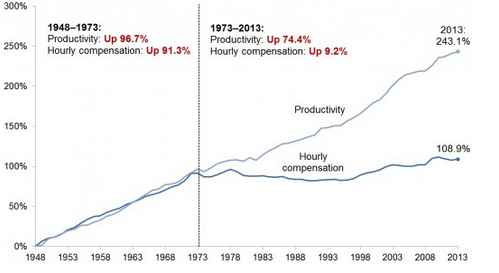
KomradeBishop wrote: » Workers are actually receiving far less of a share of productivity improvements than they have in the past - combined with other changes like the rise of reliance on Private Debt, this has led to the squeezing of worker wages, that has made both parents working more of a requirement than before:
KomradeBishop wrote: » As a proportion of overall productivity gains, workers are earning a lot less, the gains are not being shared out like they used to be - that's a fact - and that relates directly to what you were replying to, backing it up.
Suryavarman wrote: » It doesn't have anything to do with what I said. I said that workers are earning more and working less which I edited my post to show. Engaging in statistical gymnastics and bringing up workers share of productivity gains is a red herring that doesn't address what I said.
Suryavarman wrote: » That has nothing to do with what I said. Regardless, According to the OECD average annual hours worked are declining steadily in pretty much every country. Likewise average hourly compensation is increasing steadily in pretty much every country
KomradeBishop wrote: » It's not a red herring - it directly relates to what you replied to: The poster you replied to, was clearly talking in terms of productivity.
OttoPilot wrote: » Who do you think owns the banks and receives their profits on interest? People! And the economy is just a grouping of trillions of two person transactions. Nobody who supports this perpetual debt system can explain their position. You just say the economy depends on debt because banks depend on debt. We could function perfectly fine without banks creating debt but that would slow down innovation due to lack of capital. If someone can explain why the real economy cannot grow without debt (even though it has done in the past and continues to do so today) I will accept I'm wrong.
andrew wrote: » This seems like a fairly good post with which to begin a new thread - this post has been moved to a new thread in this forum
andrew wrote: » Fairly sure that graph is specifically in relation to the United States In any case, it vastly overstates the extent to which income and productivity have decoupled - see this article, for example. To throw my 2c in: it's hard to disentangle the extent to which both parents are working because now both can, or now both need to. Anyway, to the extent that now both parents need to, I'd put it down to housing costs, if I had to guess. I don't think the cost of any other good, for which there are few substitutes, has risen so dramatically.
KomradeBishop wrote: » It is in relation to the US, yes - but it represents a trend which is fairly prevalent across much of the western world. I tried to gather comparable stats to generate a graph for Ireland a while back, but it's hard to gather the data - just getting accurate wage data going back that long isn't easy. The second article doesn't seem to deal with productivity though? The graph I used, would mostly be in reference to corporations breaking the trend of sharing productivity improvements with workers - so it wouldn't just be about wealth/income deciles. I agree with you though, that housing costs would play the biggest part.
KomradeBishop wrote: » It's silly the way so many people who have studied economics, mistake oversimplified models as representative of reality.