eviltwin wrote: » As much as I love my kids it's no fun being a stay at home parent. It's tiring, lonely and demeaning.
iguana wrote: » Maybe that's true for you but it's not even close to true for many stay and home parents. I'm a stay at home mum and it's the most fun, rewarding and exhilarating experience of my life to date. And in my past career I worked for NGOs which I found extremely rewarding, surprisingly fun and in my last role occasionally glamorous. But being at home with my son on the worst days is like every best day I ever had working, rolled into one and then multiplied by a thousand. I wake up every morning literally thrilled by the prospect of another 13 hours hanging out with my favourite person and getting to help shape the person he's becoming. It's often tiring, extremely so, but it's the furthest from lonely or demeaning that I can imagine. I belong to the Stay at Home Parents Association Ireland the universal idea that being at home with our kids is some awful sacrifice is not the reality for huge numbers of stay at home parents. For most of us we do it because we genuinely love it and many members are parents who can't afford to stay home but wish they could.
armabelle wrote: » I don't understand why it is so common that both parents work nowadays? This was not the case before. Surely humankind should be advancing and we should be needing to work less to enjoy the same lifestyle?
Eugene Norman wrote: » Anybody who thinks that mobile phones add to costs relative to the past needs to rethink. I remember my parents in the late 80's and 90's dreading the phone bill, and they were dual income. It could easily exceed 100£ per month depending on how chatty teenagers (and/or my mum) got. We had relatives in the uk. My phone bill is always €35. And that includes the phone cost but I can sell the phone. Add on Netflix and my uploaded music collection, along with a TV and Bluetooth speakers (the cost of both is < 40% of rent by the way) and that's my entertainment cost. Trivial.
Slydice wrote: » I remember watching this video where Elizabeth Warren talks about this topic. Starts 6 mins in: https://www.youtube.com/watch?v=akVL7QY0S8A It's (obviously) stayed with me as a very interesting video of note since (as it was 8 years ago) Might be of interest to you.
Tazz T wrote: » While wages have risen, the financial demands on the average household have never been greater.
armabelle wrote: » This is the one. I watched the whole thing and there couldn't be a better explanation. The problem is that after watching it, I had more questions than when I started Mainly: Why should houses be 50% or 100% (for families) more expensive than in the 70's? Also, why does healthcare take such a chunk out of the earnings of families nowadays in the USA. Can't they see there is something wrong with that and change it?
Wanderer78 wrote: » Op it's called debt peonage. I'd highly recommend the work of economists such as Ellen Brown, Bill black, ha-joon Chang and Michael Hudson for more information. It's a scam We 're also following fundamentally flawed economic theories, mainly neoliberalism and neoclassical theory.
Tazz T wrote: » Taxes and bills. In the old days, it was simpler. You paid taxes out of your wages. You bills consisted of mortgage/rent, electricity and food - perhaps a home phone. Today, double and triple taxation and new services and bills equate to another wage. VAT (first appeared in 72), service charges (now even on houses), USC, broadband & TV service, health schemes, childcare, mobile phones, LPT, water charges. carbon tax on bills, excise on alcohol/cigarrettes, customs tax on imported goods... the list is endless and will soon be supplemented by sugar tax. While wages have risen, the financial demands on the average household have never been greater.
armabelle wrote: » I can believe that somehow.. or rather I can feel it because I am not smart enough to know the inner workings of it but I do want to read more about it.. I am actually reading a ha-joon book called "23 things they don't tell you about capitalism" but it doesnt talk much about this subject. What books can you recommend?
eviltwin wrote: » I'm a working parent. I work because I want to. As much as I love my kids it's no fun being a stay at home parent. It's tiring, lonely and demeaning. Working doesn't give me a lot of additional income but it's the best option for me from a mental health point of view.
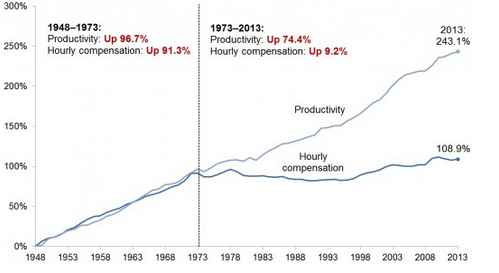
KomradeBishop wrote: » The less that goes to workers, the more corporate profits stay with the corporation (essentially, as both parents in households working became prevalent, the more that became a great opportunity for corporations to squeeze workers) - and the more that the cost of living is expanded to eat up workers income, the more a small class of people get to benefit from 'rent seeking' behaviour in the economy (easy gains, granted by holding a privileged or monopoly position in the economy, that soak up workers income - e.g. excessive property prices and rents - to the benefit of rentiers and at the expense of workers). It doesn't have to be like this, but it just so happens that the economy is run in a way that tips the balance towards rentiers like this. They have significant political power for engaging in rent-seeking activities as well, for maintaining and expanding this power over the rest of society. You can see evidence for the former (wages vs corporate profits), through seeing that corporations have held onto the profit gains from productivity increases, for a long time: You can see evidence for the latter, in the way the housing market has been allowed to experience enormous price inflation, both during the boom (due to lax regulation of credit/loans), and now as well (due to inadequate social housing, inadequate infrastructure, among other areas of inadequate policymaking regarding housing). These are all political choices which affect the distribution of income and wealth - and we're living in a time when workers are being squeezed in this regard. The economics of this explain how it happens (TLDR squeezed wages, increased lifetime cost of living), but the politics of it explain why (tipping the balance in favour of rentiers, at the cost of everyone else).
Dial Hard wrote: » Actually that's not strictly true. Prior to the 20th century there were very few opportunities for women to engage in paid work. They worked on the land, yes, but usually on family farms where they weren't paid for the work. Poultry and pig keeping were the main sources of income for rural women and that wasn't waged work as such. Domestic service was an option for some but it was always seen as a poor choice in Ireland and very few families could afford it here anyway. Factory work for women in Ireland was extremely rare before the 20C. The linen trade was pretty much the only one that employed women in numbers worth talking about and they generally worked from home. But even that was in terminal decline well before the Industrial Revolution because the Act of Union in 1800 created a free market between Ireland and Britain and the market was flooded with much cheaper British imports. Historically, paternalism very much prevented women from engaging in paid work. The ideology of separate spheres dictated that men should provide for their family and women should concern themselves only with the home, and working women were viewed with some alarm. The few jobs that were available to women were basically those that prepared them for marriage e.g. domestic service, governessing. Mary Cullen and Ciara Breathnach have done a lot of interesting work on the role of women in the pre-20th Irish economy, for anyone who's interested.
armabelle wrote: » I think if the average people were smart enough to understand all this or want to understand it, there would be a revolution
armabelle wrote: » So being away from your kids is better for your mental health?
JanaMay wrote: » Thankfully, nowadays women have access to the same education as men.
armabelle wrote: » This is the way it should be..your kids are lucky to have you.
Victor wrote: » More correctly, most women have access to similar educations to most men. However, societal attitudes to achievement and the use of gendered schools that prioritise different subjects means that those educations can be quite different, especially above the age of 12.
armabelle wrote: » Can anybody who know a bit more about this share the answer please?
JanaMay wrote: » In the past, in general, people married younger and the older generations died earlier, which often meant that young married couples (especially daughters and their husbands) stayed in the family home. The newly-married daughter looked after the house and elderly parents while the young husband worked. The elderly parents died and the house passed to the new couple.
ezra_pound wrote: In terms of government policy, fianna fail/pd tax individualisation incentivised both parents working.
esforum wrote: » how did they split the family home between the 10 kids people were having back then before the evils of contraception?
Speedwell wrote: » The idea that only one parent had to work in the past is a myth. It only ever applied to a certain class of people, those whose single earner parent was a highly paid professional or happened to inherit money. Anyone else was poor and struggling, or both parents did something to contribute to household finances. You might as well argue that because families in Victorian novels employed a cook and housekeeper that we're deprived today.