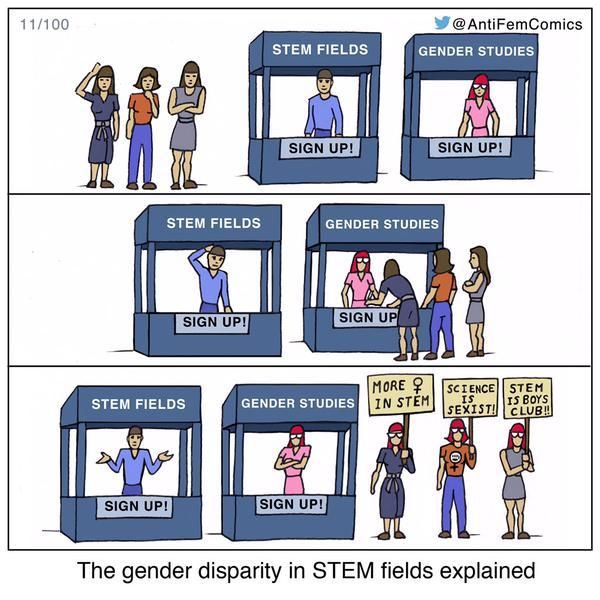
I work in science where there is big push to get more women involved in science and research. Saying this there's no gender discrimination in science or education. Girls are not denied to access the same education as boys. You are however denied the same access to education based on the wealth that you are born into. Not how hard you work or how intelligent you are but how wealthy your parents are. We need to close the gap between the education of children of differing parental wealth. In other words we need equality of opportunity.
A study by Dr Philip Kirby shows the difference in equality of opportunity. Link to the article from the Independent
here. There's a hypocritical nature of some social justice warriors at play here. They say that women are excluded from some stem subjects while ignoring the fact that some law firms actually bin the CVs of law graduates from certain areas.
One employer suggested firms were unwilling to sift through applications from those of working-class backgrounds. “Is there a diamond in the rough out there?” the unnamed recruiter told researchers. “Statistically it’s highly probable but the question is … how much mud do I have to sift through in that population to find that diamond?”
Today’s report, carried out by Dr Philip Kirby, goes on to show that 71 per cent of senior Army officers – two-star generals and above – went to private schools. Only 12 per cent attended comprehensives. In medicine, 61 per cent of doctors were privately educated while 22 per cent went to selective state grammar schools and just 16 per cent to comprehensives. The list goes on – 48 per cent of civil servants were educated privately, 29 per cent went to selective grammar schools and 23 per cent to comprehensives.
The higher echelons of journalism are also dominated by the private sector, with 51 per cent educated in independent schools. And of those chief executives of FTSE 100 companies who were educated in the UK, 34 per cent were privately educated.
Nearly half the top actors – 42 per cent of Bafta Award winners – went to private schools, fuelling criticism made in the past month that the profession is becoming more elitist.
“Our research shows that your chances of reaching the top in so many areas of British life are so much better if you went to an independent school,” said Sir Peter Lampl, the chairman of the Sutton Trust. “As well as academic achievement, an independent education tends to develop the essential skills such as confidence, articulacy and teamwork, which are vital to career success.
“The key to improving social mobility at the top is to open all independent schools to all pupils based on merit, not money – as well as highly able students in state schools.”
Sir Peter advocates the adoption of the Open Access scheme, which the Sutton Trust tried out at the Belvedere Academy for girls, in Liverpool – where it paid the fees of all the girls who passed the entrance exam whose parents could not afford the fees.
The Department for Education said that 1.4 million more pupils were being taught in schools rated as “good” or “outstanding” by the education-standards watchdog, Ofsted, than in 2010.
“As The Independent Schools Guide has recognised, the state sector is increasingly matching the private sector in terms of academic attainment and learning environment,” a spokesman added.




![Photo of [Deleted User]](https://wd.vanillicon.com/v2/dcc54fc0153c491ede3e66aef098573d.svg)
