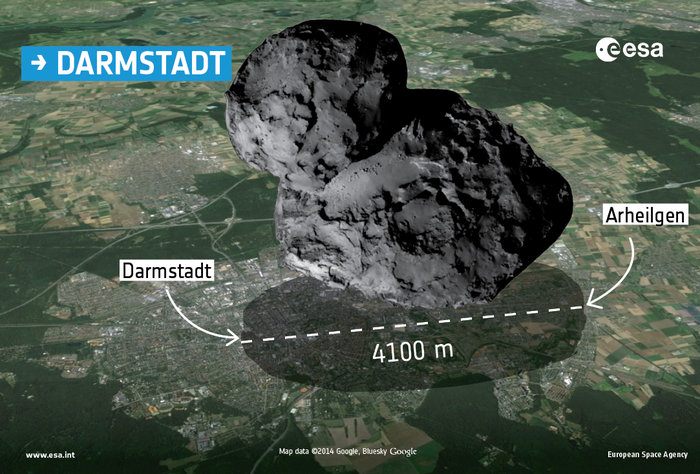
The adventure began March 2004, when a European Ariane 5 rocket lifted off from Kourou in French Guiana. During a circuitous ten-year trek across the Solar System, Rosetta will cross the asteroid belt and travel into deep space, more than five times Earth’s distance from the Sun. Its destination will be a periodic comet known as Comet 67P/Churyumov-Gerasimenko. The Rosetta orbiter will rendezvous with Comet 67P/Churyumov-Gerasimenko and remain in close proximity to the icy nucleus as it plunges towards the warmer inner reaches of the Sun’s domain. At the same time, a small lander will be released onto the surface of this mysterious cosmic iceberg. More than a year will pass before the remarkable mission draws to a close in December 2015. By then, both the spacecraft and the comet will have circled the Sun and be on their way out of the inner Solar System.
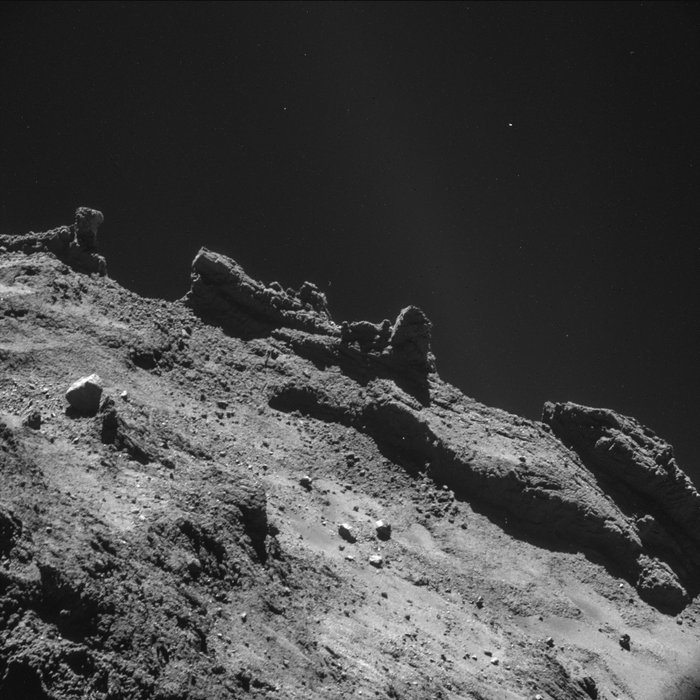
The image shows comet 67P/CG acquired by the ROLIS instrument on the Philae lander during descent on Nov 12, 2014 14:38:41 UT from a distance of approximately 3 km from the surface. The landing site is imaged with a resolution of about 3m per pixel.
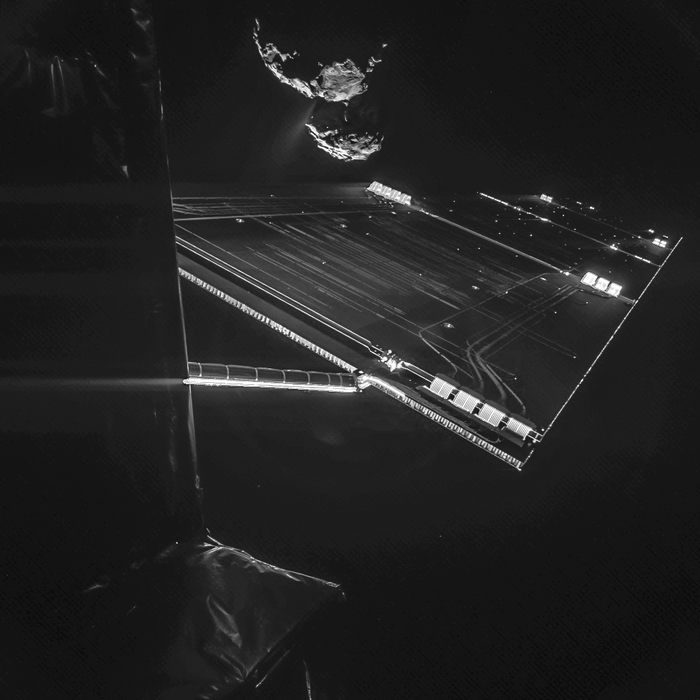
Using the CIVA camera on Rosetta’s Philae lander, the spacecraft have snapped a ‘selfie’ at comet 67P/Churyumov–Gerasimenko from a distance of about 16 km from the surface of the comet. The image was taken on 7 October and captures the side of the Rosetta spacecraft and one of Rosetta’s 14 m-long solar wings, with the comet in the background. Two images with different exposure times were combined to bring out the faint details in this very high contrast situation. The comet's active ‘neck’ region is clearly visible, with streams of dust and gas extending away from the surface.
Fikret Alić is a Bosniak survivor of the 1992 Keraterm and Trnopolje concentration camps near the city of Prijedor in northwest Bosnia and Herzegovina. The journalist Ed Vulliamy, whose reporting of Trnopolje and another concentration camp at Omarska helped draw public attention to the atrocities being perpetrated in the Prijedor camp system, described Alić as being "probably the most familiar figure in the world" in the summer of 1992, when the image of his emaciated frame, seen behind barbed wire at the Trnopolje concentration camp, was seen around the world as emblematic of the violence being inflicted on non-Serb civilians by Bosnian Serbs under the leadership of Radovan Karadžić during the Bosnian War.[1]
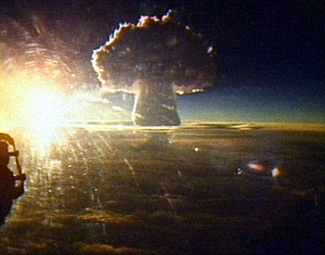
Pierce_1991 wrote: » ^^^^ You'd have to wonder who ever thought a bomb like that could be of genuine use.
Calibos wrote: » Not much. Most of the extra explosive energy over and above your garden variety large 20 megaton bomb actually escapes the atmosphere into space rather than increasing devastation on the ground. Great believer in the MAD (Mutually assured destruction) principle myself tbh. Smaller local wars will never again turn into global conflicts like the World Wars.
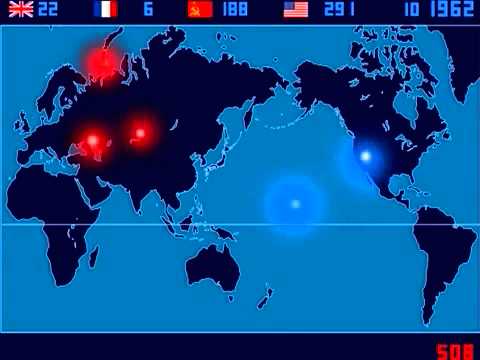
gctest50 wrote: » you'd have to wonder who ever thought of testing 2,000+ of them shook the world just a little bit, 2000 nuclear tests in 4mins : https://www.youtube.com/watch?v=Z8aWgRuVIxs
sup_dude wrote: » It's been a while since I've actually got upset over a photo but just looking at the eyes of this child did exactly that.https://fbcdn-sphotos-e-a.akamaihd.net/hphotos-ak-xpa1/v/t1.0-9/11057319_863818846997137_5152408465254821087_n.jpg?oh=67cb89b897c216825b8e80cb3fcb4a07&oe=556FA078&__gda__=1437032128_76535a98c21a577dd14a9892a19ee3b0
colmulhall wrote: » Great post on Imgur today:http://imgur.com/a/KGUEn?gallery
GerB40 wrote: » I'm not sure if chat is allowed on this thread but I'll ask anyway. Does anyone know the story behind The Priest and the Dying Soldier 1962?
Navy chaplain Luis Padillo gives last rites to a soldier wounded by sniper fire during a revolt in Venezuela. Braving the streets amid sniper fire, to offer last rites to the dying, the priest encountered a wounded soldier, who pulled himself up by clinging to the priest’s cassock, as bullets chewed up the concrete around them. The photographer Hector Rondón Lovera, who had to lie flat to avoid getting shot, later said that he was unsure how he managed to take this picture. The Catholic priest, Luis Padillo, would walk the streets, even through sniper fire, offering last rites to the fighters. Besides priest’s bravery, he also knows the enemy will think a lot before shooting him (just imagine the propaganda) and the enemy soldiers are catholic and would refuse that order.






![Photo of [Deleted User]](https://wd.vanillicon.com/v2/d3e92925f7bde702415f91ea088d4f7a.svg)




















![Photo of [Deleted User]](https://w3.vanillicon.com/v2/35a809b40027ce688f88d9ac1714e15f.svg)