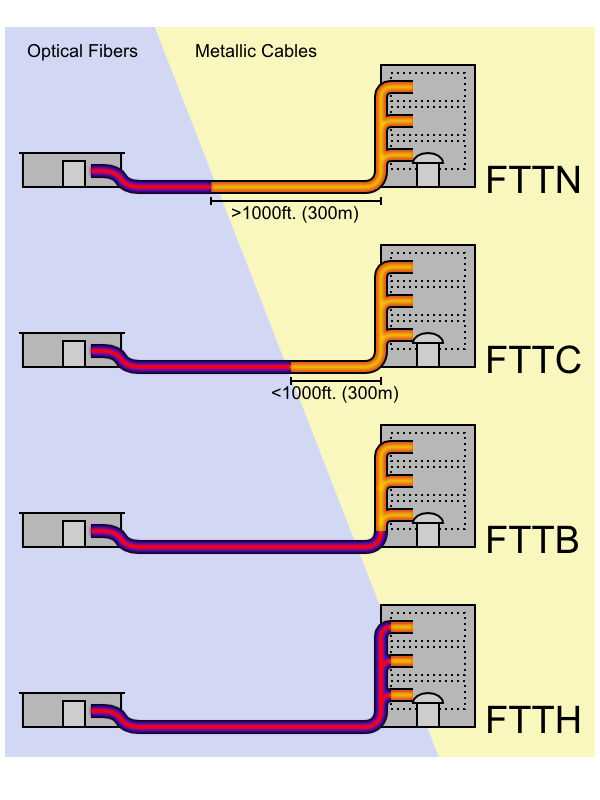
In Norway the building of FTTH has been a part of district politics. FTTH technology was seen as part of the solution to an increasing problem in Norway’s countryside; it could help lessen the migration of people from the countryside to the Norwegian cities. ..... According to Norsk Teleinfo more than 70 actors now operate in the Norwe- gian FTTH market [4]. However, the building has not been cheap. It has been estimated at an average cost of 30.000NOK [5] per connected house- hold. There have even been reports on local builds with a cost per connected household of up to 70.000NOK [6]. The main cost lies with the installation of the fibre itself. So the question is; is this profitable?
hallo dare wrote: » Maybe the farmer has a family, maybe the family like online gaming, streaming videos, downloading music, etc. All this along with his own needs for calving cameras, security cameras for his sheds. Why are you discriminating against farmers claiming they don't need ftth? Why would they not need it as much as some single person in a fibre enabled route?
bk wrote: » I don't think duplicating fibre is a bad thing if it can be done on a profitable, economic basis without government subsidy. It means a greater degree of competition and thus lower prices, greater innovation and better customer care. It makes sense in a high density country like Switzerland, specially given the high average wage there. I'd like to see the same happen here in the more densely populated areas of Ireland and I expect it will happen. However for rural Ireland it doesn't make economic sense to have more then one fiber network and to be honest, even that is a stretch.
football_lover wrote: » I am sorry but if there is no fiber optics for rural then there is going to be no broadband for rural it does not get any simpler than this. Copper cannot offer broadband for rural communities and neither can wireless (barring a fiber optics and wifi combined systems).
Liamario wrote: » You're twisting what he said.
bk wrote: » As for the need of high speed broadband for farmers, that is also a load of BS. Most sensors, humidity, motion, etc. use mere kilobytes of data, you don't need broaband for these, hell GPRS is enough for most of these sensors. Just look at smart meters or the Dublin Bus RTPI, they all do this over GPRS. The only sensor that needs high bandwidth data would be video. But even then you can just do that over a local network from the barn/field to the farmers home. All the talk about live genetic monitoring is laughable!!! Most farmers don't use such services at all and those that do (e.g. rich stud farms) do so by having an expert come to the farm, draw samples from the animals, bring it to a lab where highly specialised equipment and computers are used to analyse it and sequence here. This is certainly not something a farmer does themselves. The bottleneck is not high speed broadband, rather it is the highly specialised and incredibly expensive lab equipment that requires highly trained technicians to use! Also this isn't something you do live and frequently. It is typically done just once in an animals lifetime, after all it isn't like their genome just changes over time! So no need for FTTH for rural farmers here. You still haven't given a real world application that rural farms need gigabit broadband yet.
same ol sh1te wrote: » Now I know you are talking rubbish. Fixed wireless can offer a great stop gap fix until FTTH, 30mbit each way is easily possible. Mentioning wifi proves you know nothing about it and are spoofing
football_lover wrote: » Wireless of that nature in rural would cost a lot of money and be in the realm of the price of fiber optics. Wireless has it place but it is not a solution for agricultural communications systems. And by the time this type of network would be built it would be out of date for the types of usage that rural would need. We are not just talking about streaming video here even though that is important for educational purposes. The school my children go to they some times have a connection that they can all watch a video on but there are times it just freezes. There are also learning tools that these schools sometimes can use and sometimes not. I have a farm I live on but I also have a farm that is 20 miles away from where I live and it would be great for me to have video streaming to that farm but it is not something I can do with my current wireless. Some embedded systems use low bandwidth and mobile based technology is suitable but there are others where it is not suitable. In the next 15 year agriculture as an global industry will be high tech and those that do not adapt will perish simple as that.
Gonzo wrote: » There is genuine need for faster broadband outside of towns and cities, in about 3 years the current speeds which won't improve will be almost worthless as the internet gets more demanding as time goes on. 8 meg broadband will be the equivalent of 56k dial-up in a few years, so things will continue to get worse for those of us not served by some sort of a fibre connection, god help anyone who is trying to run a business. At the same time, speeds of 12-24meg should be fine for most users for a few more years but the fact that most of us who will continue on existing adsl connections don't even come close to 12meg+ will really find the internet a struggle over the next 5 years and beyond is really worrying. I find it kinda shocking that many people here expect those of us outside of fibre areas don't deserve anything faster and couldnt give a damn about the rest of us, once they are sitting on their fibre connections downloading more movies that it's possible to watch, that's all they care about and figure that Ireland is done and upgraded. As for the farmers tho, I don't buy the argument that they need fibre, most of em that I know don't even use the internet apart from checking their gmail or facebook. It's stuff like steaming, youtube and downloading windows updates and patches for various pieces of software that will be become very frustrating indeed. Sending fibre speeds wirelessly around town and village hinterlands of up to 30meg sounds great and is a great solution to solve everyone who is not connected to a cabinet but who is going to do this? I can't see Eircom of ESB launch a wireless serve anytime soon. A few local authorities may eventually set this up but I feel many communities will just be left waiting an waiting for nothing to happen.
same ol sh1te wrote: » There you go spoofing about the costs of wireless technologies you know absolutely nothing about. The school you mention is most likely at present supplied by a fixed wireless provider starved for funding using unlicensed gear for various reasons. It's not expensive to do right, a few hundred per customer, not much more than it's already costing to do wireless. It's the red tape and licence fees that are causing problems
football_lover wrote: » Wireless for rural in this country could cost billions. It is that simple. If you want wireless in rural that covers some areas and not other then it would be cheap as you want to make it. "provider starved for funding using unlicensed gear for various reasons" They have a patchy service because it is a rural school that has to use wireless. There is another school that far way that gets no service at all. Nothing to do with Licencing. Fiber is the only realistic high bandwidth technology that can be used throughout Rural Ireland. Copper is not realistic due to the limitations of distance. Wireless has to deal with hills and some of the wireless would have to actually use fiber anyway. Yes we could build a wireless network the government has probably at this point pumped in 750 million already into backing wireless and guess what it is still terrible. This is the kinds of nonsense that Ireland is involved within check out the link below to the story.http://www.independent.ie/business/irish/government-to-invest-up-to-512m-in-rural-broadband-scheme-30218310.html Ireland spends hundreds of millions and yet there are people that do not get a service. The ESB/Vodafone deal is all part of this load of nonsense.
ED E wrote: » 60 new jobs, probably not using ESB staff to do the installs so, and vodafone dont have field crews here so it'll be contractors doing all the work customer side.
bk wrote: » Makes sense, probably KN Networks etc. in conjunction with support from ESB networks staff (for electrical safety work, etc.). It is funny how KN Networks are ending up being involved in all ISPs roll outs of their network. They have been heavily involved in the building of UPCs upgraded network, Eircoms VDSL network and now looks likely they will be involved in this too!
Kristopherus wrote: » Well, as long as they keep those shysters, Sierra, out of the loop, I'll be happy.
bloodyhawk wrote: » Is there a difference between fiber to the building and fiber to the home?