"men must accept that most violent crimes perpetrated against women are by men, and that they have the power to stop this."
old hippy wrote: » "Feminism is the radical notion that women are human beings - Cheris Kramare
GalwayGuy2 wrote: » Hmmm, that is one argument. Although others would argue that the current feminism is conservatism that sees women as potential victims that should be protected. Whether that's saying women shouldn't wear short skirts, or men should be thought not to attack women in short skirts, it still sees women as potential victims rather than human beings. But, each to their own. EDIT: Yes. I do believe people are only really campaigning because of the benefits for women, but it does have equal benefits for men. So, as much as I disagree with other aims, that would have my full support. Although, I hope it doesn't lead into a mentality that says a stay at home dad is 'progressive' while a stay at home mother is 'conservative'.
http://farfirifirefly.tumblr.com/post/67856775015/and-now-an-experiment
GalwayGuy2 wrote: » Yes. I do believe people are only really campaigning because of the benefits for women, but it does have equal benefits for men. So, as much as I disagree with other aims, that would have my full support.
Although, I hope it doesn't lead into a mentality that says a stay at home dad is 'progressive' while a stay at home mother is 'conservative'.
clairefontaine wrote: » Yeah ha ha. A single dad is heroic, a single mother is unleashed and invalidated sexuality run amok. She is a threat.
K-9 wrote: » GalwayGuy2 wrote: Yes. I do believe people are only really campaigning because of the benefits for women, but it does have equal benefits for men. So, as much as I disagree with other aims, that would have my full support. Well in fairness many men would argue that a significant factor in the pay gap is women having children and staying at home more, so it's a bit "having your cake and eating it" if the same men then dismiss the proposal as biased. As I mentioned it stands to reason that women would benefit from more men getting paternity/parental leave, it isn't going to end up any other way.
GalwayGuy2 wrote: Yes. I do believe people are only really campaigning because of the benefits for women, but it does have equal benefits for men. So, as much as I disagree with other aims, that would have my full support.
K-9 wrote: » Well I really don't know about single mothers but with single Dads being a small percentage of single parent households and the majority of them may well be widower's, there maybe some truth in the perception of men. I don't really see how those 2 images tie in with decisions in family courts.
the_syco wrote: » Thought I'd drop this video in here, as it seems to fit the topic rather well... https://www.youtube.com/watch?v=hc45-ptHMxo
iptba wrote: » Looks interesting. However, it's not just other males who say things like "man up".
iptba wrote: » The point isn't, or at least the point I was making isn't, that the proposal is biased. It's that it isn't being done solely to help men. There are disadvantages men face in the world and there are disadvantages women face in the world: the point some of us make is that feminism hasn't been equal in its actions. It is a movement largely about helping women. It may incidentally also help men on occasion but it can't be relied upon to do so. It's driving motivation is to help women and this example doesn't disprove it.
Thought I'd drop this video in here, as it seems to fit the topic rather well...
JRant wrote: » It is somewhat biased though, simply by its very nature. Paternity leave has nothing to do with fathers rights, from a feminist pov it is purely about career progress for women. Nor is it a fathers rights issue as far as i can see. If the law was changed to give all fathers equal rights then items like paternity leave would naturally follow. Instead they want to hold onto all the rights and be able to assign babysitting duties as they see fit.
Another perfect example of this is in education. Girls are outperforming boys at levels that really need to be addressed, yet we are constantly told it's up to the boys themselves to catch up.
Also for years we've been told we need more women in Engineering, my old college for example had a women only club for the advancement of female engineers. I argued at the time that such groups were counterproductive and lead to a further divide between the sexes. You're either for equality or against is was the gist of my point but I was swiftly told to mind my own business by the lecturer organising it.
pwurple wrote: » This does need to be addressed, but there is also a corresponding difference on the other side with regard to sports participation. I suspect they are linked.
pwurple wrote: » I don't know how you can make this sweeping statement like it is fact. It's not true for my family certainly. We want paternity leave for many reasons.... For our children primarily, I don't see why they should see less of their father than their mother. Doesn't make any sense to me. For him, he would love to see more of them. For the family financial situation... I don't get paid leave, he probably would, the family would be better off. For my gender as a whole... because as I have noted, women don't get hired IN CASE they ever get pregnant. No matter what their circumstances. For me? It doesn't affect my career. I take projects as they come along, so gaps don't particularly matter. This does need to be addressed, but there is also a corresponding difference on the other side with regard to sports participation. I suspect they are linked. That kind of thing I agree is complete nonsense, and I refused to participate in it myself when I was in college. I found it patronising in the extreme, and yes, counter-productive.
Nathanael Jolly Barmaid wrote: » ... After all, some feminists would lead you to believe that if you reject their views you reject equality. It's a very powerful position to be in for feminists, where any criticism of them results in the critic being turned on by society. Of course it's not a new concept, where two mutually exclusive things (feminism and equality) get tied together as one. Two that spring to mind in 20th century history are from Germany and the USA regarding patriotism and nationalism. The Nazi government lead people to believe that if they didn't support fascism and Hitler they were not patriotic Germans, they were traitors and the enemy. In the 50's and 60's the American government convinced people that anyone who didn't support them could be a communist. I'd love to know the private thoughts of radical feminists, the thoughts that are too extreme to make public, it might not be comforting. ...
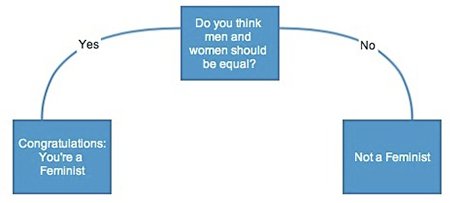
Anecdote 1: Last year, I gave a talk at the Women of the World festival about body hair and sexism. A male feminist friend watched it, and texted me to say that men are affected by similar pressures when it comes to the body, just in different ways. I replied that nine out of 10 eating disorders are suffered by women, 95% of cosmetic surgeries are carried out on women, and I had yet to meet a man ashamed of the hair on his legs. All the same, he insisted, If I'd taken account of men's experiences in my talk, I could have gained more allies. Anecdote 2: I am discussing street harassment with a male feminist friend. He says that men are more likely to experience violence on the streets than women. I wholeheartedly agree, then continue talking about street harassment. I'm instructed that if I expect men to be allies in the feminist movement, I can't talk about wolf whistles and arse pats when men are at risk of having their teeth kicked in. Anecdote 3: In the pub, a group of friends is discussing the obstacles that a girl born today may have to face as she grows up. A male feminist friend says that in his law firm women with three children are now becoming partners, and in 20 years – he can guarantee – the glass ceiling will no longer exist; the real problem, as he sees it, is male students dropping out of law degrees. The next day, he emails to say that he calls himself a feminist, and implies that if feminism is to be more than reverse sexism, men's issues must be taken into account. He includes a link to a Wikipedia entry on men and feminism. These are not isolated incidents, and, for the record, I respect all of these men: they are good, smart people. But I don't think I want them as allies any more than I want to start calling myself a "genderist" because Joss Whedon thinks 'feminist' sounds icky. The question for me is: why do these men describe themselves as feminists, if they feel unable to talk about women's issues without shouting 'but men!' or insisting that the movement for equal women's rights compromises its focus in order to make men comfortable? I have a theory. Somewhere along the line, someone came up with a pithy, witty test for feminism that might be illustrated as follows: And it's clever, right? I don't know who first used this trick, but Caitlin Moran riffs on it in How to Be a Woman, and Michael Kaufman and Michael Kimmel's The Guy's Guide to Feminism has a great passage (that you can listen to Kaufman narrate here), asking the reader whether he might have "caught" feminism, which is really just a variation of the above. The test is fun, to the point, inclusive: it gets people on board and gets more men calling themselves feminists. Allies – huzzah! But it's also kind of lying. You need to believe some other important things in order to be a feminist, things that might be illustrated as follows: Have you surprised yourself by getting a "not a feminist" result when you've been proudly calling yourself a feminist for years? Are you getting bogged down in semantics, shrugging "it depends what you mean by equality", instead of answering the questions in the straightforward spirit in which they are asked? Are you feeling excluded from an equality movement that you instinctively feel you should be a part of? Even a bit angry that you're excluded, perhaps? Are you thinking: "Fine then! If that's how you want to define feminism – fine! But – be warned – you're losing me as an ally." Don't be angry. You don't have to be a feminist. There are plenty of ways to be awesome without working towards equal rights for women. For example, if you answered "Who do you think is more disadvantaged by gender inequality?" with "Women, but I'm still more interested in talking about men," that's fine. Maybe, like Tom Matlack, who founded the Good Men Project, you are a pro-feminist: that is, someone who supports the goals and objectives of the movement for equal women's rights, but who is actively working on male issues. Gender initiatives like the Good Men Project move us towards a more equal society, which benefits women in many ways, just like feminist initiatives benefit men in many ways. And, please, if you are worrying about what feminism will do without you, stop. The feminist movement does not need you. It's doing a pretty incredible job of tackling female disadvantage without pandering to reluctant allies. Most of the feminists I know care about how gender inequality affects men. Of course they do – they're egalitarians. And some also work on male equality issues. But feminism is a movement that seeks to achieve equal rights for women. This focus is necessary, because we live in a world of historically and culturally inscribed female disadvantage. If you don't agree on this – if, every time someone starts talking about women's equality, you feel the urge to argue that, nowadays, men have it as bad or worse, or you secretly fear that in 20 years women will be keeping men in cages or some such, then, very simply, you are not a feminist.
Playboy wrote: » Piece in the Guardian the other day by our very own Emer O'Toole. Attracted in excess of 1500 comments on the website. Thought it was relevant to the discussion here re feminism and equality.http://www.theguardian.com/commentisfree/2014/jan/09/not-a-feminist-move-on-men-women
But feminism is a movement that seeks to achieve equal rights for women. This focus is necessary, because we live in a world of historically and culturally inscribed female disadvantage.
JRant wrote: » . Campaigning for paternity leave while fathers across the country struggle to get access to their children smacks of wanting your cake and eating it to (not directed at you personally by the way).
I'm not sure about the sports link. Sports would be extra-cirricular in schools, exams are not. IMO the school system seems very heavily biased to the female. The majority of teachers are female, girls are seriously outperforming boys at exam time yet there is hardly a peep about this.
Wrt to sports participation amongst females, especially young teens then a lot of this starts in the home if i'm being honest. There are plenty of options for youngs girls to get into sport. My local club has camogie and football teams set up yet struggle to get the numbers in.
cantdecide wrote: » In my case, for example, I went to an all boys school and between being bullied and some other social issues, I fell behind in school. In my school, I was pressured to do sports which I had zero interest in and despite the school having 500 students, there was no music taught whatsoever (the only thing I was interested in in life at that stage as well as and aptitude for it) and private tuition was beyond my family at the time, I was spat out of the education system with my hands hanging to me and no inclination to do anything in particular. Meanwhile, my sister who studied music as she, too, was only interested in it, went on to get a degree in music which lead to further studies and she earned her phD last year. With life experience, I could look back and see that I should have gone on to do other things but I still resent that I was deprived of opportunities because I was a slightly immature (although smart) boy.
pwurple wrote: » I don't see why both items can't be addressed? One does not exclude the other surely? They do tend to be different groups affected by each, which is probably why they are separated. Father's rights tend to be noted as missing when either the father didn't get married, or a marriage has broken down. Where paternity leave is more likely to be married fathers. Doing well at school work and excelling at sport both require time outside school though. That's the point I was trying to make... homework, extra study, all that kind of thing is done in time outside the school hours. If you're pushed into one, the other can suffer, just purely due to less time invested. Yes, you're right here. It does start in the home. Girls are not encouraged into sport participation, and boys are pushed into it, whether they want it or not. I encountered similar subject choice issues in my own all-girls school. My leanings were towards maths and physics. My school didn't do higher level maths, physics or applied maths. Luckily for me though, my parents were extremely pushy about this, and an arrangement was made where I was allowed to walk up the road to the local boys school every day with two other girls, to attend the 3 classes there. I don't know what on earth I would be doing with my life now if I hadn't attended those.
pwurple wrote: » I don't see why both items can't be addressed? One does not exclude the other surely? They do tend to be different groups affected by each, which is probably why they are separated. Father's rights tend to be noted as missing when either the father didn't get married, or a marriage has broken down. Where paternity leave is more likely to be married fathers.
pwurple wrote: » Doing well at school work and excelling at sport both require time outside school though. That's the point I was trying to make... homework, extra study, all that kind of thing is done in time outside the school hours. If you're pushed into one, the other can suffer, just purely due to less time invested.
pwurple wrote: » Yes, you're right here. It does start in the home. Girls are not encouraged into sport participation, and boys are pushed into it, whether they want it or not.
pwurple wrote: » I encountered similar subject choice issues in my own all-girls school. My leanings were towards maths and physics. My school didn't do higher level maths, physics or applied maths. Luckily for me though, my parents were extremely pushy about this, and an arrangement was made where I was allowed to walk up the road to the local boys school every day with two other girls, to attend the 3 classes there. I don't know what on earth I would be doing with my life now if I hadn't attended those.
clairefontaine wrote: » ... So what I learned from this, is that much of this was in my own head, that had I had some guidance or back up and didn't feel so isolated I could have plundered on. Was there sexism there? Probably. But no amount of academics or bureaucrats with their excel spreed sheets staring at their quotas could have solved this. It has to come from within the individual, and sometimes the barriers are there, but you can break through them, as long as you are not waiting for invitations, or let the illusion of no access stop you. What happened back then is something I really regret. And it was all my fault.
clairefontaine wrote: » It has to come from within the individual, and sometimes the barriers are there, but you can break through them, as long as you are not waiting for invitations, or let the illusion of no access stop you. What happened back then is something I really regret. And it was all my fault.
JRant wrote: » pwurple wrote: Doing well at school work and excelling at sport both require time outside school though. That's the point I was trying to make... homework, extra study, all that kind of thing is done in time outside the school hours. If you're pushed into one, the other can suffer, just purely due to less time invested. That's a fair point but doesn't really explain the significant difference between the sexes in exam results. For any correlation to be taken it would need to assume that all boys play sports and no girls do, which we certainly know is not the case.
pwurple wrote: Doing well at school work and excelling at sport both require time outside school though. That's the point I was trying to make... homework, extra study, all that kind of thing is done in time outside the school hours. If you're pushed into one, the other can suffer, just purely due to less time invested.
cantdecide wrote: » I don't think you can accept an adult level responsibility for things you did when you were a teenager. Schools should do everything possible to make sure a willing student should be nurtured. Maybe that's impractical in the real world but I think you you would benefit from using different terminology than "regret" when you think back to your school days. It sounds like the unfortunate decision of a vulnerable teenagerl.