FISMA wrote: » I remember reading an article once about how our brains edit visual information. They used the analogy of streaks that appear on television when a camera pans which we do not see when our eyes pan. They noted that we do not see such streaks, because our brain "edits" the information. I forget the exact amount of time, but over the course of a day, our brains edited out something on the order of tens of minutes. That set me thinking about the trust we have in our brains. In discussions of God I am often asked for scientific proof or evidence. Such information will presumably come from my past memories. But, if we are going to hold God to scientific standards, shouldn't the tools we are going to use be held to the same scientific standards? So I ask: what is your scientific test to demonstrate that your memory is working properly?
FISMA wrote: » IThey used the analogy of streaks that appear on television when a camera pans which we do not see when our eyes pan. They noted that we do not see such streaks, because our brain "edits" the information. So I ask: what is your scientific test to demonstrate that your memory is working properly?
FISMA wrote: » In discussions of God I am often asked for scientific proof or evidence. Such information will presumably come from my past memories. But, if we are going to hold God to scientific standards, shouldn't the tools we are going to use be held to the same scientific standards? So I ask: what is your scientific test to demonstrate that your memory is working properly?
FISMA wrote: » I remember reading an article once about how our brains edit visual information. They used the analogy of streaks that appear on television when a camera pans which we do not see when our eyes pan. They noted that we do not see such streaks, because our brain "edits" the information.
I forget the exact amount of time, but over the course of a day, our brains edited out something on the order of tens of minutes.
In discussions of God I am often asked for scientific proof or evidence. Such information will presumably come from my past memories.
Doctor DooM wrote: » I would guess we're all painfully aware of how crappy the human memory is and its tendency to fill gaps with made up stuff.
FISMA wrote: » Perhaps, I did not make the intention of my post clear, my mistake, I will try again. The purpose of this post is to determine a scientific test to demonstrate that my memory is working properly . . . .
FISMA wrote: » Concisely, as a scientist, one who makes a nice living off of the scientific method, I state that there is no scientific test to demonstrate that your my memory is working properly.
FISMA wrote: » I think it is ironic that the mechanism by which we put all of nature under the scrutiny of scientific fails to be testable itself.
pauldla wrote: » Axioms are assumed without proof, yes, but are they assumed without evidence?
pauldla wrote: » As an example, why do we assume that the universe is governed by rules? Is there a reason holding this as being axiomatic..?
pauldla wrote: » Axioms are assumed without proof, yes, but are they assumed without evidence? As an example, why do we assume that the universe is governed by rules? Is there a reason holding this as being axiomatic..?
FISMA wrote: » That set me thinking about the trust we have in our brains. In discussions of God I am often asked for scientific proof or evidence. Such information will presumably come from my past memories. But, if we are going to hold God to scientific standards, shouldn't the tools we are going to use be held to the same scientific standards? So I ask: what is your scientific test to demonstrate that your memory is working properly?
Zombrex wrote: » Most people here would already know that our brains are not all that reliable, so excusing the some what inaccurate context you put it (what is "properly"), the simple answer is our brains don't work properly. As to how we have confidence in our memory and how this relates to the scientific method it actually is quite close. An example should highlight this. I'm in Starbucks and I see a girl that looks familiar, that I think I have met on holiday a year ago. That is the hypothesis. I can quickly turn this into a predictive model. The "girl model" (as in theory, though she was pretty hot) in my head's name is Laura and combined with a more general model that humans have names and respond to names when they are asked them, I can form a predictive test.
HHobo wrote: » The problem FISMA is presenting would be that the instant you end your startbucks conversation and attempt to record your result, how do you know the event occured, or occured as you think it did. What was the word uttered just now? You have to remember to know. In fact, the instant after she says "Yes, I am Laura." or "No, my name isn't Laura and please stop licking my face!" you are reliant on your memory to be aware of the previous moment at all. All comparisions between a static current state and historical data, no matter how recent, relies on memory to one degree or another.
HHobo wrote: » There is no avoiding the problem. We simlpy have to accept that our memory's work in principle.
Zombrex wrote: » The easiest thing is to not assume anything about your memory and assess the different models as they come up from the point of view of functioning in the world.
HHobo wrote: » In terms of the practical, real world, you are right. I think you may still be missing the class of enquiry that was being made. It is purely a philosophical question. It has no real world application.
HHobo wrote: » If I asked you to prove to me that the universe exists and isn't just a figment of your imagination, any test you attempt to undertake will never be free of the implication that they might also be imagined by you and therefore can't be trusted.
HHobo wrote: » It is really just a hyperskeptical postion. Nobody really holds the view that it is true, but it cannot be shown to be false.
Peregrinus wrote: » Is the issue about memory not just a particular instance of a more general point; that, in the scientific method it is axiomatic that our subjective experiences of the world does map onto the objective reality of the world in a meaningful and consistent way? So, for example, when I see a red apple the redness is an entirely subjective impression generated in my brain in response to certain electrical stimuli from the optic nerve, which in turn is a response to light of a certain wavelength stimulating the optic nerve. I have no guarantee that when you see the apple you have the same subjective impression, even though you give it the same name as I do. And neither of us can be certain that the impressions we experience actually tell us anything objectively true about the apple. But it’s axiomatic that they do. Memory is just another subjective experience generated within the brain. When I can no longer see the apple but I can still recall the redness, how do I know that I am correctly recalling it? I can’t know that, is the answer. But is reliance on the subjective experience of memory any different from reliance on the subjective experience of seeing red? I don’t see that it is.
Zombrex wrote: » For example, it might be actually possible some how to work out that the universe did actually start 5 minutes ago in a particular state, who knows. Why assume that the opposite just has to be taken as an axiom. It comes back to the old point that the universe is under know obligation to us to be a particular way (I guess that would be my only axiom :P)
Zombrex wrote: » Not really missing, more dismissing the significance. People (particular theists) seem to get a bit worked up over these questions.
Zombrex wrote: » The issue is can we trust our memory. One propose is that we just have to assume it works, in the same way that someone might say we just have to assume we arne't brains in jars, we just have to assume that the universe works in an ordered fashion, we just have to assume that the entire universe didn't just some how start 5 minutes ago in a state that appears it is a lot older. My point is that you actually don't need to assume these things at all. You can continue not assuming them and there is no downside. You can assume them, but that to me is an unsupported assumption.
Zombrex wrote: » It irks me when theists assume I assume without evidence certain axioms about the universe and then try and use that as justification for their faith in God. They say things like, well you take it on faith that tomorrow is going to continue on with the same physical rules as today and you can't justify that so how is that any different to me assuming God exists. The point is that I don't assume, on any particularly deep epistemology level, that tomorrow is actually going to be the same as today. People seem to think you have to (how can you plan anything!), but you only have to if the alternative is thinking it won't be. But I don't assume, on any particularly deep epistemology level that it won't be either.
Zombrex wrote: » Correct. But then there is no reason why I have to assume the universe exists and isn't just a figment of my imagination. To say (not saying you said this) that we must take that as a starting point seems irrelevant to me.
Zombrex wrote: » And again it particularly irks me when theists say that their assumption that God exists is no more illogical than an atheist assuming the universe exists. I, as an atheist, don't assume the universe exists, and not doing that poses no disadvantage.
Zombrex wrote: » This line sums up what I'm objecting toI think it is ironic that the mechanism by which we put all of nature under the scrutiny of scientific fails to be testable itself. That should not be "ironic" at all. It is only ironic if you hold certain assumptions that are themselves unscientific, such as assuming you aren't a brain in a jar, or assuming the universe didn't pop into existences 5 minutes ago.
HHobo wrote: » I don't really agree with this position. You can claim you aren't making these class of assumptions but when you go about your day as if all these are true, I don't see how this isn't assuming them.
HHobo wrote: » Agian, I would be skeptical that you get up everyday, look around you to see if objects are floating or flying apart. Don't misunderstand me, I'm not saying the argument has any force, it doesn't, but I do think that we all make these assumptions.
HHobo wrote: » I make these assumption and would contend that everyone does.
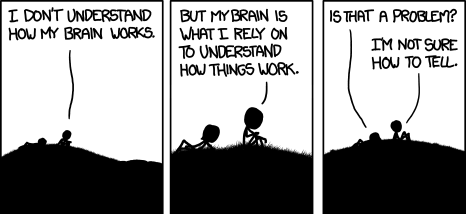
swampgas wrote: » From XKCD ...
FISMA wrote: » how could we be sure that our brains would handle and process the new information as expected/hoped? How could we be sure that processing a new timeline was not something that we did regularly, however, due to a necessity of evolution, only the later would be remembered? I asked, what is the scientific test to demonstrate that our memories are working properly?
Nader, now a neuroscientist at McGill University in Montreal, says his memory of the World Trade Center attack has played a few tricks on him. He recalled seeing television footage on September 11 of the first plane hitting the north tower of the World Trade Center. But he was surprised to learn that such footage aired for the first time the following day. Apparently he wasn’t alone: a 2003 study of 569 college students found that 73 percent shared this misperception.
In short, Nader believes that the very act of remembering can change our memories.
Memories surrounding a major event like September 11 might be especially susceptible, he says, because we tend to replay them over and over in our minds and in conversation with others—with each repetition having the potential to alter them.
Nader decided to revisit the concept with an experiment. In the winter of 1999, he taught four rats that a high-pitched beep preceded a mild electric shock. That was easy—rodents learn such pairings after being exposed to them just once. Afterward, the rat freezes in place when it hears the tone. Nader then waited 24 hours, played the tone to reactivate the memory and injected into the rat’s brain a drug that prevents neurons from making new proteins. If memories are consolidated just once, when they are first created, he reasoned, the drug would have no effect on the rat’s memory of the tone or on the way it would respond to the tone in the future. But if memories have to be at least partially rebuilt every time they are recalled—down to the synthesizing of fresh neuronal proteins—rats given the drug might later respond as if they had never learned to fear the tone and would ignore it. If so, the study would contradict the standard conception of memory. It was, he admits, a long shot... It worked. When Nader later tested the rats, they didn’t freeze after hearing the tone: it was as if they’d forgotten all about it.
Daniel Schacter, a psychologist at Harvard University who studies memory, agrees with Nader that distortions can occur when people reactivate memories. The question is whether reconsolidation—which he thinks Nader has demonstrated compellingly in rat experiments—is the reason for the distortions. “The direct evidence isn’t there yet to show that the two things are related,” Schacter says. “It’s an intriguing possibility that people will now have to follow up on.”
HHobo wrote: » I invite FISMA to correct me if I am wrong here, but I think the problem he/she was talking about was much more fundamental than what you deal with here.
FISMA wrote: » Thanks Hhobo, you are correct, your post is pretty much what I was trying to get at. Surely, there is more information out there of which we are unaware. Could there be information of which we are aware, but unable to retain or otherwise mentally "digest?"
FISMA wrote: » No matter what, it is interesting that there's no scientific method to demonstrate that our memory is working properly.