NIMAN wrote: » I was just thinking about the physics of a car crash whilst reading another thread here, and have a question. If 2 cars are in a head-on crash (similar car, same weight etc) would the person in the faster car have more chance of coming off with less injuries? Basically Car A doing 30mph, and Car B coming the opposite direction doing 50mph. Car B obviously has more momentum and power behind it, is Driver A likely to come off worse or does it not matter?
CiniO wrote: » If both cars are the same weight and model, then they both will be affected like each on of them crashed at 40MPH into a wall.
goz83 wrote: » Am I missing something here? If one car is doing 30 and the other is doing 80, then the combined speed is 80. So would the collision speed not be 80mph? The above post would suggest that collision speeds are halved without any reason being given. If i hit a car head on, and I am doing 100 mph and the other car is doing 20mph, the inertia/collision force is 120mph, not 60mph. Lets say the other car is stationary....If i hit it at 100mph, what is the collision force/speed that the other car will experience? Not 50 as far as I can tell.
Anan1 wrote: » The energy will be equally shared between the two cars, the effect on each car will be the same as if it had hit an immovable object at 40mph.
goz83 wrote: » Collision speed = 80mph for both cars
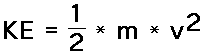
Del2005 wrote: » The faster travelling car has more kinetic energy so should do more damage to the slower travelling car.
Del2005 wrote: » Wrong, the energies involved is the square of the speed. The car going at 50 will have a K.E of massx1250 and the car at 30 will have a K.E of massx450, non SI units used so only a rough estimation. The faster travelling car has more kinetic energy so should do more damage to the slower travelling car.
goz83 wrote: » The only part I can't wrap my head around is why the impact is halved, just because the impact is with another car....
Mikros wrote: » In the event of a head on collision the total momentum is conserved. Because the momentum of the faster car is greater, the final velocity of the combined system (2 cars together) will be in the direction of the faster car after the collision. In other words the slower car will be pushed backwards.
Mikros wrote: » That means the driver of the faster car experiences less acceleration (same direction of velocity) than the driver of the slower car does (direction of velocity is reversed). The person in the slower car is likely to come off worse, all things being equal.
Anan1 wrote: » The force of the impact isn't halved, but there is twice as much crumple zone to absorb it. :)This is true. No, even though one ends up going backwards, both are still subject to the same deceleration.
tacofries wrote: » wrong. both cars exert the same force on each other no matter what the difference in speed is. This can be seen by newtons third law: if a body 'a' exerts a force on a body 'b' ,then body 'b' exerts an equal but opposite force on body 'a'. thus each car experiences the exact same amount of force in the crash. Collision speed is 80mph.
Mikros wrote: » Car1 travelling ---> +30 mph Car 2 travelling <---- -50 mph Car1car2system after collisions < -20mph Change in velocity of car1: -50 mph Change in velocity of car2: -30 mph There is a greater deceleration on car1 and the resulting forces on the driver would be higher.
Anan1 wrote: » Where are you getting those figures from? If one car is doing +30mph, and the other is doing -50 then the wreckage will be doing -10, ie a reduction in velocity for both cars of 40.
Mikros wrote: » The train will not experience the same force as the car because the change in velocity of the train will be almost 0.
Mikros wrote: » You don't understand Newtons laws and their application to collisions. The force each car experiences is determined by the acceleration.
Acceleration is change in velocity over time. When two cars collide there is a change in velocity in a very short period of time. The change in velocity is based on the conservation of momentum - the momentum before the collision is the same as the momentum after.
Momentum is mass x velocity. The faster and heavier car will lose less velocity and therefore will experience less acceleration / force.
Think about if a train hit a car head-on both travelling at 80 km/h. The train will not experience the same force as the car because the change in velocity of the train will be almost 0.
07Lapierre wrote: » Send an email to "mythbusters"!!. They'll sort it!
MrDerp wrote: » Now, where it gets interesting is if the cars are at different speeds. Lets say Car A is at 50km/h and Car B is at 100km/h. - action A = reaction A - action B = reaction B - BUT the speed is not equal Effective car to wall impact speed? 100km/h. - Car B hits a 'wall' at 100km/h [action B = reaction B] - Car A has a 'wall' coming at it at 100km/h. It hits at 50km/h, but the wall hits back at 100km/h. You see: - The action brought by car A in hitting car B has an equal and opposite reaction on car A, but car B is hitting car A too, which in turn has an equal and opposite reaction from car A to car B. - The action/reaction pair on A must be the same as the action/reaction pair on B The 'effective speed' (car to wall equivalent) of the crash is the speed of the faster car.
BrianD3 wrote: » What if car A is doing 0 km/h and car B is doing 80 km/h - in terms of damage and injury the "car to wall" equivalent is not going to be the speed of the faster car. An 80 km/h impact into a parked car is a lot less severe (for the occupants of both the parked car and the moving car) than an 80 km/h impact into a wall.
Ronnie Beck wrote: » Depend on the wall...
Ronnie Beck wrote: » Depends on the wall...