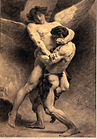
PDN wrote: » Oh for heaven's sake, rather than cherrypicking Google results and pretending that constitutes 'the common interpretation', go and look up 'Theophany' in any Bible Dictionary or Theological reference work. Jacob said, "I have seen God face to face". You can dance around that any way you wish - but you're only going to make yourself look silly.
Zombrex wrote: » Groan. I'm well aware of what theophany is PDN. Do you actually have a response to what I said or do you think I will just be impressed by you throwing out big words :rolleyes:.
Jacob fought an angel. That is the interpretation common among Jews and Christians, at least the ones who know what the heck they are talking about.
marienbad wrote: » Do you have any sources for your speculations on Pilate ?
Peregrinus wrote: » It’s hard to quote a specific source for an event that never happened – namely, Pilate’s report to Rome regarding the tiresome Jesus of Nazareth business. My general comments on the way Roman provinces were governed are based on my reading in the area. There are plenty of general texts on the subject of Roman government. “The Roman World” by Victor Chapot is a useful introduction. “Palestine in the Time of Jesus: Social Structures and Social Conflicts” by Hanson and Oakman focuses particularly on Palestine, though it deals with more than just Roman government. Your question is a reasonable but, in all fairness, Recedite’s claim that a report by Pilate would have been expected should, if well founded, be much easier to evidence – e.g. he could point to the existence of reports by Pilate on other matters, or by reports from other provincial governors of the crucifixion of religious troublemakers. If he can’t point to any of those, then he really has no foundation for his expectation that there should be a record of a report of Jesus’ crucifixion other than his own assumption that that’s how Roman provincial government worked. Positive claims are generally much easier to evidence than negative ones.
Peregrinus wrote: » Recedite’s claim that a report by Pilate would have been expected should, if well founded, be much easier to evidence – e.g. he could point to the existence of reports by Pilate on other matters, or by reports from other provincial governors of the crucifixion of religious troublemakers. If he can’t point to any of those, then he really has no foundation for his expectation that there should be a record of a report of Jesus’ crucifixion other than his own assumption that that’s how Roman provincial government worked. Positive claims are generally much easier to evidence than negative ones.
PDN wrote: » Well, if you know what a Theophany is, then you're obviously just making things up on the fly as usual. Because it is untrue to claim that 'the common interpretation' of Gen. 32 is that Jacob wrestled with an angel.
Zombrex wrote: » Wow, you really will argue the sky is black, won't you :rolleyes: Perhaps you can explain why, if this is just my made up ramblings, that when this passage has been interpreted throughout history in art it has involved Jacob fighting an angel
namloc1980 wrote: » Man created God.
PDN wrote: » Sorry, I thought we were discussing what the Bible says rather than some paintings.
PDN wrote: » Presumably you also therefore think that Christianity teaches that God is an old man with a white beard, that the devil has horns and carries a pichfork, and that angels are chubby little prepubescent fellows with rosy cheeks.
PDN wrote: » Claiming that someone holding a position that Christians have held for 2000 years is 'arguing that the sky is black' holds out little hope that Wicknight will stop arguing nonsense in 2012.
PDN wrote: » Happy New Year.
The Quadratic Equation wrote: » If thats the case what created man, everything has a cause, so what was the first cause ? The uncaused cause ? We know from Science that energy cannot be created or distroyed, it can only change form, so what was its source ?
Zombrex wrote: » You are going to reject any answer to that question that isn't "God", so is there much point discussing this yet again?
PDN wrote: » I tell you what, you show me a source from before 33 AD that demonstrates that Jews interpreted this as referring to an angel. Then you can legitimately claim that Christians (except the ones who an atheist with abysmal biblical knowledge concedes that they know what they're talking about) have changed the Jewish interpretation.
recedite wrote: » Pilate only lasted a few years in the post, and just because his actual correspondences don't survive, it does not follow that he sent none. Indeed they may even have been routinely destroyed after being read, for security or political reasons. His reports would have been read in Rome, and anything unusual discussed there. In that case we would expect to see an indirect reference to the "event" further up the chain of command. To clarify, I am not considering the crucifixion of a jewish troublemaker, at the request and behest of the local jewish rabbis, to be a significant event. As Jesus was only accused of breaking religious laws, it was tricky enough, in that neither Herod nor Pilate wished to tread on each others toes in those volatile times. But not something to report back to Rome, nor something be embarrassed about. Pilate could not have handled it differently; in his position he would have risked revolt by the Jews, nor could he have headed it off earlier by predicting Jesus' melodramatic arrival at the sensitive Passover time in an overcrowded town already seething with discontent. The significant events for the Romans would have been (a) returning the body to the followers (b) disappearance of the body (c) the followers claiming resurrection of the body (d) a new sect of radicals being born. We have detailed contemporary accounts of the Jewish Revolt from Josephus, including a blow by blow account (quite similar to a modern war correspondent's news report) of the fall of Jerusalem. We also hear indirectly from Josephus that when a successor to Pilate (named Festus) died, detailed instructions were sent from Rome regarding the politico/religious arrangements to be made; "And now Caesar, upon hearing the death of Festus, sent Albinus into Judea, as procurator. But the king deprived Joseph of the high priesthood, and bestowed the succession to that dignity on the son of Ananus, who was also himself called Ananus." So, it is not credible to suggest either that Pilate covered up the events, or that Rome was far away and ignorant of what was going on, or that no records from those times survive.
The Quadratic Equation wrote: » Untill you have reputable proof for any claim that nothing created something, and everything sprang from nothing, then no.
PDN wrote: » No takers? It seems strange that posters claim they know what Jewish interpretations were before Christianity, but can't produce any sources.
PDN wrote: » Btw, just to clarify, some paintings from 13 centuries later don't quite cut it. :pac:
Ciaran0 wrote: » It just reminds me of the Christian fear of non existence. Seeing as we don't know how the universe started, how does someone saying that God doesn't exist equate to something having to have sprung from nothing?
Ciaran0 wrote: » And if god does exist and created the universe then what did he create it from? surely not nothing!
Zombrex wrote: » Seeing as you are the expert when was the Book of Hosea written?
marienbad wrote: » No ISAW the could haves, should haves, might haves, in general have absolutely no place in history
and where we dont't have primary sources or eyewitness accounts we don't speculate about how those we do have could have might been rtc....
I don't fully understand your second paragraph but it appears to refer to cultural history as opposed to history where you can speculate all you want.
I personally by the way have little or no doubt of the existance of Jesus, it is his achievements that is the issue. And on that issue, what motive or agenda have those people you refer to who take the achievements of Alexander as fact and yet doubt the achievements of Jesus ?
By the way as I asked Impaoml but got no reply- do you believe in hell ?
ISAW wrote: » I dont think you are getting it! History is a map The Past is the territory. People might have different maps. The maps are not the territory. So you might have a map with feature A and B on it but no C and i might have a map with B and C but no A Assuming A B and C were all there neither of our maps are 100% true. We can boith however write a history on whichb we both agree on B butyou might say "A happened and C might have happened" and i say "C happened but A might have happened" Really? and in the case of Alexander the Great or Socrates WHAT primary sources or eyewitness accounts can you prodiuce for me? I suspect zero! Yet you will argue they both existed? How is your belief they existed not "speculation"? AS I stated, it seems to me you are confusing "history" and "the past" Clearly many are atheist and dont believe ion Christ. Some hate the church. they think if they can assert Jesus never existed then they will make Christians look foolish. Buttheir smug position seems to be ignorant of classical scholarship and the methodologies employes and the material available. For example they refer to problems of scant "contemporaneous writings" about Jesus when no such writings at all exist for Socrates and Alexander as is a widely accepoted fact amone historians of antiquity. You would have to ask him that. As for me one could consider hell as the absence of God or not being able to tolerate the presence of God.
marienbad wrote: » On those deniers of Jesus- are you seriously stating that there is a 2000 year old and continuing plot to deny the existence of Jesus by reputable historians ?
Fanny Cradock wrote: » No, it's a thoroughly modern position.
marienbad wrote: » So when did all this start then ? and what are they denying ? the historicity of jesus the man or the god or both ? And while we at it and on this thread that so loves its sources, can we have a few names and examples.
marienbad wrote: » Lets us just dis-agree on the meaning of history then, could haves should haves mights haves just don't make it in my book. It would appear that you are the confused one.
You seem to be particularly fond of using Alexander and Socrates as valid comparisions ,So lets compare ,
Alexander (356-323 BC)was not a writer he was a soldier but his contemporaries that served with him did write accounts, all of which are lost.
Then we have the coinage,
the cities named after him and the dynasties that followed on from his generals . He even gets a mention in the Koran
Socrates (470-399 BC) Again left no writings but detailed accounts from his contemporaries Plato Aristophanes and Xenophon, and not all flattering.
But why pick those two ? Why not near contemporaries of Jesus ? Say Tiberius and Lucretius for instance ?
On those deniers of Jesus- are you seriously stating that there is a 2000 year old and continuing plot to deny the existence of Jesus by reputable historians ?
namloc1980 wrote: » Why are you shoe horning the debate into the "something from nothing" argument? Much of contemporary cosmology is based on the theory that this universe originated from the collapse of a previous universe and that universe originated from the collapse of an earlier universe and so on.