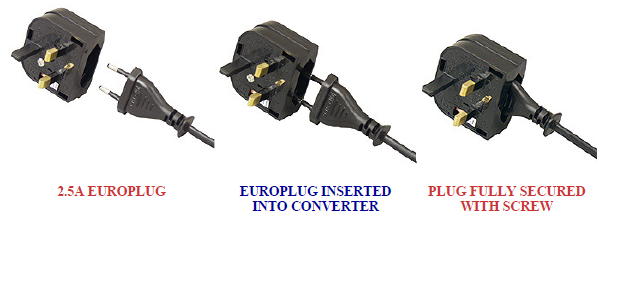
dmclean1842 wrote: » To be honest what your doing is ok as long as the house is wired correctly and the MCB on the circuit is not high rated.
robbie7730 wrote: » Not a great idea though, with maybe a 0.75 flex to the filter and a 20 amp MCB as the first protection. And if it was a ring main, it would be 32 or 35 amp. Sometimes i think the rules in ireland are a bit over the top. But i would never see a plug fuse as a bad idea. For the simple sake of changing a plug.
dmclean1842 wrote: » Agreed but I would not change the plug in this instance. I would buy the adapter as a lot of plugs you get these days have 13amp fuses and people dont bother to replace them with lower value fuses to suit the appliance.
robbie7730 wrote: » What fuse does the adaptor have in it?
dmclean1842 wrote: » 3 amp, think it used primarily for a shaver
robbie7730 wrote: » Not a bad idea at all then, so they are the options Short extension with plug fuse swapped to 3 amp Or cut off and change 2 plugs and swap fuses to 3 amp ones while fitting plugs. Or 2 of the adaptors linked in dmclean`s post #28, a good option.
dmclean1842 wrote: » You can buy the adapters in Tesco too, just make sure they are 3amp (which I think they are). Cant search the Tesco website for some reason.
robbie7730 wrote: » You will be doing very well indeed to get a load of 0.087 amps to arc and melt anything, would an electrical engineer not know that? Not that loose connections are recommended or anything.
robbie7730 wrote: » It may not be lethally dangerous to have no fuse in a plug, but saying a 3 amp fuse is useless because a portable appliance is taking only 0.086 amps is very amateur to be honest.
robbie7730 wrote: » Even if they are not 3 amp, its still a good option for someone that does not want to be changing plugs. Just check the fuse, and replace with 3 amp if they are 5 or 13.
sharkbite1983 wrote: » True about the small arc, but in general, I dont agree with people changing plugs/socket when they dont know how. Fair point, but in the case of a short it should pull more than enough to blow next fuse down the line, at the board most likely. Extension lead is prob the best, safest, easiest & quickest fix.
Theres plenty of appliances in a house hold that only have protection at the consumer unit and sometimes internally fused. Immersion elements are hard wired straight from consumer unit with no localised fuse as are mini valves for heating zones.
Ireland's electrical standards, though very impressive, are way overboard at times.
sharkbite1983 wrote: » also good to remember, every standard 3 pin plugtop will have 13amp written on it, that does not represent the fuse rating, that is the rating of the internal parts of said plugtop!!
golfdiva wrote: » Sharkbite thanks for your offer but I’m in Cork so it mite be a bit far to travel. Ok just to make sure I understand this right. There is no need for me to cut off the existing 2-pin plug. What I can do is buy an extension lead like this :http://www.argos.ie/static/Product/partNumber/9821383/Trail/searchtext%3EEXTENSION+LEAD.htm All I would need to do is change the fuse that’s in the extension lead to a 3 amp ?
shogunpower wrote: » that is dangerous because you could turn the plug upside down and insert it the way you describe which would be connecting the live to the neutral and the neutral to the live unless im missing something?
dMaN24 wrote: » This sounds a bit odd, seeing that you then would require to have it labeled up/down or right/wrong way all over the European countries that apply to this standard. Or how do you mean? I have been using many plugs like these both ways without any issues at all whatsoever. I'd find it fairly outlandish if there would be a "prescibed method of connectivity"
lightnin wrote: » Handy website for future referencehttp://www.powerconnections.co.uk/converters.htm Available with either a 3,5 or 10 Amp BS1362 approved fuse Available herehttp://cpcireland.farnell.com/jsp/search/results.jsp?N=411&Ntk=gensearch_003&Ntt=POWERCONNECTIONS&Ntx=mode+matchallpartial&suggestions=false&ref=globalsearch&_requestid=1016429&isGoback=false&displaytext=&isRedirect=false
M cebee wrote: » though-the breakers tend to trip on short-circuit with 13amp
M cebee wrote: » the 3amp and 13amp seems to be standard now as robbie said they protect the appliance cord from overload i'd say though-the breakers tend to trip on short-circuit with 13amp
pegasus1 wrote: » The fuse, wheather it be in the distribution board or on a plug is there to protect the cable, not the appliance! end of!
robbie7730 wrote: » Nothing worse than that phrase `end of`:D
dmclean1842 wrote: » Also the fuse is not there to protect the cable, it there to protect the person in case of shock or house in case of fire
robbie7730 wrote: » Actually, no, the 3 amp fuse will never blow no matter how severe a person is getting shocked, that is what the RCD is for, although that will not trip on a Live to Neutral shock, but neither will a 3 amp fuse, not a hope. If 3 amps flows through a person, its almost certain instant death, and would in fact take far higher than 230v to achieve. 0.03 amps is the danger level roughly, and 3 amps is 100 times this.
dmclean1842 wrote: » Sorry have to disagree with you there. If you grab a damaged cable and short the live and neutral with your hand the fuse will blow and a will probably save your life. It all depends how long the current is flowing through you.
the 3 amp fuse will never blow no matter how severe a person is getting shocked, unless the 2 conductors happen to come in contact
Also im not sure how the RCD would trip if you hold the live and neutral while not touching anything and wearing shoes.
That is what the RCD is for, although that will not trip on a Live to Neutral shock while insulated from the ground
golfdiva wrote: » Sorry probably a total noob question. Say when I put the 3 amp fuse into the 4 gang extension cord. Is it ok to use the all 4 slots at the same time? Theres not a danger it would get overloaded or anything?
golfdiva wrote: » How could you tell if the plug is a transformer as well ?