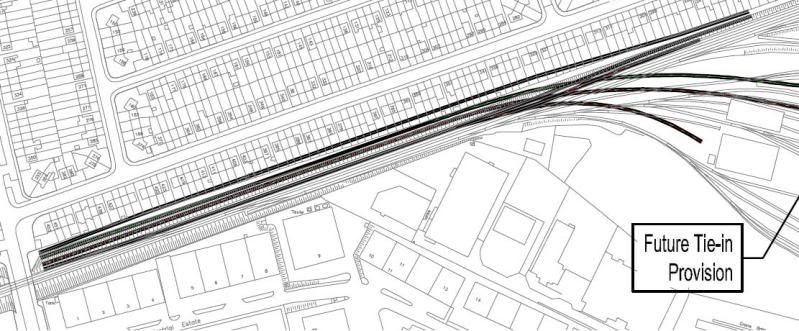
Sponge Bob wrote: » I don't think they took enough land to retrofit the foundations without disturbing the express tracks!!! Period. While they may remedy this oversight when relaying the southern pair the problem is unresolved with the northern pair. More chronic dicking around with long term speed restrictions for Inter City and Kildare commuters may be expected.
BluntGuy wrote: » http://www.dartundergroundrailwayorder.ie/ All documents are up.
A turnback and stabling facility is also provided at Inchicore within a retained cut to facilitate the operational requirements of DART Underground.
The grade-seperated tie-in to the main line would be constructed as part of the future Kildare Route Project. In the interim, DART Underground trains would terminate and turn back at Inchicore.
BluntGuy wrote: » From reading, it appears no connection to the mainline will take place as part of the DART Underground contract. It mentions Kildare Route Project Phase 2, but there has been absolutely no mention of that anywhere else.I have a sneaking suspicion they have no intention of running DARTs to Hazelhatch from day one.Edit, Suspicion Confirmed:
BluntGuy wrote: » From reading, it appears no connection to the mainline will take place as part of the DART Underground contract. It mentions Kildare Route Project Phase 2, but there has been absolutely no mention of that anywhere else.
BluntGuy wrote: » From reading, it appears no connection to the mainline will take place as part of the DART Underground contract. It mentions Kildare Route Project Phase 2, but there has been absolutely no mention of that anywhere else.I have a sneaking suspicion they have no intention of running DARTs to Hazelhatch from day one. Edit, Suspicion Confirmed:
monument wrote: » I did happen* across some drawing in the documents showing different options from Inchicore to the Kildare Route Project.
BrianD wrote: » Would it not be better that the electrification to Drogheda excluded for the DART and be serviced by an outer suburban diesel service? This means that those living in Dublin can enjoy a higher standard of service. The distance by road between to locations is 50km (presume less by rail) and it seems a long stretch of low density population to serve by what the public expectation of a high frequency service.
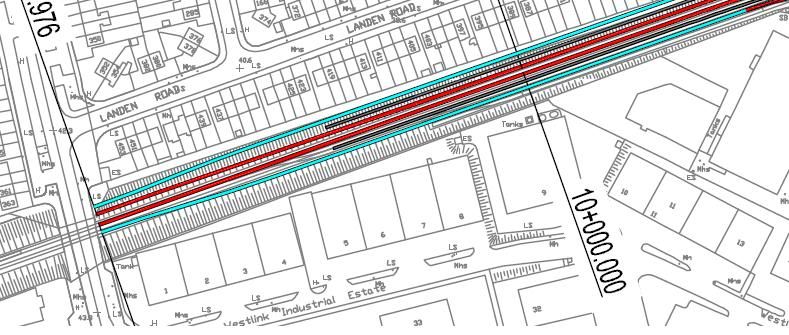
Sponge Bob wrote: » We also have this visualisation of the fKRP ( aka the Missing Link) clearly showing part of the proposed new express trackage in peoples gardens in Landen Road. It looks like ALL the Odd number houses from numbers 289 to 439 are going to lose their back gardens with 120kph express trains outside the bedroom window :eek: Frankly I feel this is sloppy but this is what gets you in trouble at an oral hearing.
Cool Mo D wrote: » Electric trains have much better acceleration than diesel though, so that would make up a bit of time. I'd imagine that Drogheda DARTS would not stop between Docklands and Howth Junction, so that would only add on a couple of stops on a typical service - it could even improve on the Drogheda - Dublin commuter speed. Something like 8 DARTS per hour off-peak would be ideal - 4 to Howth, 2 to Malahide, and 2 to Drogheda, serving Inchicore to Docklands, then Howth Junction to Drogheda would be about right. That pattern would allow scheduling of an hourly Enterprise too, without trains getting in each others way, running a Drogheda DART 8 minutes after a Howth DART lets it go full speed non-stop to Howth Junction. On the other line, 6 per hour from Bray/Greystones would be adequate, splitting between Maynooth and Pace.
BrianD wrote: » There is no compelling arguement to extend the service to Drogheda and it would be a bad move to do so.
BrianD wrote: » Far better to create a high frequency service within the bounds of the Dublin suburbs and have greater frequency of direct/express services from Drogheda to Dublin.
Aard wrote: » Exactly. We should be modelling the DART on the Paris RER. By and large, the RER doesn't leave the contiguous urban area of Paris. The DART to Drogheda, OTOH, would be going through fields more often than urban areas. Like you said, an express commuter would make more sense for all concerned.
Aard wrote: » Yes, they are not directly comparable, not least because of Paris's scale. Nonetheless, I don't think it's justified to have an "urban" rail line running mostly through fields.
Cool Mo D wrote: » The line to Drogheda already has very large usage by commuters. Electrifying it makes sense. The DART is an express commuter train anyway, so I don't see what the difference is? The route could certainly support a half hourly service. And the RER goes far outside Paris's continuous urban area - the ends of lines C, D and E serve many suburban towns that are not continuous with the bulk of Paris, like Melun, Malesherbes, Tournan,and Saint-Rémy-lès-Chevreuse - not unlike towns on the northern commuter route.
murphaph wrote: » Just thinking a bit further about why everything stops at Inchicore and east Wall....it's probably the simple fact that IE don't need a railway order to do the neccessary works from Inchicore to Hazelhatch: it's already a live railway, so no railway order is needed to simply improve it, electrify it etc. It would actually be idiotic to include the section from Inchicore to Hazelhatch. The only new railway is the tunnel section, so that is all that needs to be in the railway order application.
ilovegermany wrote: » But surely they will have to get planning permission as they will need extra land take for the extra tracks and for altering the existing road overbridges at Kylemore and Le Fanu?