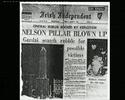
At 02:00 on 8 March 1966, a group of former Irish Republican Army (IRA) volunteers, including Joe Christle,[13] planted a bomb that destroyed the upper half of the pillar, throwing the statue of Nelson into the street and causing large chunks of stone to be thrown around. Christle, dismissed ten years earlier from the IRA for unauthorised actions, was a qualified barrister and saw himself as a socialist revolutionary. It is thought that the bombers acted when they did to commemorate the 50th anniversary of the Easter Rising.
The construction of Nelson's Pillar had been, from the outset, controversial. As early as September 1809 a paragraph appeared in Watty Cox's Irish Magazine, stating: "The statue of Nelson records the glory of a mistress and the transformation of our state into a discount office."
In 1876 the Corporation took up the question of removal, but discovered it did not have the power to remove it. They tried again in 1891, causing much debate in the city and in Parliament, but due to financial considerations they did not succeed. A writer on Dublin's history in 1909, Dillon Cosgrave, acknowledged the temporary nature of the Pillar's existence, remarking that "For a very long time, the project of removing the Pillar, which many condemn as an obstruction to traffic, has been mooted, but it has never taken definite shape".[11] In 1923, when W. B. Yeats supported its removal on aesthetic grounds ("It is not a beautiful object."), in 1926, and again in 1928 the debate was renewed. Several attempts were made subsequently to have it removed, including by the Taoiseach, Seán Lemass, in 1960.[12] Other plans, also not implemented, saw proposals to replace the statue of Nelson at the top of the Pillar with other statues.
Blisterman wrote: » Was it merely because it was a legacy of British rule? Or was it specifically because it represented Lord Nelson. As far as I can see, Lord Nelson did nothing negatively affecting Ireland. In fact, when the Battle of Trafalgar was won in 1805, there were public scenes of jubilation in Dublin, as he was seen as fighting in the interests of the British Empire, which at the time included Ireland. The column was constructed 3 years later, and there doesn't seem to have been much opposition at the time.
MUSSOLINI wrote: » My father tells me it was widely celebrated, people gathered and cheered when the army blew what was left into smithereens. Personally I think it was a great way to celebrate 50 years of freedom.
Blisterman wrote: » I suppose the question is, how did it survive for over 40 years after independence? Also, was its bombing comdenmed at the time, or celebrated? Whatever about the symbolism of the statue, it's hard to condone an act of terrorism like that.
MUSSOLINI wrote: » Blowing up the spire would have no symbolic meaning whatsoever.
Morlar wrote: » The way I always heard it was the IRA explosion was clinical, no injuries and no 'collateral' damage and it was only when the Irish army came along to get rid of the rest that they blew out every window on the street.
Kev_ps3 wrote: » Do you realize how stupid you sound? Imagine a statue to General Rommel in the heart of an Israeli city, it being destroyed by Patriots, and some idiot posting a thread saying 'Why was that statue destroyed?'. Wouldn't happen in any other country than this:rolleyes:
Manach wrote: » Perhaps they should have replace him by Wellington, having been born in Ireland. Given his alleged saying, "Born in a stable those not mean being a horse", it w'd have annoyed him no end.
Snickers Man wrote: » It was said about him, not by him. It was Daniel O'Connell who said it.
Blisterman wrote: » Interestingly enough, I was reading that 4,000, nearly a quarter of the total men fighting under Nelson at the battle of Trafalgar were Irish. So there must have been a reasonabl amount of support for Nelson at the time.
brianthebard wrote: » The Irish and Scottish were always disproportionately represented in the British army it had little or nothing to do with support tbh.
getz wrote: » there was a lot of hero worship for nelson in ireland at that time,irishman the rev patrick bronte [father of charlotte,emily, and anne,] changed his name from brunty to take one of nelsons titles duke of bronte.
CDfm wrote: » What about the taking down and burial of the Queen Victoria statue in UCC.
Fratton Fred wrote: » She is effectively UCC's founder.
CDfm wrote: » Queens University Cork does have a bit of a ring to it. Was it ever called that??