Aidan1 wrote: » Again, this is their premium service, and it should always be this good.
dowlingm wrote: » BK "does his job well" (and I dispute that, he comes off as a bully to me) because he has had far too much practice for the wrong reasons.
DWCommuter wrote: » If you weren't so blinded by your own love affair with IE, then you would appreciate a message saying, that despite new trains and track, the company has failed in many other areas. Its rather simple.
Transportuser09 wrote: » You have admit that video is a bit OTT. It claims Irish Rail didn't get anywhere, well service frequencies on many routes have increased over what they were ten years ago, rolling stock s newer and more efficient, track is newer, so surely they've got somewhere. It highlights the Malahide collapse, fair enough. That should not have been allowed to happen. But in the overall context, its one incident. Their safety record is alot better than that of many other countries, just look across the water. The video ignores critical issues like the Rosslare-Waterford closure. It ends on a note suggesting they have wasted money...on new trains and infrastructure? Even though they are a rail company. So overall the video comes across as a tad ridiculous, I don't have a love affair with Irish Rail I just don't buy into the whole 'IÉ are evil' concept that some appear to advocate.
DWCommuter wrote: » Its a bit of fun and a twist on the usual IE ad spin that many will understand. Obviously you don't hence your repeated misrepresentation of what the piece is.
DWCommuter wrote: » New toys does not a decent rail company make.
KC61 wrote: » If you are seriously suggesting that we cannot discuss any of the speed restrictions on the railway and the effect that they are having on services because of a court case then you are losing the plot. They are a legitimate subject to discuss as they are causing serious issues across the network - the numerous restrictions on Dublin/Cork, the 25mph restriction between Killonan Junction and Birdhill, and 35mph onto Ballybrophy. There are issues within the court case, but to say that we cannot discuss the impact on services of the restrictions is plain daft. The article was quite factual in this regard.
Transportuser09 wrote: » It highlights the Malahide collapse, fair enough. That should not have been allowed to happen. But in the overall context, its one incident. Their safety record is alot better than that of many other countries, just look across the water.
Transportuser09 wrote: » I'm well aware of those ads. But the video still doesn't hold up much of an argument.
Transportuser09 wrote: » No, but if they use those new toys to increase the level of service to the customer then surely its a step in the right direction. Its hardly fair to say they're not a 'decent' railway company. They're by no means 'World class', but decent enough all the same.
murphaph wrote: » Speed restrictions this low are a joke and an indictement of everything that is wrong with IE. If the line is in such poor nick, right down to the formation, then they shouldn't have relaid it with CWR (with rail that is too light anyway) and bought flash carriages but should have repaired it properly, with extended closures if necessary. Cork Dublin should really be 125mph along it's entire length by now. IE spent a lot of money on a lot of the wrong things tbh. I can't imagine a long term speed restriction of 25mph existing on an intercity line anywhere in Germany, heck, regional trains here are faster than Inter City in Ireland.
DWCommuter wrote: » I find that the opinion expressed above is too hard for some people to fully digest. The old Irish Rail line is that "after decades of under investment, we had to invest to make the railway safe." No argument there. But the bit that us realists don't accept is why they failed to bring speeds across the network up to a level that competed with a motorway network being rolled out while they were simply placing new track around the same bends etc. They brought the blueprint to Government. On Track 2000 wasn't designed in Leinster House. Irish Rail failed to appreciate that the inter urban roads programme was a very obvious threat to the mickey mouse railway they were delivering to the public. The railway we have today would have been fantastic in the 70s/80s/ and even the 90s because the road network was a shambles. But its a poor product this century when one looks at the road network. Many rail operators across Europe survived because they quickly realised that Motorways/Autobahns/Autopistes/Autostradas etc. etc. were serious competition. That was back in the 60s. The lesson was around long enough for Irish Rail to learn it. The Dublin - Cork line should have been made safe and at the same time upgraded to 125mph where reasonably possible. Same with Dublin - Belfast (and lets not even talk about the failure rate issue of trains on that line. Another Inchicore calamity.) Other routes should have at least 90mph for the majority of their line lengths. At a time when the country was awash with cash we opted for the Strategic Rail Reviews, "staying in the game option". But the rules of the game were already changing when BAH were formulating those options. Yes there is some blame at the cabinet table, but Irish Rail are ultimately responsible.
KC61 wrote: » I think that it would be fair to say that even Irish Rail would (albeit unofficially) admit that they made a mistake not pushing for the Dublin/Cork line to be renewed at an earlier stage.
Karsini wrote: » Lets face it, IR are down 12 coaches right now (two 3-piece sets and a 6-piece) so we could do with having at least two Mk3 rakes out there to make up for the loss.
Karsini wrote: » But I do think that it should be run by a board who actually know how to run a railway.
Transportuser09 wrote: » You're right, it would make sense to have a set (only until extra 22000s arrive) in service to cover the shortfall. Ideally keep it on a specific route to minimize the need to have shunters/guards all over the country to cover the random arrival of a loco hauled set at some provincial location. By keeping it on one route you only need such staff in specific locations. Its not really fair to say they don't know how to run a railway. On the face of it, they're actually quite good at it in terms of making the service more efficient, well, in most cases anyway. Before some of the current management came in, we had a railway which ate up resources. Loco hauled trains meant running round or shunting in terminals, which meant additional locos, shunters, guards and all that goes with it. Now we have a efficient railcar based railway which allows faster turnaround times, less handling, easier to split a train to make a shorter formation which is more economical for off-peak trips. A standardised fleet means standardised parts, etc... They've streamlined the railway from what it was ten years ago and the resulting efficency indicates that they are very capable of running a railway.
Judgement Day wrote: » I don't agree with any of your post but this last point is total nonsense - a standardised fleet - DART's from 3, or is it 4, different manufacturers, railcars of a wide variety of types and manufacturers - just the thing that CIE always maintains was the cause of its problems back in 1945 when they inherited all the pre-GSR locos and rolling stock form a myriad of different concerns.
Judgement Day wrote: » As for doing away with a few shunters and guards, most of whom were probably redeployed scratching their arses out of public view (like the displaced signalmen, Fastrack staff etc), a fat lot of money that saved.
Judgement Day wrote: » Contrary to what you appear to believe we now have a railway which is irrelevant to the vast majority of the Irish public (outside the Greater Dublin Area) - almost no freight traffic, no parcels traffic, bicycles are a nuisance, catering teetering on the brink, not even a public timetable anymore - timings worse than they were on some routes 20 years ago - Dublin/Belfast in particular. A total shambles is the most charitable thing that can be said about the whole company.
Transportuser09 wrote: » Sorry, I should have been more clear, I meant the Intercity fleet; we have virtually the same train operating all non Belfast/Cork intercity routes, before it was myriad of craven, mk2 and mk3 carriages, 121, 141, 071 and 201 locos. By ordering more 22000s while they had the chance to do so IÉ are allowing themselves to maintain this standardised fleet for the foreseeable future. If they had waited another few years down the road to order more trains the jigs etc...used to make the 22000s may not have been around and a new production line would have to be set up. They would end up with yet another type of train to keep parts for. Instead they've upgraded their mainline fleet in close to one full swoop.
MYOB wrote: » So what happens when a safety fault is found on the 22ks?
Hamndegger wrote: » No, Kildare Street are primarily to blame here and you know they are. They fund the network, own it, licence the services, dictate staff numbers, okay budgets, give nods to new stock and renewals etc etc. Irish Rail could put forward plans for Chunnels, HST, Bullet Trains, Deltics, double decker DARTs to Dingle and a 44 track railway in Kildare but they are only allowed to do what those above let them and with whatever resources let to them. The DoT knows that so long as it's a Semi State company running it people will blame the company if they perceive it to be wrong or if it lets them down regardless of whose fault it is deep down. This is not to say that they can do better or worse (they can) but there is only so much they can do without a glass ceiling being reached
Transportuser09 wrote: » Perhaps, but there is now no need to keep training new staff for these positions, so gradually there will be a reduction in overheads. Well you can hardly expect them to carry freight traffic where it is uneconomical to do so if they recieve no subsidies for it. They do run freight trains where they are guaranteed to earn revenue, look at the likes of the container trains in and out of Waterford. Regarding the public timetable, I'm not sure what you mean. You can pick up leaflets for your local route at your local station. Someplaces have a larger selection of leaflets to cater for other lines. If your referring to the combined timetable booklet which listed all routes you have to ask hwo many people actually use more than one, maybe two routes on a regular basis. As for the railway being of no relavence to people outside of the Greater Dublin Area, well the fact that thye see fit to keep a relatively high frequency service on many (not all I admit) intercity routes and make them sustainable would indicate that it does have a relavence in these areas. Now, in the case of some of the cross country routes you may have a point.
DWCommuter wrote: » I disagree. I've learned the difference between what the Government are responsible for and what they cannot be responsible for. Remember it was a Government that requested a root and branch survey of the rail network (post Knockcroghery) and sought recommendations. Irish Rail did not present a business case that was future driven and economically ambitious. They presented a safety driven and out of touch case as they failed to use it as an opportunity to bring the railway up to a 21st century standard.
DWCommuter wrote: » We need to leave all the reopenings aside in any examination of the rail network. Reopenings were politically driven. The basics in terms of the operation of the existing network were the responsibility of Irish Rail. Funding was made available on the basis of what Irish Rail wanted to put in place. It is inconceivable to think that a rail company would suggest a multi billion DART tunnel through Dublin, while the rest of its network was upgraded to a level that was already outdated by the time of completion. If a Government can give a committment to a DART tunnel and a Metro, then it can just as easily give a committment to a network upgrade that allows for higher speeds.
DWCommuter wrote: » I am accutely aware of how Irish Governments neglect public transport expenditure. But I am also aware of the fact that Irish Rail did not actually ask for funding to bring the rail network up to the required standard. They honestly thought that what they had done was enough. It isn't and to merely lay the blame at the door of Government is unfair.
foggy_lad wrote: » by the time consultants and others were paid and different materials tested and irish rail staff trained in unwrapping with special courses and bonuses/allowances etc it would cost more than giving those old crocks to the army for target practice!
dowlingm wrote: » monument - without using a search engine or otherwise cheating, can you name the PR guy for DB and BE? I know I can't. BK "does his job well" (and I dispute that, he comes off as a bully to me) because he has had far too much practice for the wrong reasons.
dowlingm wrote: » By the way I am not Ken G - I don't have to limit my criticisms to what was in the Tribune article, which served as a catalyst for wider discussion.
dowlingm wrote: » Also, while modern does have a certain implication, it is not a synonym of "new" - see "modern art", for instance. Compared to a 50 year old Budd car you could ride on this side of the Atlantic, or a New Zealand Mk2, the Mk3 is pretty modern because we benchmark it on stuff like aircon, autodoors and so on.
monument wrote: » The Kildare Route Project cannot be seen as "a culture of waste". The project is not even complete, two tracks are/have being dug up in large parts at the moment. New stock is due next year and can be used then to allow for an increase in services on the route (Some new railcars were damaged beyond use in transit, this can't be seen as Irish Rail's fault).
Aidan1 wrote: » And I'll give you my perspective : Post MK4: Clean toilets, that work for the entire trip.
Seriously, the Cork Dublin Service I travelled on last week is of a completely different standard to the one I used on a weekly basis in the late 90s/early 00s.
Victor wrote: » Surely, in particular on the Waterford route, there was scope for one morning train to be a Mark 3 and the other a 6 x 22000, whatever stopping pattern is used. Or to have Mark 3s (with proper first class, even have two first classes) on the direct services to Limerick and Tralee, with even fewer stops and using the freed up 22000s to serve stops in the commuter belt. So, the KRP could be put to its full(er) use now, but it isn't. The track (re)laying could have been done somewhere else where there are lower speed limits, which would deliver results within a month of the re-lay.
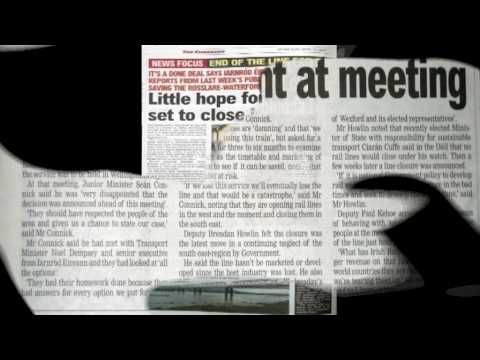
monument wrote: » As for Waterford, in my eyes, that can only be viewed as a political issue. The service was political in nature -- it was there so it could be said there was a service, but the service was useless to nearly everybody. Even if it was not designed for failure, it was clearly not designed well enough to be viable, or at least attractive.
Hamndegger wrote: » In reality, it happened the opposite to how you put it here. The Government requested a report thinking it was the execution warrant they were signing and the answers Irish Rail staff were gagging to spit out for donkey years finally came out when outsiders came in and saw what drivers, PW men, guards, signalmen, porters, inspectors etc knew; the network was ready to go bang and in a bad way.
A tunnel that they were told by numerous external experts to build to unchoke Dublin 40 years ago. The DART was the first phase that as the SRR showed 20 years on was a by pass when the patient needed a heart transplant; we are still awaiting on the donor. The rest of the network needed work regardless so don't pass it off as Irish Rail's lip service when it patently isn't.
Again, you know well that Irish Rail asks and Irish Rail gets but they don't ask for what they actually need for fear of getting nowt. Regardless, nothing will be done as current things stand.







![Photo of [Deleted User]](https://w4.vanillicon.com/v2/466401cd19c9456f42bab76885725388.svg)


