http://www.independent.ie/national-news/eirgrid-pushing-to-erect-400-new-pylons-1990768.html
NATIONAL grid operator
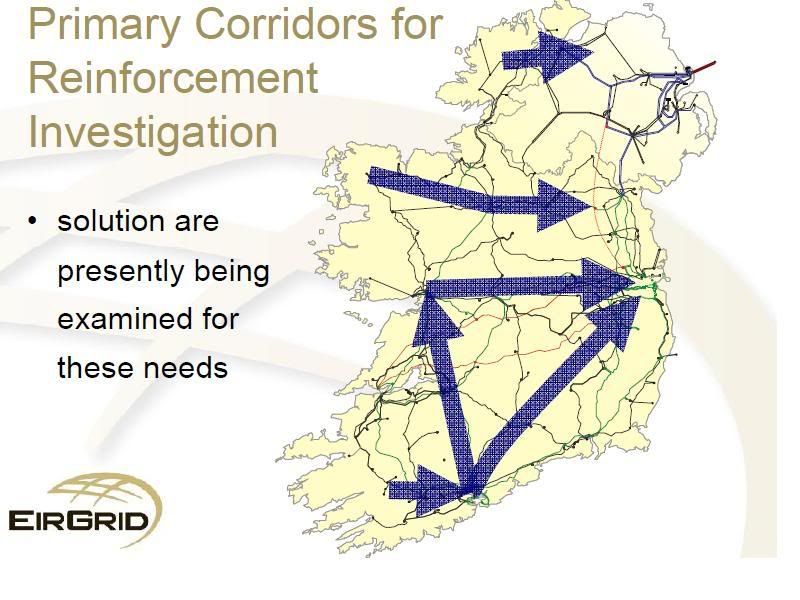
EirGrid plans to erect up to 400 electricity pylons, some up to 44 metres tall, across four counties as part of a major upgrade of the transmission system.
The company yesterday revealed it would seek planning permission to build a €280m electricity interconnector through
Meath,
Cavan,
Monaghan and
Tyrone as part of a major upgrade of the national grid.
And the semi-state company has refused to build the 105km interconnector underground, saying it was too risky and could jeopardise the entire electricity network.
This means that up to 400 pylons carrying high-voltage power lines will be built between Meath and Tyrone, some the height of Dublin's Central Bank.
The public hearing into the project is expected to run for at least four weeks. Public consultation has been ongoing for more than two years and the public have 10 weeks to make submissions.
Up to four steel transmission towers will be erected every kilometre, ranging in height from 24 to 44 metres, EirGrid confirmed.
Community group North East Pylon Pressure (NEPP) made up of 45,000 residents and businesses, says it will lobby to have the power lines built underground because it will lower costs over the long term and address health concerns.
EirGrid says that placing the lines underground could add €500m to the overall bill. NEPP says an independent study it commissioned found that the combined investment and transmission costs over 40 years were €968m for overhead lines compared with €805m for an underground system.
"From a business, health, environment and visual point of view, underground cables are a viable alternative," spokesman
Liam Cahill said.
"We're not against overhead, but an underground cable system will be cheaper over the long term. The research we have commissioned tells us underground is not only technically feasible but advisable. Overhead devalues property and interferes with wildlife."
But EirGrid says no line of this size and type has ever been placed underground.
"Attempting to develop this project on an underground basis would at best be a high-risk experiment, which may well result in failure, could waste many hundreds of millions of customers' money and would jeopardise security of supply to the north-east region and indeed to the electricity system throughout
Ireland," project director
Tomas Mahony said.
"No line of this size and type has ever been placed underground anywhere in the world. You're talking about the security of the national power system here. If you have a hi-tech industry, any problem with the power supply could jeopardise future investment."
Charge
The project will be paid for by utility customers by way of a standing charge on their bill. Planning sources said they expected the public hearing to last for at least four weeks as the pylons would have an "enormous" impact on the landscape which would lead to objections.
"You could be looking for a minimum of four weeks, possibly, six weeks for something that size given the number of experts who will testify," one source said.
The most objections ever received by
An Bord Pleanala in relation to an individual project were the 600 submitted as part of developer
Sean Dunne's application to redevelop the Jury's Berkeley Court site in
Dublin 4.
Meanwhile, EirGrid is to introduce a new type of conductor in the coming year, which will significantly cut the cost of upgrading part of the national grid.
The new conductors, known as high-temperature, low-sag conductors, can carry much higher power than the model they will replace; and the new technology is crucial in delivering cost savings to consumers and enabling upgrades to the national grid over the next 15 years, the company claimed.