https://www.independent.co.uk/extras/indybest/house-garden/lidl-plug-in-solar-panels-b2945237.html
https://www.mylondon.news/news/cost-of-living/plug-solar-panels-how-work-33648134
"Until now, UK wiring regulations effectively banned them without an electrician’s sign-off, but the government’s intervention changes all that."
What Irelands policy with these ?
none unless anyone knows
If you're off-grid, what will you be plugging into? Have you already got an existing off-grid system? The 'plug in' inverters being discussed here are 'grid-tie' and need some sort of existing 'grid' to tie into.
Edit: read the specs on that, you're pretty much just charging up a mobile power bank with solar.
I think what they were saying is that they'd plug the microinverter into the storage batteries 3 pin socket. A bit like what this lad is doing.
EcoFlow STREAM Ultra X — Going (a bit) off-grid with plug-in solar
Ye, checked the specs and I see what he means, kinda reminds me of my 1st off-grid system years ago made up of spare car batteries, old panels, cheap Ali charge controller and inverter, don't think I worried too much about regs!
Thank you for your response.
I am not talking about a grid-tied system.
The Ecoflow Delta 2 max is a combination of battery and pure sinewave inverter. The solar panels charge the battery of the Ecoflow unit which in turn outputs 230V AC to the shed (via a small CU connected to sockets and lighting. There is no grid connection whatsoever.
My question is what, if any, regulations are applicable to this setup?
Thanks
Once you start hardwiring stuff like that with a CU it would fall into I.S. 10101 rules territory.
If you're not connecting it to the grid, then it's just a fancy powerbank (no shade), so have fun. Good for charging up other batteries, running lights, maybe the lawnmower.
Not if it's not connected to the grid, no
This question has been written by an elderly technophobe, so please handle me gently!
I currently have a 10 panel 4.15 KV system on a west-facing roof. My inverter has a capacity of 6 KVw and I also have a battery. There is no possibility of me installing any additional panels on the east-facing roof as I have dormer windows.
In mid-afternoon in the summer months my PV system delivers 4.4 KW (absolute max). But before lunchtime these west-facing panels deliver very little energy.
I would like to install one (or max two) plug-in solar panels which I would locate on the ground facing east or south east - no shadows, so uninterrupted sunshine.
From what I've read here, my understanding is as follows:-
I'm sure that this situation has already been answered in the earlier posts on this thread, and I apologise for any duplication, but I'm just being very cautious before I take the plunge. Thanks.
Yep
2. incorrect, but makes no difference. it will use the micro invertor as a stand alone system. once again, this makes no difference to you.
3. correct
4. correct
That's a great help, thanks.
So my two options would appear to be: either (a) go for it now, or (b) wait until it's legal, and then go for it!
Hopefully, option b will mean that Lidl and/or Aldi are likely to start flogging cheaper systems!
On point 4, you are increasing your inverter capacity above the 6kVA you have.
Your plug in solar panels needs an inverter and whatever the capacity of that will be added on to your existing.Technically this will push you into NC7 territory.
You could just add additional panels to the strings on your existing inverter and then it wouldn't change your NC6 status. You can oversize your array as much as you like, you have headroom there to do it
"You can oversize your array as much as you like, you have headroom there to do it."
This is where my head starts spinning!
What's my array? And what does headroom mean in this context?
I can't add any more panels to my roof; if I could, then I would. And adding panels to my exisiting string would require me to dig a trench through a patio and, I assume, would require me hire an electician.
That's why I found the plug in solution so simple and attractive.
AI is your friend for questions like that if you are not sure.
But basically, your 'array' is the term used when talking about all of you PV panels together as one entity.
An array is usually made up of 'strings' of panels connected together, which are sub groups within your array.
These strings are connected to your inverter. Most setups your size will have 2 strings connected.
Your inverter is connected to the grid and this allows you export.
When I talk about headroom, I mean the difference between the peak power of your panels Vs the peak power of your inverter. 6kw Vs 4.15kw. You can add additional panels to use up the capacity of the inverter, so you can have 6kw (or more if you like in your total array).
ESB website says "Adding extra PV panels behind an inverter of less than 6kVA Single Phase or 11kVA Three Phase does not require ESB Networks permission. " This is your case currently - but a plug in solar setup is not adding panels behind an inverter, it is adding extra inverter capacity.
You could break into the loop in an existing string and add more panels, they don't have to be physically on the roof, but they would want to be nearby to be practical
https://www.esbnetworks.ie/customer-support/customer-support-queries/generator-connections/connect-a-micro-generator
If you have spare time and access to a van, get 2nd hand panels on Adverts. People replace the old ones and can get them for a low cost. I did that twice and got the rails too.
I found it enjoybale to set it up
Just to be clear if your following NC6 rules - the limit is 25Amp for all combined inverters. As you already have a 6kW inverter you must of got this prior to the stricter 25Amp limit. 3. Total PV output here doesn't actually matter - NC6 only deals with total combined inverter(s) max output. (you could have 2 x 5kW inverters both with only 2kWp of panels each - that would not be allowed under NC6) 4. Your NC6 is good for any number of inverters provided total output is (in your case) 6kW, ESBN has confirmed there is no problem swapping out one inverter for another provided it is same or less than the size you have been approved for. So technically if you added a plugin inverter of say 1.5kW. your combined total is now 7.5kW which exceeds the 25amp I still never understand why people don't just look up the actual rules as defined by ESBNWhat is micro-generation | ESB Networks
On the other hand plenty of people will totally ignore the NC6 rules and add who knows how many inverters - be it plug in or wired.
Thanks idc. My last encounter with Ohm's law was in June 1973 A lot of current has flowed through the neural network in the intervening 53 years!
Received the inverter yesterday. 12 panels have arrived today. 10 will be going onto the field to be connected to my existing solar system (already have 12 panels on the roof) and the remaining 2 panels decided to use for plug in solar.
Set up took 5min, generating 705w (east facing) as I type.Happy days!
Thanks everyone for all the useful information posted in this thread :)
Btw, is it possible to see in the app what is being consumed and what is being sent to the grid? Any ideas?
If the app connects to the inverter then I don't know how it could tell what is being consumed and what is sent to the grid?
if the other inverter used a CT clamp on the incomer then, It would show up there.
you'd have to do the calculation yourself.
If I wanted to put 2 panels on the shed and then put the inverter in the shed, how would I run the power to the house if the shed is 12 meters away? Surely the cable that comes with it won't reach 12 meters from the inverter to the house?
Ecoflow is plugged into the garage socket.
Garage has its own CU which is a slave to House main CU.
My main solar with Solis and 16kw battery is installed in the garage but it is connected to ESB meter with 30m Cat5 CT clamp monitoring consumption to activate battery’s discharge.
There is practically no day load on the garage (only during the night when one of EVs is charging on a granny cable from the garage socket ) so I presume anything generated by my plug in solar, since being invisible to Solis inverter, will be unused and exported? Am I correct?
Apologies if it’s a stupid question.
Anything in your house could soak it up, and anything that's not soaked up will go out to export. The main inverster won't "see" it if it's used by the house but will see it get exported. IF your batteries are full, then it'll just get exported, and if they're not, it'll manage teh house load while the solis dumps anything it perceives as excess into the batteries (it's not going to pull from your microinverter, rather not try to power the house as it's already covered)
you can’t generate unseen electricity. it has to go somewhere. If you don’t need it, it’ll spill ionto the grid.
You 'see' what the microinverter generates as being lower house consumption.
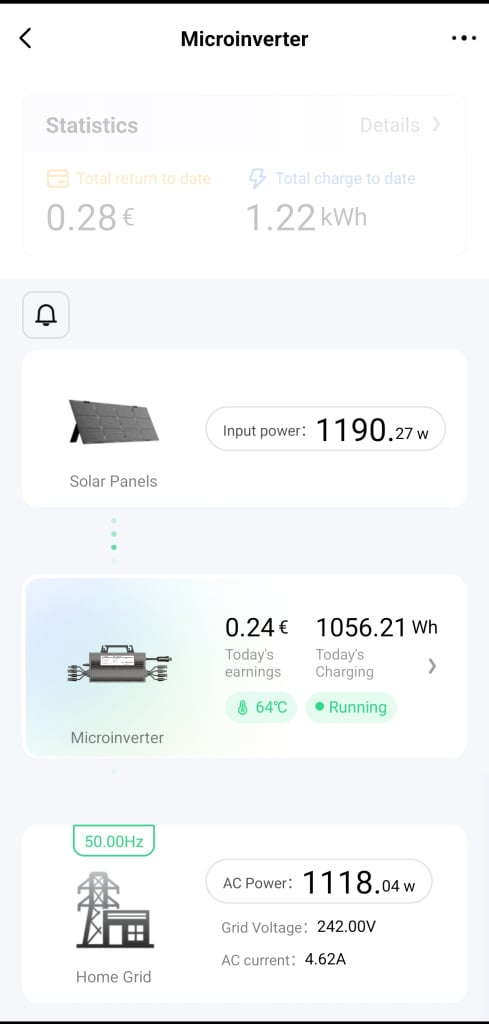
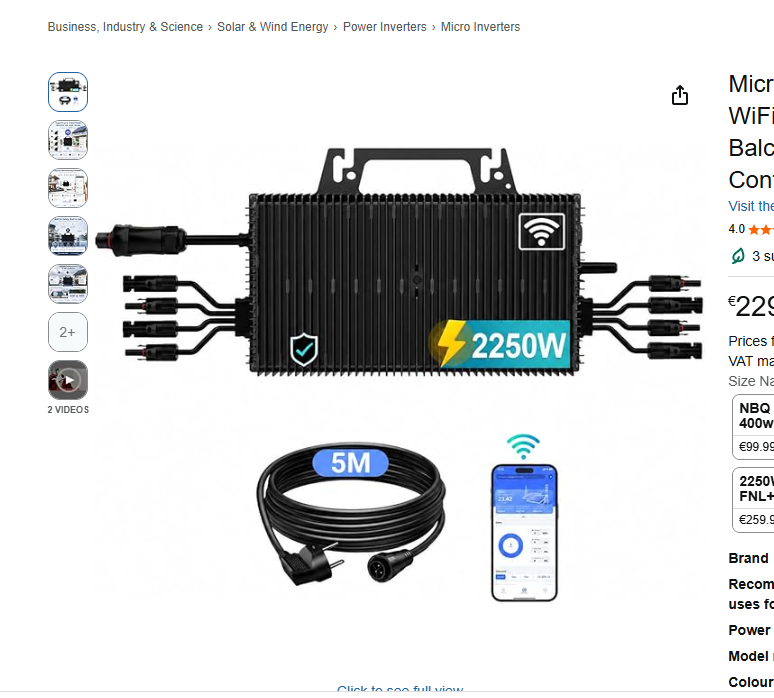
Thought this might be of interest to some here. An EN-50549 certified 2250w Microinverter sold via Amazon.de and shipped from the manufacturer store for €217.49 delivered. https://amzn.eu/d/0eOTDzFn
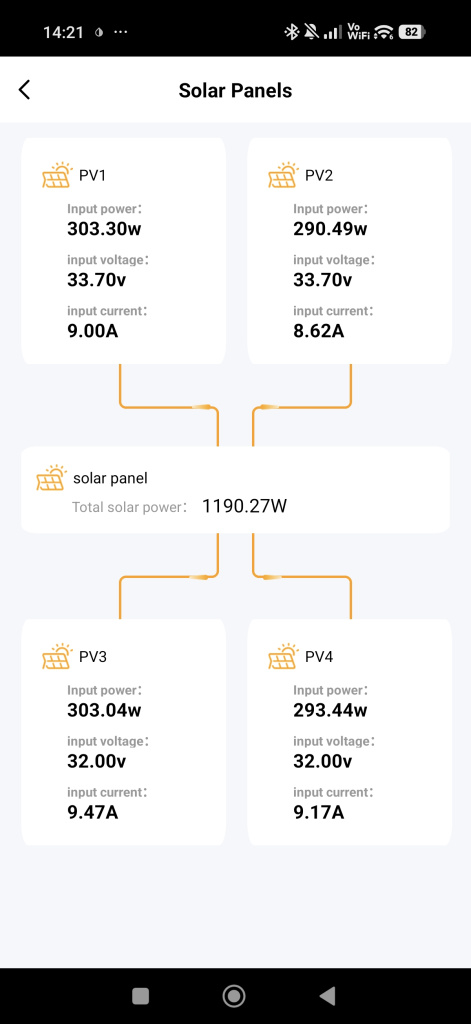
4MPPT and the main issue I've seen in the reviews is that although it's advertised as having the ability to limit AC output, that this is achieved via disconnecting panels rather than via the app.
Bit of an unfortunate brand name though 👀
I have installed this Microinverter yesterday and happy to report it's monitoring is via Smartlife/Tuya and integrates well with HomeAssistant so unlike the Microinverter it replaced, app monitoring can be open sourced and isn't reliant upon the manufacturer keeping a server active.
are you monitoring the temperature of the module itself . Don’t see any cooling fins or heat sinks . At max load the dc/ac conversion would drive temps high .
the whole device is a heat sink..