I think it should go in Dublin docks, land is there and so is majority of the state demand and power lines converge there and a river/sea for water and cooling (or even better heat half of Dublin with it like Finns do)
But not until after Phoenix park is replaced by solar farms and battery storage and Dublin hills with wind generators
People need to see what powers them and Dubliners are already proud of a couple of smoke stacks
Lets try again, does S Korea have cheap slave labour like you allege the UAE has?
So you think Dublin should be the first capital city in the world to have a non-research NPP located within 50 km of the centre? In a country that doesn't have any nuclear.
I don't think you're serious about actually wanting nuclear. If you were, you'd suggest somewhere with a better chance of succeeding.
France r and Finland have nuclear built in the 80s. If they started today they’d have the dearest.
Where in Ireland would you put a nuclear plant and how much would it cost.
Probably cost 1.5x Sizewell.
If Carnsore not available probably somewhere between Dublin and Belfast. If there is even a site that qualifies.
There are already 8 nuclear power plants on Irish Sea including one not far from Dublin at 118km
That’s also where majority of the country’s demand and grid infrastructure lies, moneypoint could be another location but that probably require grid trunk updates
all the environmentalists and wind and solar lobbyists here are only supportive of renewables as long as it’s not in their back yard, funny how that works eh?
Anyways about time the capital is moved to Athlone 🤓
Oh and Armenia, Croatia, Taiwan within 39km of their capital And Belgium, Lithuania and Slovakia within 57km as well as multiple state capitals in US, while China has hundreds of millions of peoples next to their rapidly growing fleet
It’s quite obvious that the green movement is not serious about climate change, tho even Greta T and Eamonn Ryan have seen the light now
so £60bm. But that’s an extra reactor on an existing site. So let round it up to £100bn.
Now that you are building a 3.2 GW plant. To
Meet N-1 where will you build its sister plant ?
Do you want to break the news to the residents of Wexford
I'd preferably leave it to the zealous pro nuclear posters to actually think about this and answer.
I think it should go in Dublin docks,
So, you want to put a Nuclear Power Station right in the heart of the capital city, on prime development land… I think this confirms you are a troll. You really have little interest in Nuclear; you just hate renewables. Why? Did someone put a wind farm next to your house down the country?
But not until after Phoenix park is replaced by solar farms and battery storage and Dublin hills with wind generatorsPeople need to see what powers them and Dubliners are already proud of a couple of smoke stacks
You are not to be taken seriously.
Ill answer it as soon as you answer this.
So, what is the real number, as it seems you're shooting the messenger here.
https://www.boards.ie/discussion/comment/124410633/#Comment_124410633
I’d prefer pro offshore wind use realistic prices especially for floating offshore and don’t forget to multiply by 3 or 4 due to stuff at sea rusting and.breaking in storms as well as adding the required battery backup and grid upgrades
marketing representatives and clowns from the wind and gas lobby who let us to some of the highest electric prices while emitting multiples of co2 of nuclear neighbours unfortunately we’re taken seriously and no we are paying for it while continuing to cause climate change
But you supplied evidence in another thread that Ireland had the 15th most expensive electricity in 2024.
Are you now saying we pay some of the highest prices 🤔
Yea, you are really concerned about climate change, like really concerned.. :lol A few days ago, you stated explicitly that the only renewable you are for is rooftop solar. All else should not be allowed.
ESRI puts us as the highest up to 2024 but supports knocked us down to second
https://www.irishtimes.com/business/2026/04/14/electricity-bills-in-ireland-among-the-highest-in-europe/#
it’s now 2026 in case you failed to notice, and there is report of another 10% increase coming soon
but keep splitting hairs it’s noticeable how easily facts are just hand waved away
carpeting fields used for food only ensures rainforests are chopped down, which is a double whammy for the climate, but you don’t care, nor do you care about rainforests being chopped down transported to and across Ireland and burned as “green” energy (this goes on across Europe too)
One reason to decommission Bellacorick Wind Farm was that each of the new turbines going there can generate as much power as the whole wind farm used to.
Here's how much nuclear power has been installed in the West during Bellacorick's 34 year lifetime.
Blue = completed. But with costs at least 2.4 times the original price.
Green = not completed yet. Red = Abandoned.
It's just that I could have sworn the ESRI paper said we have the 8th most expensive when corrected for wages and 15th when corrected for wages and government supports.
I'm referencing 2024 because that was the year in the paper. I don't want to make false claims like you do.
I don't want to backseat mod, but this thread feels like it would be a lot less noisy if discussion (positive and negative) of renewables was banned, same as nuclear is in the other thread. This thread should surely be about:
Eight nuclear plants in the UK ?
I think you are getting confused with - The statements confirmed eight sites as potentially suitable for new nuclear power stations and ruled out three sites for the development of new nuclear power by 2025.
To jog your memory the timeline was
2003 The government's 2003 energy white paper highlights the lack of planned new nuclear plants to replace decommissioned ones, but rejects the technology, saying "its current economics make it an unattractive option for new, carbon-free generating capacity".
October 2005 The government's chief scientific adviser, Sir David King, voices his support for a nuclear power revival, saying there are economic as well as environmental reasons for a new generation of reactors.
November 2005 The then prime minister, Tony Blair, commissions a second white paper on energy policy and confirms that a new generation of nuclear power station's is to be considered. He says nuclear power is once again a serious option because "the facts have changed over the last couple of years".
March 2006 The Sustainable Development Commission warns Tony Blair that there is "no justification" for a new nuclear programme.
April 2006 The government's environment audit committee warns that a new generation of nuclear power stations would not be able to avert a serious energy crisis. The government has become "too focused" on nuclear energy, it says.
May 2006 Tony Blair endorses a new generation of nuclear power stations in a speech to business leaders. He says the issue of a new generation of stations is back on the agenda "with a vengeance". He is backed up again by King.
July 2006 The new white paper confirms that nuclear power is back on the agenda. It says a mix of energy supplies is essential and that new nuclear power stations could make a significant contribution. The review says it will be up to the private sector to cover the costs of investment, decommissioning and storage of nuclear waste.
Feb 2007 EDF’s chief executive of its UK Division says: “EDF will turn on its first nuclear power plant in Britain before Christmas 2017 because it will be the right time.”
November 2007 New prime minister, Gordon Brown, calls for an acceleration of nuclear power in a speech to business leaders.
January 2008 The government announces its nuclear plans. It backs a new generation of nuclear power stations.
March 2008 Britain and France announce a deal to construct a new generation of nuclear power stations and to export the technology around the world. The deal will allow Britain to take advantage of French expertise in building new reactors.
May 2008 Half a million people in the UK hit by power cuts as seven power stations, including Sizewell B, unexpectedly stop working.
June 2008 Government inspectors warn that plans for a new generation of nuclear power stations may be delayed because of a shortage of skilled engineers.
July 2008 In a speech to EU states, Gordon Brown calls for eight new nuclear plants to be built in as part of a 'nuclear renaissance' in the UK.
September 2008 Business secretary John Hutton calls for a 'renaissance in nuclear power' in a speech to parliament.
French energy giant EDF finalises a £12.4bn deal to buy British Energy, which runs eight nuclear sites with land on which new reactors could be built.
January 2009 Gordon Brown backs plans for a new nuclear power station at Sellafield, after the Nuclear Decommissioning Authority agrees to provide land for the building of two new stations adjacent to the old site.
April 2009 The government publishes a list of potential sites for a new generation of nuclear plants.
The Nuclear Decommissioning Authority raises almost £400m after a seven-week online auction between energy companies wanting to buy three sites for new plants.
May 2009 Centrica, which owns British Gas, announces a deal with EDF that will involve it in building new nuclear power stations in the UK.
June 2009 A secret report by the government's chief nuclear inspector, Mike Weightman, shows more than 1,750 leaks, breakdowns or other "events" at UK nuclear plants over the past seven years.
July 2009 Rolls-Royce announces it will open a new factory in the UK to build and test parts for new nuclear power stations.
September 2009 State-owned Russian group Atomenergoprom unveils ambitions to break into the British nuclear market, raising fears about the Kremlin's use of energy as a political weapon.
UKAEA, the body responsible for decommissioning and cleaning up Britain's fleet of nuclear power stations, has been bought by Babcock International Group for £50m.
October 2009 The Guardian learns of secret government plans to tax electricity consumers to subsidise the construction of the UK's new nuclear reactors, contradicting repeated promises by ministers that the nuclear industry would no longer benefit from public subsidies.
November 2009 The Health and Safety Executive says French and American designs for new nuclear reactors are significantly flawed.
Energy secretary Ed Miliband outlines government plans for a new fleet of nuclear power stations at 10 proposed sites. An 11th site at Dungeness was turned down because of the "adverse effect" it could have on the local ecosystem.
March 2010 The government announces a £170m funding package for the British nuclear manufacturer Sheffield Forgemasters, who will build a 15,000-tonne press to make large forgings used in modern reactors.
May 2010 The Liberal Democrats abandon opposition to the development of new nuclear plants, with new energy secretary Chris Huhne saying a construction programme would be acceptable "without new public subsidy".
The Health and Safety Executive is cracking down on Sellafield's operators, Nuclear Management Partners, after a series of radioactive leaks and safety blunders.
June 2010 Huhne reveals Britain is facing a £4bn black hole in unavoidable nuclear decommissioning and waste costs.
The government cancels a proposed loan of £80m to Sheffield Forgemasters approved by the previous government.
August 2010 The Health and Safety Executive says the schedule for the UK's nuclear reactor building programme has slipped behind, as the two proposed designs await approval.
October 2010 The government gives the green light to eight new nuclear reactors. - UK government names Hinkley Point one of eight candidates
A report prepared for the government by the British Geological Survey identifies the Lake District as the area of Cumbria most geologically suitable for nuclear waste disposal.
Nov 2010 EDF relocates a colony of badgers off the Hinkley Point site
January 2011 Huhne announces plans to raise the amount nuclear operators will have to pay towards the cost of any accident in the UK to £1bn.
March 2011 In an Observer interview, Huhne says Britain may back away from the use of nuclear energy because of safety fears and a potential rise in costs after the Fukushima disaster.
Sir David King, the former government chief scientist, says the UK's nuclear industry is in no shape to cope with a large-scale reactor building programme and must be overhauled if the coalition wants to push ahead with its nuclear expansion plans.
April 2011 Government plans to build a new programme of nuclear power stations in England will be delayed by at least three months while a report into what the UK can learn from Fukushima is published.
May 2011 A report by the energy and climate change select committee criticises the government for planning to award covert subsidies to nuclear power, betraying the coalition promise that the taxpayer would not foot the bill for a new generation of reactors.
The government approves a controversial scheme to dump 250,000 tonnes a year of nuclear waste at King's Cliffe, a traditional landfill site near Peterborough.
June 2011 Huhne confirms the list of eight new sites for the next generation of nuclear power stations.
The government publishes a consultation on how to select potential storage sites for nuclear waste.
The eight sites are: Bradwell, Essex; Hartlepool; Heysham, Lancashire; Hinkley Point, Somerset; Oldbury, south Gloucestershire; Sellafield, Cumbria; Sizewell, Suffolk; and Wylfa, Anglesey. All are adjacent to existing nuclear sites. But not all are on the Irish Sea.
Dec 2011 The first new reactor not operational until 2019, says government
Rinse and repeat ad nauseam.
The long stop date on the FIRST of those eight sites is now 2036. It was to have been 2025 for the last of the them.
Note on the eight sites
Dungeness was ruled out for environmental reasons, and Braystones and Kirksanton were ruled out because of possible risks to the Lake District National Park, and uncertainty about interest in site development by 2025. Also, three additional sites were discounted for differing reasons: Druridge Bay (Northumberland) because of lack of infrastructure, Kingsnorth (Kent) because of complications of the existing power station, and Owston Ferry (Yorkshire), because of the complications of drawing cooling water from a river.
The remaining sites are Sellafield, Hartlepool, Heysham, Wylfa, Sizewell, Bradwell, Oldbury and Hinkley Point.
Timeline Ref:
https://www.theguardian.com/environment/2016/jul/28/hinkley-point-c-timeline-all-the-key-moments
https://www.theguardian.com/environment/2008/jan/10/nuclearpower.energy
read it, most expensive but government supports for some bring down the average
All of the nuclear ones are cheaper and greener than us too
But I quoted an excerpt from the report, and then you ignored 🙁 too afraid to reply.
It says 15th most expensive corrected for cost of living and 8th with only one of the corrections.
Maybe you read it please.
Of the wind farms the U.K. has in the Irish Sea, West of Duddley Sand has the highest rolling capacity factor @ 41.3%. The lowest is Ormonde @ 25.1%. So no, they do not have a capacity factor of 45% or anywhere close. But don`t let me stop you posting these 10 U.K. wind farms in the Irish Sea that have capacity factors of 45%
If you think I am making figures up then you should contact Gas Networks Ireland and accuse them of doing the same. But before you do that it might be an idea to save yourself embarrassment and do a bit of research on thermal efficiency losses.
Similar to renewables, and unlike nuclear, gas does not have anywhere close to 100% efficiency when generating electricity. For Ireland last year, mainly due to the inefficiency of peaker plants which had to be used when wind and solar were doing little or nothing, the average efficiency here for 2025 was 42%. But I did inadvertently make a mistake and it should have been 33.7 TWh rather than 25.2 TWh as 33.7 TWh is the figure Gas Networks Ireland gives as the total amount of gas used for electricity generation here for 2025. 42% of 33.7 Twh = 14.2 TWh.
When you add in the 14.6% of electricity we imported to save on gas attempting to hide what would have been our emissions that figure becomes 38.6 TWh. Close to 2.4 times your 16.26TWh. Doesn`t say much for your renewables reducing the level of gas we used last year now does it ???
Tonn Nua is not in the Atlantic. it is in the Celtic Sea where a very good rolling capacity factor would be the same as the U.K. average of 42%. The estimated capital costs of Dublin Array increased by 40% in early 2025 from the estimate just two years earlier, so I was being conservative with all planned licensed offshore for €9 Bn. Especially for NISA with the problems they are encountering on a SPA, fishing grounds and depths of 60 meters for fixed turbines.
WE had the Captain on here some time ago on how onshore turbines life could be extended y nothing much more thn a bit of sticking plaster. He gave an example in Scotland to back that up. Problem was it was not the case. That wind farm was torn down, bases dug up and a new road being installed as well as new bases new turbines. These wind companies have contracts for 20 years. They are not going to continue selling diminishing returns of generation at a 20 year old strike price while paying ever increasing maintenance reducing their profit margins when they can get a new contract for a higher strike price. It`s simply business 101. This idea that turbines out at sea in an environment that has turned anything we have ever placed in it to rust buckets will be any different is defying logic, let alone business sense.
Denmark due to their problem of being cut off from electricity from Norway and their inability to get a single offer for their largest ever wind offering have been looking for companies to operate beyond their contract lives and from what I have seen, those companies are not showing much interest in doing so.
I have posted verifiable data here on wind and solar when compared with nuclear. It all in this thread and I am certainly not going to waste my time re-posting it for someone who no matter how often they have been asked has not given as much as a single figure on what they favor or at what financial cost. Not to rush you - but it has been some time now - so if you could provide those as soon as possible that would be great.
"I have posted verifiable data here"
You do know do you not that they are not needed for nuclear plants because their generators provide the grid with inertia and reactive power ?
In fact decommissioned nuclear plants generators are often converted into synchronous condensers to manage the volatility of renewables.
😅🤣😂 From a poster that cannot even state what his preferred plan is or give a cost for.
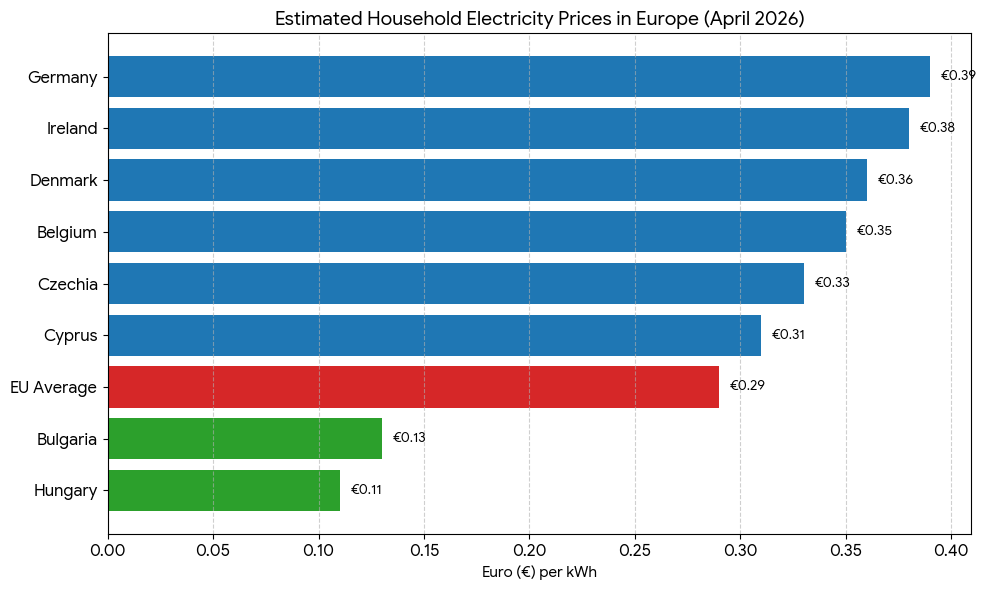
Denmark, Germany and Ireland are consistently the three most expensive countries in Europe for electricity.
no sh1t Sherlock.
I was referring to your post where you tried to put a poster down by telling him that they don’t generate electricity, when he clearly said they were required for to increase the SMSP
The three of us generally appear on the most expensive countries in Europe. And the highest. We are also an island with no AC interconnectors. And we said no to nuclear when it was cheap. …
Well **** Sherlock here`s another fact for you. The don`t generate electricity. They consume it.
For the Nth time.
To keep the lights on we can't reduce spending on renewables, interconnectors or storage etc. until there was a guaranteed date that nuclear could share some of the load.
And until it can deliver reliable power it's not worth having on the grid. None of the AP1000's built outside Asia or any of the EPR's have done three years in a row above 70-80% capacity factor. So the need for zero carbon backup would outweigh any emission savings.
The UK started this process in 2005. They have been doing nuclear power since the 1950's so they have a head start on us. The current long stop date for their first plant is 2036 , that's 31 years.
If your plan is to use other nukes to provide spinning reserve and backup , you first need those nukes. The US abandoned 50% of their reactors. The UK started this process in 2005, it will be a long, long time before they get a third reactor.
another one for the ignore list.
They provide inertia. They allow more RES onto the grid..