Yeah there was one in particular from some Alison person talking about how road deaths were "increasing exponentially" as if hi-viz was the only solution to that. I'd bet my money she has some sort of Range Rover or X5 parked in the driveway.
At 30km/h and assuming a 1 second reaction time a cyclist will travel 8.3m before brake application.
Assuming use of front and back on a dry surface with decent grip a braking distance of 5m be possible but for most cyclist it'll be somewhat longer and certainly longer in wet conditions.
13m is the absolute minimum distance bar you want to argue a shorter reaction time is appropriate; which I don't think it is in the circumstances here.
As an aside the Plaintiff here didn't want a finding against cyclist; assuming he was uninsured. Collecting off lay Defendants is what any legal team want to be doing.
Pure nonsense from Dublin Bus, they could have bought this off for the cost of joining the Third Party alone pre proceedings.
Insofar as I know they don't use barristers to run their cases, with solicitors office doing all the work including in the High Court.
That friction between a solicitor and a barrister has the advantage of countering group think
Idiot village more like.
If I'm approaching 3 buses parked up, I'm not slowing down 'more than 30m' before the stop, but I am waiting to react with my fingers on the brake levers (as is tradition cycling in traffic in Dublin). Not all cyclists will behave like that, but it isn't safe to make assumptions in either direction - the cyclist in this case could have been paying no attention and therefore even 10km/h was too fast, or he could have been watching like a hawk and he meant it when he said in his testimony that he had no time to react before impact and it wouldn't have made a difference if he was traveling at 10km/h.
If I was to always start slowing significantly 15m before any potential conflict in Dublin, again, there would be no point cycle commuting and I sincerely doubt there is anyone here who actually cycles that way in practice.
Yeah and she has no idea what the word 'exponentially' actually means.
I'd be all for this, but only if it was accompanied by a mandatory assumption in law that motor vehicles are responsible for all collisions, unless proven otherwise with dashcam or similar.
i'd probably do the same as you even if not turning right into northwood.
30km/h downhill on that path? i'd take the road. especially if i knew there could be bus passengers alighting.
Some pushback in the IT letters page today.
Debating safety and cyclists
Sir, – Mary O’Sullivan (Letters, January 21st) and Alison Fergusson (Letters, January 23rd) call for the mandatory donning of high-vis by vulnerable road users.
I wholeheartedly disagree with their position. Scolding individuals for how they dress will do very little to improve their safety. The evidence just does not support such a measure.
The biggest killer on our roads is excessive speed and distracted driving. There is inadequate enforcement of the existing rules of the road in this country. Sensible measures that would have reduced fatalities such as a 30kmh speed limit in urban areas and the introduction of static red light cameras, were rolled back in the past few months. It seems that any measure to improve road safety but which may inconvenience drivers cannot be considered.
We will not see a reduction in deaths until we accept that every road death is preventable and start enforcing our existing legislation and improve our inadequate public transport and active travel networks. – Yours, etc,
Dr JOHN LEGGE,
Sandycove,
Co Dublin.
Sir, – It seems that mandatory hi-vis clothing for pedestrians, cyclists and, even more bizarrely, motorcyclists is now firmly established as the latest road safety panacea on The Irish Times Letters page.
No doubt its popularity is at least partly because it imposes no responsibility or inconvenience whatsoever on car drivers.
If one does not look, one does not see. I frequently encounter this despite my motorcycle being as well lit up as any car, day or night. – Yours, etc,
EOIN KIRWAN,
Dublin 22.
Sir, – The call from Alison Fergusson (Letters, January 23rd) for mandatory high-visibility clothing for cyclists, pedestrians and e-scooters reflects a regrettable but all too familiar pattern in our public discourse on road safety, namely the displacement of responsibility from those operating high-powered vehicles to those who are most vulnerable on our roads.
The notion that ever more garish clothing will compensate for distracted driving is a convenient fiction. No amount of fluorescent fabric can counteract the motorist scrolling on their phone or the driver travelling too fast.
What is required is not legislation mandating luminous attire, but a credible commitment to roads policing. Only last year the Crowe Report found members of An Garda Síochána openly acknowledged that roads policing had not been treated with sufficient seriousness within the organisation.
Without systematic enforcement of existing laws on speeding, dangerous overtaking, drink driving and mobile phone use, no additional burden placed on vulnerable road users will achieve meaningful safety gains.
Perhaps a compulsory module placing learner drivers on a stationary bicycle while a van passes at 50kmh would communicate, far more effectively than any pamphlet, the acute vulnerability experienced daily by those who travel without the protection of a steel shell. – Yours, etc,
SOPHIE McDERMOTT,
Dalkey,
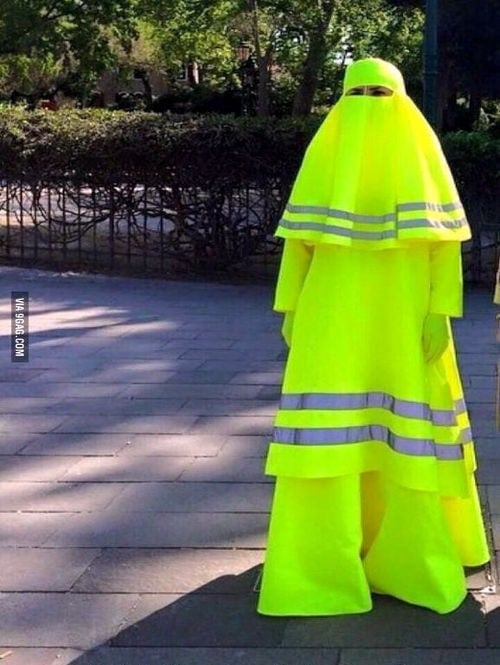
Is this the future? 😯😂
Missing helmet and ears are covered. That person is just asking for it.
Sure they've not even got any feckin lights 🙄
https://www.theguardian.com/world/2026/jan/25/amsterdam-prepares-to-ban-the-fatbikes-amid-rise-in-serious-accidents
They're preparing to ban them in certain city centre parks rather than the entire city, for people who don't read past the headline.
It is so clean! How do they wash it, 90°? and then steam iron it?
Whenever somebody uses that word they should be asked for the value of the exponent.
Tell me you loved math more than anyone else you know, without telling me, (BTW, I agree with you)
https://www.irishtimes.com/life-style/people/2026/01/26/cycling-helmets-and-high-vis-jackets-are-symptoms-of-an-irish-problem/
interesting to see a nod to a bunch of cyclists who even in coverage sympathetic to cycling, have been criticised:
Urban cycling is no longer the preserve of skinny men in Lycra, though, torchbearers, we thank you for your service.
The image used is very illustrative:
not about cycling specifically:
https://www.thejournal.ie/readme/ireland-road-safety-6933338-Jan2026/
though a (tiny) quibble:
At 50 km/h, a pedestrian has a 50% chance of survival, at 60 km/h, that chance drops to just 10%; at 80 km/h, 9 in 10 pedestrians will be killed.
that makes my brain itch.
A piece on Radio 1 this morning about cameras catching cars breaking lights of course led to talk of bikes, hi viz and helmets. Tiresome.
Id say just a mistype, this said I will be wheeling this out from now on every time someone says that cycle lanes and pedestrianisation are killing off towns and business:
https://assets.publishing.service.gov.uk/media/5a74ad3aed915d7ab83b5a59/value-of-cycling.pdf
It really is tiresome at this stage. Same old back and forth points being made. Same with cycle lanes.
I've no problem talking to anyone who is asking a genuine question rather than one laden with agendas. I don't need to convert everyone to my world view - if they see things a bit differently having heard a cyclists POV then great. If they don't, leave them off.
Why we can't just live and let live, why people can't see the benefit of active travel and why people can't recognise that if cyclists and pedestrians disappeared from the roads tomorrow motorists would still be stressed, raging at other road users and involved in fatal RTAs is all beyond me.
As an aside, I was listening to Sunday Miscellany on RTE Radio yesterday and was amused to hear an account from 1920s (I think it was) Dublin where the traditional horse and cart drivers were in dispute with the newly arrived commercial motor vehicle drivers who wouldn't allow right of way to the horse and carts. It was a nice reminder of the history of roads use. Amazingly enough, people have been walking, riding (careful now!) and cycling on roads for a lot longer than they have been driving cars on them. But anyway…
Why people can't recognise that if cyclists and pedestrians disappeared from the roads tomorrow motorists would still be stressed, raging at other road users and involved in fatal RTAs is all beyond me.
Amen 🙏
It requires basic self awareness and some common sense/critical thinking skills which the majority lack.
Should we introduce mandatory classes on motonormativity as part of the driving test and driving license renewal? It'd make more of a difference to road safety than any amount of hi-vis vests and lights.
https://ascelibrary.org/doi/10.1061/JTEPBS.TEENG-8805
Most recent research I'm aware of.
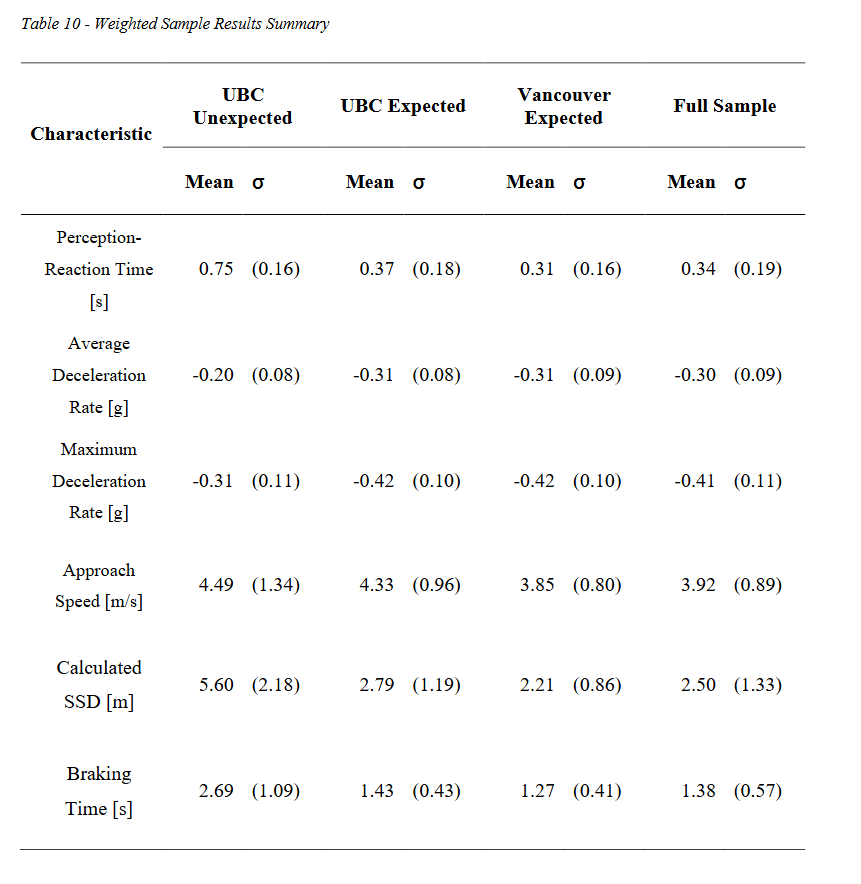
"The 85th percentile perception–reaction time for an unexpected hazard was 0.84 s, substantially shorter than in motor vehicle studies and design guidance, possibly due to heightened vigilance when riding a bicycle. In contrast, the 85th percentile deceleration rate was 0.20𝑔 (1.96 m/s2), smaller than some design guidance, possibly due to the risk and complexity of hard braking on a bicycle."
Applying the 0.84sec perception/reaction time and the 0.2g deceleration to the 30km/h cyclist.
Perception/reaction distance 7m
Braking distance 17.7m
Total distance 24.7m
A cyclist who knows what they are doing regarding front and back brake application and weight distribution will achieve very high deceleration rate; that's beyond most cyclist, certainly your regular urban commuter.
In contrast any d1psh1t in a car can just slam on the brakes and let 100 years of car technology do the heavy lifting.
The average and max deceleration rates were measured as 0.31g and 0.42g in the same study on expected braking.
The unexpected braking was on a controlled course where deception was used to make cyclists expect that they would not have to brake at all (which is different than unexpected braking where you expect you will have to brake at some point but are unaware of specific hazards).
The average approach speed was 16km/h, and the methodology doesn't make it clear in any way that greater deceleration was needed during the unexpected stopping test.
The research also found that lower perception time correlated with higher deceleration rates, and that this also had a positive correlation with cyclist speed during the test (those cycling faster, tended to react quicker, and brake harder).
Just reading an abstract on a small sample size study shouldn't be extrapolated into a general truth!
And then they should be decimated….
I'm not extrapolating anything; its a study by Transport engineers were the 85 percentile is a common metric.
String of posts came from this comment from you added below.
"but it's not going to require even 10m unless someone isn't even trying - potentially it could only take half that"
Even being kind and assuming you were only talking about braking distance; 5m braking would require a deceleration of circa 0.7g.
Given you included "attention" its clear you were including perception/reaction in your 5m.
That figure is wildly inaccurate for an average cyclist decelerating from 30km/h.
Lad, it's clear you are and it's also clear you didn't even read the report, just the abstract. It was a PhD thesis from a Master's student in Canada, not a "study by Transport engineers". It was later published in a journal, but it remains a PhD thesis from a Master's student, not a "study by Transport engineers".
There's also no such thing as an average cyclist (commuter? recreational cyclist? fitness cyclist? frequency of cycling? time of day? type of traffic? type of bike? type of brakes? and endless variables), and even if there were, there's nothing to suggest that regular commuters in Dublin are 'average' cyclists from a small sample size in another country.
You're also skewing or deliberately misinterpreting what I previously posted.
To avoid dragging the thread into a pointless back and forward, I'll just repeat this part with a small addition:
Just reading an abstract on a small sample size study shouldn't be extrapolated into a general truth, particularly when it's in a case where a Judge accepted that the cyclist's behaviour had no attribution in determining fault and compensation.
A very reactionary comment