It’s 16kWh.
About 150KG!
I think some of the Fogstar stuff is due in this week, I ordered a couple of 280Ah cells for one of my Seplos and Victoria said they should be in by the 15th, not sure about the bigger stuff, mail them?
Got an email from fogstar asking if I want to hold off on the order to the end of February and get an updated V4 with fire suppression.
In two minds
Depending on cell size, about 140kg.
Don't bother. LFP cells don't combust. FS is a gimmick
Yeah, already decided to get it asap, it'll be in detached garage so not too worried about fire. I wonder if theyve had a run with their black Friday deal and trying to push some orders out
The Dyness 5kw x 2 batteries on my new solar installation do not charge overnight on the cheaper rate as some nights are too cold. Only found this out from installer after the installation, tells me there is an update due on them to remedy this? Are all batteries the same?
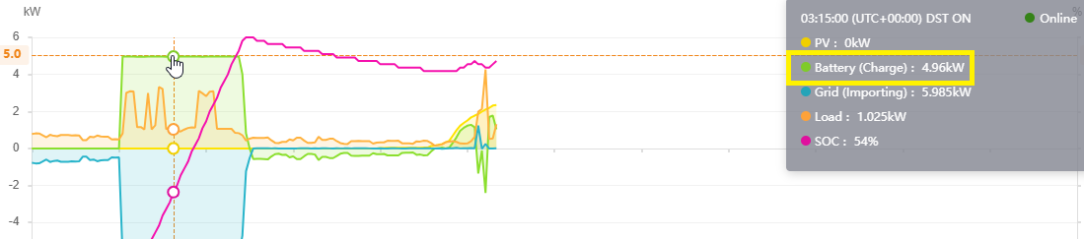
My fogstar 16kwh Battery is located in my utility room for this very reason , Last night was freezing . I have a 3hr EV Window with Pinergy and 14kwh is added to my battery in less than 3hrs at a rate of 4.96kwh per hour !
You can remedy this with a minor level of effort, some PIR insulation if outside…
No issues charging if in the attic. Perhaps slightly slower on very cold nights, but hardly noticeable.
Have connected my battery and everything working well except I can’t see data in the solis app. It was there when I first connected the battery but once I did a user defined battery (battery name not in the list) I lost it. Has been gone for 24 hours now.
Fogstar seem to only be about €200 cheaper on the 16kWh DIY kit than the prebuilt. What do I need to beg, steal or borrow to setup the DIY kit? I'll need a torque wrench (or some way to check I'm not overtightening the cells).
And some power supply to 'Top Balance: Charge Slowly to 3.65V – Use a constant voltage power supply with a low current (≤10A). What sort of cost is that and where would I get it?
Anything else bar usual spanners and screwdrivers?
Can't find the info on their site. Ta
lads i got solar installed about 18 months ago. Happy with it, but only got 5kwh of batteries. How easy is it to add battery capacity? is it just plug & play? How much am i expecting to pay for another 5kwh of battery (new or a couple of years old)?
Have a SOLIS inverter if it makes any difference.
solis?
sorry yes. SOLIS. Typo. corrected now.
Depends on how well your torque calibrated arm is. Done all mine by feel, hand tight and a quarter turn.., (with lots of previous calibration of when rightly tightly becomes righty loosey)
Tool choice is key, you don't want to be using much more than a 1/4" rachet,
Multi meter, grab the uni-t one from AliExpress.
With the kits all having active balancers even just a good float charge at the start is enough to balance them out.
Nkon also do prebuilts too.
What way / device does a 'good float charge'?
The inverter itself. Usually in voltage mode but can be done in the normal communication mode too depending on bms
Just to close this out my baud rate was wrong, solis support gave me the correct figure to use and the app came back online a few mins later. Have to say for €1400 including delivery the 16kwh deligreen is very good.
The data logger communicates over rs485. Possibly during the user defined the baud rate for the serial connection was changed inadvertently.
It seems to be often confused with the battery communication.
Baud rate for other coming across this is 9600 I think
folks where do i best start to understand battery installation, equipment required, connection types etc?
we have an a3 house with an EV and heatpump, solar is on the list but not just yet, but if i could move most of our usage to night rate electricity it would help and probably save 800-1000 annually.
Does the invertor need to be connected to the main fuseboard for example? i have a shed with its own fuseboard run from the mains but assume i cant have the battery out there?
The inverter could be in the shed, if the power cable to the shed is big enough.
Ideally also some cat6 cable from the shed to the consumer unit/meter box for the CT for the inverter, so it can read the grid import/export.
Does that 800-1000 saving take into account 18%-20% losses between battery charging and discharging?
You can put a battery wherever you want, usually within 2m of inverter
Batteries in your shed: It depends a little on how the shed is connected back to the main consumer board in your house. There's a couple of factors such as length of the cable run, but the main thing is the guage (thickness) of the cable use to connect to your shed as that will determine the amount of current allowable on the cable. More current requires a thicker cable - as they heat up when you pass a large current on the wire. Your typical 2.5 sq mm cable is good for about 20-25 amps, which at 220v would see you being able to charge/discharge a battery at 4-5kw. Should be ok, but a heavier 4 sqmm would be better if you have that.
If you have a 1.5 sqmm cable on the other hand, that wouldn't be enough as while it would be fine for a 13amp socket and a few bulbs, a battery would be too demanding for it. Still not hard to get a spark to install a heavier cable.
Cable Size & Current Rating Chart
Note: It's only a rough guide.
thanks folks, so basically shed can house the invertor and battery (ies) if the wiring to the shed isnt of the correct gauge that can be remedied.
Larger gauge cable is more efficient too. I went with 6mm^2 for the shed when I had plans to put an inverter in there.
I'm approaching completion of a DIY PV install, so its non grant. I have a REC lined up to do commissioning when complete. Solis 5kW hybrid inverter with 16kW of battery. I'm mainly waiting on the SemplosV4 to top balance, its taking ages as I only have a 5A PSU. To save waiting I'm thinking of asking the REC to commission without the battery. We have detailed in the NC6 which has been approved that there will be a battery. If we do this, is there any extra certification that needs to be submitted just for the addition of the battery?
No, Theres nothing extra. You could still just connect the battery to the inverter and have that top balance it.
Thanks. Yes I was thinking of powering the system and using that top balance, but I've decided to follow Fogstar's recommendation to parallel the cells and charge at less than 10A with a CV of 3.65V. I'll just have to be patient.