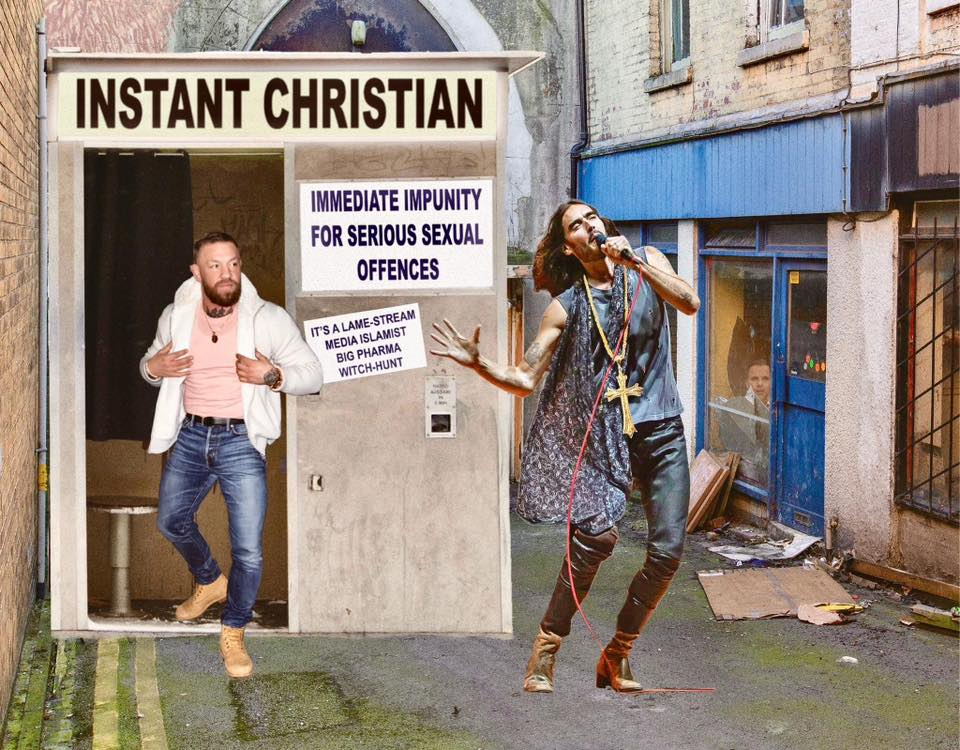
In the latest "Celebrity in trouble over sexual and other misdeeds, needs a career redemption fast" move, Conor McGregor has found god:
Funny article in the Irish Times:
https://archive.ph/djBmi
(both taken from the McG thread)
So, I heard on the radio something about a survey being run by Aontu to move towards more 'multidenominational' schools in Ireland. I think it's this: https://www.rte.ie/news/education/2025/1104/1541998-primary-school-ethos-survey/ , however, I don't see Aontu mentioned in the article. Having Aontu do anything related to legislation ahd religion, is basically asking the fox to census the henhouse, they're just running-dog lackeys of the RCC.
Is Aontu running this survey? It seems like there'd be some opportunity to reduce indoctrination in schools, but as always in Ireland, there'll be a report and who knows if anything will happen.
From the report, it seems clear that the survey is being run by, and for, the Department of Education. It has been welcomed by Educate Together and by ETB Ireland; I think if they had any concerns about either the people or the motivation behind the survey I think they'd be raising them.
I don't know anything about a survey being run by or for Aontú. If there is one, I don't think this is it.
Looking forward to the outcome from this one. My guess, rather cynically perhaps, is that it will show bigger demand for multi-denominational education across the board, but not enough for any given school to actually change. It would be great to see multi-demoninational educational school places available in rough proportion to the demand out there, both for primary and secondary. Interested to hear that 90% of our primary schools are already co-ed which I'm entirely in favour of.
I think you put your finger on the problem here. The Catholic church is grossly over-represented as a school patron, relative to the wishes of parent, but it's still a more popular patronage choice than any other. Thus, at the level of the individual school, there are very few Catholic primary schools where the number of parents wanting (say) ET patronage exceeds the number preferring to retain Catholic patronage. I think that's the rock on which previous moves to reduce the number of Catholic-patronised schools foundered.
The RTE story linked above mentions factors like "misinformation . . . claims that they would no longer be able to celebrate occasions such as Christmas or Easter or use Irish greetings such as 'Dia Dhuit’" as being at least partly responsible. In a perverse kind of way, this is somewhat encouraging. Ten or fifteen years ago, schools stayed in Catholic patronage because it was the most popular choice; now, those wanting schools to remain in Catholic patronage, have to try and shore up their situation by aggressively promoting Trumpy lies like this. I get the impression they'e on the run. As support for Catholic patronage gets weaker and weaker, there may be more and more schools where a majority of parents will seek a switch to other patronage models.
Or, maybe we shouldn't wait for that, or rely on it. if you take the view that the patronage of each school should be determined by the patronage most popular with the parents, the patronage that is most popular nationally will always be grossly overreprsented. It's the first-past-the-post problem, basically.
The only way round this may be to group schools into districts and say right, the school patronages here are going to be distributed according to parental preference in the district as a whole, so if 40% of the parents prefer Catholic patronage then about 40% of the schools will have Catholic patronage. And, to acheive this, we are going to give some schools new patronage models, even if that's not the preferred model of the parents whose children go to those particular schools.
(I should add; I think the problem here is well-understood in the Dept of Education. I suspect, or perhaps I just hope, that the reason they are conducting this survey is to get data for a new approach to partronage change that can get around the barriers presented by dealing individually with each school.)
While this would seem like the fair and logical way of working, it is pretty much the same idea as the existing divestment approach which has failed utterly. I'm not sure the political will exists to do much more than give this cursory lip service while preferring to kick the ball down the road for another decade or so. Change will happen when politicians feel their chances of staying in power are compromised by failing to act on this issue. While we're much closer than any time in the past, I'm not sure we're quite there yet.
@smacl it's not the same as the current divestment approach - well, at least, what @Peregrinus is talking about is not.
e.g. Remember the "divestment" exercise a few years back in the Malahide area (the one with no Christmas, no uniforms, no school outings(!) and no grandparents allowed in the school(!) if they dared change, according to the FUD the teachers shamelessly distributed to the kids to bring home, and parroted in public meetings) ?
There were 8 RC primary schools in the Malahide area, with easily enough demand in the area to fill one ET and possibly two.
Result - no change - because no individual school could secure a majority for change. First past the post system.
Proposed district led approach - patronage in proportion to demand - at least one school changes, even if there is no majority in that specific school. This is proportional representation…
But the whole notion that you can only have your constitutional and human rights respected if enough of your neighbours agree, really needs to be binned once and for all.
Also this process is, like Malahide, still wide open to FUD campaigns from the RCC and god-bothering principals. Meanwhile parents who've never had their kids attend an ET know little or nothing about them.
P.S. - there is a school patronage thread, this is kinda a funnies thread
@Hotblack Desiato I'll believe once I see a significant number of schools, i.e. the number in proportion to the demand, change patronage as a results of this. I'm not holding my breath just yet.
Politicians want the least amount of change they can possibly get away with. So that (if anything at all) is what we will get.
As usual, follow the money.
A self-styled mystic who drew hundreds of pilgrims to a town near Rome by claiming a statue of the Virgin Mary wept tears of blood has been sent to trial for alleged fraud.Gisella Cardia, who also claimed the statue was transmitting messages to her, will be tried along with her husband, Gianni Cardia, in April next year.They are accused of staging fake apparitions of the Virgin Mary and making false predictions of catastrophes to attract donations from their Catholic followers.Cardia drew hundreds of people each month to Trevignano Romano, a lakeside town near Rome, to pray before the statue, which had been placed in a makeshift shrine on a hill. Over several years, the alleged scam generated €365,000 (£322,000) in donations from the pilgrims, who believed their money would go towards setting up a centre for sick children.
A self-styled mystic who drew hundreds of pilgrims to a town near Rome by claiming a statue of the Virgin Mary wept tears of blood has been sent to trial for alleged fraud.
Gisella Cardia, who also claimed the statue was transmitting messages to her, will be tried along with her husband, Gianni Cardia, in April next year.
They are accused of staging fake apparitions of the Virgin Mary and making false predictions of catastrophes to attract donations from their Catholic followers.
Cardia drew hundreds of people each month to Trevignano Romano, a lakeside town near Rome, to pray before the statue, which had been placed in a makeshift shrine on a hill. Over several years, the alleged scam generated €365,000 (£322,000) in donations from the pilgrims, who believed their money would go towards setting up a centre for sick children.
The late Pope Francis cautioned in 2023 that apparitions of Mary “are not always real”.
The insufferable Peadar Toibin's latest would-be publicity stunt / culture casus belli is whinging that Dublin City Council's Winter Lights, which have been around since 2018 and were never called Christmas Lights, aren't called Christmas Lights.
(These aren't the city centre street Christmas Lights which are, and have always been called, Christmas Lights. They're in addition to those lights)
Michael Nugent and John Hamill discuss on Newstalk - linked in below article
While I enjoy a bit of pedantry as much as the next person, is this argument really worth the hot air expended on either side?
Has that ever stopped Toibib?
gotta meet that word count somehow
😄
Belief in witchcraft is also so deeply ingrained in Sierra Leone, even among many police officers, that there is often a fear of pursuing cases further - and most go unsolved.
On a second visit, Kanu became more confident and showed Osman what he said was evidence of his trade - a human skull."You see this? This belongs to someone. I dried it for them. It is a woman's skull. I am expecting the person to pick this up today or tomorrow."He also pointed to a pit behind his shrine: "This is where we hang human parts. We slaughter here, and the blood goes down there… Even big chiefs, when they want power, come here. I give them what they want."When Osman specified that he wanted limbs from a woman to be used in a ritual, Kanu got down to business: "The price of a woman is 70m leones [£2,500; $3,000]."
On a second visit, Kanu became more confident and showed Osman what he said was evidence of his trade - a human skull.
"You see this? This belongs to someone. I dried it for them. It is a woman's skull. I am expecting the person to pick this up today or tomorrow."
He also pointed to a pit behind his shrine: "This is where we hang human parts. We slaughter here, and the blood goes down there… Even big chiefs, when they want power, come here. I give them what they want."
When Osman specified that he wanted limbs from a woman to be used in a ritual, Kanu got down to business: "The price of a woman is 70m leones [£2,500; $3,000]."
Way to go, Germany. Need this in Ireland, too:
https://www.dw.com/en/germanys-empty-churches-repurposed-as-congregations-shrink/a-75227388
Happening here as well. The church is was christened in was deconsecrated not so long ago. Happened to the Church of Ireland a lot sooner
https://www.rte.ie/archives/2018/1217/1017648-what-to-do-with-empty-churches/
Not fast enough nor that widespread.
Well, we can't get everything we want, can we? Besides, the funding model is different in Germany. a reduction in people who say they are Catholic has a direct affect on church finances.
She's wrecked her last artwork.
"The fight over Christian nationalism in a small Tennessee town"
They are self-described "Christian nationalists" who question modern values, such as whether female suffrage and the civil rights movement were good ideas, and call for mass deportations of legal immigrants far in excess of President Donald Trump's current plan. Another thing they sometimes say: "Repeal the 20th Century."Mr Isker and Mr Engel announced their move to Gainesboro last year on their podcast Contra Mundum - Latin for "against the world".On their show, which is now recorded in a studio within Ridgerunner's Gainesboro office, they have encouraged their fans to move into small communities, seek local influence, and join them in their fight to put strict conservative Christian values at the heart of American governance."If you could build places where you can take political power," Mr Isker said on one episode, "which might mean sitting on the [board of] county commissioners, or even having the ear of the county commissioners and sheriff… being able to do those things is extremely, extremely valuable."
They are self-described "Christian nationalists" who question modern values, such as whether female suffrage and the civil rights movement were good ideas, and call for mass deportations of legal immigrants far in excess of President Donald Trump's current plan. Another thing they sometimes say: "Repeal the 20th Century."
Mr Isker and Mr Engel announced their move to Gainesboro last year on their podcast Contra Mundum - Latin for "against the world".
On their show, which is now recorded in a studio within Ridgerunner's Gainesboro office, they have encouraged their fans to move into small communities, seek local influence, and join them in their fight to put strict conservative Christian values at the heart of American governance.
"If you could build places where you can take political power," Mr Isker said on one episode, "which might mean sitting on the [board of] county commissioners, or even having the ear of the county commissioners and sheriff… being able to do those things is extremely, extremely valuable."
Nothing new in cult-like movements trying to take over local politics though…
In 1984, 751 people suffered food poisoning in The Dalles, Oregon, United States, due to the deliberate contamination of salad bars at ten local restaurants with Salmonella. A group of prominent followers of Rajneesh (also known as Osho) led by Ma Anand Sheela had hoped to incapacitate the voting population of the city so that their own candidates would win the 1984 Wasco County elections.[2] The incident was the first and largest bioterrorist attack in U.S. history.[3][4]
Sure but there seems to be quite a bit of inertia (a period of years) between people stopping attending services regularly and actually bothering to deregister themselves for church tax - and some never do.
Here, if you don't attend you're not putting money on the plate so the income loss is immediate.
The CoI has been deconsecrating churches for decades - in Dublin they have become apartments, offices, at least one pub, and one a mosque.
RCC in Ireland appears to be very slow and reluctant to deconsecrate any churches, but this is going to have to change sooner or later.
Traditionally, the CofI model has been that, as long as the local community can find the resources to keep a church building standing, and safe, they will maintain it as an active church, even if a service is celebrated there only one every three months (or less frequently). As a result there are still a large number of rarely-used but still technicallly active CofI churches in rural Ireland. In many cases the desire to keep a church technically active is underpinned by the fact that the churchyard is still an active burial ground, or at least holds graves that are significant to local families.
I suspect the Catholic policy will be similar. Parishes will be merged, with one church becoming the regular parish church and other churches uses only occasionally.
I often think the Irish Times is trolling us with articles like this written by bishops and priests.
Back in the day when I was young – in the 1970s and ′80s – there was basically no homelessness in Dublin. Those were the days of the “bad old Catholic Ireland”, which, despite my pretty good memory, I cannot for the life of me recall. I don’t think I am alone on that score.
There was less (but not no) homelessness because there was so much emigration and abandoned property to squat in, and housing standards for council and private rentals were abysmally low. But perhaps the main reason was that those who didn't quite "fit in" in society was liable to be forcibly institutionalised - the laundries and mental hospitals saw to that.
He can't recall bad old Catholic Ireland because he was a young religiously devout celibate seminarian and then priest. He never had to experience it affecting his life in any adverse way. The whole country was set up to pander precisely to him. He wasn't wondering how to provide for yet another child in a country where contraception was difficult or impossible to obtain. He wasn't a victim of sexual abuse sworn to silence. He wasn't a teacher dismissed from his job for writing a literary work dismisssed as a 'dirty book'. He wasn't any of the many other people victimised by the excessive, unaccountable power of the church.
There is a dynamic and reciprocal relationship between faith and charity. As faith increases, so too does charity. Likewise, as charity grows, so also does faith. On the other hand, a lessening in either of these theological virtues ensures a diminution in the other.
If that's the case we might conclude the orders and dioceses here with their vast assets (often, ironically, property lying idle) must have little enough faith indeed. Has he never heard of a secular charity, of which there are many?
It's just bizarre that the taxpayer is stumping up for this not the church.
The Bishop of Galway, Michael Duignan – through a spokesperson – said the current situation was “unsatisfactory” but the Diocese has always prioritised this important ministry, and it was committed to supporting the return of a 24-hour chaplaincy service at UHG.
Doesn't prioritise it enough to pay for it though.
Ironically because the taxpayer is paying, the Organisation of Working Time Act applies so they had to cut the rostered hours.
I presume they are not paying for similar for any other denomination or faith, it's special privileges for members of one denomination only.
The taxpayer and the State should have no role whatsoever in funding the religious practices of anyone.
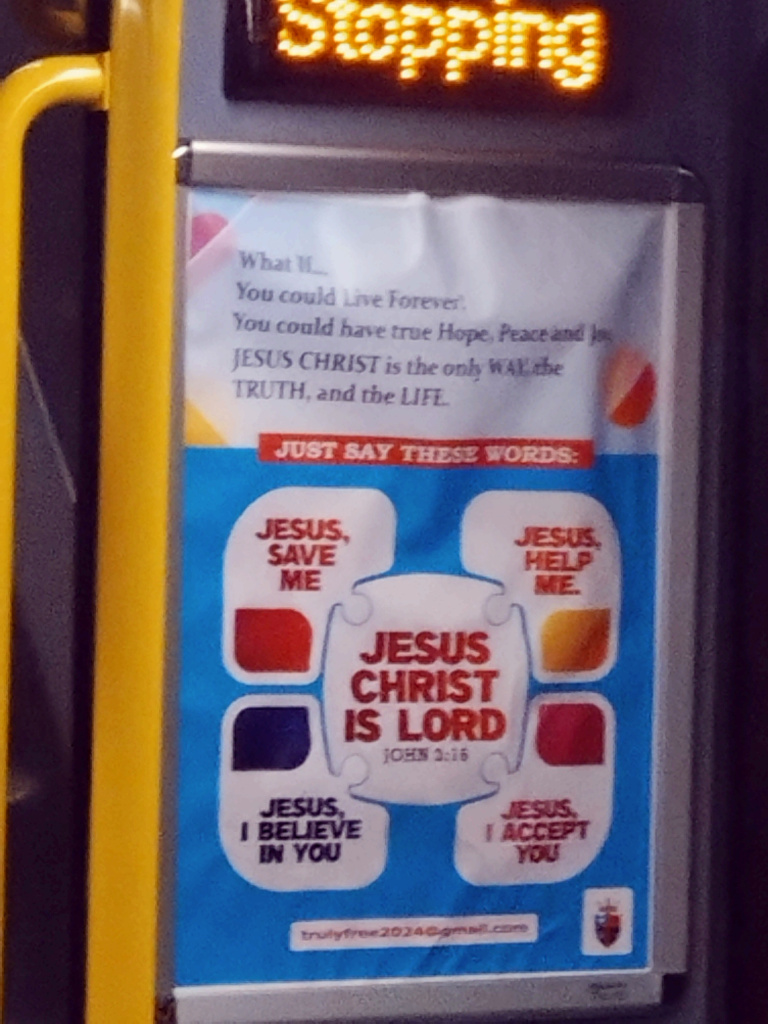
It's an awful shame Dublin Bus is allowing advertisers that spout this crap.
Does the denomination with the most money "win" ?
Well it looks like another religious despot who should never have been let run a sweetshop, never mind a country, has discovered whether his beliefs were true or not.
Family flowers only, house private.
And here they go again, our spoof presidential would-be candidate (who made no real effort to get nominated, but continues to moan endlessly about how unfair everything is) is now complaining we're not all collectively down on our knees given the day that's in it:
Teh gheys! Oh no!
People having a good time! Oh no!
Etc.
But this takes the biscuit:
There are those who would rather see us return to a superstitious, uneducated pre-Christian era of Druids and magic, rather than the science, logic and scholarship of Christianity, with its sophisticated and systematic philosophy and theology.
Absolutely zero self-awareness, as ever…
Does she fit the definition of 'gowl?'
What a laughable, un-self-aware (as you pointed out) editorial. I suppose the IT needs to fill its web pages.
Had it not been for a patriotism that was often intertwined with a fervent Catholic identity, we might never have broken away.
That is deeply sectarian and historically inaccurate.