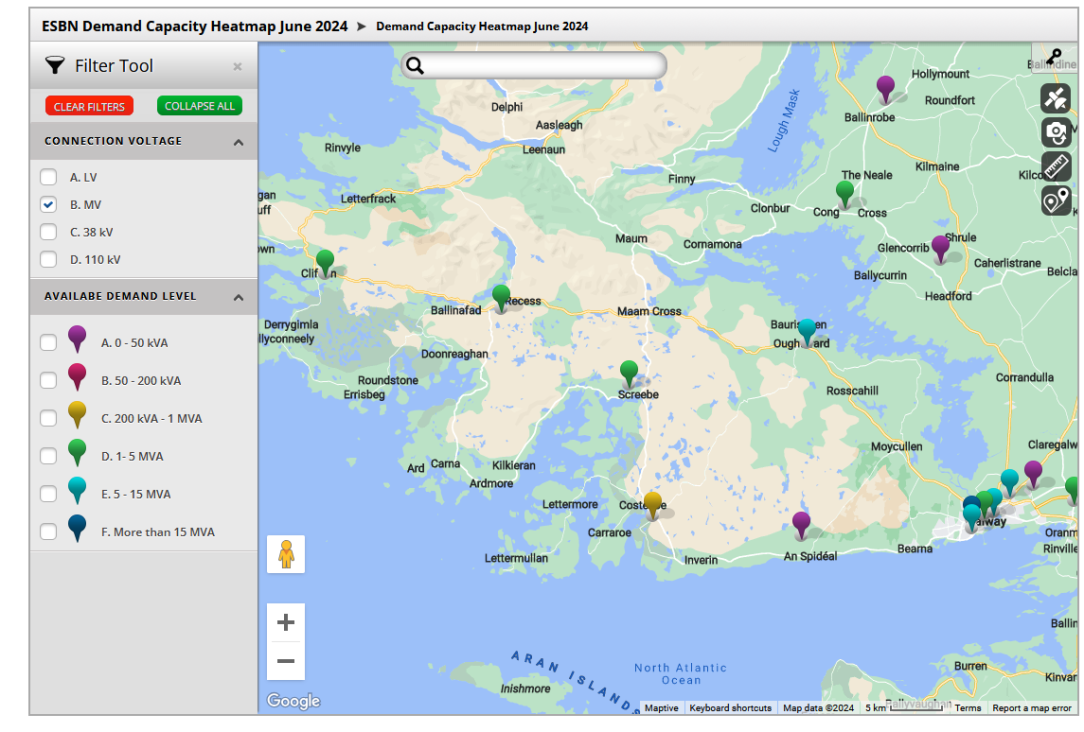
nice answer, there is one in Oughterard but seems sparse enough alright
There's also a question of need, it's likely the vast majority of people looking to charge would be passing through
I'm not a fan of gambling but I'm willing to bet there aren't many apartments in rural Connemara 😜
So most of the locals can charge at home
The distance between Galway and Clifden is ~90km, so there's definitely an opportunity for a charging hub somewhere along there. Close to Maam Cross or Oughterard would probably be the ideal locations
"...Modern EVs can typically go 300km+ between charges.."
Planning should account that not everyone has a new EV or one with a large battery, and also may not start with a full battery and also consider winter ranges. I've been surprised at the increasing number of EV owners without home chargers.
just on the "need" and "passing through"
Is this not what a lot of EV chargers are used for in the first place?
Some locals without home chargers will use the nearest charger, I assume preferring a cheaper AC over a DC but not always. So not always passing through.
But a charger on a main route (especially a tourist one) might have more passing traffic.
I assume the operator can tell from the stats
There's generally two use cases for DC chargers
People passing through, the en route charging scenario
People who don't have a home charger, the neighbourhood charger scenario
In the second case you'd want the chargers to be as close to amenities like shops as possible, so you can combine charging with some other purpose
In the first you'd want the chargers as close as possible to the main routes with some conveniences like bathrooms and fast food nearby
I guess with a tourist hotspot like Connemara you could combine the two, like put a hub in Oughterard so people touring the west can grab lunch and charge without being stuck with petrol station food (ugh 🤢)
As I recall there isn't much around Maam Cross. So while it's convenient being on a fairly major crossroads, you wouldn't exactly be eager to hang around
Do Circle K have an EV charging app?
Had a poke around but could not find one, may need to use it at weekend so just prepping.
I don't think so
I think it's part of their main loyalty store app. I haven't signed to to it.
They take card anyway.
Nope, credit/debit cards only
I think it's a €25 block on a debit card to start the charger.
Select the charger, tap card and when the payment goes through the plug unlocks and you can plug in
You need to tap your card again to unlock the screen, stops passers by from stopping your charging session
It was very straightforward when I used it
The loyalty app has a map of chargers. Dunno if there's any discounts if you sign up. I won't bother, as I'm only ever going to use one very rarely, so card payment is perfect.
The business case would be iffy even if there was sufficient power. Half of Connemara shuts down for 6 months during the dark months. Many locals go back to the states and UK during this period.
Locals who do hang around and have EV's would likely charge at home (there's no reason why they wouldn't have a home charger etc.) while at the same time tourism is at a trickle. It's feasible that a HPC along that route could go weeks without custom during the dark months.
Theres been a couple of posters who claim to be doing very long journeys in the vicinity (out west) either for work or family once or twice a week. But I think it's useful to hear the variety of types of journeys people do regularly. I imagine there's quite a few travelling home at weekends, where there no destination charger and needing a quick turnaround, or top-up on route.
You'd think the operators could see the demand and if it's growing along certain routes enough to forcast future demand.
Out west is a very big area. If heading to Mayo there's chargers along the way and with the route to Westport included in the latest Zevi grant scheme that part of the west will be covered by the end of 2025. However the business case of having a HPC in the middle of Connemara is questionable. Perhaps the route will be included in a future Zevi grant scheme, I don't know I don't have any insight, but that is probably the only way the area will get a HPC in the next 5 years. Any fast charger installed now will not make back capex cost before it needs replacing.
Most people traveling home at the weekend would stay at least a couple of hours and a granny charge would likely give them enough to get back to civilization and a DC charger. There will be some edge cases, but given the low EV ownership in the country, I can't imagine there's the business case yet for a HPC in that area.
This is actually a situation where a battery backed charging hub would work very well
You could fit a lot of power into a relatively small grid connection
During the summer months you've enough power stored up to cater to the tourists, then in winter you generate passive income by storing up night rate electricity then selling it back to the grid
Couple it with a solar canopy or nearby ground mounted array and it'd be a nice setup and income generator
This is a possiblity. It would be interesting to see if the numbers stacked up. Location would be key of course.
I was reading the TII document for the latest grant scheme. Interestingly battery technology was mentioned. 200kVa is the minimum requirement and it a bank of battery's are to be installed they could not be used to supplement a lower connection. Presuming a future ZEVI scheme was to include the N59 then the requirements would like be similar.
I haven't looked at the ESB link above regarding available power but 200kVA would need to be available nearby to keep costs to a minimum. 200kVA would get you two 150kW chargers or one 300kW. Not huge but a 2 or 3 of those pools of chargers between Westport and Galway would likely do the trick in the future when demand increases.
https://www.boards.ie/discussion/comment/122757894#Comment_122757894Consider not just to providing for current EVs but encouraging the take up of EV for future demand.
I'm not sure why your so concerned about the viability. Even a charger running at a net loss had other benefits. This is always going to be the case when providing infrastructure in rural areas. You made me think about profitability. I found this...
"... Forecasting the profitability and cash flows Due to low variable costs the active use of station services is the key to profitability. We notice that the most important factor of charging station success is committed customer who visits the station constantly.
This can be achieved by providing the customers a service that serves their needs (right plug, acceptable duration of charging) where they prefer (shopping centre, parking house) rather than trying to minimise the investment costs or imitate the gas station infrastructure.
Table 2 illustrates that to run a single quick charging station profitably doesn’t necessarily require high EV rates, but rather a handful of dedicated customers. The break-even number is roughly 2500 full charges (20 kWh) per year, which means less than seven customer visits per day. Seven daily visits means either 21 customers visiting every three days or less than four customers visiting twice a day..."
https://www.researchgate.net/publication/318306674_The_business_case_of_electric_vehicle_quick_charging_-_no_more_chicken_or_egg_problem
Separately...
While I understand the policy is to install high speed charges. I wonder if public AC chargers are easier to implement in rural or remote areas and villages.
I'm not personally concerned about the viability but any private, commercial company must be. They won't remain in business very long if they don't. I agree that there are valuable intangibles to installing there, but only for a state owned network provider.
CPO's are in it to make money. If the business case stacked up they would do it.
It's highly unlikely local residents in Connemara would use the HPC regularly. The vast majority would have their own charger at home. It's not like in Dublin where HPC's have a steady stream of taxis and couriers charging up. That same clientele does not exist in rural Ireland.
If the state wants a pool of HPC chargers in Clifden or wherever they are going to have to pony up.
Even for a commercial company if you get people used to your chargers, get them on a loyalty card, discounted rate, consistent interference and reliable theres a good chance of becoming the preferred network for that customer.
If the state provide a similar deal as they do through ZEVI to potential CPO's along the N59 then 2 or 3 charging pools would appear I have no doubt. 50 or 60kW units in the likes of Roundstone, Louisburgh would cover off a lot of the demand in the future. The only issue is the winter when tourism dries up...the installation of these units would need subsidies to make them attractive to potential CPO's.
I think it's a bit early with EVs a tiny % of cars on the road to utterly dismiss the idea that more rural and remote locations won't eventually get better charging infrastructure structure.
I can't see the ONLY demand being from tourists.
I'm not saying charging infrastructure will not exist in the future in these locations, it's just at this moment in time I think it's unrealistic to expect private organisations to invest in chargers in locations which haven't a hope of making money.
I will be shocked if at the turn of the decade the N59 is not served by a number of HPC's along with 50 or 60kW chargers located outside libraries etc. I bet my bottom dollar the state will have subsidised the installation.
The charging operators can only really get data from the sites they already have, which is difficult to interpret at best
For example if the charger at Clifden is always busy then that tells you there's demand in Clifden but it might be met by the current charger already
The people who have the data needed are the car manufacturers and probably the likes of Google
No doubt the CPOs are trying to plug into that analytics data to plan their network. If for example there's a bunch of Google searches for "EV chargers near me" from around Louisburgh in Mayo then that's an indication there's unmet demand in the area
Well that's why the ZEVI scheme exists in the first place, to ensure there's chargers in areas there is need but not the business justification. I assume they have some priority order they're working off so we'll just have to see what areas are included in the next phase
While I'm all for public AC the question is who will use them. Locals can probably access home chargers, and tourists would be looking for a quick charge passing through or an overnight charge at their accomodation, so not much use for on street chargers
90% of EV charging occurs at home according to the ESB. The other 10% - in places like Connemara - would mainly come from visitors who in the majority of cases would be Irish residents taking their EV on their holliers out west. Many of these visitors will in the future charge at the place they are staying and I'm sure some do already, again driving down demand for public chargers.
Now, if you plan on doing a day trip then the need for a HPC might become necessary but again given many EV's are capable of 400pppkm the need might not be all that great.
What % of EVs on the road can do 400km. Kinda ignoring all the older and small battery EVs with that.
From personal experience 95% of my driving is from the home charger. But on the few occasions I've been on a long trip a public AC charger for a top up on a day trip has been useful to me now and then.
Even at home I'll often top up for 30-50 mins because the car is just sitting there and its useful to shorten my charging time later, or handy in case of unexpected journey. But perhaps that's a small battery older EV habit.
I just think let's not ignore cheap and cheerful because we can't get high speed.