Wow thanks for reply very indepth
Just for clarity
There is was a valve removed from downstairs (conveniently installed at the back of a kitchen press ) and the other one upstairs in the hot press.
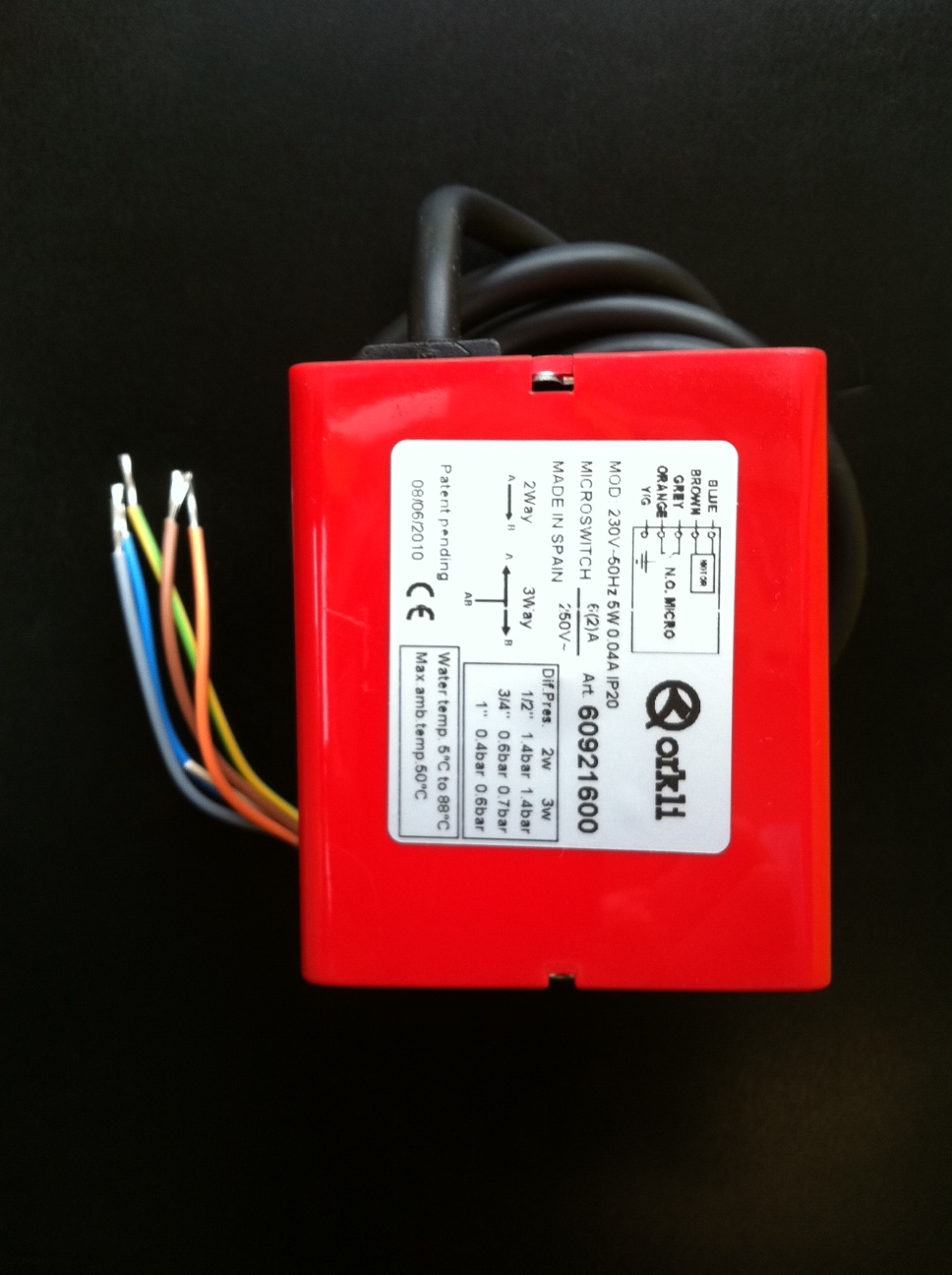
The valve is orkli mod zv-2v - 3/4"
We have two thermostats one in hallway and one on landing
I don't know does either of those points add or takeaway from the advice given.
Slightly. It looks like a single timer CH, sent to both stats, which individually opened and closed their respective valves, so you did have two temperature CH zones. If the valve relays weren't used to instruct the boiler to fire, then the HW timer output in gravity mode was, meaning the boiler would cycle or 'tick over firing and heating HW only, until one or both valves opened. Youd have to inspect wiring from the remaining valve to whatever wiring box it goes to, to see if the original system implemented s-plan valve relay firing, using the grey and orange wires. I'll look up that valve. The plumber could just have manually turned the valve external lever opened and clicked it in plac, permanently open. Maybe it's badly blocked inside. Have a look at the removed one. Turn the manual handle and look/blow through it. You won't die.
This one has the valve relay, and gre and orange wire. Whither they were used or not, you'll have to see.
Ok this home press , where upstairs valve was connected
Wrapped in blue insulation and it's running to the grey box
Dogs Dinner, but you'll find that the SLs from the stats are routed to the valves, and the valves' relays grey and orange are routed back, live connected to usually the orange, with relays' SLs coming back on the greys, which are combined, usually with the SL from the HW timer,( directly or via a HW cylinder stat). Thus all three sources can independently call the boiler, keeping the source SLs from the wall stats isolated from each other.
Hi Guys,
Planning to replace my current EPH R37 thermostat with the Drayton wiser 3. Just want to make sure I have this correct.
Current wiring
Drayton wiring
Is this correct?
swap the 2 live and 2 neutral wires
3 (hot water) to 2
5 (ch1) to 1
7 (ch2) to 3.
(And then the earth wire )
Spot on. EPH 3, 5 and 7 go to Wiser 2, 1 and 3. It helps to label them with a permanent marker or a bit of tape in case the brown wires get mixed up when you pull off the EPH backplate. Note the order of L and N is reversed on the Wiser, it's N and L from the left, this is important. Knock off power to EPH and Boiler. Earths are all tied in the metal wall base box as far as I can see.
Hoping someone has a smart solution for my current issue. Oil boiler controlled via a three channel EPH controller, one channel each for water, downstairs zone and upstairs zone. Every plumber that has ever come into our house has said the first day plumbing is weird. The Crux of our issue is that the boiler will continue to heat the water in the tank during it's scheduled 'on' time no matter what. For example, if the immersion is on and the boiler is scheduled to come on, the boiler will heat the water to an excessive temperature. I've asked plumbers about putting in a thermostat to shut it down but apparently it isn't an easy thing to do given our config. I'm thinking there has to be a smart solution that takes the temp of the water and kills the boiler if the water is already at our desired temperature. Any thoughts? Something like a nest or hive with a water thermostat accessory? Thank you
You're saying the boiler will heat the HW when it comes on, even if this is for one of the CH zones? Do you have three motorised valves, one for each zone? Otherwise, HW will heat for any boiler event.
Wonder has anyone experience something similar - have Hive system for upstairs/downstairs/hot water zones. Hive receiver on the wall gets signal from app or thermostat to turn on downstairs heating but grant vortex doesn't ignite/switch on. Boiler can be turned on manually. Upstairs thermostat and receiver works perfectly as does app to turn on hot water. Have reset trip switch and the reset button on the burner itself but still nothing occurring - downstairs receiver does go green when activated but grant vortex doesn't ignite.
The signal from the receiver opens the motorised valve for downstairs. Once this is opened, a relay in the valve head closes and sends a Switched Live voltage to the the Grant. The SL from all three zone valve relays are combined together into one connection to the boiler, so any zone can fire it.
As you can heat downstairs by manually firing the Grant, or, I suspect, by opening the upstairs zone at the same time, I'd conclude that there is a fault in the motorised valve head unit, which contains the motor and the relay. The actual valve may not be opening sufficiently. it rotates open and the relay contact is closed at the end of this rotation. Try working the manual lever on the downstairs valve, see also how far it moves under power from the motor. This lever moves when the motor operates, but can be manually pushed to the open position and latched open in a little indent.
The heads are replaceable as a unit without any plumbing or pipe work. If the fault is the actual relay contact, these are standard microswitches. though no one is likely to repair these. When the head is off it's easier to manually grip the valve stem and rotate it fully back and forth to see if its sticking.
Hi @deezell , the hot water is on its own zone. I can heat the house without heating water and vice versa. My issue is that if my water is scheduled to heat from 6am to 7am, it will still heat, even if the water is already at a high temp say from the immersion being on the night before (accidentally or otherwise). What I'm ideally looking for is...
Water is scheduled to heat via boiler set to come on at 6am to 7am.At 6am the boiler comes on, checks the temp of the water say via a thermostat and reaslises the water is already hot and turns itself off.
Or similarly, the timer comes on at 6am and the thermostat temp has not yet been reached, it heats the water until the desired temperature has been achieved and then turns off.
It's really just a thermostat that sits in front of the boiler control that tells the boiler to turn on or off between defined times.
Thank you!
Then you must have a proper 3 zone system with motorised valve zones. All that's needed is a cheap cylinder stat strapped to the cylinder, or an insert stat if its a more modern cylinder. This stat will break the timer voltage to the HW motorised valve. The motorised Valve doesn't open, it's relay to the boiler doesn't close and the boiler doesn't fire. If the motorised valves are in the same area as the cylinder then it's a simple job.
I don't understand why a plumber would think your system was strange, if it was plumbed and wired correctly as an S plan system, with independent CH and HW. Meantime, if you run your oil boiler at a lower temperature, say 65°, the the cylinder temperature won't exceed this. When the HW calls the boiler it will only fire until the boiler jacket temperature reaches this temperature, then it will stop firing, even though the HW timer is on. The circulation pump will likely be running during this time, but no additional heat above the boiler set temperature will be transferred to the cylinder, unless someone draws down a decent quantity of cold.
This is what a cylinder stat looks like installed into a standard insulation coated cylinder.
This one is set just at 60°, when the water at that point in the cylinder rises to 60, the stat cuts the HW timer voltage.
This is a fancier EPH digital one, which needs a mains power supply to power it, as well as the HW timer in and out through the thermostat relay contacts. Pointless really, but it does have the probe for cylinders which have a probe insert tube.
Thanks Deezell, appreciate the help. I've locked the downstairs motorised valve in the open position using the little latch and am getting hot radiators via the upstairs hive receiver/motorised valve igniting the vortex. To note when I turn on the downstairs hive receiver to action the motorised valve it flashes green on and off for maybe a minute until it goes green but doesn't make any action on the motorised valve outside of turning on the amber led light on the valve itself (valve "runner" doesnt move). Upstairs Hive receiver instantly goes green light/motorised valve/vortex fires up.
So it's powering the valve, but the valve motor is not moving. Sometimes the valve head cable is connected to the wiring centre by an inline 6pin plug and socket, which facilitates easy swapping out of the heads, a diy job if you fancied it, otherwise they're hardwired into the wiring centre box which is usually spaghetti junction. The head is held onto the valve by a couple of screws on the baseplate visible when you remove the top cover. https://youtu.be/RlYa19QfYNk?si=L-c7BIwt9pzwRz1l
Hi All
Hoping someone can point me in the right direction in relation to Boiler Modulation.
I have an Ideal Logic System S24IE Gas boiler. I have two wired Tado Room stats one upstairs and one downstairs and I have installed a with Tado Radiator Values on every Radiator. Upstairs Radiator values use the upstairs Room Stat and the downstairs Radiators call the Downstairs Room stat. I also have an Tado Extension kit that does the hot water. Guess I'm a tado maximist :-)
Everything is currently working fine under Normal Boiler Relay/On Off Calls. I have the boiler flow running at 57% and this works fine heating the water and the rads and in term the rooms.
However I do see the boiler recycling a lot, over shoots the 57%, drops back and overshoots again, especially when single rads calls for heat.
Some research later I've learned about the modern form of heating/green/money saving :-) under the name of Boiler modulation. Based on my build I was thinking to go for Tados own modulation and not use weather comp. My simple understanding of Tados version is, it looks at the room temp, checks what you want it to be and will modulate for a slow or full burn accordingly.
However, I've no idea how to proceed.
The LHS of the motherboard is like this
The RHS of the motherboard is like this with the OpenTerm block in place.
I know I need to change the Room stat wiring to move from the left hand side block to the right hand side block (the ones with the yellow tabs)
Logic tells me wires need to be moved on the boiler (but can find no information on it) and i assume the same wires somehow must relate to this block on the right.
The last part of the puzzle (that I know of) I need to reconfigure my Tado to use OpenTherm mode by moving from D01-->HC01
Has anyone done this on their set up?
Is it worth it?
As its a boiler and electrics I was thinking of getting a plumber with Tado experience, but have not succeeded in finding one of them yet? Any recommendations of one that could do the above?
Any help/assistance would be great.
Many thanks
The OpenTherm connection on a Tado is the + - connection to the right of the base plate. These are connected by an isolated wire pair to the OT connectors on the boiler. Afaik you can only have one souce of OT connection to the boiler. Ideally you would not be using two wired stats, but rather a single one as your TRVs create multiple zones. Your two Zone plus HW system is probably zoned with 3 motorised valves, which require the normal mains switching from the Tado stats and extension kit relays to operate. These valves in turn have relay output which are combined to fire the boiler in on off mode, by connection to the SL1 terminal of the boiler.
I haven't read of a Tado system using OT where zone valves were in use. I did read where the mains relay in the wired stat is disabled when the stat is configured to OT, so operating a valve us not possible. Also, the HW feature of OT is only implemented in direct HW supply from a combi boiler. The OT HW feature is limited direct HW temperature setting, and selection of pre heat, which stores a small amount of HW constantly in the boiler HW heat exchanger.
If you treated your system as a single zone, with the CH valves always open, the TRVs effectively 'zone' as and when. All TRVs can be assigned to one wired Tado, which will be the interface to the boiler OT connection. I can't say for certain if the OT implementation in Tado can work when the Tado is calling for heat on behalf of a TRV, or if the flow temperature modulation of the boiler will be controlled by reference to the Tado stat measured temperature, or the temperature of a TRV. What happens when multiple TRVs are open? How does OT trim the flow temperature to maintain a steady state temperature when there are multiple temperature measuring devices making demands on the flow.
It was always my understanding that the OT implementation in Tado catered for a single zone CH only system, where there is one source of feed back to the boiler of the set room temperature status, from the single main stat. This facilitates the boiler to run in a modulated manner to effectively reduce flow temperature to the lowest required to maintain set stat temperature, thus maximising the condenser performance of the boiler. Gas boilers can't vary the heat transfer and subsequent flow temperature by reducing the burn rate, that's constant, so its only on/off modulation achieves this. How responsive and smart the boiler is in maintaining this is a function of its design, and not the OT connection. If the boiler is using sufficient and accurate temperature sensors on its input and output flow, it should be able using predictive calculations to maintain a steady flow temperature. Your experience suggests a more crude control when cycling near the 57° setting, giving temperature overshoot and undershoot when the drain from the CH flow is low because only a single TRV is active.
The OT spec does allow for simple on/off calling of the boiler, by just closing the OT input terminal with a short. For a HW call, the isolated volt free connections from the HW motorised valve relay are simply joined across the OT terminals. This will switch the boiler on with no feedback from the stat OT, until such time as the HW timer or cylinder stat closes the HW motorised valve. If CH is active during this period temperatures will continue to be controlled by the TRVs. I don't think they contribute to the OT feedback loop anyway, only the main stat has this function.
In summary, you could possibly have some element of OT feedback to vary your boiler flow temperature, but how well are TRVs integrated in this is a question Tado support can answer. Your HW will need to continue to operate the boiler in onoff mode, as its not a combi boiler with direct HW. This is possible according to the general OT spec by closing the OT data connection with a volt free relay. You'd have to establish if the boiler implemented this, but my guess is it should. The real risk IMHO is the possibility of accidently placing SL mains boiler calls from the zone relays onto the OT low voltage connections, which would fry your Tado and the boiler data OT data input. It's not surprising that a plumber, let alone an electrician, might be reticent about getting involved in rewiring to OT, especially as you have on off control still required for HW, and you still have two CH zone stats and valves, when the OT connection is limited to one.
Multiple source OT is defined in the OT standards. I've only read of one thermostat manufacturer who has an OT hub receiver which can accommodate more than one stat. It's an Irish manufacturer also, but I haven't read anything since the initial publicity some years ago, and I forget their name. I posted about this here, so I might be able to search that out for the reference.
Meantime, I understand your issue with the cycling temperature during low demand. Boiler output is always going to be much higher than the demand of a single rad, so return temperature will be high and the boiler chamber will heat very quickly. There are probably more advanced boilers out there that might cope better. In general operation, with most zones running, the Tado stats do quite a good job if establishing a steady learned state, and maintaining it by its own modulation pattern. It should in theory even anticipate demand from scheduled TRV zones, as it can see the temperature raise expected by an upcoming scheduled event, so would fire the boiler accordingly. Nothing's perfect I suppose.
New boiler , new system
So now have hive system with normal trvs (not hive trvs )
I assume I am use other smart trv valves ,I'm not tied to the hive ones (I'm nervous about using the hive ones as the reviews are extremely mixed )
Any recommendations for smart trvs?
My logic / understanding is
As long as I set the hive thermostat to a higher temp than the smart trvs the smart trvs are in control
@deezell I really appreciate the in depth reply.
You mentioned 3 motorised valves. I only have 2 one for each floor. I have the Extension kit running off the electrics in the hot-press relating to the zones and the original controller set to CH On with Hot Water on always. You taught me that trick many moons ago :-)
I did wonder myself how it would work with two stats, I thought maybe the code dealt with it, like adding two slow calls to make a medium one :-).
That's the last thing I want is to fry any thing (other than a good Irish one :-) )
I guess one possible half solution is to remove the upstairs heating value and leave it open, disable the upstairs stat and that would leave a simpler configuration, in terms of a single stat and HW to work with.
Out of curiosity, if you know, based on how you explained the above and how I've inferred it, being that SL/1 is firing the boiler, if the open therm is controlling the flow and the stats are wired on MC and COM relating to SL/1, i assume then it's just moving the MC and COM wires and the brains of the operation is the motherboard on the boiler.
Indeed, nothing is perfect.
Eventually found the post from 2018 , page 33 of this thread...in relation to my extension kit install.
Maybe we should call this thread the @deezell thread :-)
You mean NC, Normally Closed I think. The stats (or their extension kit) are wired from Com and NO, Normally Open. Live 220v into Com, nothing out on NO until the stat calls for heat. Then NO is closed, connected to the Live at Com. This Live doesn't go directly to the Boiler SL1 (unless the system is a single CH and gravity HW). With 2 or more zones and their motorised valves, the SL from the stat goes to the Zone valve, which in turn has a relay with Com and NO. When the valve opens after a call from heat from it's stat, the valve relay connects the permanent Live on its Com to its NO, and from their to the boiler to fire it. Why the relay? you ask. Can you not just open the valve with their respective SLs, and also send both of these to the boiler to fire it? No is the answer, as you would have to connect both stat SLs to the one boiler SL1 terminal, but then if one stat called for heat, its Switched Live would go to the boiler, fire it, but also travel back down the other stat SL cable and open its Zone valve, so either stat would open both valves. This wrecks peoples heads a bit, until you think it through
Once you install the wire pair from a single stats OT terminals to the OT connectors on the boiler, you would dispense with the live mains connection from the zone valves' relays into the boiler. You'd need to remove the purple wire link on the boiler's OT terminals, and replace the wire link onto the SL1 L and In terminals. (This would be in place when the boiler was unpacked). I already stated that afaik the stat configured in OT mode does not close its mains relay, so can't operate a zone valve, but as I said, OT is a single CH zone setup with Tado, so you wouldn't in theory need a zone valve. If you had cylinder HW, supplied by a third zone valve, this has its own relay on the ext kit, and should function to open its valve, but again I'm not sure if the OT implementation of HW will fire a non combi boiler simultaneously.
Its not surprising that the new extension kit which has the two relays, for one wireless CH stat, and one for HW zone control, is now only sold in the UK, as suitable for S-plan valved zones. There are no OT terminals in it as it obviously can't control the boiler by SL and OT simultaneously. A different version of this new extension kit receiver is sold in Europe, it has OT terminals but no HW relay, as virtually all boilers in Europe are combi and deliver HW direct to the tap on demand, no HW cylinder. There's much angst on the Tado thread in 'AV Forums', a UK fora site, where OT fans are dismayed at the absence of the OT terminals on HW relay equipped ext kits supplied in the UK, and have difficulty ordering the EU version from DE Tado site due to Brexit. Serves them right. Just this week one poster claimed he cracked it, by using the IE version of the site, where you can chose apparently. More confusing if it wasn't bad enough, but so ironic that we've become a gateway into the forbidden fruit of EU websites. Poor brits.
I'll post your boiler install guide so you can have a peek at wiring instructions, which has no mention of OT, other than in the illustrations. It does show an illustration of a two CH zone S plan installation using Honeywell EVO kit, and a Honeywell interface from the controller to an OT connection, so I guess Honeywell have embraced the multiple Zone part of the standard. Expensive kit though. I'll have a read of that 5 year old post, where have 5 years went? I think they slip through your shaky fingers when you get old.
https://idealheating.com/uploads/documents/215350-9-logic-system-installation-and-servicing.pdf
@deezell Thanks. You spotted what I spotted in the manual, no reference to OT unless you use the weather compensation module. I did look at the Honeywell at the start, but Tado did what I needed at a better price point, so going to stick with the Germans :-) At the end of the day, system is working perfectly and i have full home and room control. What more really can one ask more, I hear everyone say....other than cheaper energy prices...at which point I wouldn't even be having this conversation :-)
Yes I had noticed the Brits were getting upset about 1. the modulating version being removed from the UK market and 2. struggling to acquire said item into the UK. There was a interview on Heatgeek and the Tado guy basically said they removed it because no one used it. Which is understandable, if your product isn't selling remove it.
I only recently, as I said learned about this whole new world and by all accounts most plumbers would not know about it either.
I assume the Analog/Digital connection in the EU kit below is the OT connection.
Net result would seem as if a third version of the kit would ideally be needed to cater for modern homes so save a whole lot of plumbing changes, and I guess there is no ROI for it.
As an aside would there be any benefit in using the Weather Compensation module on the boiler, i don't believe so, as i think it more designed to keep the entire house at a set temp all the time ideally and works better without TRV and colder/less insulated homes.
Right bar is open, time for a wee drink or two :-)
Yes, weather compensation is linked to flow temperature control, the feature of OT that tries to ensure optimum efficiency by lowering flow return temperature. This is achieved by reducing flow out temperature to the minimum required so the boiler is more or less 'on' permanently but with barely heated water, sufficient to just reach the target temperature of your stat, which the boiler knows as its sent from the stat via OT. Thus the boiler is also aware of the rate of rise of temperature, and just like the Tado, can predict the on to off modulating ratio needed so as to arrive at target. In cold weather, the boiler (or the Tado) may not calculate this correctly if the rate of loss from the house increases due to a sudden drop in outside temperatures. Having an externally sited weather compensation kit installed means it can trim its learned modulating profile accordingly, and prevent the system failing to actually heat the house to target if it's putting out insufficient heat to cover the extra cold weather losses.
Thing is, the Tado, which modulates the boiler in simple on/off mode but as a function of the stat measured temperature rates of change, to mimic OT operation, can also implement weather compensation simply by using the online forecasts such as Accuweather for your local area. This is even more accurate than a simple sensor outside, as it has access to current and predicted future weather. All this is churned in the Tado servers afaik, and delivered to you stat, so you're right in assuming there's no additional benefit, as the system severs are far more capable that an unconnected boiler processor.
There's also Frost protection mentioned, which can be an internal stat to prevent the boiler freezing if the heating is off in cold weather, or an external stat on the return pipe, specifically where the pipes may not be located indoors, but are coming from a garage or shed where the boiler is mounted. Certainly not unusual for oil boilers, with pipes passing from the house out and in to an unheated garage or shed.
On a sad note I see a plumber died from suspected electrocution in town today. If you're a plumber and are expected to navigate the spaghetti junction of cobbled together S plan wiring centres, you would be in fear of your life, as live could be arriving in from more than one fused source, and a cold contact could turn hot while you're working on a simple stat replacement because someine wired it off a completely different breaker to the one you tripped off. There's actually a YouTube channel by a UK sparks who was nearly electrocuted on a job when a mis-wired boiler, on who's mains circuit he has thown the breaker, suddenly lit up the circuit with mains reverse fed from an upstairs stat and valve back into the boiler S, and out through the boiler 3 pin plug which was plugged into the circuit he had just isolated. Its no wonder plumbers fear anything but a stock set if wiring and control options, and most would install EPH and nothing else. Enjoy the pints.
That would be a partially correct assumption. The TRVs, smart or manual, will regulate the local room temperature to their setting, as long as heat is being supplied by the action of the Hive stat calling the Boiler. When this stat reaches it's local target, the boiler halts. The temperature in a room controlled by a TRV may or may not have reached it's target setting in this time, but if it has, it's room temperature may well be set higher than the temperature set on the Hive, as the Hive can only measure where it is located. Thus the Hive may be set for 20° say, located in the Hall or living room, but another room with a TRV may be set higher, to 22°, an office say, and it might reach this temperature and close before the Hive has reached its lower target.
The difference between using manual TRVs or non Hive smart TRVs is that neither can instruct the boiler to keep firing when the main Hive stat has reached target and has cut off the boiler. A room which hasn't yet reached it's TRV limit is at the mercy of the main Hive stat resuming a call for heat to the boiler. Adjusting the lockshield valve on the other end of radiators, and having sufficiently large radiators depending on room size will ensure that rooms managed by passive TRVs will have the capacity to reach their TRV target before the main Hive stat closes. Hive smart TRVs only are in communication with the main stat receiver, and will continue to call the boiler to achieve their target temperature.
It may be possible for non Hive smart TRVs to do this if you are into writing scripts using third party controls and hubs, such as IFTTT and others, so that a non Hive TRV can issue an instruction to the Hive stat to fire the boiler. I'm sure someone has managed this somewhere.
Hi… I’m looking for advice. I’m getting a new gas boiler soon. I have a S-Plan system with three zones. Upstairs, downstairs and hot water.
Am I right in saying I would need two nest thermostats? Two of the zones work on one thermostat, hot water and one of the heating zones, and the other heating zone goes on the other nest?
Have I got this right in saying I will still be able to control all three zones independently like I can at the minute on my 3 zone time clock?
I have a Google home app with the door bell and a few speakers. I like the Google stuff but if there is better automated boiler controls then I’m all ears.
What should I be buying?
Your assumptions are spot on. Alternative brand leaders are as follows.
Drayton wiser Kit 2 with 2 wireless stats, and 3 zone controller receiver is the simplest direct replacement for your controller. It has a full array of app control and smart integration. Stats are wireless, can be wall or table mounted. If you have existing old wired wall stats, they can be removed and hardwired on, or left and just turned up full the close the circuit from the Drayton receiver to the valves.
Assuming your system has two wired wall stats, another very cost effective option is Tado wired smart stats in their place. You can retain the old controller for HW timing, set the two CH zones to always on and the Tado wired will take over time and temperature schedules of the CH via the app. Replacing the old wired stats with the Tado wired is a competent DIY job. If you require Tado control of HW, one of the CH stats can be purchased with a wireless CH + HW receiver, to replace the old controller, while the other CH zone with a hardwired Tado wall stat the Live on the Tado receiver sent to the wired Tado wall stat location
Similar to the nest but at less cost would be the Hive system. Two wireless stats and two receivers, one with CH + HW , one CH only. The wiring challenge the same as the two Nest install.
All the above brands have smart integrated TRV radiator valves available for future individual room control. Nest does not market a TRV option.
Hi there,
Hoping for some advice!
We currently have a 3 zone heating system for our natural gas boiler (zone 1 heats downstairs, zone 2 upstairs & zone 3 heats the water in our cylinder)
We’d like to get a Smart controller & wondered about the Tado V3+ wireless heating & hot water smart thermostat starter kit.
We have valves on all the radiators which we can control manually to regulate the temperature in each room & we also have an EDDI which we use to heat water during the summer (we use our gas to heat the water during winter as it’s cheaper).
Would the Tado be suitable for our setup? We’d be getting an electrician/ plumber to do the install.
Is there a subscription charge for using the Tado app? We have a few Google devices so would like to be able to use voice controls from time to time.
Apologies for the lack of technical lingo - we’ve a lot of learning to do!
Do you have a 3 zone controller and wall stats similar to these
If so, Your simplest solution is two tado wired thermostats, one in a starter kit with an Internet bridge, the other as an add on stat. These are a DIY replacement for the two mechanical stats, just 2 wires, a few minutes work for a sparks. You then set the zone timer on full for the CH zones as the smart stat takes over time and temperature schedules. You can continue using the HW timer on the zone controller.
Alternatively you can replace the zone controller with a tado ext kit, part of the Tado wireless starter kit. You will then replace one wall stat with a wireless Tado stat, and the second one with a wired Tado stat. The extension kit will take over HW timing, all through the Tado app. Wiring is a little more involved, but no plumber required, just a sparks or competent DIYer.
Hi @deezell ,
Thank you so much for your detailed reply!
Am attaching photos of what we currently have. Your simplest suggestion sounds like it should work fine for us. One more quick question - are there any ongoing subscriptions to be paid if we go down the road of the Tado app?
Thanks again for the advice. We really appreciate it.
Ok, I'm fairly certain that those EPH wall stats are wireless to the controller, EPH Controls Curve TRFi Wireless Room Thermostat (UP12). If these are the original zoneed system installed, then it's unlikly that there is a wire pair from the controller to the back of the stats. You can check if they're unwired by popping down the front panels by loosening the front bottom screw. I assume they are battery operated, but there are a confusion of similar looking EPF stats in the past, some wired, some mains ,some battery. If you have to change batteries occasionally, then you propably open the case occasionally. If they were installed as an upgrade to previous mechanical stats, there may be unused or blanked off wires beneath, but i'd expect these stats were installed where there was previously no wall stat, or perhaps just one. Running wires to wall stats in no easy task. as a consequence, The Tado wired stats probaly will not be suitable, and replacing the EPH stats with wireless tado stats is problematic, as the Tado wired receiver has only ony wireless CH Zone, so you would need to be able to wire at least one Tado stat bak to the receiver.
An alternative and virtually drop in replacemt smart stat system is the Drayton wiser Kit 3. This has a three channel receiver which is a direct replacement for the EPH, and two wireless stats. There is only one caveat, in that you may also have a wiireless EPH thermostat fitted to your HW cylinder. I see a little antenna icon in the top left corner of each zone. There is only a temerature reading display on the controller for Zone 2, it's not clear if this can also report the temperature of Zone1/CH1, or HW if it has a wirelles EPH thermostat ( it may just have a manual one). Unfortunately EPH are one of the few stat and controller manufacturers who use a wireless to controller thermostat option for their HW zone. the other players who make smart systems tent to just proovide HW timing from their receivers/controllers, and let the user fit a standard mevchanical thermostat on the cylineder into the HW circuit to interrupt timed heating when the cylinder reaches set tempearture.
Check if you have an EPH device attacked to your HW cylinder, or any stat. take a pic. Lift one of the wall stat covers to see if they have and cables visible. I assume you have two of those stats pictured, one upstairs and one down. If the EPH controller is timing the hotwater and also has a wireless cylinder stat to provide temperature feedback, it might be preferable to leave HWcontrol to the EPH device, and replace just the two EPH stats with Smart wireless stats, connecting their receivers beside the EPH controller and moving the CH zone cables only across to the new receiver(s). The Drayton Kit 3 would still be viable, you could also install Hive smart stats with their individual receivers.
As with Tado, these brands can be further extended with smart radiator contols, or TRVs as they are known. You say you already have mechanical TRVs on the radiators, so with Wireless smart TRVs you have the option of creating room by room programmable zones. No plubing required, just change the TRV heads. With Tado, this is often the route taken during upgrade. You set your home back to one general heating zone with a single Smart wall stat, wired or wireless, then implement smart TRVs on as many radiator as you wish, to create numerous individual or grouped room zones. A pic of one of the radiator vales also with a brand name visible just to check comaptiblity with Tado and other smart TRV valve heads woould be useful.
Wow, thanks for another detailed reply @deezell !
Yes, both upstairs & downstairs wall stats are wireless. Am attaching a photo of what’s on our hot water cylinder. I couldn’t see any brand / marking on it, apologies.
So, what do you think we should go for? Ideally we’d love to be able to remotely set our heating schedules. At the moment we only have a 5 day (Monday to Friday) & weekend option. It’s not the most efficient way to schedule our heating!
Again, thank you so much for taking the time to reply to my questions.
![Photo of [Deleted User]](https://w6.vanillicon.com/v2/6b1975299c8e5d4897a60061c4f145b7.svg)