It amazes me how some EV advocates whine when the grant is reduced but have no issue with proposing far greater increases on ICEs. I'm not sure what pedestrians and cyclists have got to be concerned with by maintaining the status quo for ICEs. I'm thinking proposing to increase VRT by 50% yoy could only come from people well insulated from the impact of such a proposal.
I'm not advocating for road user charges but you could equally argue that because EVs are practically free to run there is no reason why people can't afford to pay increased road tolls. I mean has your employer asked you to take a pay cut because your commute costs have reduced radically?
interesting and timely proposed changes to the way Evs and electricity are to be taxed
The background, we are ALL going to be driving Evs, so those perks for the few driving them now have to end.
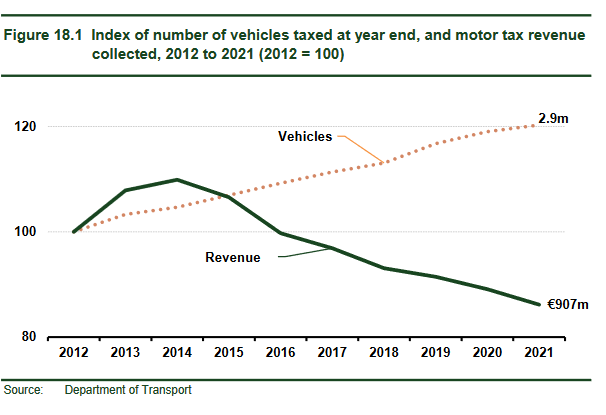
The Republic may need to introduce higher taxes for larger, heavier cars to help make up for about €1.5 billion in lost revenue per year as motorists switch to electric vehicles, Government officials have said.
While such a move would have the biggest impact on SUV drivers, congestion charges are also an option to be considered by officials as they grapple with how to replace the tax stream from cars that run on fossil fuels.
Regarding loss of revenue from taxes relating to vehicles that run on fossil fuels, the officials say that medium-term options may include road-user charging or congestion charges.
They also note calls for a shift towards weight-based taxation for cars — a system already in place in Norway, Belgium and the Netherlands.
Irish motor tax is based on emissions, which generally correlate to vehicle weight.
“Therefore within the existing tax system the larger more pollutant cars are those which are already subject to the highest rates of tax,” say officials. But they add it is “likely that in the medium to longer term, vehicle taxes may shift to a weight-based vehicle tax or surcharge in order to protect the vehicle tax base”.
The document also sets out options for extending electricity tax to domestic residential customers as well as the impact of increases in the rate.
Taxing by weight is a fantastic solution and it really should have been introduced back in the late 2000s when people with 100grand beemers or mercs were on the lowest motor tax bracket because they had a diesel which produced some good numbers on the test track with the seats removed.
https://www.irishtimes.com/ireland/2023/07/19/higher-taxes-may-be-needed-on-larger-cars-to-replace-lost-15bn-revenue-due-to-electric-vehicle-switch/
Probably needs its own thread but the government often put out news stories in advance of the budget to see public reaction and if they should consider it or avoid it like a hot potato.
I agree in terms of EVs being a tax dodge for now...
New signs upgrades on M50 are designed with per junction tolling in mind. They now have more or less gantries over each junction which is a big multi year project nearly complete.
New signs upgrades on M50 are designed with per junction tolling in mind.
This should have been brought it years ago....
It's absolutely outrageous* that if you drive 5km from Blanchardstown to Lucan you get hit with a €3 toll, but if you drive from Blanch to the M1/Airport (12km) or from Lucan to Sandyford (19km) you pay no toll...
It's absolutely outrageous full stop that we are still paying tolls on the M50... but it's the cash cow that will never end....
I think there is a thread somewhere ref this. I "like" that EVs are blamed for such a "loss". It is as blaming someone who quits smoking that there is no money for hospitals.
I found this document on the gov data hub which is a quite interesting read.
As bullet points:
And way more money have been lost due to CO2 emission rule than it is going to be lost due to EVs, even if the 845k target would be reached in 2030.
and to put this 58M amount in perspective the cost to run the motor tax office is estimated at 50% of this amount.
I think there's too many alternate routes for M50 tolling to work. There was a report that complained about the number of people who drive through the city centre canal cordon when their destination isn't the city centre. To me it wasn't at all surprising considering that the first non tolled bridge over the Liffey outside of the cordon is Lucan. You have two choices pay a toll to cross the Liffey or drive through the city centre.
i know it's a hoary old chestnut, but how about splitting motor tax in two?
the main 'motor' tax based purely on car weight/dimensions. doesn't matter what the drivetrain is. and then a second one levied purely on fuel; increase the duties on petrol or diesel possibly.
That's very similar to the current system and simply replaces the emissions with weight. There are too many issues with applying a fuel duty to electricity used to charge a car, if you thought green diesel was popular imagine how many people will happily install solar to avoid a domestic EV charging tax.
lorries would be crucified. Or do HGVs not damage the road?
exactly. how do they tell the difference between me charging my home battery, running my oven, charging my EVs etc especially from self generated energy!?
The most common way I charge is at 5-10A, trickle charge, from excess solar during the summer. If you're telling me theres a way to identify that then I'm all ears. I think we stick as is and just charge a tax per year. It's simple and it has worked for years. Maybe do like the UK and increase the year 1-3 tax if the purchase price is above X euro or something, but implementing tax on km driven or on kg or on home electricity is nonsense. And fast charging is expensive enough without adding duty to it.
HGVs are a crucial function of the economy, and they still pay.
Mammy dropping the kids to school in her Range Rover EV is not so crucial
so there is a reason for more tax on a 2.2 tonne vs 1.8 tonne SUV because of road use. But the 36 tonne lorry is fine? Because they support the economy? If I drive to work with 4 colleagues is that more important than driving to school?
What a silly silly reason for tax, 400kg more means more tax but 35 tonnes more and its fine. Silly. What if I bring two fat friends on board and they add to 400kg, do I pay more tax for that trrip?
I think politically M50 per junction tolling is a hard sell for a new tax. Politicians are worried it may go the way of water charges. It does not have much of a green aspect if EVs pay too which they would need to long term
The NTA wants per junction fees with possibly peak and off peak times to encourage people to work from home and drive before or after peak times. I sometimes aimed to be past toll before 7am to get reduced EV rates so it can have an impact.
An inside the canals charge may impact a lot of civil servants who have free work parking, indeed work place parking tax was announced 10+ years ago (?) In the budget and quietly never implemented due to logistics in collecting it and push back from civil servants etc.
Personally I am all on taxes to drive behaviours and that make roads quieter at peak times. I for one moved house closer to work to avoid long commute and future taxes on M50.
Weight based tax seems to me to be another kludge similar to the engine CC system.
The CC system was designed with the idea that generally more powerful cars are more expensive, therefore people who can afford more car pay more tax. This fell apart as engine development led to some very powerful and expensive cars but with low engine displacement.
We see people attempt to justify a weight based system due to the impact of road wear but it quickly falls apart when we apply that same logic to commercial vehicles. A 4 axle truck (the type allowed inside Dublin) has a permitted weight of 8 tonnes per axle, compare that to an Audi SQ8 e-Tron (the heaviest EV I can find) which has a max weight of 1.65 tonnes per axel. Road impact is a power of 4, meaning that one truck has the same impact as 552 SQ8s. Do the same with a Model Y Performance (best selling EV this year in it's heaviest version) and the truck is the same as 1594 cars.
Tax all vehicles evenly based on weight, and expect to pay more for all goods due to the increased costs of transit. It will be subsidised somewhere, might as well do it at source.
Would taxing vehicles based on their OMSP not make more sense? That way you're targeting those who can afford to pay most.
That's what I would design a system on, we have a database of the OMSP for all vehicles sold or imported into Ireland already.
Tie the OMSP bands to a future road usage system and you end up with a system that taxes people based on a nominal vehicle value and how much they use the car. It will be unpopular with the type of people who don't like taxation based on wealth, but is probably the fairest way to replace the current combined tax take from excise duty and motor tax.
Yes, we already do that on purchase though. Remove VRt and instead have tax based on price. This happens in UK already.
While this is probably the fairest system, it's also the most open to abuse
Consider that the difference in trim levels between most cars nowadays is some added parts and software
Indeed it's quite possible (and has been done) to enable the Travel Assist feature in a VW ID car which doesn't have it from the factory
Then you're effectively turning a €42k car into a €56k one, which muddies the OMSP somewhat
Then there's the fact that car manufacturers want to get into the model of selling aftermarket subscriptions and services, which again muddy the OMSP
I suspect that when the government or whoever are thinking of a new tax, there's a general thought process as follows 1) how much money can we take in, 2) how will people try to evade the tax, 3) how much work will be needed to enforce payment, 4) is it worth it?
(I'm not using a bulleted list because they always break in boards when I do)
If you take fuel as an example, it's pretty easy to enforce payment. People need fuel, there's effectively no way around it. There's only a certain number of places that sell fuel and they need a license to do so. Part of that license states the business needs to keep track of fuel sold and taxes paid and is liable to inspection at any time, and they will be prosecuted for any discrepancies that are found
So it's that realistic possibility that the service station owner will be in court if he just "forgets" to charge excise on fuel which means they probably won't be on board with a suggestion that they skip all the taxes and just take an extra €10 in cash for the trouble
Similarly for characteristics of the car like CO2 emissions or weight, they're set values which are well known from the manufacturer, so are easy to enforce
Transient values like OMSP are more difficult to nail down and enforce
This is one of the issues with VRT and how people are able to save thousands at times by showing some car ads with the same model of car for a lot less than what the OMSP is estimated at
Problem statement: Electricity taxes drove mass adoption of domestic solar PV and resulted in a drop of tax revenue
Me: I fail to see the problem 😁
Remember taxes can also be used as a nudge, not just a way to make money. I don't think the plastic bag tax or sugar tax have ever brought in a decent return but they do discourage certain behaviour
One of the governments stated aims is to reduce CO2 emissions. A fairly simple way to do this is reduce the amount of commercial electricity production and encourage microgeneration
We've already seen how high energy costs have driven the adoption of Solar PV, I'm quite certain there's several people in government nodding their heads and saying it can be done again
Personally, I think a tax on high powered DC charging might be unavoidable. It's a kick in the teeth for anyone using public charging but the annoying truth is that the least environmentally friendly way to charge an EV is from a HPC around 5pm-9pm, since that is when the grid is dirtiest
Maybe it doesn't need to be a tax but enforced time of use tariffs. I recently posted a video in the Random EV thoughts thread of a charger in Norway that follows the spot price of electricity through the day. Andy even mentioned that in Lithuania it's possible to charge for free at certain time of the day
Perhaps something like that is in the future for public charging
high power DC charging is already very expensive to the point that if it was your sole method of refuelling, you'd not save money vs an ice car. Thats a non starter.
The two real options are per km pricing (or a massive toll road expansion) or a flat tax for EVs that replaces an equivalent ICE - or perhaps a tax on kW (like the old days of tax on deemed hp).
So instead of having EVs taxed at 120, you tax them at 400-500 per year, which is roughly equivalent to a family 1.6 on the old system.
Or (and probably the most palatable option) a tax based on mpge, so tax the inefficient cars more, so a model 3 would be taxed at less than a fat etron.
We shouldn't be designing in to a system a mechanism that once again leaves people who are well enough off to afford private driveways and the capital cost to install domestic solar in a much better situation than a person who doesn't. The taxation from current motoring should be replaced by a fair system not one that overall burdens people who are less well off.
Make it power to weight ratio and I think you've got a reasonably fair approximation of the former CC system. I'm sick of people thinking bhp is important without considering that performance is a function of power and weight.
Firstly a drop of €1.5bn is a drop in the ocean, the bank bailout was €60bn for example
Secondly €1.5bn over 2.1 million cars is the equivalent of €715 per year per car... Seems too high to be motor tax based alone and far too low to be inclusive of Carbon/excise taxes - which account for 75.5c/L
So I'd question the figures at both ends
Agree with all of this but the problem is that the Govt wants to ensure that the motor vehicle taxation base is protected as it has been a very reliable cash cow for years now. Unfortunately this requires higher taxation on EVs into the future to replace fuel duty and emissions based VRT. Easiest option is to increase the EV annual motor tax rate on a phased basis over a number of years. Won't be popular but probably can be sold by emphasising the low running costs of EVs compared to the taxation costs of running an average mileage ICE
Ok and that would be fairly simple to implement actually, there's a kW and KG figure on most new logbooks these days already. Could implement tax based on kW/kg.
I still prefer just a flat tax on EVs but I think the power to weight tax is a more palatable option
Only heard about this light: window / tax recently. Heard of a old locally place that knocked down the second storey as they couldn’t afford the window tax. For anyone who’s interested here’s a read. Apologies if slightly off topic but just shows they’d tax anything.
https://www.irishcentral.com/roots/history/window-tax-hats-taxing-ireland-history
Going totally off topic now, the famous canal houses in Amsterdam are due to the city historically taxing the width of the house that faced onto the street, as well as a window tax which made it cheaper to have smaller windows
Back on topic, I like the power to weight ratio, but again could be subject to abuse by manufacturers offering an aftermarket upgrade to the motor power. Probably not as likely as some other exploits but it's still there
I think weight scaled for the number of passenger seats would be another good option. It favours smaller lighter cars which are generally more efficient, but at the same time something like a people carrier or an 8 seater van isn't going to be penalised because it's heavier. The ones worst off will be the big heavy 5 seater SUVs which is probably how it should be
To give some worked examples:
Dacia Spiring EV, 970kg kerb weight, 4 seats, weight per seat = 242.5kg
Citroen E Spacetourer, 1969kg kerb weight, 7 seats, weight per seat = 281.3kg
Audi Q8 E-tron (the big one), 2585kg kerb weight, 5 seats, weight per seat = 517kg
So the smallest and lightest car is cheapest to tax.
The bigger 7 seater costs more but not much more (I don't think anyone is going to buy a people carrier for style or tax avoidance).
The big heavy SUV costs the most because it's the least efficient per person moved around
Somewhat extreme examples I'll admit, the Spring is a far cry from the E-tron, but I think it illustrates the point
Just a heads up that the drum is being once again beaten to bring in weight-based taxation.