The wish to join the EU. The wish to make a Scottish voice heard among the nations of the world. The wish for a Scottish version of Riverdance. Scotland can be a Frosty place for some in the grip of the misguided worship of Anglo-centric politics.
The Anglo centric corrupt Westminster Tory government will (could be) be replaced by an Anglo-centric Labour party that might be corrupt or not, but will still ignore Scotland since they lost all their Scottish MPs.
Use your imagination.
They are a hard bunch to work out. They seem to be in love with the Tory Party and with right wing English nationalism and to hate Sturgeon and the SNP with a vengeance.
As you say though, a lot of them might be English immigrants or even English people living in England itself but pretending to be Scottish residents.
Nah, there are quite a few Tories in the Highlands and in the farming areas of the NE around Aberdeen. Lairds and the like, and Queenie has a house there too.
But the Queen has no vote.
Given that there is a law that says NI can vote every 7 years or so, it will eventually become difficult to keep refusing the Scots a second chance; but as the general belief is that the referendum could easily go the 'wrong' way at present, the mandarins in London will hold off until they have no choice.
But the wish for EU membership is 100% about economics.
It about trade and the value of trade, it's not about any cultural ties with Denmark, The Netherlands or someplace like Bulgaria.
And they are dead right to pursue membership if they do get independence.
I read the SNP white paper from the 2014 vote and it was heavy on the economic benefits that would allegedly be coming from independence.
And what exactly is stifling that wish for a Scottish version of Riverdance.
Labour are finished in Scotland. They are very unlikely to win the next GE outright and may need to do a deal with the SNP.
Economically Scotland is a colony that sells food and fuel to England in a UK economy setup to support the export of financial services from England.
Sturgeon seems to attract an especially hostile, visceral reaction from some quarters
I think it's her very calm, reasonable, unruffled manner; added to the very genuine English fear of losing control of all that productive land and sea.
They keep saying that Scotland couldn't pay for itself, but have you ever heard a central government say different about a region or colony that wants to control its own destiny?
True to some extent.
You may have noticed that Canada, had their own currency not too long after receiving the power to decide. Oz, NZ and SA stayed tied to the Pound until the 1960s - however we didn't - we remained tied to Sterling pretty much until we got hitched to the EMU.
"the taxes are too high, who needs all this tea anyway?"
There was also a little matter like the English refused to allow the expansion of their colonies west of the Appallacian mountains, into their Indian allies' lands. This would have been one of the major, unstated, reasons for breaking away.
The wish to remain part of the EU was not just economics - Erasmus was cultural based on the wish to travel and learn a European perspective on life. The Scots have a history of travelling the world. They have always had an outward view rather than the English inward view.
I never said that they had a stifling wish for a Scottish Riverdance, just that it is a worldwide phenomena that says 'Irish' to many parts of the world. Why would the Scots not want a similar phenomenal success?
At independence something like 92% of our exports went to poundland. Pegging to Sterling took out all the currency fluctuation risk. It's now close to 8% of exports going to GB.
Just in case there is any confusion Scotland already has Sterling assets to cover every single Scottish banknote in circulation because it's the law. So the Scottish pound is 100% backed by Sterling right now. And there is no reason to change that or float the currency until Scotland diversifies it's markets.
The six Scottish and Northern Ireland banks must, by law, set aside assets that are worth at least the value of all of the banknotes they have in circulation. This ensures that people with genuine banknotes issued by the six banks receive a level of protection similar to people who have genuine Bank of England banknotes.
The assets can be a combination of Bank of England banknotes, UK coins and funds held in an account at the Bank of England. This means that, if one of the banks failed, the backing assets could be used to reimburse everyone who has one of its banknotes.
Bank of England banknotes held as backing assets may be kept either at an authorised location or at the Bank of England. Some of these banknotes are of very high value, including £1 million banknotes (known as Giants) and £100 million banknotes (known as Titans).
Do you really think that Scots angry at being outside the EU are angy because university students can't get Erasmus or are they angry because it has affected trade and the economy?
As for the Scots being outward, they certainly were, they were some of Victoria's finest empire builders.
The Edinburg festival is pretty big, and it says Scottish to many parts of the world , is that not an example of their Riverdance?
And by holding off they probably increase the yes vote.
We are members of the UN Security Council - a position not available to Scotland as a minor, ignored, member of the UK. It would be available to them if they were independent. It is not our first stint in the position, but validates our pursuit, as an independent nation, to be neutral in this war torn world.
Membership of the EU as an independent state is not only an economic matter but it identifies them as European, which is cultural. I think that the Scottish people value that - as evidenced by the fact they voted to remain - and by quite a bit more than 52% to 48% which is the yardstick for democratic validity. The Erasmus scheme is just one example of EU solidarity, which the Tory UK eschews with great vigour. There are many others.
Why stop at the fringe, there is a wide world out there.
Scotland should decide for Scotland.
But there is nothing to stop at the fringe when there is a wide world out there.
What part of being in the union exactly is preventing the promotion of Scottish culture?
Your original point (which I agree with) is that you need a lot more than economic arguments to make a successful independence movement.
To quote yourself "heart, national pride and preservation of their culture that will drive independence movements"
And I agree with that also.
I also agree that Scotland should decide.
But what I don't agree with is that the examples you have given in the past few posts are enough to ensure a successful independence referendum.
Scottish culture is not under threat, Scottish identity is not under threat.
Both are existing and doing well in the status quo.
I don't think there are enough Scots willing to take the economic hit of going independent because of some perceived threat to their identity.
Economics might not be a solid argument for independence but it is certainly used by voters as a reason to reject independence.
If you agree that Scotland should decide, then that is surely enough.
I am not campaigning for Scottish independence, and am not listing arguments for their campaign - I am sure they have their own ideas.
However, I cannot understand why any Scot would walk away from the opportunity to release themselves from the English yoke that stifles their opportunities to express their Scottishness, and denies them their ability to run their own affairs in the way they wish.
If you agree with me, then this should close the matter - well it does for me.
The post you are quoting doesn't seem to deal with Scottish culture and more about Scotland's ability to partake in deals like Erasmus. The current Tory position is isolationist and creates issues for athletes and musicians travelling abroad. A position Scotland very heavily opposed and appears to still oppose given the SNPs success in elections. The fact is that Scotland will never be seen as anything but an underling. The current Prime Minister has stated the opinion that a Scottish person should not be able to lead the UK.
As you say Scotland should decide but if they decide not to leave now the choice will be taken away from them for decades at a minimum and so they will, I don't want to say lose the right to decide since they don't really have it in the first place but lose any chance of deciding. Had the UK decided to stay in the EU they would have retained the right to ask the question again whenever they wanted.
For the economy I would suggest Scotland take the equivalent of the Norway deal but with the UK. The aim should be to minimise the initial influx of change and make any desired changes slowly over time to reduce the economic hit. Also while Scotland is doing ok economically as part of the union I would say it may not be sustainable. They are one of the few regions in the UK outside of London who have managed this so it shouldn't be counted on long term. Indeed as soon as the economic outlook becomes worse they will become more dependent on London for handouts, one of the main arguments for Northern Ireland to stay in the UK is that the UK has crippled it to the point where it would take a massive project to fix if and when it rejoins the rest of Ireland. So from an economic point of view Scotland may not have forever to make this decision.
I'm not sure what answer you're looking for here, ultimately. The Scots have a distinct, cultural and ethnic identity that has become global enough to basically exist in the zeitgeist as a universally recognised concept (see your Groundskeeper Willys). The distinction even extends internally within the UK with its own Legal system, bank notes etc. etc.
I've read your posts and it's like you're just asking for some Silver Bullet that might "explain" a yearning for independence in any broad sense. And neither I nor anyone here can give you one; maybe you're best asking some Scots TBH. Why do Scots want to leave? Why did the Moldovans? The North Macedonians? And so on.
But maybe the flood of responses about Scotland's own identity is the point: it's not about what is being restricted or silenced. Maybe "Scotland" as a concept already exists so much as its own, untrammelled entity, that existing within an archaic Union like the UK no longer makes any sense, especially as that union increasingly reflects the Anglocentric direction inherent within its structure. The nominal sense of a Union of equals never more false.
As mentioned elsewhere, NOrthern Ireland has provisions for a clean exit from the Union every few years - why not Scotland?
The point I am making is as follows.
People tend not to seek independence based purely on economic reasons.
Independence in the short to medium term will result in poorer economic outcomes, and this naturally puts people off independence.
So parties that promote independence need another angle.
Culture and identity, and love of that culture and identity is another angle, and it's an angle made even stronger if that culture and identity is see as being under threat.
So what is gets independence over the line for Scotland.
The economic argument wouldn't work and the culture and identity is not suppressed or under threat.
I'm not suggesting that Scotland doesn't have an identity or culture that is different from the rest of the UK
I'm arguing that the desire to separate that culture and identity even further from the UK will not outweigh the desire not to become poorer in the process.
When I think of Scottish people, I see them as being a completely different people to the English - I would say the differences are as marked as the differences between the Irish and the English. When you watch someone like Eilish McColgan winning gold at the Commonwealth Games earlier this month and Flower of Scotland being played as her anthem, it's hard even to imagine her being 'British', even though she represents Team GB at other events.
It doesn't matter what you think.
But what percentage of Scottish people hold the same "it's hard even to imagine her being 'British'" view ?
Enough to allow them break away from the UK ?
No one is doubting the difference between the Scots and the English, the question is how may Scots wants that difference to be bigger and more defined politically.
I agree that my thoughts on the matter are completely irrelevant to what will actually happen. But I must admit I'm gobsmacked at the Scottish unionists who claim Scotland is 'not a real country'. Also, a somewhat bizarre aspect in all this is that the ruling party in the UK appears to have lost interest in the union (which might explain why Scottish unionists are so freaked and vocal at the moment).
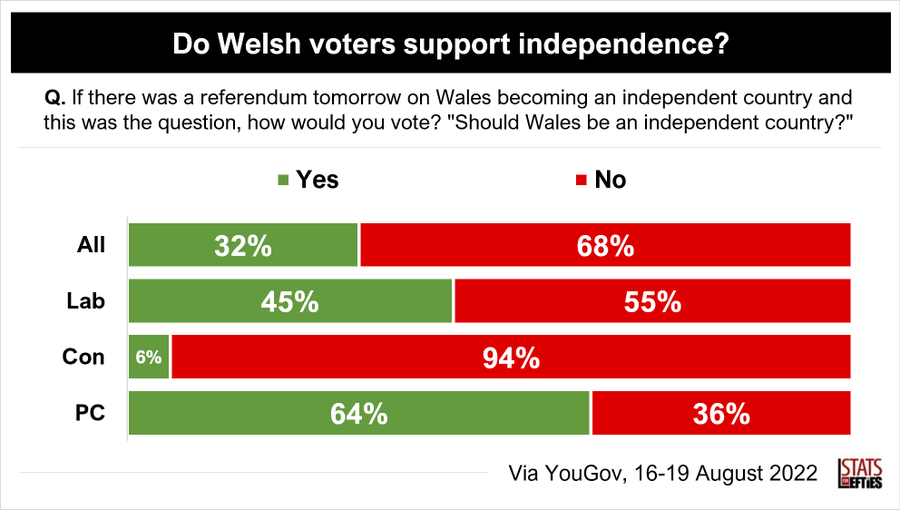
Interesting opinion piece here on Welsh independence. It makes the point that it's polling similar numbers to what Scottish independence was doing circa '07.
Poll seems to be based on this recent one from YouGov when the 'don't knows' are excluded:
I suspect if Scotland goes independent within the next few years, the numbers for Welsh independence will grow. I'm just not convinced the Welsh appetite is as strong as Scotland's. I could see Wales being willing to settle for some sort of Home Rule/devo max type arrangement. I think that ship has sailed for Scotland.
Though it could be argued that if Scotland and NI left the UK, it would radically change the political landscape in Wales. Would they really want to be a member of a two country 'union', one of which has 50m people and the other 3m?
Not enough. I wouldn't underestimate the potential for civil unrest similar to NI if they did vote for independence also.
Open to correction but I can't think of a country that has peacefully parted ways with Britain.
Also the English establishment knows full well the consequences of losing Scotland in terms of landmass, resources, prestige, security and relevance.
Look how they spent 100 years holding/propping up NI.
I have a hard time believing England will simply let the Scots go. There'll be all sorts of dilution in any negotiation after a vote.
They'll claim they have to protect British people and all the rest.
Then you'll get the trouble.
Australia, New Zealand, Canada, Belize, Malta, Cyprus until the Turks got involved, the Caribbean islands all spring to mind.
And I'd say you can add Scotland to that list when it happens.
Agree, there's no way the rest of GB is going to sign up to force. Maybe a bit of street violence/disgruntlement but it will be a peaceful transition.
I think this was the final Tory hustings. Listening to the atmosphere, you'd be forgiven for thinking this was an openly English nationalist party as opposed to one that professes to be unionist.
Let's just call a spade a spade here: the current Tory party is an Anglo-Nationalist party. They don't care a jot about unity, or a union of equals. The rot is complete at this stage and if the lingering Undecided Scots don't wake up to this, maybe Lord Frost will see his suggestion enacted, and Holyrood gutted.



![Photo of [Deleted User]](https://we.vanillicon.com/v2/e68aa2b0e039b12ade8384a2f42841c6.svg)