So the Option Selection Report for N3 M50 to Clonee has now been published. This is the justification for adding another traffic lane in the hope of solving congestion, this is one report which is well suited to its future role as a dust collector on a shelf, unfortunately it will be joining other reports which should be actioned.
About the only positive thing I can see there (and I haven't looked too closely) is the proposed closure of private entrances along the N3.
The extra lanes here are critical and fully justified. It doesn't go far enough but we'll take it for now.
No motorway, which presumably this will be redesignated to, should have two lanes in the GDA. 3 minimum.
I'm really not bothered if the 3-laning happens or not. I'm more interested in the junction upgrades and closure of bad access arrangements. If that was all they ended up building I'd be happy.
However I'm not happy they are keeping the left-in-left-out at Parslickstown. This was never a good enough arrangement and the roads here should have fed into the nearby grade-separated junction. Here's a quote from the Existing Junction Analysis Appendix:
"It is proposed to retain Parslickstown Junction with only minor alignment changes to the traffic island to facilitate three lanes on the main carriageway. The closure of private entrances along the N3 corridor is to be carried out by providing alternative access arrangements to the rear of the properties and land holdings (See Figure 4.2). The closure of these entrances is necessary so as to not prejudice the re-classification of the N3 to motorway.
However, other departures from standard resulting from the proximity of Junction 4a will be required to retain the junction layout in general if the N3 is to be designated as a motorway eastward beyond the existing end of motorway at Junction 4a."
This is interesting as I'd been hoping they would reclassify Clonee-M50 as motorway but didn't know they were still considering it.
Closing the gaps around Dublin in the radial motorways is a logical step. It's protects the routes from unwise adjacent development with access and enhances safety.
🙄We need 12 lane highways like the utopia in the US, right?
Not for me, but a contiguous motorway network would be a good start.
The idea that adding lanes to “fix” congestion is how you end up with 12 lane roads. You add more lanes, you get more congestion so you add more lanes. Each time you think this is the one that will fix it.
The M50 is already 8 lanes wide in parts and 12 if you consider the motorway and it’s ancillary roads around Sandyford. That €1bn that we spent a few years ago did very little to fix congestion.
I don’t believe that adding additional lanes will do anything positive. But there are plenty of other options once we remember that moving people is important, moving cars is not.
The M50 is 4 lanes wide there, 6 to the west where there’s lane drops. You can’t count slip roads as capacity increases because they’re ultimately constrained by the capacity of the mainline.
That’s a bit obtuse. Longer exit slip lanes absolutely add capacity by preventing queues at the exit from affecting the mainline. The construction of a 2x2 lane DC between Dundrum and Sandyford along with the segregated on/off ramps also increases capacity on the motorway. Do you think they were built for the craic?
In either case, adding more lanes to urban roads does not help in the long run. It’s been proven time and time again.
Longer slips add capacity. Junction design and spacing is the biggest factor in maintaining a road’s capacity. There’s a theoretical limit to trhoughput generally taken as 2000 cars per hour, per lane on a multi-lane divided road, but every time you come to a junction, you will reduce that throughput temporarily as traffic adjusts for leavers, passers-through and joiners.
If a car has to leap into the mainline from a short slip, anyone behind has to slow down. Give that joining traffic more space to build up speed, find a safe gap and merge in cleanly, and the new car will cause no disturbance to existing traffic. The same applies to cars leaving the mainline. If the exit slips are too short, then the queue to exit can extends into the mainline, and the leftmost lane of the mainline ends up being dragged down to whatever speed the exit junction can accept cars at. Longer (and wider) exit slips allow cars to leave the mainline at the same speed as surrounding cars.
J13 and J14 on M50 are what you have to do if your junctions are too close together to allow for acceptable merge and exit lane lengths. Here, the pair of junctions has been reconfigured to function as a single interchange. Doing this allows them to effectively share the same, longer length of sliproads, which gives traffic a lot more space to enter and leave. (The Bandon Road/Sarsfield Road junctions on Corks N40 are the same idea).
The reason that adding lanes for something like N3 won’t work is that through capacity isn’t the problem: junctions are. A series of closely-spaced juctions, onto 50km/h roads means that traffic never gets enough time to take advantage of an extra traffic lane, and also, a lot of traffic joins at one junction and leaves at the next, negating any advantage. The better solution is to separate the local and through traffic using a parallel access road, but there’s not enough space here to do so, as commercial premises are built right up to the road edge (same as with N7).
Closing the direct private entrances would do more for N3 than adding a lane each way.
At the Anne Graham NTA meeting last night, someone asked about this scheme. From the comments made it seems that 6-laning is out but the other elements might still happen. Closing side accesses and rebuilding junction 4 at Clonee.
There is only one private entrance outbound (between j3 and j4) and a few before Parlickstown junction inbound. I don't think closing all of them would have any real impact on traffic flow as they are well away from traffic pinch points and lightly used. It's not like the approach to Killarney where there are private entrances aplenty.
I've looked at Fingal Co Co website and can find nothing since June 2022. Has nothing of significance happened to this proposal since or am I looking in the wrong place?
Seems to be dead in the water until there’s a non-Green minister in place.
Will hardly matter the spending rules and policy will be the same, the state will also likely have already signed contracts for 10s of billions of euro for dart, bus connects and metrolink projects before next election so there'll be no spare cash for things like this.
Budgets are highly malleable and have nothing to do with fiscal space. They are entirely decided by political priorities. You can just borrow if you don’t have it.
If an incoming government decides that there should be more spending on roads then it’ll happen.
It won't happen though
The priority should be to add a bus lane, further general traffic lanes would be pointless.
An outbound general traffic lane would be useful to remove traffic from the city more quickly. An inbound one won't achieve much as you say.
There is an inbound bus lane, up to Snugboro Road on ramp where there is a lane gain. An outbound bus lane from j1 to j3 would help. I'm not sure if there is a short hard shoulder between j1 and j2 which forces traffic into mainline only to leave again after about 100m - it would be good to have that shoulder as an auxiliary lane between those junctions.
Depends on the capacity of the N3/M50 junction. If it could handle 3 inbound lanes, they should be provided.
6 lanes+bus lanes is the way to go.
i had to come in via blanch early this week and i got stuck in traffic out near clonee. I noticed plenty of Buses stuck with me.
Since this project has been droped by TII should they not convert the Hard shoulder from clonee to were it becomes a bus lane at maxol to give buses a full run to the M50?
I think the issue is the LILO at the Maxol station needing to be set back from the N3 to allow a bus lane run through.
No mention of this in latest update of NDP so this is dead until after 2030.
It is mentioned in this NDP update as actually commencing construction by 2030.
The reason it’s not in the main list is because that list is only projects of value exceeding €200m
I don’t see any mention of this scheme in the most recent NDP document, Marno? Is there another document with the cheaper schemes that I missed?
My apologies spacetweek it was actually included at the bottom of the press release associated with that document
https://www.gov.ie/en/department-of-transport/press-releases/minister-obrien-secures-cabinet-approval-for-e243-billion-sectoral-investment-plan-for-transport-2026-2030/
Thanks Marno. Needless to say I missed that - as did many others no doubt:
I had been wondering why Mallow Bypass wasn't in the NDP document.
@Roadmaster: Looks like your idea of converting the hard shoulder to a bus lane is the height of the ambition for this road. The addition of an off ramp west of Clonee will take the Dunboyne bound traffic out of Clonee village and J4.
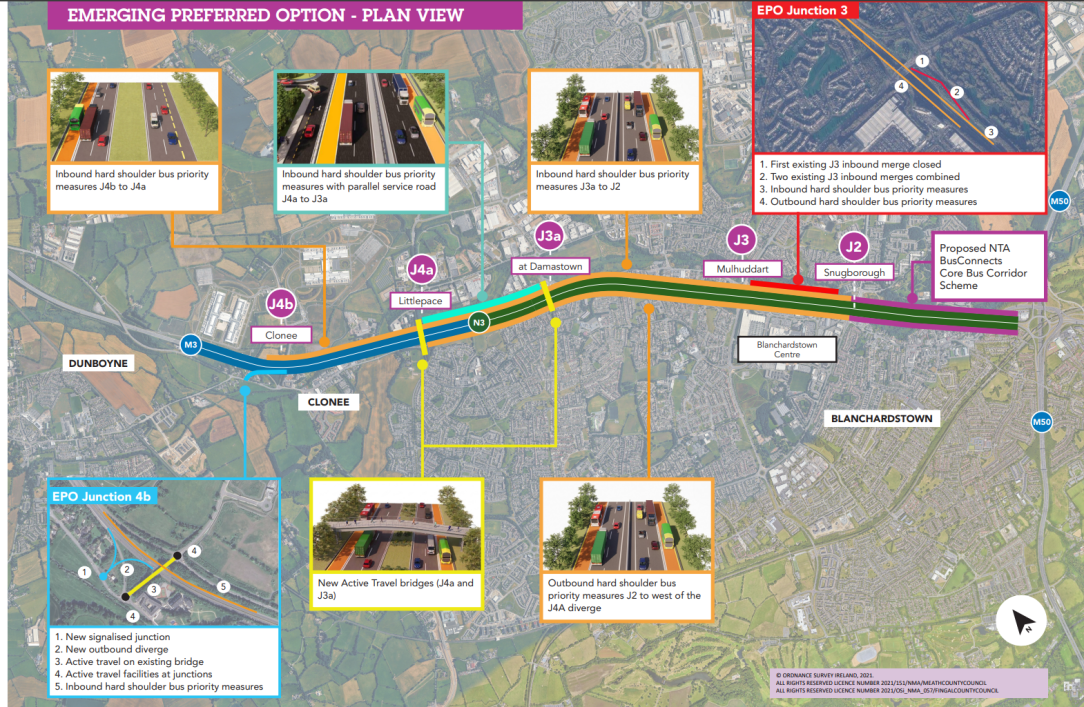
https://consult.fingal.ie/en/consultation/n3-m50-clonee-bus-priority-and-active-travel-scheme-junction-2-snugborough-junction-4b-clonee-non
.
The document is 105 Mb and downloads very slowly so to make it easier here is the map.