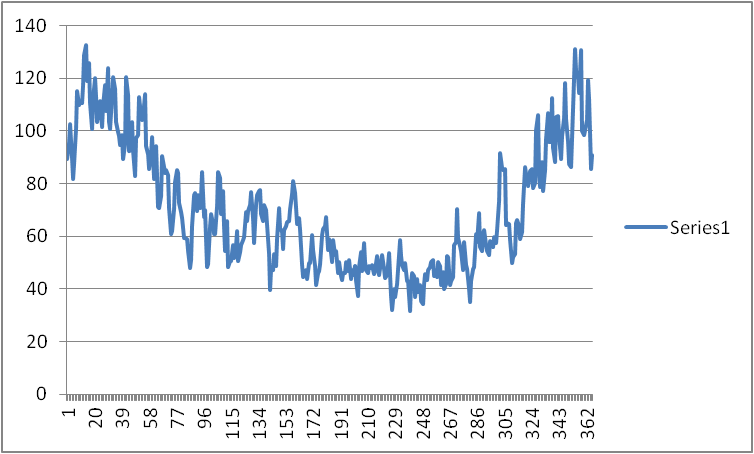
As we head into the well-forecasted few days of rain, wind, and colder temperatures, it occurs to me that once again, an old Irish legend which my dad likes to cite at this time of year is coming true, as it seems to do every year more or less. Laethanta na Bo-Riabhach, "The Days of the Brindles Cow", tells the story of a cow which survived a particularly harsh Winter, and led Winter to "borrow" a few days from Spring in order to finish off the cow as a matter of pride. This legend refers to the fact that virtually every year with few exceptions (as evidenced by a trawl of news articles going back years), we tend to have a period of relatively decent weather in mid-March with sunny spells and warmer temperatures, followed by a brief but bitter return to late-Winter conditions around the final week of March or first week of April, with much lower temperatures, wind, rain, sleet, maybe even a scattering of snow here and there.
Given that this is a rather ancient Irish legend, it's clear that this phenomenon is not a recent development. It would seem therefore that it can't be put down to any long-term, large scale oscillations (AMO, ENSO, IOD etc) considering that it seems to strike independently of any of those background signals. I'm curious though, is there an actual underlying reason for this being such a predictable and frequent phenomenon? What exactly is the mechanism for a brief return to much more wintry conditions at this very, very specific time of year, that is late March and/or early April? It must be the result of a mechanism which recurs annually, which makes me wonder if perhaps it's related to the final warming of the stratosphere, the beginning of the warming of the oceans or melting ice, something to do with the days becoming longer and the increase in sunlight, radiation, etc - or something else entirely?
Before anyone points to the NAO, yes, this feature is indeed caused by the NAO turning sharply negative, as you can see if you have a look at the NAO charts. What I'm wondering is, what's the mechanism which causes the NAO to turn negative at more or less exactly the same time of year, annually? It just seems far more regular than most related weather phenomena. It does seem to me that there must be a specific mechanism behind this rather than just the standard "Irish weather is unpredictable because of kinks in the jet stream" explanation, this seems to be something extremely regular, predictable, and recurring in nature so can't simply be put down to the usual random luck-of-the-draw chance that gives rise to Irish weather's changeability.
Anyone have an insight into this?







![Photo of [Deleted User]](https://w5.vanillicon.com/v2/5117ec177439400b1e5944f4d30acdda.svg)