The clues or answer might be in PV2 Voltage and Current, if you can post those pics
I’m getting 16 panels and tigo optimisers next week, anyone gone with the tigo gateway to see each panel performing or is that just geeky and not worth it
I bought a TAP because I found one cheapish, but plan to see if I can see any data over it's RS485 Interface. The TAP connects to the Gateway over a cabled RS485 link
Could be something stupid like a bird sitting on one of your panels. I have seen stuff like this before and it fixes itself for no rhyme or reason.
I don't know, as the PV1 string (11 panels over 2 aspects) all have optimisers....Very odd as the following days it was back to it's normal self, ramping up as expected..
Massive thread so apologies if it's been asked/answered
Does anyone else get a repeating issue with Solis Home reporting No Battery and Can Communication Failure errors ?
From my energi
Hi
Okay so set up wise this is a tricky one due to the system being Hybrid. Battery systems that charge directly from the solar array and cannot charge from AC are usually referred to as being DC-coupled or Hybrid.
This type of battery system uses the solar PV inverter to provide power from the batteries, thus it is not possible to differentiate between solar and battery power when using a CT to measure the AC current
from the inverter.
Due to this, we cannot distinguish on the myaccount or graphs what is excess solar or battery power. As long as you have an export back to the grid of the 1.4kW required to start a charge while that is ongoing Zappi will charge the vehicle.
Has the EV not been seeing the export and charging?
Thanks
Kieran
For some reason this posted again...cant seem to see a way to delete post on my phone🤔
Like The Alm said I think you need to set up export margin and avoid drain. I have mine set at 100w and it hasn't ever drained from my battery.
Sorry thanks, great idea I'm heading out now to change it 🤞🤞👍👍
Changed it...There is an option is battery (no drain) ?
Hope fully this works - I'll try both perhaps
Tks guys
That will not work. That only applies when a battery is AC Coupled.
The Hybrid is specifically designed to take the PV and charge the battery.
Is there an option to reduce / limit the charging rate of the battery ? If you could, then you could force excess while also charging the battery.
Or, you could try ECO mode and even set it to 100% "grid". It could the just pull a constant 1.4kW from you "Hybrid" who of course be 90% battery or 100% PV.
Last resort is to use your granny charger instead, for a constant low level of charge.
Okay that makes sense cheers
I'll try both options..over the next few days..
Granny charger 😄 forgot about that 👍👍
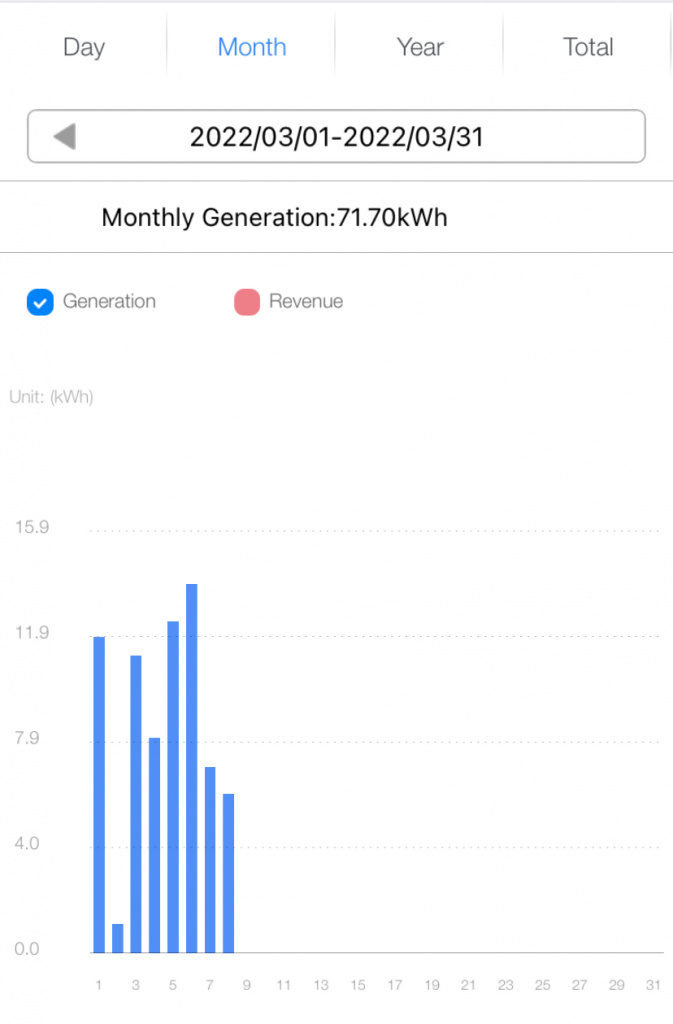
Is there anyway to accurately record monthly production on solis inverters. Both solis home and Cloud apps appear to record any night charging of batteries as "generation" so gives a false high yield during months I'm charging batteries at night. Thanks.
That seemed to do the trick tks
Changed it from 50 watts to 100 watts 👍
Have a look here on your desktop browser. Much more options for graphs than on the mobile apps.
https://m.ginlong.com/main.html
Guys if your charging you storage batteries
1. what time during the night do you usually have them set for
2. And what amps to you usually charge then at. Its defaulted to 50A
Cheers
On the summary page of the Solis Home app, is you scroll down you can select day, month, year etc…. And it shows production only
Thanks for that 👍👍
It varies wildly for me. I was charging at 30a throughout the night rate through the winter to get a full battery.
Dropped to around 15a in the better weather and then reduced the times to 4 hours. Stopped entirely the other day but then bad weather rolled in so I'm now at 15a for 7 hours.
I'm working with a 20kWh battery mind you.
5kw battery. i do 10A for 7:50 starting at 00:05 and finishing at 7:55am. I dont want the clock to drift on me so i always stay in night rate. Thats when im filling - low and slow to ensure a long battery life!
Going to stop charging for the spring/summer this week i think, too much hassle to try and second guess the forecast.
Is it actually worth the extra battery cycles, to charge by night?
Mine is set to charge from midnight to 7:59am.
it was at 12 amps which filled it by around 7am, now it’s set to 6amps and by 7:59am it’s at about 55%.
will top it charging completely in the coming days.
More to Cork_exile. It's a fair question that.
I think people worry too much about battery cycles. Batteries are good for like 80% capacity after 10 years. Some higher than that. Sure, you don't want to be flogging them needlessly, as in you have 9 hrs night time rate, so why would you force charge something at 100 amps for 2 hrs when you could let it run for 8 hrs at 25 amps. Makes sense to charge it easily as there's no cost in doing a relaxed charge.
If you have only a small window of super cheap rates for example the 3 hrs that Energia have, I'd say "have at it" for those 3 hrs at max charge or whatever rate makes sense to charge your battery to 100% SOC where your taking advantage of the cheap rate. They are rated for like 5000 cycles (that's 10+ years)
Not using the battery is akin in my mind to buying a car and then not driving it as you don't want to wear the tire thread. You want it to payback and that means you got to use it. :-)
Where did the 20% SOC originate?
I have been saving 20% for backup all winter so along with the other 20% that never gets used I've only been using 60% of my batteries capacity.
I think the 20% is a lithium chemistry thing....the batteries last longer if you don't deplete them fully. Sure, a once-in-awhile discharge to 0% ain't going to kill it in a single run, but if you want it to last as long as you can.....avoid going to 0%.
Thinking about getting solar panels installed, but we might convert our attic at some point in the future.
Do I need to have a good idea of where any velux windows will go, and avoid putting panels on those spots? Trouble is we don't know where we might break out windows if ever.
How costly would it be to move the panels if we need to shift them for the veluxes at a later point? Would you trust a building contractor to do it, or would i be getting the solar crowd back to move them?
So after 10-15 years when they are getting depleted is it OK to lower this to say 5-10% just to get an extra bit of life out of them or will that just kill them off altogether?
To be honest mate, I don't know for sure. I did have a quick look and found
Best practices to maximize LIFEPO4 useful life? - Victron Community (victronenergy.com)
How to Find Happiness With LiFePO4 (Lithium-Ion) Batteries – Solacity Inc. – Solacity Inc.
but I didn't read them fully. Perhaps the answer is contained therein. I only quickly scanned it, but I did notice that the lad in question was mentioning that he goes from 95% -> 20%, so it would appear to be good practice.
Me? I'd be inclined to push it "a little". Your battery is there for a reason, to be used. So dropping it to 15% is (probably) ok....maybe even 10%. The way I look at it is that batteries verses price over the last decade have been dropping, in 10 years time I'd probably be happy to purchase another battery with 2x the capacity for the same money as I spent on my one this time.
Aside: I've a 8.2kwhr Givenergy battery. This is actually a 9.9 Kwhr battery "under the hood". So I actually deplete mine down to 4% (the minimum they allow) as I'm only depleating the "usable storage" and there's still 20% left, even though I go to 4%. The manual explaining this is atrocious. It's also how they guarantee a very high capacity after 10 years as they have this "reserve" behind the scenes


![Photo of [Deleted User]](https://w5.vanillicon.com/v2/5dc0c82bb5d5c9e7a358d7971a18240f.svg)