ECO_Mental wrote: » Hi, Building a new house out in the country and am I just looking to get my ESB connection. What size of MIC should I get to be some way future proofed for EV charging, I don't have an EV yet but planning to in the next year or two. My house will have Air Source HP, MHRV and I will be putting in solar PV, 3KWp min but probably as much as I can. Looking as the ESB site 16 kVa I think is the new minimum I think I should get if I am planning to get an EV. But ESB have 20 kVa or 29 kVa options. There isn't a 3 Phase line near me but can I get 20 kVa or 29 kVa on a single phase, but again are these over kill but I want to be future proofed as best as possible. I have this cross posted in the Electrical forum but then though the EV charging will be the main consumer of power in the house into the future so I posted here as well. many thanks
ECO_Mental wrote: » Just filling in the the online application for the new connection through the ESBN system and going into the Connection Capacity section and they ask you do you have a heat pump and are you planning to have EV charging. If I select EV charging it automatically selects 20kVa or 29 kVa and 3 Phase. No option for 12kVa or 16 kVa. If I say I am NOT EV charging then I can select 12 or 16.... Is this a new policy in ESBN
pauldavis123 wrote: » 16kva 3 phase is only a grand. They use 100a fuses in the 16kva and the 29kva so I'm not sure what the difference really is of you never want to upgrade from 29kva.
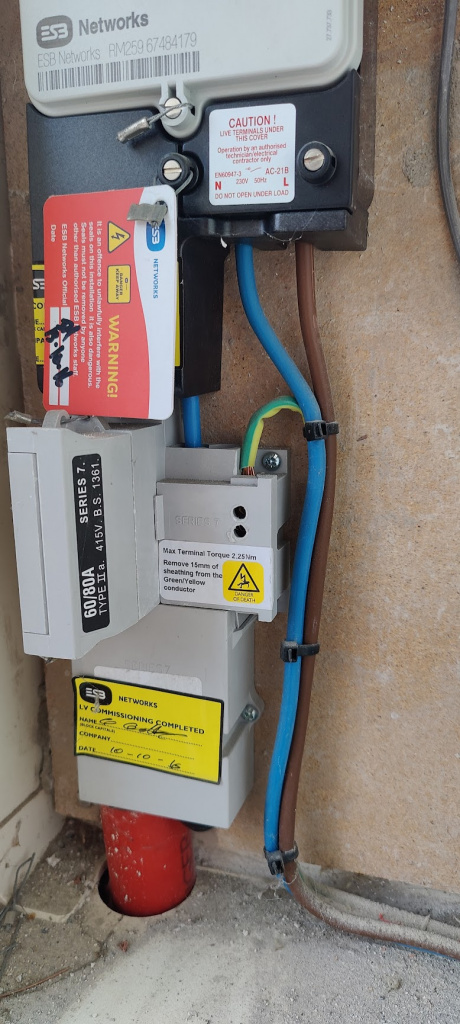
KCross wrote: » Are you specifically referring to 3ph there? I have a 1ph 16kVA connection and it has an 80A fuse. A standard 12kVA connection typically has a 60A fuse and the 100A fuse is for 20kVA+
Apologies for resurrecting this thread, it's actually one of the top linked on google when searching MIC power supply.
After reading around and looking at my fuse board. It would appear I've a 80a mains fused and a 63amp consumer unit. House is a new build with a HP from 2016.
A few questions:
Can I assume that if I have an 80a mains I already have a 16kVA enhanced supply.
What exactly does that get me? My understanding is that a 16kVA will allow me to use more power at the same time. So for instance charging two EVs or an EV and HP at the same time with plenty left over?
The kVA in is somewhat meaningless, it's more about the conductor size going into your unit. I have an old 8A supply in the city centre but it's fed by 25mm square conductors with an 80A main fuse.
That 8A supply pulls 40kW in the winter no problem. I rang ESB Networks after an ECIR about this a while ago and was basically told if the main fuse has not blown there is no problem.
More kVA means more ability to draw more power. The weak link is the 80A fuse. ESB Networks will replace it once but will complain the second time according to a spark I spoke to.
Three-phase is the way to go, €2k to install but they will limit it soon I would say once EV's kick-off.
Standard three-phase is 3 x 100A connections compared to a single 80A for single phase.
Is this something you've actually done? That pricing doesn't seem realistic.
I have a 16KVA supply and the fuse in my consumer unit (well its in the meter cabinet) is 80A. My main tails are 25mm2.
I got my supply upgraded for the farmyard thats connected to the house.
I have a 16kVA connection with 6kW heat pump and 2 EVs with 2 chargers
It isn't an issue for us because the chargers have load balancing built in, or rather one of them does
The chargers share the same 40A fuse. The Leaf only charges at 16A so the Zappi will monitor the load on that circuit and slow down the charging speed of the ID.4 so as not to overload the circuit
Similarly the Zappi monitors the house's usage and will slow down if the heat pump is drawing a lot of power
When we replace the Leaf the next car will probably draw 7kW, so we'll probably replace the EO with another Zappi as they can do better load balancing that way. The EO can also do load balancing but the version we have is too old for that
Ok so it's really about supporting more concurrent load as opposed to faster charging, though obviously if you have to limit the current that will slow things down.
Page 8
You will need a new distribution board as well
OK, I take it you didn't get this done then or you got it done business? Page 8 listed business charge at 2,430.00. Page 5 has the charge at €3,790 including vat + MV Network Charges. I'd assume I would need an electrician as well, and given what I'm paying for a days work installing a charger and writing a cert, it's hard to imagine I'd have change out of 5K.
Yes but you cant assume your "tails" is rated for 80A. You'd need to eyeball that cable. 25mm² is what you need to see there.
Standard domestic has 60A so if you have an 80A main fuse and your consumer unit also has an 80A fuse then you have an extra 20A to "play with".
Two EV's at full charge rate would be 60-64A and then the heat pump would be another 10-20A depending on the rating of the heat pump. So you wouldnt have "plenty left over" but you have enough to just about run all 3 together at full tilt, which is then where you would use load sensing charge points so that they would reduce their rate to keep the overall house load under your 80A fuse rating.
In practice you wont have two EV's charging all night every night unless you are doing very high mileage on both, so the load sensing is there just as a protection and wont actually affect your ability to have two fully charged cars everyday.
Over thinking this a bit, a lot of charge points have load balancing built in. So the it will slow the charge to not over load your connection.
I'm not really able to eye ball the cable thickness and there appears to be no writing on them. The thing is we've an AC system which is 6.5A, Induction Hob, Dryer, Heat pump and now a EV Charger on the way. It's mainly just piece of mind to know how close we are to hitting our MIC.
Some folks are happier to live in ignorance I guess than others. The charger I'm getting has an adaptive fuse so I'm not worried about tripping anything, I'd just like to understand better the options and what different things get me so I can have an informed conversation with the installer.
You might be able to see the meter tails in your attic?
ESB will tell you for sure tomorrow anyway if you call them and your electrician will be able to tell too.
You're right, a lot of it comes down to resource management. The load balancing can slow down the charging, a bit, but it's very rare that we need to charge both cars at the same time anyway
Even still, if we push up to the 40A limit for the circuit, that's 9.2kW. Over the 9 hours of night rate, that's 82kWh. On average that's probably around 435km of range
Divided between both cars that's still 200km per car per night. If you regular daily commute for both cars is more than this, then you'll need more power
Even then, you can charge a couple of hours at the day rate if needed, it's worth balancing the costs against the cost of upgrading your supply
The heat pump might not have a major impact depending on the power draw. Ours is a 6kW output so pulls around 1.5kW of electricity. I think with the immersion or backup heater it's closer to 3kW for short bursts
We haven't had any issues of overloading with the Leaf. We'll see how it goes this winter with both cars but I don't forsee any issues
OK, so it turns out after contacting ESBN that I've a standard 12kVA supply. The CU Main fuse is 80A rated but based on the supply the fuse at the meter must be only 60A. She sounded a bit vague about whats really involved in doing an upgrade, suggesting I may need new cables running back to the CU, as per above. Anyway, I maybe getting way a head of myself on this, I hardly expect to be driving from 100% to 0% every day.
I've found the folks on the ESBN customer help aren't really knowledgeable about the engineering involved and can't help with any technical stuff. They told me I need a new meter when switching to a Day/Night meter, even though I've a newer digital meter which can do all of the readings already
My house has an 80A fuse in the meter and 63A on the CU as well. Not sure what the logic behind that was, might be standard but could also be that the electrician probably had a box of 63A MCBs in the van
It does mean I'm limited to 63A, but if the meter tails support it I also have the possibility to increasing this to 80A if needed (or a but less, since I assume I'll want some buffer between the CU fuse and the ESB one)
For 16 kva your supposed to have 25mm² cables from the meter to the consumer unit.
The CU Main fuse is 80A rated but based on the supply the fuse at the meter must be only 60A.
That sounds a bit dodgy. If correct it means you can pull more than the ESB fuse and hence easily blow it. Either your electrician put in the wrong fuse or that ESB person on the phone hadnt a clue what they were talking about and you actually have an 80A meter fuse.
Mine was done the same way and I think it is just down to a lazy electrician not having the uprated CU.
I got mine changed to "unlock" the extra 20A.... after all, thats why I paid extra for the enhanced supply so why have it limited to 60A like that. I regularly go up to 60A so I'm glad I did uprate the CU.
Do NOT do this!