Fathom wrote: » TechCrunch Sessions: Robotics & AI is a single-day event that features in-depth interviews and networking opportunities with top robotics and AI technologists, founders, investors and researchers. March 3, 2020. University of California Berkeley.
Black Swan wrote: » That's a Tuesday. Might fly north to attend.
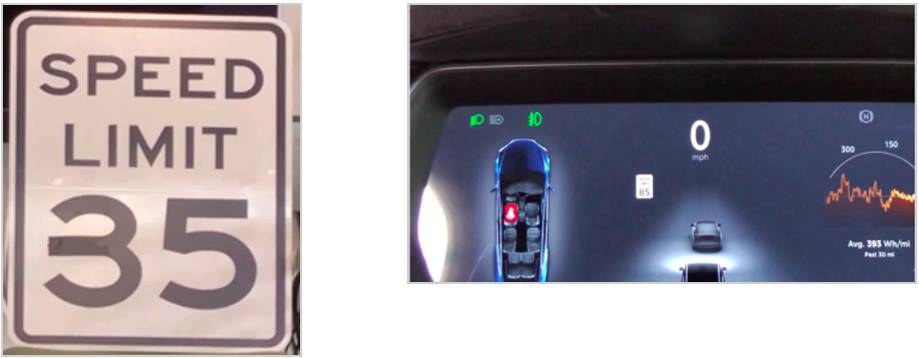
A single piece of electrical tape stuck to a 35mph (56kph) road sign is enough to trick the autopilot software in Tesla's vehicles into speeding up to 85mph (136kph).
Capt'n Midnight wrote: » . So the OCR failed.
Fathom wrote: » There are several bot cars driving about our university streets the past couple of months.
Capt'n Midnight wrote: » It's your civic duty to interfere with them.
“Whenever someone says autonomy is ten years away that’s almost certainly what their thought is. There aren’t many startups that can survive ten years without shipping, which means that almost no current autonomous team will ever ship AI decision makers if this is the case,” he warned.
Capt'n Midnight wrote: » An AI startup stops. Because AI is a lot more difficult than cheap tricks.'Supervised machine learning doesn’t live up to the hype. It isn’t C-3PO, it’s sophisticated pattern matching'
Smiles35 wrote: » Gently nudging away investors. Then again, surely we are coming close to a company that will start producing robots for the home.
Fathom wrote: » Are the continued development and proliferation of lethal autonomous weapons inevitable?
Fathom wrote: » Killer Robots: Survey shows opposition remains strong (Feb 2, 2021).
Notably, a majority opposed killer robots in five countries most active in the development and testing of weapons systems with decreasing levels of human control: Russia (58 percent), UK (56 percent), US (55 percent), China (53 percent) and Israel (53 percent).
Capt'n Midnight wrote: » Hmmm, not so sure I trust an article that doesn't mention the actual killer robots already deployed, the sentry guns facing north on the Korean border.
It may be true that AI learns from every single case it sees, the problem is that you don't know what it learned, can't ask it and can't correct it. No doubt it will some times get the right answer, but that just makes it Accidental Intelligence. ...Learns? That's marketing speak. No AI is capable of learning at all. It's pattern recognition aided by human curated data and human initial labelling. But indeed, you don't really know if it's matching (data comparisons) for what you intended or some other feature in the images. We see patterns, familiar objects in clouds, toast, flames in the fire, scattered stones. Because once we understand chair, we can decide to use a crate as a chair. A child that has eaten bread and sausages will assume a sausage-in-a-bun or a hot dog is edible. A two year old can do things easily that are impossible for AI. It's called the AI paradox and it was known nearly 60 years ago. Expert systems were the big thing in AI in the 1980s because they used text. The problem was capturing the expert. Faster cpus, bigger databases and more RAM simply made actually simpler so called image recognition possible. There is no recognition. Just matching. It's all marketing. None use "machine learning" or "neural networks" as those don't mean what they mean outside of AI marketing. Even machine translation has gone backwards. It now uses a brute force approach like a giant Rosetta stone and matching phrases and words. Text to speech isn't much better than nearly 40 years ago and so called smart agents are just voice to text front ends using pattern matching to search engines and chat bots hardly better than Eliza or ALICE. Speech recognition has moved from being a program on your car radio, phone or PC to something creepy running on a 3rd party system, the so called cloud. That's a backward step in privacy and needs the Internet. ...Anti-Tank Dog Another serious training mistake was revealed later; the Soviets used their own diesel engine tanks to train the dogs rather than German tanks which had gasoline engines. As the dogs relied on their acute sense of smell, the dogs sought out familiar Soviet tanks instead of strange-smelling German tanks.
Capt'n Midnight wrote: » Killer Robots mean AI Today's AI is just like 1960's AI. It's just database lookups, pattern matching and rules. The databases are way bigger now.
Capt'n Midnight wrote: » No AI is capable of learning at all. It's pattern recognition aided by human curated data and human initial labelling.
smacl wrote: » I think that statement is quite a bit out of date at this point. Generative adversarial networks for example don't need much in the way of training data and are capable of learning new patterns. AIs at this point can create new patterns which in turn can be used to synthesise training for other AIs.
A pigeon in each compartment, trained by operant conditioning to recognise the target, would peck at it continually. Pecks to the centre of the screen caused the missile to fly straight, whilst off- centre pecks tilted the screen which would alter the missile’s course.
Capt'n Midnight wrote: » During WWII there was project about training pigeons. to guide bombs.
The error rates vary across the datasets. In ImageNet, the most popular dataset used to train models for object recognition, the rate creeps up to six per cent.

![Photo of [Deleted User]](https://wf.vanillicon.com/v2/fc7d50eddf86fd2a7872c6ffac511c39.svg)